Booming At Last
pp. 53-57 · Read in the full issue


Governor Lee Gets Cracking!
American Samoa Is Booming At Last
From Ralph Craib In San Francisco A new era has dawned in American Samoa. Its driving orce and architect is an imaginative civil servant, H. Rex Lee, vho was appointed Governor only 11 months ago and who has ince shaken Pago Pago out of its sleepy lethargy.
E is rapidly making up for years of neglect and penny-pinching gets. And he is almost certain to remembered in the future as one the most able administrators the has sent to the Pacific, rovernor Lee was installed at Pago 0 on May 27 last year. Within ;w weeks, he had flown back to jhington to argue for a budget in ise of $5 million as a supplemental ropriation. For years, the terri had scrimped along on $1.5 to million annually. /hat the Governor had been ap ited to amend has subjected the ted States to criticism throughout Pacific. For he found: An education system with only one out of some 300 teachers qualified to teach in US mainland schools; An economy so weak that liter ally thousands of American Poly nesians had migrated to the mainland or to Hawaii seeking jobs; A medical system which simply did not treat some patients—for instance, those with cancer—but which sent them back to their villages to die; A woebegone and bedraggled utilities and road system, with no sewage facilities, coral-topped dusty and hole-pocked roads, and an electric plant in Pago Pago that was subject to frequent, lengthy breakdowns, fhe Governor immediately began a Stic overhaul—and obtained sup t and backing from his cabinet mber, Secretary of the Interior wart L. Udall, and members of Congress. Congressmen, the vernor says, were frankly ocked” with what he had to tell m. fhey have responded by giving 1 the finances he requested—and budget for the financial year be
ginning this July 1 will probably be about $l3 million.
This money is being spent in a variety of ways.
The most imaginative project will be the installation of three television transmitters, a key to revamping the Samoan educational system.
“We have this force of Samoan teachers,” the Governor told Pacific Islands Monthly. “Many have been teaching for 20 to 25 years. They teach in English and yet I had difficulty in understanding some. I could not even consider dismissing them after their long, loyal service. Nor could I possibly afford to replace them with qualified teachers from the mainland; there isn’t enough money for that. So it seemed logical to me to study the possibility of television.”
The $1.6 million approved this
year for TV will provide for con struction of studios, transmitters, equipment and some 60 staff houses, operation in the first year, the television educational programmes provide for three simultaneous programmes, or classes, taught by teachers m Pago Pago studios and carried into every American Samoan village school.
The equipment will be powerful enough to reach Western Samoan re ceivers too. Educational programmes will be broadcast to adults in the evenings. Three additional channels will probably be added in 1963-64, making possible six simultaneous pro grammes.
As part of the overhaul of the
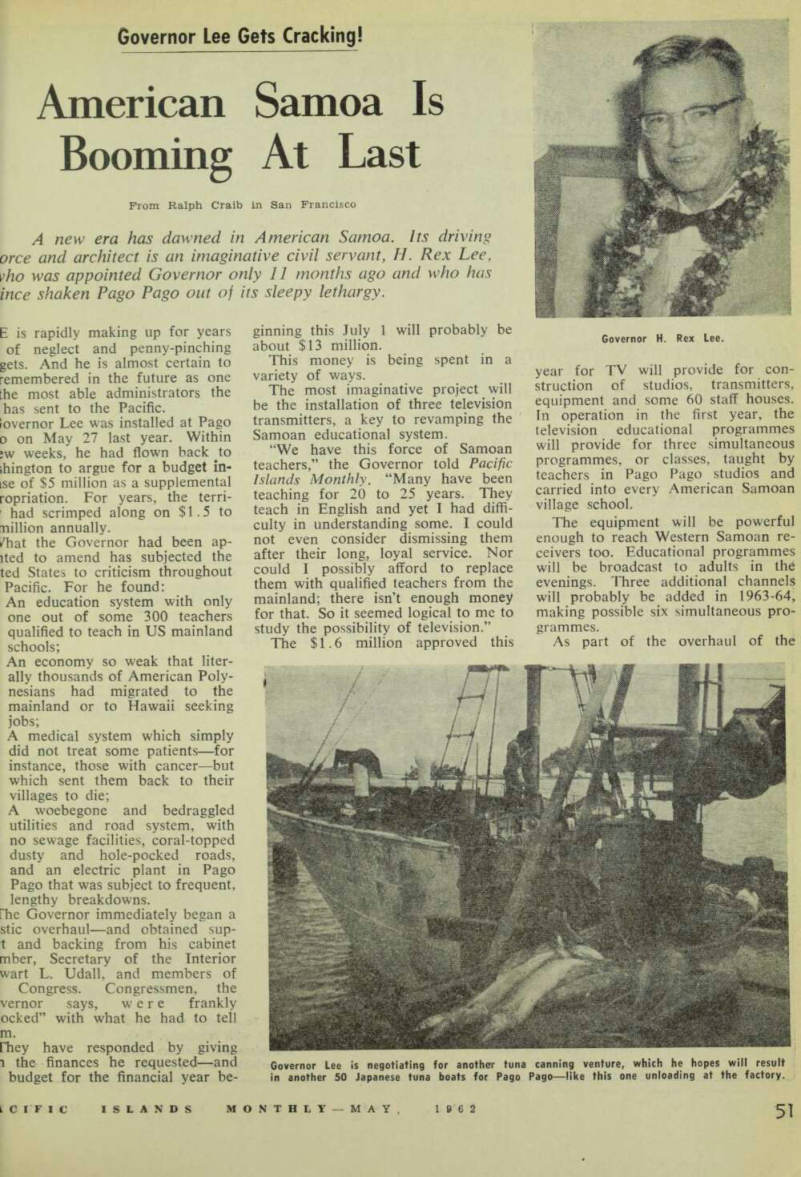
Governor Lee is negotiating for another tuna canning venture, which he hopes will result in another 50 Japanese tuna boats for Pago Pago—like this one unloading at the factory.
Governor H. Rex Lee.
00l system, another $2 million is eduled to be spent to rebuild ry school building, with materials plied by the Government and our supplied by villagers. Dead ; for completion of this programme fuly, 1963. fhe medical service of the territory already been improved, and both ntal and cancer patients have been t to Hawaii for treatment, fhe Hawaiian Medical Society has ne to the Governor’s assistance 1 has sent four surgeons down to noa to “pick up the problem es”, he said. The doctors have ved without payment, being pro ed only transport and accommoda i by the territory government.
Salaries are a stumbling block to the recruitment of physicians. But the Governor has added two registered nurses to the medical staff to train Samoan girls and he is seek ing a medical director.
The work of revamping public utilities and roads is also well under way. A new 2,000 kilovolt generator will be installed in Pago Pago before the South Pacific Conference in July —if the West Coast US shipping strike does not prevent its shipment.
Next year, another 4,000 kilovolt capacity will be added. “We will then have electrical power in every village in American Samoa,” the Gov ernor said.
“This is urgent, chiefly for nutri tional reasons. Fish spoil very rapidly as does any sort of meat in this climate. On stormy days, people simply go hungry. They live a feast or famine existence and this results in quite a bit of malnutrition, particu larly in youngsters up to two years of age.”
Road work has also been pushed— with the new road from airport to Pago Pago scheduled for completion before the South Pacific Conference.
Sixteen-thousand barrels of asphalt were unloaded at Pago Pago early in March for surfacing.
The Governor adopted some un conventional means to get his road
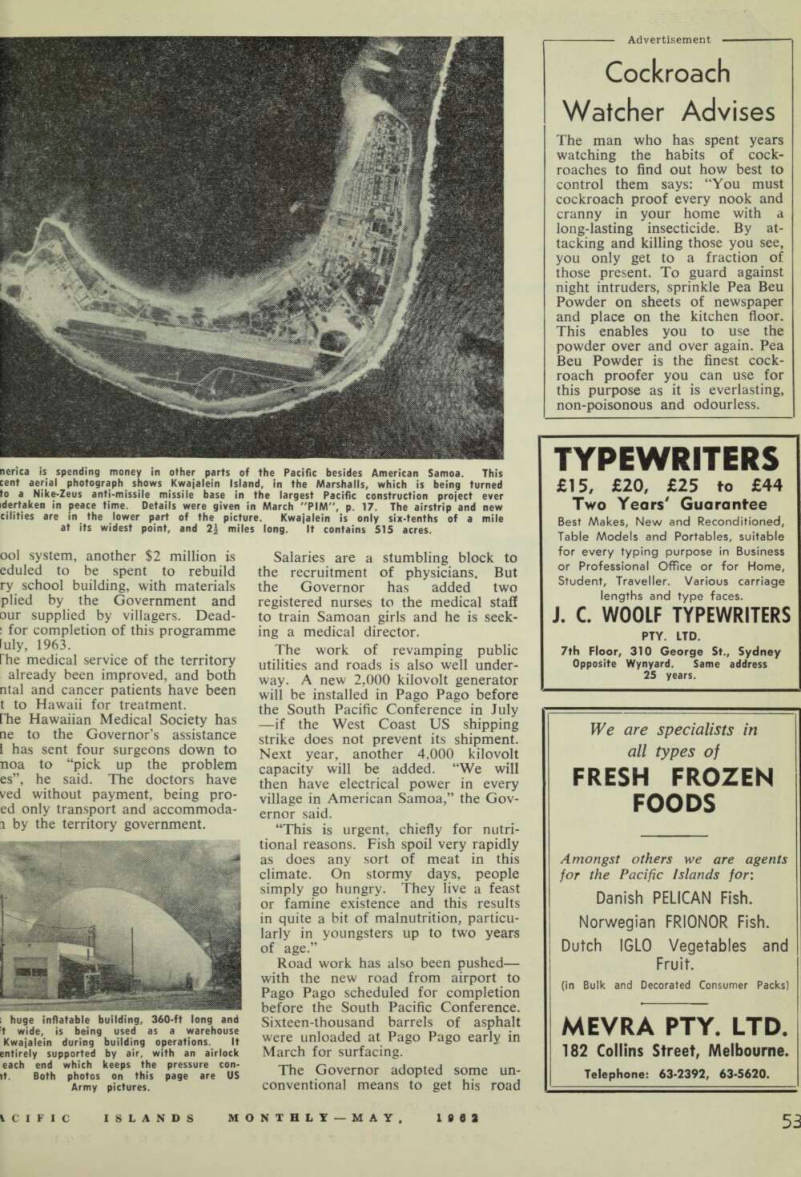
nerica is spending money in other parts of the Pacific besides American Samoa. This cent aerial photograph shows Kwajalein Island, in the Marshalls, which is being turned to a Nike-Zeus anti-missile missile base in the largest Pacific construction project ever dertaken in peace time. Details were given in March "PIM", p. 17. The airstrip and new cilities are in the lower part of the picture. Kwajalein is only six-tenths of a mile at its widest point, and 1½ miles long. It contains 515 acres.
huge inflatable building, 360-ft long and t wide, is being used as a warehouse Kwajalein during building operations. It entirely supported by air, with an airlock each end which keeps the pressure con [?]t. Both photos on this page are US Army pictures.
k and airport work done. “We e used to spending a few hundred asands dollars—and suddenly we millions,” he said. With the ference approaching, action was ded. fovernor Lee went to Pearl Har r and borrowed “top flight Navy pie” to boss his engineering staff, some construction equipment also n the Navy and went to work. [e has promised chiefs of outlying iges that they’ll have roads too— the Samoans are busy working on r roads, much as New Guinea fie have done ever since the end Vorld War 11. he new airport, he said, will be y for daylight use in June and tour use in July. When construc equipment is no longer required afuna, he will put it to work on Is already started by the Samoan gers, who have voluntarily ited rights-of-way as well as ur. ■eparations for the South Pacific ference include construction of i new senior high schools, two of ;h have been completed. These give students their eighth or i through their 12th year of oling, erection of 27 houses, and ling of a huge “fali” conference and theatre. iis large auditorium—in tra nal Samoan building style—will sed after the conference for stage /s, dances and movies, hat’s ahead for American Samoa? le Governor says that the flight be Samoan to the mainland and aii has greatly slowed down as suit of this booming activity of new programmes—but he is fly concerned over the problems providing economic opportunity” the people. e is negotiating for another tuna ing venture, which may result in oning of another 50 Japanese s at Pago Pago and would pro more jobs for Samoans, e is also negotiating for a copra essing plant, a pulp squeezing ation for the processing of fresh a. It would process copra from ?a, West Samoa and American oa, he said. The plant would out premium grade oil, as well variety of by-products and would i jobs for 75 to 100 Samoans, mrism is another area that he can be developed.
Ve will have a hotel before the of the year,” he said. “It won’t rooming house either.” s has talked over this problem, ays, “with dozens of people” and tiations are continuing. ie Governor is supported in his
desire to build up tourism by the US Department of the Interior, which has formally requested that the Civil Aeronautics Board require any American airline flying into the South Pacific to stop at Samoa. South Pacific Airlines has already started to do this.
The Department will also urge the CAB to require Qantas Empire Air ways to serve Tafuna if it is granted a new route to the United States via Tahiti.
Governor Lee—a compact and de cisive man—has forced himself to follow a gruelling schedule to change American Samoa. In San Francisco in mid-March, for instance, he had appointments from 7.30 a.m. until long after midnight, with a long stream of business callers, a stream
so steady that he went without dinner.
And after bidding his last caller goodbye at 2.45 a.m., he was up and on his way to an appointment at 8.30 a.m. the next day.
He is following this pace out of a deep conviction that “time is run ning out for us down there”. The eyes of the world, he believes, are watching what the United States does to and for its dependent peoples.
Retiring from Fiji to live in Queensland are Mr and Mrs. W. A.
Barton. Mr. Barton went to Fiji in 1927 from Scotland to join the staff of Morris Hedstrom Ltd., and has just completed 35 years’ service with that firm. He was merchandise man ager at Suva when he retired.