Nauru Need Rehabilitation
pp. 49-51 · Read in the full issue

A Nauruan Speaks Out!
Nauru Need Rehabilitation Not Resettlement
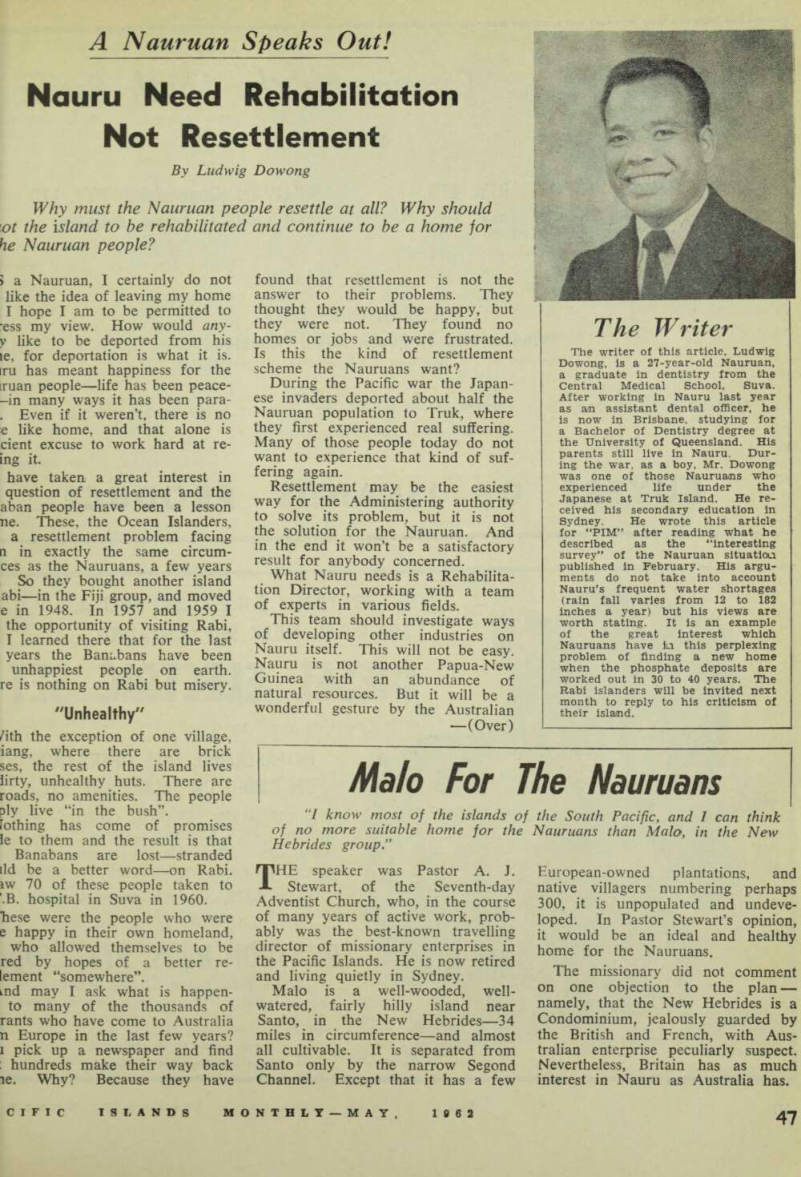
By Ludwig Dowong
Why must the Nauruan people resettle at all? Why should ot the island to be rehabilitated and continue to be a home for he Nauruan people?
> a Nauruan, I certainly do not like the idea of leaving my home I hope I am to be permitted to •ess my view. How would any y like to be deported from his le, for deportation is what it is. iru has meant happiness for the iruan people—life has been peace -in many ways it has been para . Even if it weren’t, there is no e like home, and that alone is dent excuse to work hard at re ing it. have taken a great interest in question of resettlement and the aban people have been a lesson ne. These, the Ocean Islanders, a resettlement problem facing n in exactly the same circum ces as the Nauruans, a few years So they bought another island abi—in the Fiji group, and moved e in 1948. In 1957 and 1959 I the opportunity of visiting Rabi, I learned there that for the last years the Banabans have been unhappiest people on earth, re is nothing on Rabi but misery,
"Unhealthy"
/ith the exception of one village, iang, where there are brick ses, the rest of the island lives iirty, unhealthy huts. There are roads, no amenities. The people ply live “in the bush”, lothing has come of promises le to them and the result is that Banabans are lost—stranded ild be a better word—on Rabi. iw 70 of these people taken to ’.B. hospital in Suva in 1960.
Tiese were the people who were e happy in their own homeland, who allowed themselves to be red by hopes of a better re [ement “somewhere”, md may I ask what is happen to many of the thousands of rants who have come to Australia n Europe in the last few years? i pick up a newspaper and find ; hundreds make their way back ic. Why? Because they have
found that resettlement is not the answer to their problems. They thought they would be happy, but they were not. They found no homes or jobs and were frustrated.
Is this the kind of resettlement scheme the Nauruans want?
During the Pacific war the Japan ese invaders deported about half the Nauruan population to Truk, where they first experienced real suffering.
Many of those people today do not want to experience that kind of suf fering again.
Resettlement may be the easiest way for the Administering authority to solve its problem, but it is not the solution for the Nauruan. And in the end it won’t be a satisfactory result for anybody concerned.
What Nauru needs is a Rehabilita tion Director, working with a team of experts in various fields.
This team should investigate ways of developing other industries on Nauru itself. This will not be easy.
Nauru is not another Papua-New Guinea with an abundance of natural resources. But it will be a wonderful gesture by the Australian —(Over)
yernment if it really shows that vants to investigate every possi tys there a possibility of a cement jstry on the island?
Wiat are the opportunities for culture? The Japanese were very :essful at this in the war and duced an abundance of tropical t and vegetables. With trained ionnel and with modern science help there should be a future in culture. Little Niue Island, east Tonga, is virtually nothing more i a coral outcrop with pockets soil, but the Niueans are very :essful agriculturists and export anas to NZ. ig ships regularly take phosphate n Nauru. Why should not the e ships return with loads of soil n Australia, to be dumped on island after the rock pinnacles t after the phosphate is extracted) been levelled off? In other ds, bring back the soil to Nauru!
Why Not Copra?
he Gilbert and Ellice Islanders reported to be concentrating on easing copra production now that Ocean Island phosphate supplies dwindling, like Nauru’s. So why ildn’t Nauru go in for a big mut replanting scheme? Coconuts v everywhere on Nauru, ftth copra growing, side industries d be established. Fiji has its factory for making biscuits, oils soaps, Nauru could perhaps do same, with markets in Australia, i Zealand and Britain the
countries which have been taking the phosphate.
And what of the fishing industry on Nauru? The idea has been tried, but it met with little success. Yet there are fish by the millions around Nauru.
There is no natural harbour on Nauru, we know, but can’t something be done by reef blasting? The reef could be blasted at Anibare Bay to make it big and deep enough to accommodate a fishing fleet.
Such a scheme needs proper in vestigation and it is merely one of the things that the Director of Re habilitation and his team would look at.
Other possibilities may eventuate.
Surely it is worth the effort and the money to find out?
And is finance such a huge prob lem? What will it cost to purchase and prepare an island for resettle ment, to bring it up to a standard which will accept the Nauruans?
Surely to bring an island, from nothing, up to a suitable standard of civilisation will cost much more than improving the present one? There is money put aside for resettlement.
And I submit that the old island, remade, will have less terrors for the Nauruans than another “home”, yet to be selected, yet to be tried.
The answer to the Nauruan prob lem is surely rehabilitation, not re settlement.
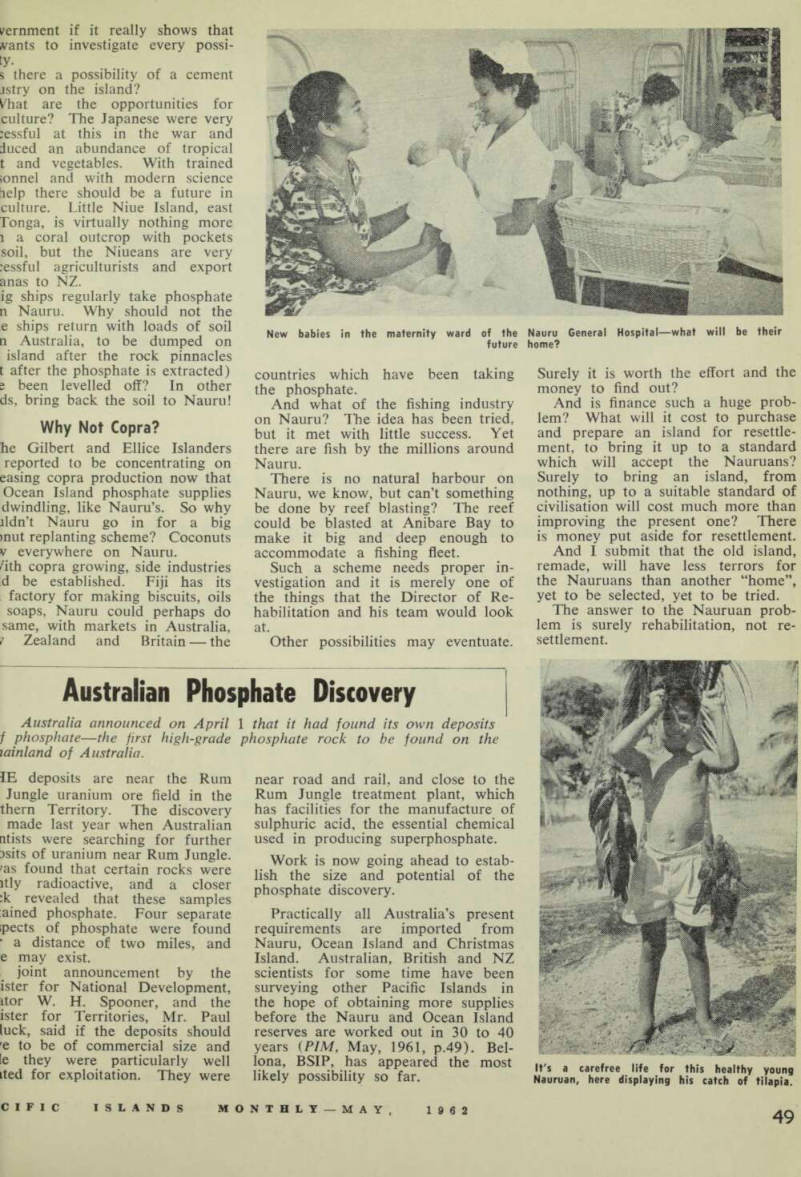
New babies in the maternity ward of the Nauru General Hospital—what will be their future home?
It's a carefree life for this healthy young Nauruan, here displaying his catch of tilapia.