erritories TALK'TALK
pp. 31-36 · Read in the full issue
With Tolala
The other day I met up with CSIRO Senior Research fficer M. D. Murray, who is trying to track down how and hen the blow-fly Chrysomyia bezziana, responsible for “fly rike” amongst P-NG cattle, came to the Territory.
I tells me the fly is not preva lent in Australia and would inly not be a welcomed impor n. Was it in the TNG prior Var 11, or was it a Jap fellow dler with their invasion? Such the questions Mr. Murray is ig. He spent a short while in Moresby and Lae, but did not to Rabaul. ggs of the fly, so he told me, are on the edge of any wound, where hatch within 24 hours; then maggots (screw worms) burrow the wound, causing blood and m to ooze; the reaction is con •able and the skin around the nd becomes thickened and lened. The smell is very power “Of particular interest to us,” ;ays, “is the presence of maggots ;he navels of calves within 48 rs of birth.” [r. Murray would like to hear i any pre-War II planters who cattle as to whether this parti r fly was noticed in early days, address is: M. D. Murray, Mc :ter Animal Health Laboratory, ate Bag 1, Glebe, NSW. .s a matter of interest to cattle ded folk, in 1913 (during the man time) there were 3,067
cattle and 225 buffaloes or zebu; in 1958 official figures give total cattle as 10,250. Much of the stock was lost during the Jap occupation, of course.
The 1958 official report states: “The control of the screw-worm fly with newer insecticides has reduced the incidence of strike to negligible proportions.”
Let’s hope that’s true.
Bop's
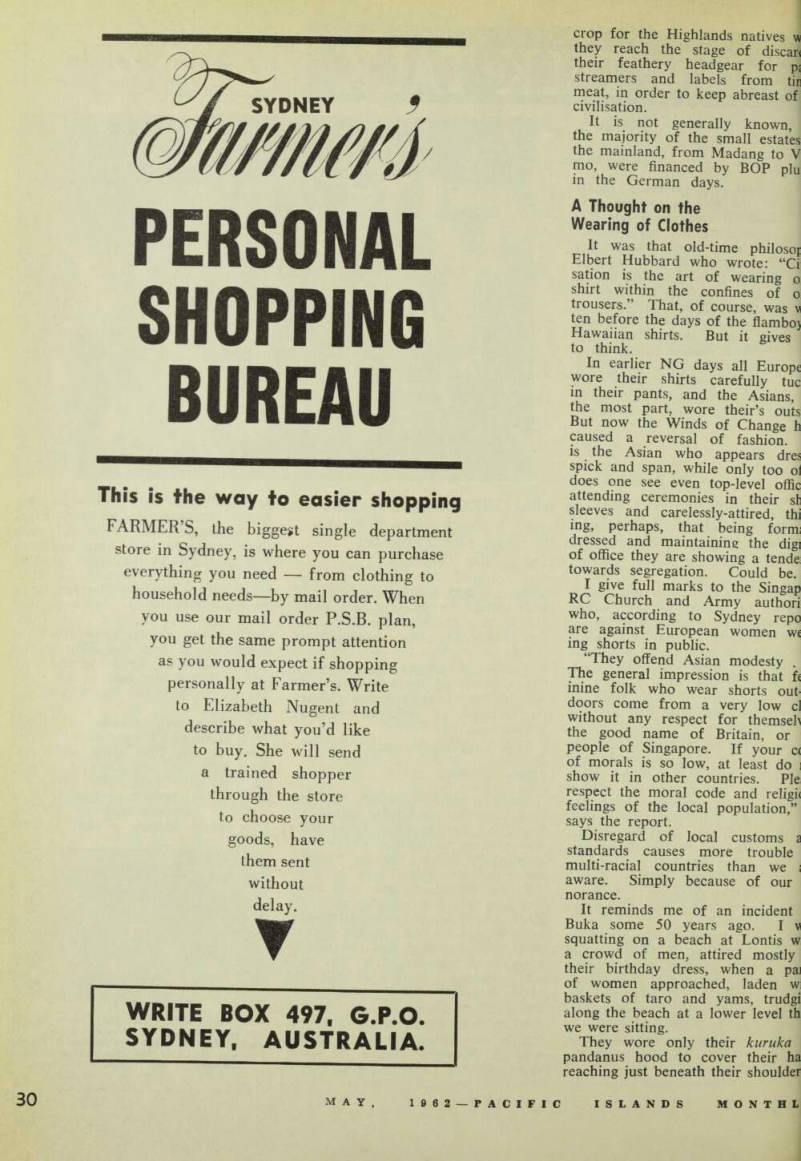
Many readers, I expect, will not even know to what those initials re fer: Birds of Paradise. Recently I was reading an article, which was, incidentally, by E. Thomas Gilliard, mentioned by Judy Tudor in April PIM (p. 85), about those gay birds, their possible extermination and the glory of their plumage when—lo, and behold—l picked up my Sydney morning paper and saw the picture of a local socialite at a “hat par ade”, wearing a “turban of dull gold mesh, trimmed with birds of para dise feathers . . .”
There was a time when even be ing in possession of these plumes was an offence. During the early years of War I (1915-17) it was a
common sight in Sydney to see with these exotic p i ume s. They had been sent from NG by the troops up there for their wives, sweethearts, et al.
And then authority clamped down on their importation. Some enthusi astic RSPCA member got busy, thinking the plumes came from the female birds and that their deaths meant neglected bairns in the nest, which is not the case at all. Its the ma^e which has the sought-after plumes, Looking back at some of the old
re Sf Jg
item from the old German colony, Tn iQn_the vear before War l— out of
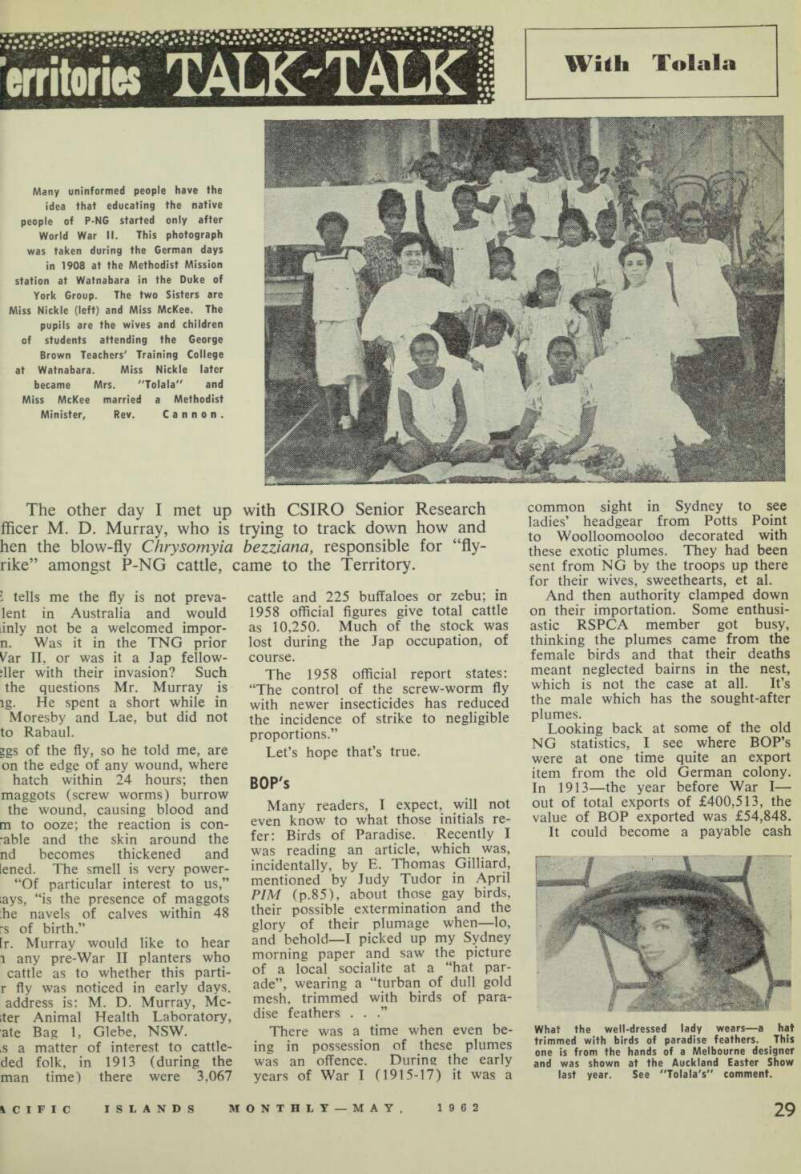
Many uninformed people have the idea that educating the native people of P-NG started only after World War . This photograph was taken during the German days in 1908 at the Methodist Mission station at Watnabara in the Duke of York Group. The two Sisters are Miss Nickle (left) and Miss McKee. The pupils are the wives and children of students attending the George Brown Teachers' Training College at Watnabara. Miss Nickle later became Mrs. "Tolala" and Miss McKee married a Methodist Minister, Rev. Cannon.
What the well-dressed lady wears—a hat trimmed with birds of paradise feathers. This one is from the hands of a Melbourne designer and was shown at the Auckland Easter Show last year. See "Tolala's" comment.
crop for the Highlands natives w they reach the stage of discan their feathery headgear for pj streamers and labels from tin meat, in order to keep abreast of civilisation.
It is not generally known, the majority of the small estates the mainland, from Madang to V mo, were financed by BOP plu in the German days.
A Thought on the Wearing of Clothes It was that old-time philosop Elbert Hubbard who wrote: “Ci sation is the art of wearing o shirt within the confines of o trousers.” That, of course, was v ten before the days of the flamboj Hawaiian shirts. But it gives to think.
In earlier NG days all Europe wore their shirts carefully tuc in their pants, and the Asians, the most part, wore their’s outs But now the Winds of Change h caused a reversal of fashion, is the Asian who appears dres spick and span, while only too ol does one see even top-level offic attending ceremonies in their sh sleeves and carelessly-attired, thi mg, perhaps, that being formi dressed and maintaining the digi of office they are showing a tende towards segregation. Could be.
I give full marks to the Singap RC Church and Army author! who, according to Sydney repo are against European women wc ing shorts in public.
“They offend Asian modesty The general impression is that fc inine folk who wear shorts out doors come from a very low cl without any respect for themseh the good name of Britain, or people of Singapore. If your a of morals is so low, at least do i show it in other countries. Pie respect the moral code and religi< feelings of the local population,” says the report.
Disregard of local customs a standards causes more trouble multi-racial countries than we j aware. Simply because of our norance.
It reminds me of an incident Buka some 50 years ago. I v squatting on a beach at Lontis w a crowd of men, attired mostly their birthday dress, when a pai of women approached, laden w: baskets of taro and yams, trudgi along the beach at a lower level th we were sitting.
They wore only their kuruka pandanus hood to cover their ha reaching just beneath their shoulder
a tahu (a small bunch of dried r es covering their genital organs), h man rose as the women ap ached and gazed around him chalantly while I, in my ignor e, remained seated, inly later did I discover I had imitted a serious breach of eti tte by not rising while the women ?ed. In my sitting position I ht have seen beneath the swing tahus as they passed along. It k. me many moons to become ndly again with those Lontis ves over this incident.
I said at the start: It is just thought. It could cause some : to ponder, even in the Year Grace, 1962.
Time ords t was a happy thought of PlM’s it editor, Stuart Inder, to bring ng to me one day last month a ind copy of the old Rabaul Re d, which he had picked up in a Iney book-shop. It dates from :ember 22, 1915, to December, 8. fhe first two issues appeared un the title Namanula Times (the iting office was located there) I the price: “A piece of Christmas e. The third issue, titled The haul Record was dated March 1, 6, and was on more ambitious ;s; the cost was 6d and consisted 12 quarto pages, basically it was just an Army maga e, closely censored (as is always case) but full of interesting ords of local garrison life of AN & MEF members, together h informative articles, written by ponsible officers filling the posi as of DO’s and ADO’s at the le, on descriptions of outstation
areas such as “Kaewieng,” “Eitape,”
Buka, and so forth: One of the most prolific contribu tors was Capt. J. Lyng, who later wrote Our New Possession (late German New Guinea), published in Melbourne in 1919, and Island Films : Reminiscences of “German New Guinea ”, published in Sydney in 1925. Lyng was a linguist and as such obtained much cf his mate rial from the German records; thus his articles gave an accurate picture of the days during that regime.
Should there ever be an argument over land ownership on Pak Island (in the Manus Group) there is an interesting letter from the original German purchasers (the Walun Ge sellschaft mbH) giving details of the purchase price which had, appar ently, been incorrectly stated in a previous article in the magazine by Major A. L, Roberts. Tliis could be of interest to the Lands Office folk of our own generation, as land records seem to be often incomplete.
For me theie were many nostalgic memories when I read the names of those whom I had known, but who have mostly nassed on. There are but a few of those mentioned who still remain (to my knowledge): Ted Taylor, Vic Pennefather, Tex Rob erts, Bob Jolley, Mrs. Kroening, Mrs, Miller.
Well, the year 1918 was 44 years ago and tempus does fugit, doesn’t it?
And Did You Know?
Here are some bits and pieces culled from The Rabaul Record which may interest readers: The Commonwealth Bank was first established in Rabaul on Saturday, April 15, 1916. The official open
World
Health
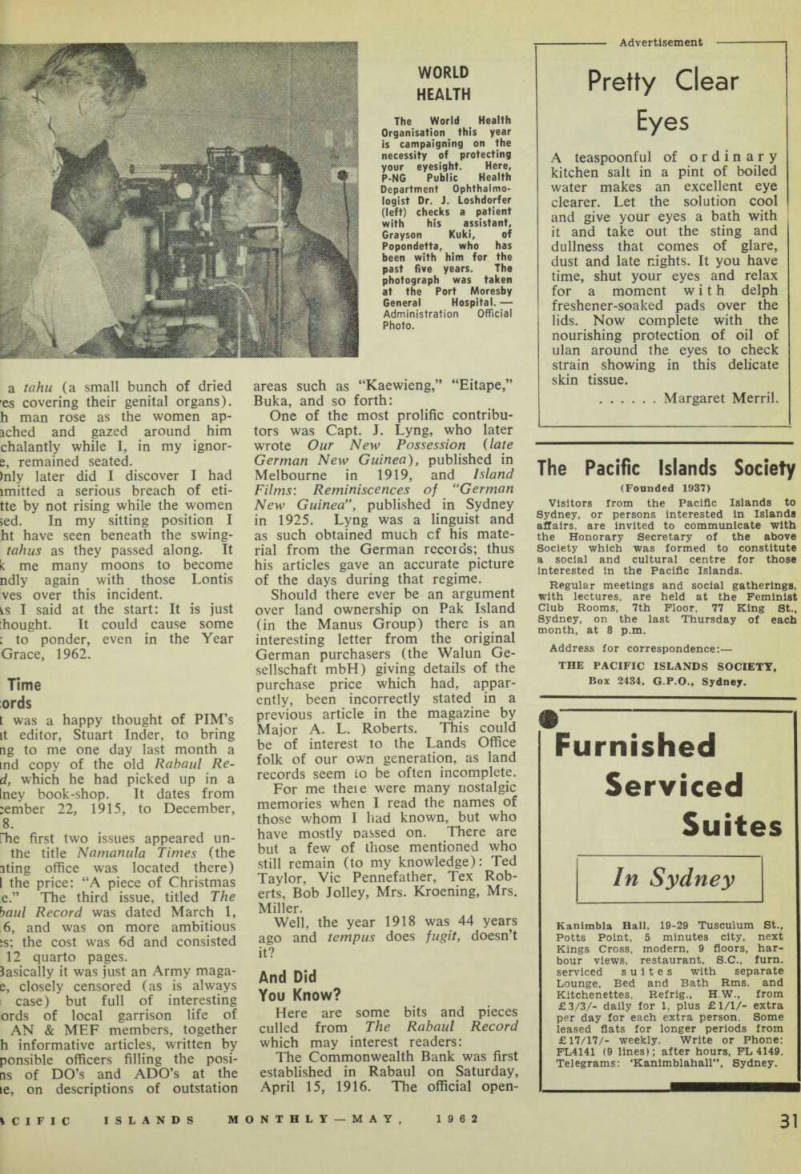
The World Health Organisation this year is campaigning on the necessity of protecting your eyesight. Here, P-NG Public Health Department Ophthalmo logist Dr. J. Loshdorfer (left) checks a patient with his assistant, Grayson Kuki, of Popondetta, who has been with him for the past five years. The photograph was taken at the Port Moresby General Hospital.— Administration Official Photo.
was performed by the Admini tor (Colonel S. A. Pethebridge). head office accountant (Mr. H.
Armitage, who in 1941 became bank’s Governor) responded to Administrator’s opening speech, first manager was Mr. T. H. yer, who came from Mary- Dugh, Q., and the accountant Mr. D. W. Gray, from Sydney, hi January 1, 1914, “expatriate” ulation figures for German New nea were; Europeans (including anese and half-caste Samoans) 10; Chinese 1,377; Malays and Ired races 232. Of the Euro ns, 562 resided in New Britain; in New Ireland; 56 in the Ad alty Group (Manus); 74 in the man Solomons (Buka and Bou iville) and 309 on the mainland New Guinea. lice Gesture 'erritory officialdom is so obsessed se days in pulling out all the )s of the publicity organ to boost ial integration, advancement of native people and the high stan d of civilisation being attained them, that it was a pleasant ;rsion when a pioneer European nan was accorded some official Dgnition and to read in NG Times urier (28/3/62) of the presence Mrs. Hazel Cresswell at the sentation in Rabaul of engraved ;lds of the Cresswell Coronation >phy to the four most efficient icemen in the years 1958 to 1961.
A. H. Cresswell was a well-known
pioneer resident of TNG with both mining and plantation interests. He died about 18 months ago, following an operation at the Mayo Clinic in the USA.) Her presence at the ceremony was most opportune, and I for one appreciate officialdom’s recognition of the valuable work she performed on the goldfields in caring for the sick patients, regardless of colour, and for her sterling qualities which aided the development of both the mining and planting industries of the Territory in the early days.
To these pioneer women there is a debt owing which it is hard to pay. ( See p,119 for photograph.)
A Worth-while
Campaign
* , . , The health of a people has, to always been the most beneficial feature of our intrusion upon the primitive races of the world and thrusting our own civilisation ( SI Q) upon them. It is encouraging, there- £ ore ’ t 0 r ® a( * °£ success which has attended the present malaria eradication campaign in P-NG.
P-NG’s Director of Health, Dr. R.
Scragg, points out in an article in the Australian Medical Journal that in one area in P-NG the malaria rate was 72 per cent, before spraying, but after three years the percentage
dropped to 7.9. That is good goi i3r. J. J. Saave, who is in cha of the campaign, is quoted as s ing that last year £190,000 was sp on the job but “nobody has z doubt that anti-malaria work in Territory will be an expensive ejs cise.”
It is not expensive when one o siders the astronomical sums pended on education and the o struction of buildings to hoi teachers and the schools. But wh; the use of teaching sick people' There is also the extravagant er tion of Army establishments z Naval depots (what has happei to the palatial buildings on Manus Granted, these come under Defei grants, but it’s still money from Australian taxpayer.
Good luck to the campaign. A I hope the Forgotten Islands rece their quota of attention. And these I mean the Western Islan west by north from the Mai group: Hermits, Ninigo, Aua a Maty, Invariably down the ye these smaller groups have be neglected and that was the reas why H. R. Wahlen was able to wi in to such a remunerative kingdc It was Parkinson (author Dreissig Jahre in der Sudsee ) the turn of the century who fi pointed out the high rate of m tality in these islands, and it v Wahlen who later realised the natr were in-breeding and imported soi hefty Buka lads to improve 1 stock.
Nevertheless, tucked away up the miles away from a Governme established post, these people—me Micronesian than Melanesian—ha nearly always remained the Forg ten People, notwithstanding moi graphs turned out by Pitt-Rivers a Margaret Mead.
Dr. J. J. Saave.