Canberra
pp. 28-29 · Read in the full issue
Commentary
From our Canberra Correspondent The Government’s announce ment of its education plans for Papua-New Guinea took the steam out of the Opposition urgency debate on the question in the House of Reps.
TWO days before the debate was due, Territories Minister Paul Hasluck announced that the Govern ment planned a university college in June Valley, Port Moresby, within four or five years.
He also announced other propo sals, made by an inter-departmental committee last August, and accepted by the Government.
These included: • A central residential administra tive college; • A multi-racial, full-standard teachers college; • A higher technical training insti tution; and • Expansion of secondary education to bring more native people to university standard.
Mr. Hasluck said that a site in lune Valley would be developed for higher educational development gen erally.
The main institutions would be grouped in this area to make the best use of libraries, sports grounds and residential accommodation.
Mr. Kim Beazley (Labour, WA), who led the Opposition attack, criti cised the Minister’s statement as a continuation of his “rather leisurely approach to this problem.”
He said that the proposal for a aniversity college only did not meet Labour objections: moreover, it seemed to have been discussed only within the Administration and not submitted to the Australian Univer sities Commission.
Mr. Beazley suggested, too, that a vice-chancellor or interim council should be appointed to set up the aniversity and that this task should aot be left to the Administration.
In his reply in the House to Mr.
Jeazley, Mr. Hasluck admitted that he proposals were based on the eport of an inter-departmental com nittee presented last August—and ‘adopted immediately by the Gov ;rnment on presentation.”
One Labour member, Mr. Len Reynolds (NSW), drew attention to
a weakness in the Minister’s argu ments thus revealed.
Why, he asked, had the Minister waited from August until April, and then made his announcement after Mr. Beazley had given notice that the Opposition proposed to move for the establishment of a university in
P-Ng?
It was a pertinent point. The Minister’s silence could not have been for lack of opportunity. Last Octo ber, in a Parliamentary statement obviously aimed at the Trusteeship Council, the Minister reported on current planning in educational, so cial and economic advancement.
This, he said, was in accordance with Australia’s undertaking to give realistic target dates, but his state ment made no reference to university training.
It gave estimates of the number of students expected in post-primary and secondary schools, technical schools, and teacher training schools at the end of five years. He also referred to special attention being given to teacher training.
But since the departmental con mittee’s report was already adopte< it should not have been too difll cult for him to give some hint c the fact that a university was und( consideration, even if no decision o detail had been made at the time. 1 It would surely have been a be ter answer to those UN critics wh are constantly attacking the spec at which Australia is moving in N( The Minister’s reticence left tt impression that the plan for tertiai education would still be gatherir dog-ears in departmental files ha the electors not administered such sharp rebuke to the Government la December.
This impression was heightene by memories of what the Ministi had said on one of his rare teli vision appearances a few weel earlier.
Then, discussing the part of native elite in the development ( P-NG he said: “I hate that ten ‘elite’; it’s usually associated wit someone who wears a white colh and has been to a university.
ir own experience in the Aus i democracy is that some of nost notable leaders have been of the mob, and it is exactly une in New Guinea today.” ; Parliamentary debate was the ter’s second brush on educa vithin a couple of weeks, her, the NSW Teachers’ Fed n had taken him to task over andards required in his “crash imme” to train teachers, der this scheme, teachers are recruited at Intermediate Cer ; level, trained for six months alaguna Training College, Ra then sent into the field as ry school teachers, ; Federation pointed out that qualifications would not ensure rmanent career, because they not qualify for admission to teaching services. ; Minister rejected the Federa protest. He said that the need achers was urgent, but in view ; shortage of teachers in Aus insufficient recruits were forth gan emergency measure, it had decided to recruit single men a minimum of Intermediate cate and give them a six is’ intensive course to fit them dive primary schools, is is an emergency attempt to )ut larger numbers of children :an read, write and count, and 3e taken further by trained rs,” he said. ry encouragement was given to rs to advance themselves by r training. ♦ ♦ ♦ liet influence” by the Admini •, Sir Donald Cleland, is one i ways the P-NG Administra s combating racial discrimina- Minister for Territories re
vealed this in the House of Repre sentatives in reply to questioning by Mr. Ward (Labour, NSW).
He said that all Territory laws were being examined under a policy direction that they should apply equally to all P-NG inhabitants.
The only exceptions would be special provisions to guard the well being of the people in defined cir cumstances or to respect their cus toms.
So far 13 ordinances had been amended, and several bills were in hand for introduction at the next meeting of the Legislative Council.
Any other forms of discrimina tion arose from the conduct of indi viduals or businesses.
The Administration continually watched, and, if an offence against Territory law was involved, action was taken.
In other cases, the Administrator sought by “quiet influence” to have the practice discontinued.
Hs * * Critics of Prime Minister Menzies have often claimed that he would sooner lose a friend than a chance to make a wisecrack.
But seldom has he let slip such a bloomer as when he made an unfortunate reference to the well respected Bishop of New Guinea, the Rt. Rev. P. N. Strong.
During Parliamentary discussion of the Australian Broadcasting Com mission’s omission of a news item containing a criticism by the Bishop of the Government’s West New Guinea policy, Mr. Menzies referred to: “. . . some comment by some body called Bishop Strong”
He did not apologise when given the opportunity during an Opposi tion attack on him for the use of the offensive phrase.
The incident presumably wouldn’t have gained friends for Mr. Menzies among the many people who appre ciate the work the bishop has done in a quarter of a century in P-NG.
In his criticism, the Bishop, who was speaking at Newcastle, NSW, said that he was “distressed” be cause it appeared to him that the Australian Gov ernment was weakening in its support for a policy of self determination for the people of West New Guinea. This
would be a shock to New Guinea natives, who trusted Australia.
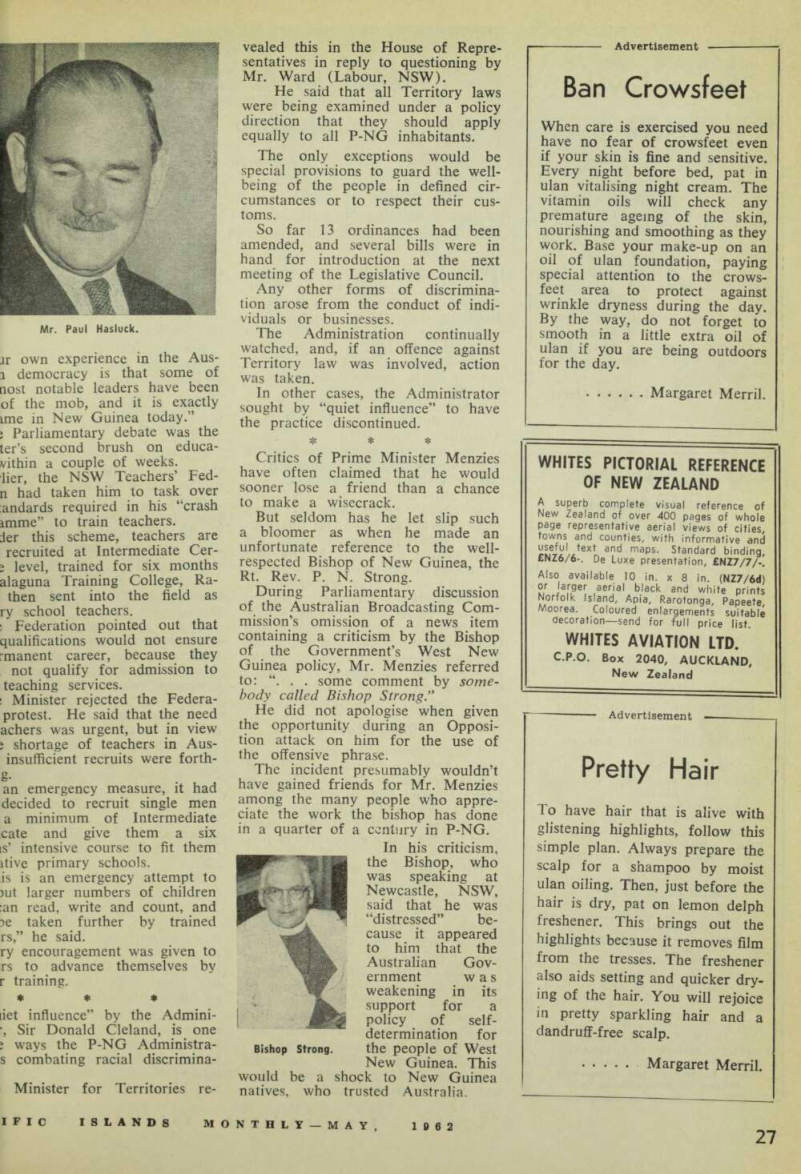
Mr. Paul Hasluck.
Bishop Strong.