Deficit In West Samoa; New
pp. 21-142 · Read in the full issue
Plans For Economy
From “PlM’s” Apia Correspondent As predicted, Western Samoa’s first budget following dependence shows a deficit. It’s £260,800, which will have be met from very slim reserves. Development expenditure s been cut drastically to less than half that allocated for last ar. Yet the general position is better than last year’s.
I Budget, the first since Inde pendence in January, was intro -1 into the Legislative Assembly ic Minister of Finance, Mr. G.
Betham. Departmental receipts £1,423,400 (compared with 3,671 last year) and this figure to meet recurrent maintenance of the Government by £142,000. imated revenue from Income is down from £139,059 to 000, and interest on investments, Customs receipts are also down, tal estimated receipts are 6,950 and total expenditure is 2,750, made up of £1,565,950 aintenance and £176,800 in de ment. The deficit will have to net from reserves of around 000. . Betham said, “There is no for complacency.” said the Government was i resolved to achieve economic ity. It was evident that the )my could not support such a heavy Administrative structure, a UN exoert in public admini nn, Mr. H. Elvins, would arrive e end of April to carry out a of the Public Service. When sport was received the Govern would introduce reforms to te maximum efficiency at the num of cost.”
Thanks to NZ . Betham expressed thanks to New Zealand Government for s of £400,000 for education d over five years from 1960; ‘lO,OOO towards Avele Agricul- College maintenance, £3,000 *ublic Relations, £7,150 towards Aviation, £5,500 towards plebi costs, and the recent annual for the next few years to y the allowances of seconded nnel above local basic salary £22,500 is expected to be ered this year under this grant. . Betham said the present ses -3f the Assembly would be asked prove in principle to the raising £lOO,OOO development loan.
Ithough our rate of progress depend on no small measure
from the aid likely to be obtained from the UN and its specialised agencies, and from friendly nations and organisations with whom the Government has been communicat ing, one inescapable fact is that we must demonstrate, by our own deter mination to help ourselves, that we are worthy of outside aid,” Mr.
Betham said.
While there is little about the Budget to encourage future optimism, trade prospects for 1962 are hope ful.
“The excellent recovery in our
export trade late last year continues, and a healthy resuscitation in our exports for the first quarter of 1962 brings a welcome air of buoyancy,” said Mr. Betham.
The prospects for copra were not much better than last year with about 13,000 tons estimated for export, but the potential for bananas and cocoa was very encouraging, he said.
“The cocoa potential for 1962 is equally exciting and inspiring.”
(Continued on p. 139)
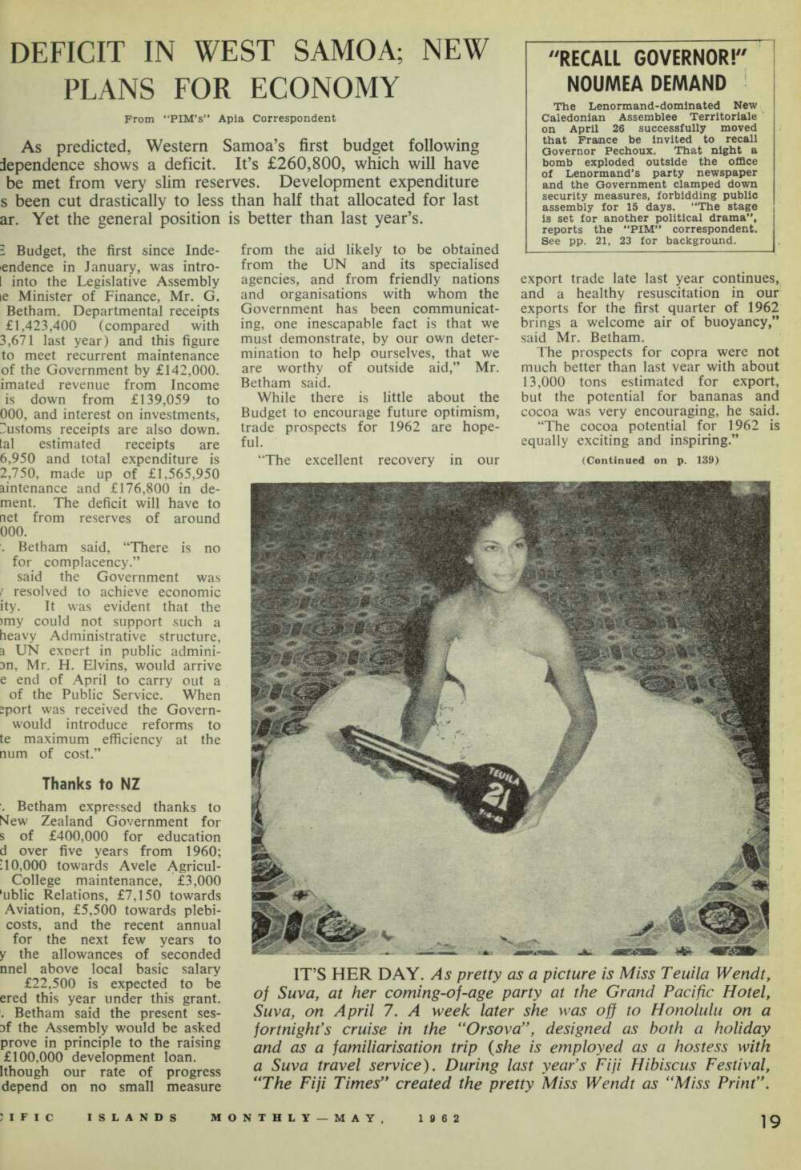
IT’S HER DAY. As pretty as a picture is Miss Teuila Wendt, of Suva, at her coming-of-age party at the Grand Pacific Hotel, Suva, on April 7. A week later she was off to Honolulu on a fortnight's cruise in the “Orsova”, designed as both a holiday and as a familiarisation trip (she is employed as a hostess with a Suva travel service ). During last year’s Fiji Hibiscus Festival, “The Fiji Times” created the pretty Miss Wendt as “Miss Print”.
e claimed that with the 400 tons xporters’ sheds awaiting shipment a earnings for the first quarter his year are over 60% of the ; income of £597,592 derived i the 4,101 tons exported in [.
“If present trends continue and expectations are realised for a bountiful mid-year harvest, almost totally absent last year because of storm damage, it is probable that cocoa will play a vital part in swelling the national income appreciably this year ”
Earlier, on March 25, the Prime Minister, Fiame Mataafa, made an important statement on the air about Samoa’s economic development.
He said that following discussions with advisers overseas, and a consideration of last year’s report of the Economic Committee, the Government felt it had to launch an energetic campaign of economic development.
Trade relations with other coun tries would be reviewed, a bill was being prepared to encourage develop ment (with both local and overseas enterprise) of selected secondary industries; credit schemes for agri cultural development would be investigated. Effort would also be made to increase agricultural produc tion, possibly with assistance to plant ers, and to “slightly increase” tourism.
The Government would look into fisheries development, the training of an adequate supply of tradesmen and also investigate the need for more adequate public relations.
A committee has been set up consisting of the Prime Minister as chairman, the Minister of Finance
and Economic Development (Mr.
G. F. D. Betham) as deputy chair man and convenor, the Minister of Agriculture (Asiata Logologo) and the Minister of Education (Tuataga loa Teo) together with their depart ment heads, Messrs. B. Parham and C. J. Williams, to co-ordinate econo mic development in all departments.
They will also consider matters of financial aid and requests for aid, and will have as their responsibility the drawing up of a five-year plan and its priorities, with power to re convene the Economic Development and Advisory Committee appointed last year.
Speaking on the aid already re ceived from United Nations, the Prime Minister mentioned the educa tion report prepared in January by Professor T. L. Green, from the University of Singapore, and the economic survey by Mr. Harry Spence, Regional Representative for South East Asia of the United Nations Technical Assistance Board and Special Fund.
He said that Mr. Spence recom mended and the Government fully agreed that the following matters should receive first attention: • An immediate and thorough study of the Public Service leading to adjustments to create the maxi mum efficiency at the minimum of cost. A United Nations ex pert in Public Administration, Mr. H. C. Elvins, would arrive at the end of April to carry out this study. • To make agriculture, which is basic to the economy, more pro ductive, expert assistance and guidance is needed. Three agri cultural experts from United Nations are due to arrive in July. • Organised Local Government should be established. • A complete economic assessment should be made of the country’s natural and human resources, ac companied by a determination of priorities and financial require ments for the future. This should be carried out by the World Bank, or through the UN Tech nical Assistance programme. An expert in Development Economics may be provided by the United Nations and may assist the Prime Minister during a trip overseas to obtain further financial assist ance when the economic survey has been completed.
I Education should be given every support possible within the exist ing financial resources. One education expert will be provided by the United Nations.