Un Mission To Ng
pp. 17-140 · Read in the full issue
Is Impressive
Prom “PIM’s” Rabaul Correspondent Ranging from a request that they be permitted to visit newly independent nations to a desire to be “taken over” by America, New Guinea natives presented their various platforms to the visiting UN Mission in April.
LMOST entirely requests by • indigenes reflected a con ausness of the need for more »nomic development and higher ication before they were equipped even consider self-determination— alone self-government. [n Rabaul Sir Hugh Foot, leader the Mission, said that he was pressed by the “extreme honesty 1 shrewdness” of the natives, rhose familiar with the Tolai will dw what Sir Hugh means by irewdness”. As to honesty this i be explained as candour, a virtue which most natives excel. \nd anyone once having seen the 4 Mission leader in action would /e no doubt that here was a man exceptional honesty and acuteness.
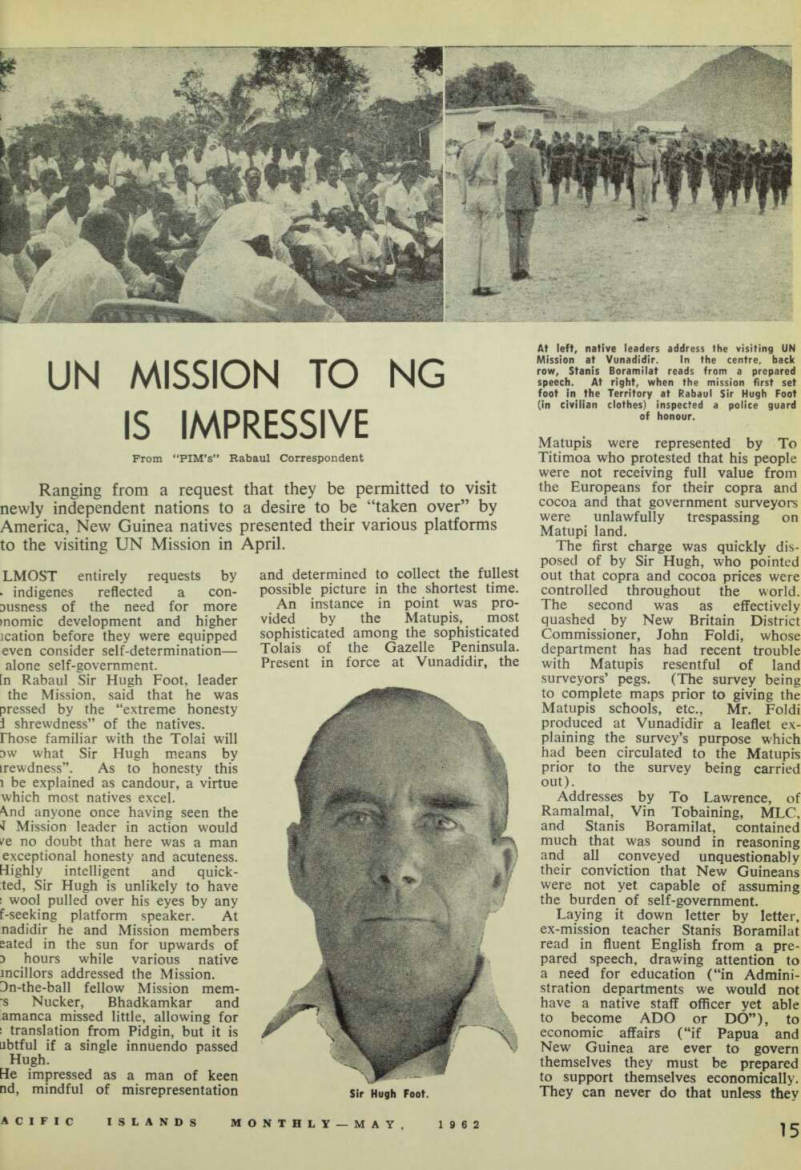
Highly intelligent and quick led, Sir Hugh is unlikely to have • wool pulled over his eyes by any f-seeking platform speaker. At nadidir he and Mission members eated in the sun for upwards of 3 hours while various native incillors addressed the Mission.
Dn-the-ball fellow Mission mem •s Nucker, Bhadkamkar and amanca missed little, allowing for s translation from Pidgin, but it is übtful if a single innuendo passed Hugh.
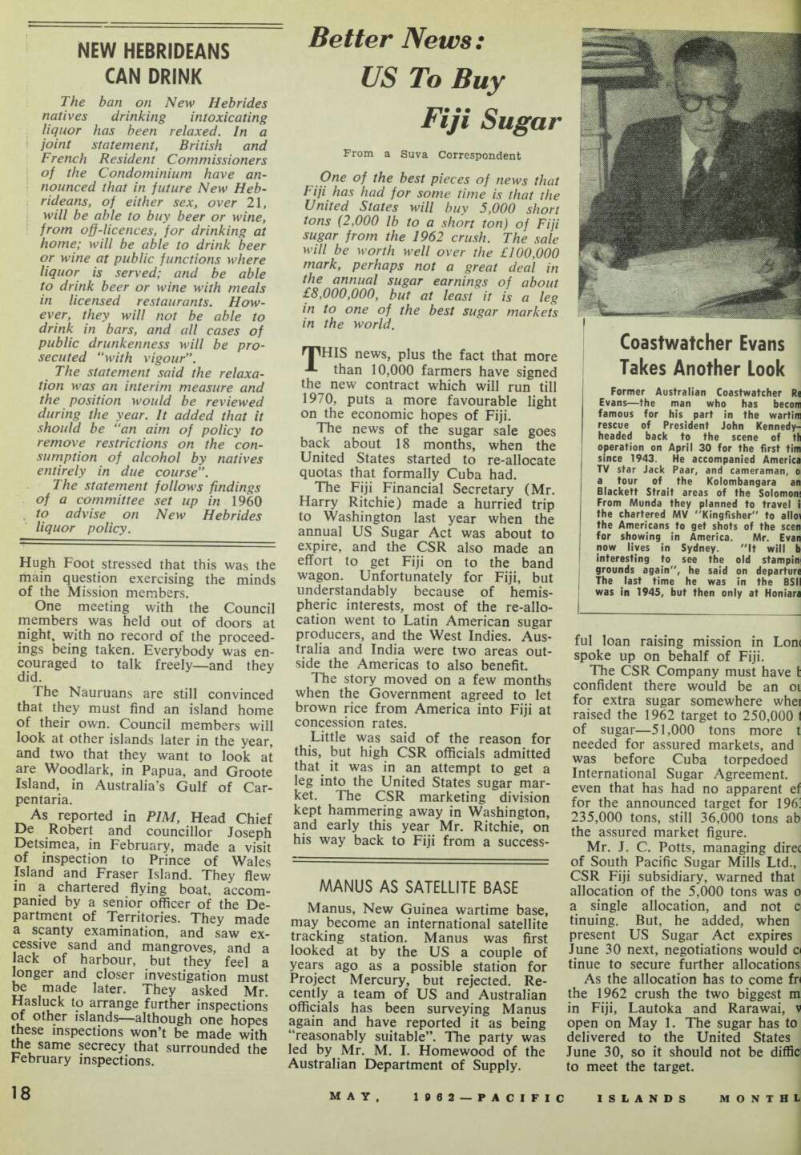
He impressed as a man of keen nd, mindful of misrepresentation
and determined to collect the fullest possible picture in the shortest time.
An instance in point was pro vided by the Matupis, most sophisticated among the sophisticated Tolais of the Gazelle Peninsula.
Present in force at Vunadidir, the
Matupis were represented by To Titimoa who protested that his people were not receiving full value from the Europeans for their copra and cocoa and that government surveyors were unlawfully trespassing on Matupi land.
The first charge was quickly dis posed of by Sir Hugh, who pointed out that copra and cocoa prices were controlled throughout the world.
The second was as effectively quashed by New Britain District Commissioner, John Foldi, whose department has had recent trouble with Matupis resentful of land surveyors’ pegs. (The survey being to complete maps prior to giving the Matupis schools, etc., Mr. Foldi produced at Vunadidir a leaflet ex plaining the survey’s purpose which had been circulated to the Matupis prior to the survey being carried out).
Addresses by To Lawrence, of Ramalmal, Vin Tobaining, MLC, and Stanis Boramilat, contained much that was sound in reasoning and all conveyed unquestionably their conviction that New Guineans were not yet capable of assuming the burden of self-government.
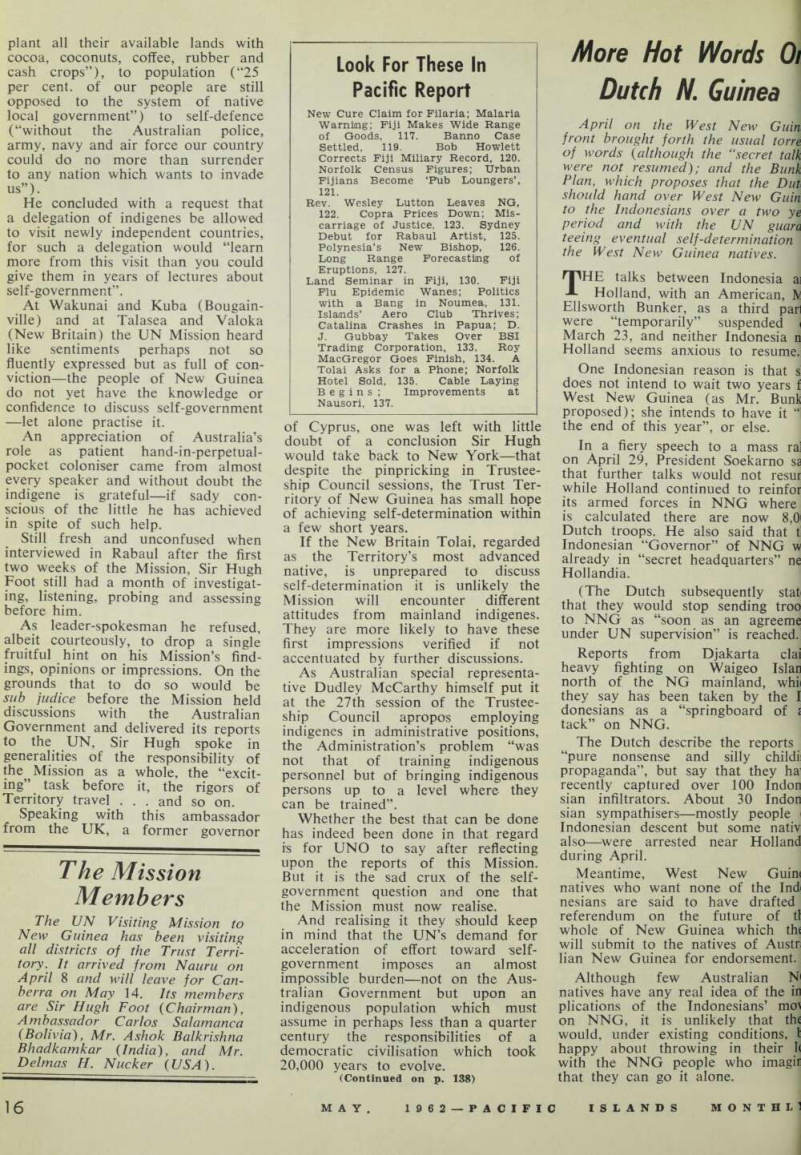
Laying it down letter by letter, ex-mission teacher Stanis Boramilat read in fluent English from a pre pared speech, drawing attention to a need for education (“in Admini stration departments we would not have a native staff officer yet able to become ADO or DO”), to economic affairs (“if Papua and New Guinea are ever to govern themselves they must be prepared to support themselves economically.
They can never do that unless they
Sir Hugh Foot.
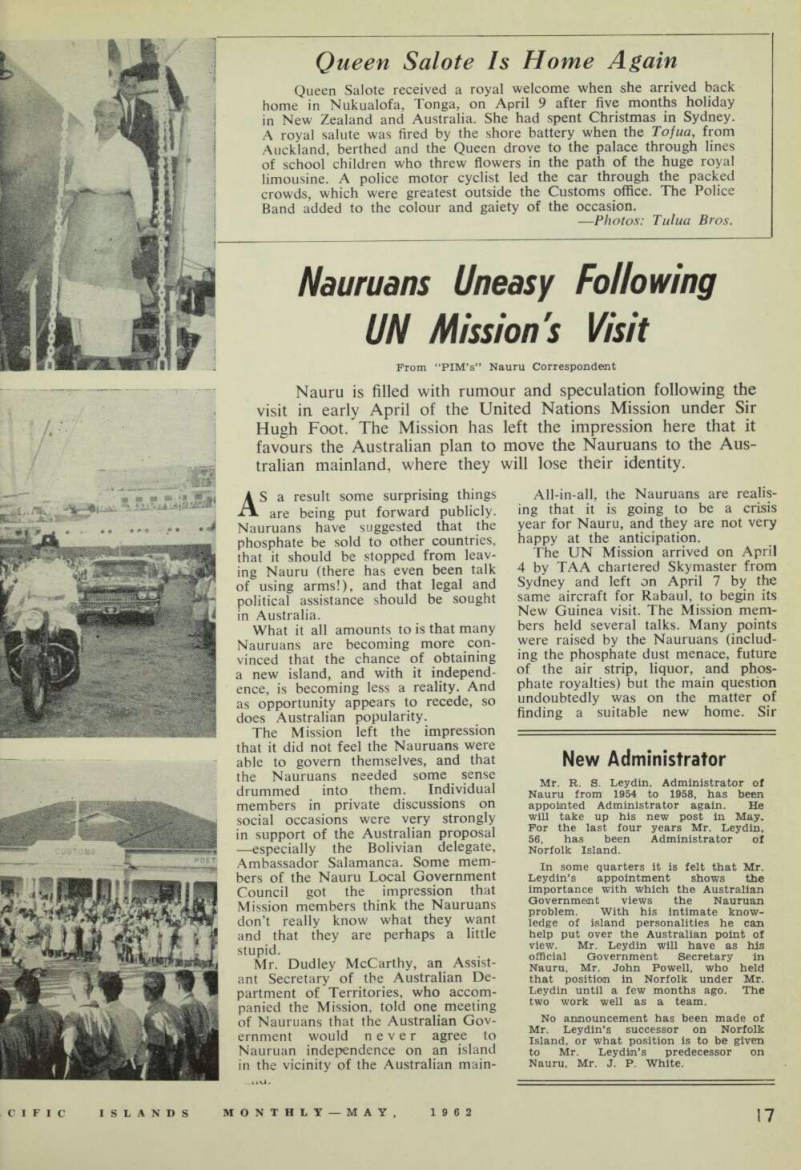
At left, native leaders address the visiting UN Mission at Vunadidir. In the centre, back row, Stanis Boramilat reads from a prepared speech. At right, when the mission first set foot in the Territory at Rabaul Sir Hugh Foot (in civilian clothes) inspected a police guard of honour.
plant all their available lands with cocoa, coconuts, coffee, rubber and cash crops”), to population (“25 per cent, of our people are still opposed to the system of native local government”) to self-defence (“without the Australian police, army, navy and air force our country could do no more than surrender to any nation which wants to invade us”).
He concluded with a request that a delegation of indigenes be allowed to visit newly independent countries, for such a delegation would “learn more from this visit than you could give them in years of lectures about self-government”.
At Wakunai and Kuba (Bougain ville) and at Talasea and Valoka (New Britain) the UN Mission heard like sentiments perhaps not so fluently expressed but as full of con viction—the people of New Guinea do not yet have the knowledge or confidence to discuss self-government —let alone practise it.
An appreciation of Australia’s role as patient hand-in-perpetual pocket coloniser came from almost every speaker and without doubt the indigene is grateful—if sady con scious of the little he has achieved in spite of such help.
Still fresh and unconfused when interviewed in Rabaul after the first two weeks of the Mission, Sir Hugh Foot still had a month of investigat ing, listening, probing and assessing before him.
As leader-spokesman he refused, albeit courteously, to drop a single fruitful hint on his Mission’s find ings, opinions or impressions. On the grounds that to do so would be sub judice before the Mission held discussions with the Australian Government and delivered its reports to the UN, Sir Hugh spoke in generalities of the responsibility of the Mission as a whole, the “excit ing” task before it, the rigors of Territory travel ... and so on.
Speaking with this ambassador from the UK, a former governor
of Cyprus, one was left with little doubt of a conclusion Sir Hugh would take back to New York—that despite the pinpricking in Trustee ship Council sessions, the Trust Ter ritory of New Guinea has small hope of achieving self-determination within a few short years.
If the New Britain Tolai, regarded as the Territory’s most advanced native, is unprepared to discuss self-determination it is unlikely the Mission will encounter different attitudes from mainland indigenes.
They are more likely to have these first impressions verified if not accentuated by further discussions.
As Australian special representa tive Dudley McCarthy himself put it at the 27th session of the Trustee ship Council apropos employing indigenes in administrative positions, the Administration’s problem “was not that of training indigenous personnel but of bringing indigenous persons up to a level where they can be trained”.
Whether the best that can be done has indeed been done in that regard is for UNO to say after reflecting upon the reports of this Mission.
But it is the sad crux of the self government question and one that the Mission must now realise.
And realising it they should keep in mind that the UN’s demand for acceleration of effort toward self government imposes an almost impossible burden—not on the Aus tralian Government but upon an indigenous population which must assume in perhaps less than a quarter century the responsibilities of a democratic civilisation which took 20,000 years to evolve.
(Continued on p. 138)
It was at Kieta, on Bougainville, that the Mission was first asked that the United States instead of Aus tralia should be made the Administer ing Authority for New Guinea. A gathering of about 1,000 natives at tended the meeting at which the pro posal was made. The recommenda tion was opposed by other natives at the meeting. Mr. Nucker explained the UN policy of encouraging self determination as early as possible for all Trust Territories and emphasised that self-effort was essential. Later the same proposal was made at two meetings.
Other points made to the Mission during its tour of New Guinea: ® Stanis Boramilat said in Rabaul: “I know of no other country but Aus tralia which could have done as good a job in New Guinea.” • Some Bougainville natives
claimed that the lack of industrj and technical knowledge encourasi the Cargo Cult. • Directors of the New Irelai Native Societies Association a vocated, almost unanimously, th natives be given unrestricted right drink liquor, and strong requests ] lift drink restrictions were also mai in the Sepik. • Epineri Titimur, in Rabat told the Mission that the Territoi was ready for self-government at asked that a target date for se] government be stated immediately. • Some Chinese residents ; Rabaul sought assurances from tl Mission regarding the security < their capital and land after self-ga eminent was established. 9 Dissatisfaction with wages w< expressed by natives in several area • Mr. R. Levi, chairman of tt Kokopo Town Advisory Counci raised the question of West Ne’
Guinea and said he considered th UN should intervene. He was suj ported by native speakers. A numbe of native speakers in the Sepik are also expressed concern about th Indonesian situation. • In New Ireland and the Sepi it was suggested to the Mission tha Papua and New Guinea become on country under the control of Aus tralia.