Pacific Report
pp. 113-137 · Read in the full issue


The month’s round-up of news and pictures of people and snts, from PIM correspondents in the South Pacific.
Moresby Man
d in Accident
Alan Newport Eagle, 42, >r of Bomana War Cemetery, Moresby, was killed instantly larch 3 when his car and an vehicle collided. ! accident occurred at Seven on the Rouna Road.
Eagle left a widow and five en and a wide circle of friends urn his loss. He was one of the ly few survivors of the 2/22nd ion in New Britain, having i the length of the island ;h dense jungle to reach safety. it hostilities ceased he returned Territory where he eventually up a position with a manufac concern in Kokopo. Later he ppointed curator of Bita Paka Cemetery and from thence trans to Bomana.
3w Escapes as
ace Founders
occupants of a New Guinea :e which foundered one mile eipau Point Reef, New Han in March, had amazing escapes drowning. sd by their own efforts were His Leggett and his wife, Trudy, larry Green of Rabaul, and a boat boy. The Leggetts’ 15- -old son, Peter, being returned after a stay in Rabaul hospital, wed by the native who swam through heavy currents with y in his arms. 18-foot pinnace with five oc s and a dog was nearing Neipau on March 2 when a violent luall blew up, the force of the springing the planks below the line. rts to repair the damage failed strong seas and the boat swiftly md sank. All hands went over- Mrs. Leggett and Harry Green g lifebelts, Ellis Leggett sup ; himself with an empty fuel
drum. The native took the boy from Mrs. Leggett and struck out strongly for the shore and help at Metakabil.
For almost an hour the Leggetts and Harry Green struggled to reach the comparative safety of the reef, fighting against heavy seas and cur rents which swept them back time and time again.
First to reach the reef was Harry Green who had found a pair of oars with which to support himself. Next in was Ellis who saw his dog swim ming towards his wife.
Mrs. Leggett grasped the dog’s tail hoping it would swim shorewards but the dog, bewildered, merely swam in circles. Almost at the end of her endurance Mrs. Leggett managed to reach the reef after an hour in the water.
Three native canoes reached the shipwrecked trio shortly afterwards and took them ashore where the Leggetts found son Peter safe and already asleep after his near-death adventure.
MV Naree later found the pinnace with cabin roof just visible above water. It was towed ashore and beached.
Suva To Be Shop
Window for Trade
The Trades and Industries Fair that was held for the first time last year in Suva, in conjunction with the Hibiscus Festival, was such a success that it will be repeated again in 1962.
The Suva Junior Chamber of Com merce will organise it, as they did in 1961. Last year they had only six weeks in which to do the job; this year they are already at work. The prospectus was printed in March and is now available from; The Or ganisers, Fiji Trades and Industries Fair, PO Box 177, Suva, Fiji.
It will be available also from the Australian Trade Commissioner for the Pacific Islands (Mr. D. M.
Walker, Box 7054, GPO, Sydney), or from the New Zealand Trade Com-
missioner for the Pacific (Mr. K. W.
Davies), Department of Industry and Commerce, PO Box 5249, Auckland, New Zealand.
The Fair will run from September 17 to September 22, concurrently with the Hibiscus Festival, and the organisers are hoping to attract not only local exhibitors but also a number from overseas. Overseas ex hibitors will have to pay customs duty on whatever they take into the Colony but this duty will be refunded when or if it is taken away from Fiji.
There will be a great deal more space available to exhibitors this year. The Jaycees are importing a
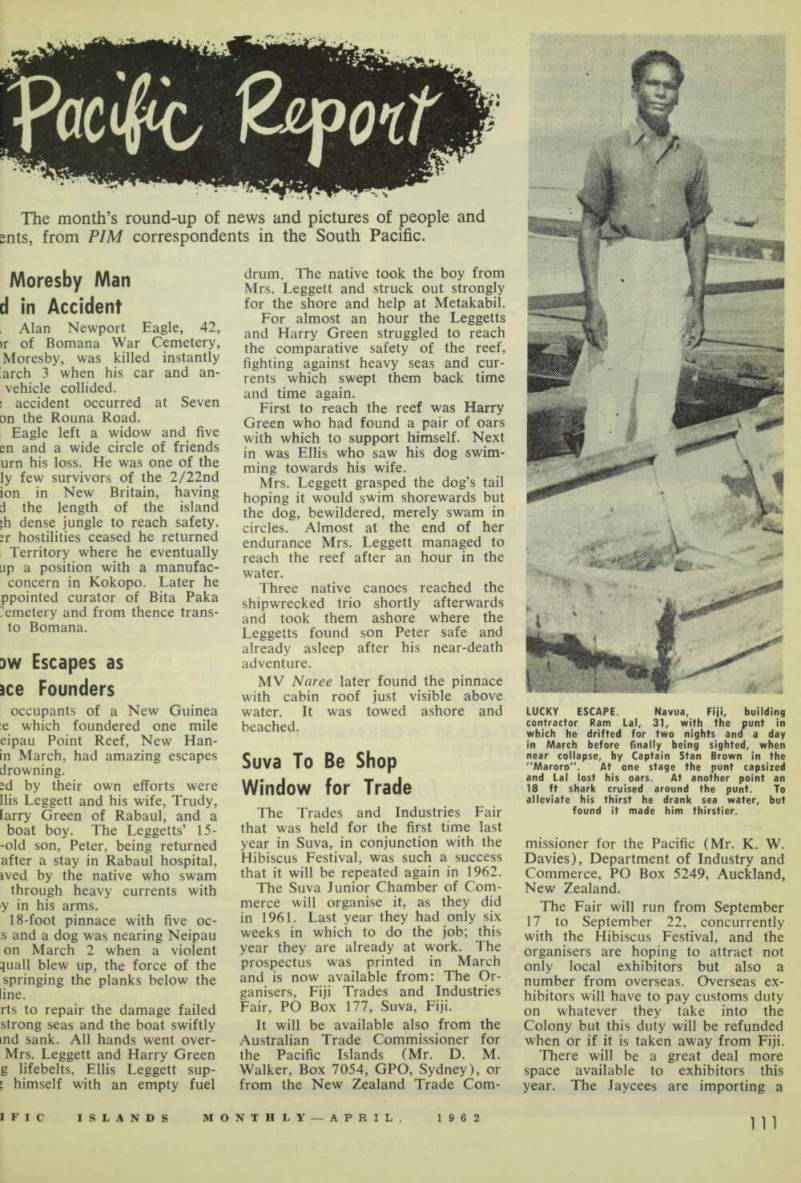
LUCKY ESCAPE. Navua, Fiji, building contractor Ram Lai, 31, with the punt in which he drifted for two nights and a day in March before finally being sighted, when near collapse, by Captain Stan Brown in the "Maroro". At one stage the punt capsized and Lai lost his oars. At another point an 18 ft shark cruised around the punt. To alleviate his thirst he drank sea water, but found it made him thirstier.
large marquee from New Zealand and this will be erected in the grounds of the Boys’ Grammar School building in Victoria Parade.
The Town Hall will again be available, so will the Grammar School.
More additional space this year will be in the Parish Hall, in Macarthur Street. Although three different buildings and the marquee are involved. they are all within a short distance of one another.
Space in the Town Hall will let from £F2S, for a 125 sq. ft. stall, to £F4S for 215 sq. ft. In the marquee, rental is £F2O for 150 sq. ft.; in the Grammar School, £FIS for 100 sq. ft and £F2O for 145 sq. ft.; in the Parish Hall, £l5 for 110 sq. ft. and £F2O for 150 sq. ft.
Plans of the various areas are sup plied with the prospectus. Intending exhibitors can state their preference when making application for space but where several people want the same space, allocation is in the order in which applications are received, The Fiji Broadcasting Commission will have a radio stand in the Town Hall and will also operate closed circuit television. Receivers will be placed at strategic places all over Suva anci a coverage of what B<*s on at the Fair will be available —literally—to the man in the street, [This should be an attraction m Suva where there is, as yet, no tele vision station. Television receivers are on sale in Suva, with duty-free privileges for travellers—who then
have no problems except how to j them through the Customs barriers the countries where they live.] Both Australia and New ZeaU are making a strong drive for m trade in the Pacific Islands. The S tember Trades and Industries I in Suva should provide an excel! shop window for them, as Suva an important distribution point only for the Colony itself but other adjacent islands groups.
Low Flying With a
Fiji Go-Kart
Go-kart racing may become latest fad in Fiji. Mr. David Gam who went to Fiji recently f; Christchurch, took his go with him, and finding that little nothing was known about the s set about whipping up interest.
He took his go-kart out to Laucala Bay sand flats at low and gave a demonstration to s enthusiastic onlookers. Then to amazement a nearby househc telephoned the police and compla about the noise.
The amusing part about all th that flying-boats are forever open over the area and their nois many decibels higher than that go-kart. [This is a matter of opii most people would prefer occasional flying-boat to the 1 pitched scream of the two-st motor-mower engine with which karts are equipped.—Ed.].
Anyway the police turned u speak to Mr. Gamble who, by time was packing up to go h But being in an obliging mooi delayed his departure and exph to interested policemen just makes a go-kart tick.
Footnote: Go-karting has popular in Papua-New Guinea several years.
Baby to the P-NG
Air Fleet
To the Cessna and Bristol P* New Guinea charter fleet of Ai MAL has been added a new ligh craft which takes short strips i stride and carries upwards of lb freight taken in through a gem loading hatch.
The new aircraft is the ver Lockheed 60 Lasa which Ansett have been putting through its at Madang.
Lockheed’s Melbourne ag Hayemason’s, supplied experii pilot Keith Busby for the Ten performance trials. In Madan observers to the Lasa’s trials
heed’s public relations officer Reddick and top Sydney photo ler Winton Irving whose job it to produce photos for publicity Dses, ic of the few small planes made ockheed the Lasa promises well Territory conditions. Unwieldy >es handle with more ease igh the large cargo door and strip takeoffs and setdowns are eeze—the Lasa needs only 800 of runway for takeoff. further progressive step by tt-MAL has been the extension heir intercentre radio system, ng Lae, Madang, Goroka, Minj, Mt. Hagen, Wewak and iul, system modifications now it contact between any of these es without having to first channel igh Lae base.
f Cuts Start at
:ala Bay
va traders will soon start to feel effect of the transfer of a large aer of Royal New Zealand Air e personnel and their families Laucala Bay to New Zealand.
New Zealand Government which s to cut down its overseas ex iture decided last year that a cut aucala Bay was inevitable, ic majority of the men are from engineering section, and they not be replaced. The plan is in future the ageing Sunderland aft will be flown back to Auck for servicing. so affected are 40-odd highly :d local workers who were em jd in the engineering section who received notice of dismissal, re possible those with the longest
service were retained, and family obligations were also taken into con sideration. The men dismissed, in spite of their technical qualifications, will find it difficult to secure suitable employment for opportunities in Fiji are strictly limited.
Adult Fiji Franchise
Poses Problems
When complete adult franchise comes in Fiji in 1963, it will come with a vengeance. Present estimates are that the roll of about 16,000 voters will suddenly increase to about 160,000.
Till now the franchise has been confined to European and Indian male adults. In 1963 will be added European and Indian women, and Fijian men and women who will vote in a national poll for the first time.
The number of elected members of the Legislative Council will rise from three to four in the case of Indians and Europeans, and from none to four for Fijians, In addition there will be two nominated members from each race to represent special interests who would have little chance of having a candidate returned at a poll.
The boundaries will have to be re drawn to provide for four electorates.
It appears, because of the present distribution of population, that there will be different boundaries for each race.
For example, a big Indian popula tion in north-west Viti Levu at present returns only one member. It would occasion no surprise if this area were divided into two for the Indians alone. The Europeans and Fijians would probably have one representative each from this area.
The Fijian poll will be watched with particular interest. The names of chiefs who would subject them selves to a poll are already causing speculation. However, long before the poll, there will be a meeting of the Council of Chiefs, who will submit a panel of names to the Governor, and the Governor will probably choose two of these to be nominated members. One is almost certain to be Ratu Edward Cakobau, and the other could be his cousin, Ratu George Cakobau.
Ratu K. K. T. Mara, at present studying at the London School of Economics, would probably win a poll in his native Lau, where his father, Ratu Tevita Uluilakeba, is Tui Nayau (King of Lau).
In Vanua Levu, Ratu Penaia Ganilau, at present Acting Secretary for Fijian Affairs, would be the natural choice, and would probably command the following. Two other almost certain starters would be current MLC’s, Semesa Sikivou, and Ravuama Vunivalu. Both are from the southern side of Viti Levu, and it would not be surprising if they fought the poll. Neither could be certain of success if he stood on the north side of Viti Levu for they
NEW GUINEA BOUND. This attractive group of air was all set in March to brighten up TAA's Sunbird service between Australia P-NG. They were attending in Sydney a special school which will teach them something of the customs and history of the Territory and give them a basic introduction to Pidgin English. From left the girls are Maureen Powderly, Laura Pel ling, Mary Sant, Barbara Wardle, Helen Tucker and Pamela Barnes.
would be out of their natural area, and parochialism plays a big role in the lives of the Fijians in the country areas.
So far no Fijian has shown out in that part of the island as likely Legislative Council material, and even if there had, he would have to be certain of support in the three provinces of Nadroga-Navosa, Ba and Ra. It could develop into a straightout provincial fight, and the winner would then come from the province with the greatest number of Fijians on the role.
The Fijians don’t know much yet about the mechanics of a general election, but the Fijian Association is sending out teams to explain what goes on. If they do their job properly there will be more interest in the Fijian results than the Euro pean and Indian results in 1963.
Mr. B. D. Lakshman Not
Re-elected Union President
The saga of Mr. B. D. Lakshman, controversial Fiji-Indian politician, appears to be over in sugar affairs.
He has been a dominant figure among the workers for the last four years as president of the Fiji Sugar Employees’ Union.
In February, after an official inquiry, he was expelled from the union. It was confidently predicted after his expulsion that he would offer himself for re-election, that he would be re-elected, and there was no law to bar him.
However, Mr. Lakshman had apparently lost much of the support he had once commanded for when the union central executive met to hold an election for a new president, they voted in favour of a young Nadi lawyer, Mr. Manikam Pillai. They
also elected a new secretary and new treasurer, to replace those 4 were expelled with Mr. Lakshman The Government moved early) March to put some teeth into j Industrial Associations OrdinanceJ that an expulsion would have so meaning. It published a bill, for i cussion at the April session of I Legislative Council, to clarify powers of the Registrar relating expulsions.
The current law does not give 1 power to decide how long a mem or an official may be expelled ] The new law, if passed, will give j power to impose disqualifications to five years. He will also h power to temporarily suspend ur office-bearers and/or officials for weeks pending a formal inquiry 3 the union’s affairs.
If the bill is passed into law, there does not seem to be any dc that it will be, then the Indus!
Registrar, Mr. Gregg will no loi be a “man o’ war” without gun:
The World News
In Pidgin
Although New Guinea Pit English has been called some flattering things in its time—inc ing a “slave” language—two of most important modern disciples Americans—Robert A. Hall, Pro sor of Linguistics at Cornell 1 versity; and Father Francis Mih
Svd.
Father Mihalic is at present Rome, organising a news-servia Pidgin for the people of New Gui He translates into Pidgin items world news that are of interest to native people—although how are to be disseminated in the T tory our dispatch doesn’t say.
Father Mihalic went to the T tory from the USA as a missioi of the Society of the Divine Won 1947. Ten years later he publi; his Dictionary-Grammar of 7 Melanesian (Pidgin English), wl as far as we know, remains the ( work on the official standardised sion of written Pidgin.
Pidgin is something that evolved out of the necessity for native people of the SW Pacific Europeans, and of Europeans of ferent tongues, to make themse understood to one another.
Basically it is English of a ! plus incursions of Malay, Gen and Melanesian words. In gram there is, as Father Mihalic points a strong Melanesian flavour to syntax.
Spoken Pidgin is not baby talk
en English or something you ; up as you go along (although y post-war residents of the SW ic territories think that it is), e have been (and still are) peans who have been expert in linguists, from whom it a’t sound like the comic opera that its detractors would have slieve that it is. ritten Pidgin was something else i. Most people wrote it as it ded to them; some of the mis in their printed books stabilised own versions but there was little ►rmity anywhere. After the last at a time when there were nine jnised orthographies in use (and xierable unrecognised ones), con able work was done on standard >n and after March, 1955, when 5 -NG Education Advisory Board nmended the official use of Pid :n the Territory, the first action taken to prepare the present lard orthography. . Mihalic’s dictionary and gram were published about two years ic standard version of Pidgin is )letely phonetic and based on inesian pronunciation and not pean. Written, it now looks a gn language—which, of course, not please a lot of critics who ?ht it new-fangled nonsense and it should be written in Angli form.
Indian Population
ws Further Gains
ie Indian population of Fiji now bers 205,068, a fraction less than of the total of 413,872. The re • for 1961 show that the Indian lation increased by 3.6 per cent. 2 months, while the indigenous ns rose by 2,97 per cent., or >, to 172,455. 1961 all races, except European, ed an increase. The European lation dropped from 10,667 in to 10,417. The part-European lation rose from 8,693 to 8,958. her figures were: •lynesians, Melanesians, Micro ns, 6,626 (6,175 in 1960); mans, 5,195 (5,009); Chinese, * (4,943); others, 117 (103). ie Colony birthrate for 1961 was 4 per 1,000, and the death rate 4.76. ie total Colony population has ased by 26,226 since the 1956 is. Most of the increase was in —12,854. Previous census totals 342,737 in 1945 and 259,638 in ie comparative figures of Fijian Indian population figures in those
years were: 1956—Fijian, 162,483; Indian, 191,328. 1946—Fijian, 145,134; Indian, 169,403. 1936 Fijian, 118,083; Indian, 120,414.
Males of all races in 1961 totalled 212,241, and females 201,631. The males outnumbered the females in all groups except the “others”.
Fiji Party By Another Name
Not Quite So Sweet
The Fijian Association in March, deciding that even though they were a political body they could make their weight felt if they went under another guise, decided to change their
name. They made a most unfortun ate choice, the Fijian People’s United Party, They acted in good faith, but did not realise a storm would soon burst about their heads. One of their leading patrons (a European) told them bluntly he would withdraw his support for them unless they did something about getting another name, quickly.
The sponsors of the move obviously overlooked the sinister ring the word “People” has had with political parties since the end of World War 11. They did not think of the number of “People’s Republics” which, if they were not straight-out
imunist, leaned so far to the left they were a very deep shade ink. ivuama Vunivalu, MLC, presi of the party, and who certainly 1 not be said to entertain Leftish ghts, let alone act like a Leftist, upset about the whole thing, n well-wishers of the Fijians ted out to him the inferences h could be drawn when the party mes strong enough to get known seas, he decided to do something t it. He said that a meeting d have to be called quickly to ge the name again, le Fijian Association in the few 5 of its existence has worked :ly and effectively behind the js to secure many of its aims, of its latest moves, with the ns to receive the franchise next for the first time, was to send s of men to outlying centres to lin the mechanics of polling and what is involved in an election.
th From Cook Islands'
m Cutting'
a indication of the problems h medical authorities have to in the South Pacific, even in isticated areas like the Cook ids, is given in the following ial warning in the Cook Islands s: i small baby recently died in the lital following a very severe in on of the brain. The germs red the baby’s body through cuts e in its gums by a “Maori ist” in Arorangi, to help its teeth e through. This is a common am in Rarotonga, f a grown-up is fool enough to medical treatment from an un ified person, he must bear full onsibility for any damage or bility he suffers as a result, igh I shall not hesitate to ecute the ‘doctor’ should I obtain cient evidence regardless of race position. When a baby dies as isult of such treatment, I become emely angry, especially because uld is too young to have any say vho treats him. rhink twice before you seek lical advice from anyone not ►loyed by the Health Department, i may be lucky and have no ible, but occasionally permanent health and possibly death (as in case above) may occur.
If YOUR child dies as a result of n cutting’, or some other similar itment, both you and whoever s the operation are equally as
guility of manslaughter as a drunken car driver who kills someone.
“There will be only one warning from this Department. You are reading it now.—B. Pitt-Payne, Medical Offippr ”
Australia Top Seller to Fiji
But Britain Buys AAOSt
Fiji had an adverse trade balance of £1,575,000 with Australia in the cx 4- of IQ6I This is revealed in the Colony’s trade report t fine firct half nf last vear. Australia in that period sold more goods to Fiji than any other country, disrfiacing Britain. Britain, at the other end of the scale is Fiji’s best customer.
Britain bought goods worth £1,750,000; Australia, £750,000; Canada £5OO 000; New Zealand, £330,000; and’Japan £170,000.
Australia sold goods worth £2,325,000 to Fiji in the first half of last ’year, and Britain was next with £2,200,000 closely followed by Canada with £2,100,000. Further down the scale as sellers were New Zealand £620,000; Japan more than £500,000; Indonesia, about £400,000 (mainly petroleum products), and the United States £208,000.
The Colony’s import bill for the first half of 1961 was about £8 000,000, while exports were only £ 3,750,000’. Copra was the biggest earner of foreign exchange with about £1,000,000. Returns from the main export sugar, do not normally amount to much in the first half of the year, unless there is a carryover from previous seasons. Last year
there was no carry-over because of the 1960 dispute in the canefields. The figures for the second half of 1961 are likely to show fairly substantial earnings from sugar.
Food accounted for most of the imports and the total was £1,659,000.
Many of the products imported could be produced in Fiji, and for years now the Government has been urging local farmers to grow more for local markets so that Fiji may cut its im port bill. For example, in the first half of 1961, Fiji imported £llO,OOO worth of milk and cream, mostly from Australia and New Zealand. Yet a JPP Ie , opportunity exists for profU able dairying in many parts of Fiji Another example was the import of £105,000 worth of fish, more than half of it from South Africa, and the seas around Fiji teem with fish as the Japanese have proved.
Potatoes worth £61,000 and ghee worth £57,000, from New Zealand, could also be produced in sufficient quantity in Fiji to serve the local population. And rice, £200,000 worth of it came from Far Eastern countries, mainly from Thailand. Fiji does pro duce rice in fairly big quantities, and could produce even more in the fertile Rewa delta, where the CSR Com pany has a rice mill, run by a sub sidiary company, Rewa Rice Ltd.
Apart from food other imports in eluded: Manufactured goods, chiefly material, £1,750,000; machinery, £1,500,000; petrol, £1,000,000.
Britain sold cars worth £250,000 to Fiji, and Australia was next with £123,000 worth. Both these items are included in the machinery total.
New
Readers
"Ah, yes . . . very, very interesting— very interesting especi ally the pictures!"
Moses and Daniel Whippy, aged 4 and 3 (Moses with his father's specs on) take a look at Nai Lalakai the new Fijian weekly published in Suva in March.
They 7 !! Challenge for
The 'Bounty Cup'
South Pacific bowlers for the fi time are to challenge Norfc Islanders for a new trophy—l “Bounty Cup”.
In silver and gilt, the Bounty C is surmounted by a small replica the ship that has played such a vi part in Norfolk Islanders’ history.
The cup will be played for Norfolk in early May when 42 Ai tralians and 42 New Zealanders i rive for an international bowli carnival which Norfolk hopes make an annual event.
Heading the first official visit Norfolk of the Royal New Soi Wales Bowling Association will senior Vice-President Ted Down Visitors from NZ will field tea] from Auckland’s Carlton Club, frc Nae Nae bowling club and ma others.
Among the visitors are 14 worn bowlers from NZ and 10 from Ai tralia. Though not competing for t Bounty Cup these women will m< their opposite members in the Nil in competitions organised by Norfc Island associates.
During the two weeks stay of t visiting teams an extensive soci schedule has been planned. This i eludes official receptions, tours, fis ing trips, barbeques and picnics. ( the last night of the tour a Grai Ball will be held at which the A ministrator, Mr. R. S. Leydin, w present the trophies. It will be tl first presentation of the Bounty Cu
A Man-Bites-Dog
Story from Papua
Legal history was made in Papu New Guinea in early March wh( a planter sued his native laboure for £123 and was awarded half ( it by a Port Moresby Magistrate.
According to the Secretary fi Law, it was the first time a Eur pean in P-NG had ever sued natu labourers. (It is usually considered waste of time.) Mr. N. G. Robinson, a plante told the court that six of his nath employees cut down a tree whic they claimed endangered their qua ters. Instead of falling where the expected it to, it fell right aero: the building, which was owned fc Robinson.
The magistrate awarded £67 1 Robinson and gave judgment again: three of the six natives.
He held that three admitted th felling but that the other three di
understand Pidgin English and r have unknowingly implicated nselves during Robinson’s ques ing. ji Assistant District Officer who eared for the natives, called the lager of a supply store and a lie Works Department supervisor iis successful attempt to lower the
lages claim.
lie cost of repairing the iron fed weatherboard building would reach £123, the witnesses agreed, 'he tree will be used as firewood Robinson’s employees.
tch-French
ipping Rivalries
)utch shipping interests, which
le time ago opened a shipping I from Europe through the lama Canal to New Caledonia I on to West New Guinea, have lounced that they will run another /ice. It will follow the same te, but will terminate in New land and return to Europe by the le way. fhe Dutch ships, reports our New iedonia correspondent, have been ing the French subsidised line, ssageries Maritimes, some hard npetition and MM has had to put ra ships on the run for prestige •poses.
Fhe Pentecoste Group in New ledonia, which has many ramifica tis, is agent for the Dutch shipping e, and ships all its own cargo— luding the popular Citroen cars— these ships.
i Beef Industry Could
i Helped by Freezer
Fiji could reduce her beef import I under the impact of local re geration, some people believe, my of the planters of the copra ;as of Taveuni and southern Vanua vu run a few head of beef to help sp their plantations clean, a practice lich has become popular with their •ming counterparts in Australia d New Zealand.
Most of these cattle have been kept I old age, and then shot, or per ps killed on the plantation for local ef supplies for the homestead or ?our. Very few are of the true ef types—in fact most of them are osses between dairy breds and halt ed beef animals.
Now Burns Philp (SS) Co. Ltd. is equipped its inter-island trader, itanui, with refrigeration on a lall scale. A recent consignment 1 two carcasses from Savusavu ar /ed at Suva in excellent condition.
The owners of the Ratanui may now add extra cooler space to take 15 carcasses.
With regular shipments assured the copra planters could go in for rais ing beef cattle on a much bigger scale, and go for the truer beef types which are suitable to the Fiji climate.
And if the quality is up to standard there could be a big drop in Aus tralian and New Zealand meat exports to Fiji.
Safety Week—in
New Caledonia
New Caledonia’s recent “Accidei Prevention Week” ended on a trag: note. A young Tahitian womai Madame Oupani Malanie, mother < four children, was killed when si tried to stop her runaway car. SI had parked it on a hill and it bega to run backwards. She chased it at
THE LABASA SCENE St. Thomas' Anglican Church at Labasa top) is newly erected and of unusual design Below is the main street of Nasea township, Labasa. Labasa is the largest township on Vanua Levu, Fiji's second largest island. These photographs were taken by Fiji PRO photographer, Rob Wright, during a recent tour of that area by the Gavernor of Fiji, Sir Kenneth Maddocks. Sir Kenneth's main interest was to see progress made on a new development road from labasa, south to the Dreketi plains opening up large tracts of land which are at present only accessible from the coasts and rivers.
The road is planned eventually to reach the Bua coast, famed last century because of its sandalwood. Early traders exploited it so intensively that it was cut out and destroyed.
tried to get in it but was crush between it and a tree.
The President of the Road Safe Council managed to inject a bit tragi-comedy into the week, Althou he may know how to keep out accidents on the road he was not fortunate at home. At his couni house he filled his kerosene refrigei tor with motor spirit by mistal and in the resulting explosion he 1( his eyebrows. £2,500 damage v, done to his house, which caught fire.
NC Soldiers To
Become Tradesmen
It is reported from New Caledoi that in future half of the young m doing their military service will to France. There they will be giv aptitude tests and trained as trad( men.
If the scheme comes to anythii it will be a good thing for N< Caledonia which is acutely short skilled tradesmen. There will pi sumably be some safeguard to s that the young men return to N< Caledonia and don’t decide to stay France. (Our Noumea corresponds reporting this, says the French mi tary authorities must read PlM— suggested something of the sort sor time ago. “But,” he adds, “1 did] go as far as to suggest that they sent to France.”)
NG's Tolais: Trouble
But Goodwill, Too
An American anthropologist, E Richard Salisbury, who has studi and lectured on the people of Ne Guinea for 10 years, sees trout ahead for the Administration < Papua-New Guinea.
Dr. Salisbury is at present Assi tant Professor of Anthropology the University of California, at Be keley. He is also a former Australii National University fellow.
Dr, Salisbury’s NG field work h been amongst the Tolai of Ne Britain and the Siane people of tl Eastern Highlands. He sees the latt in the same stage of development the Tolais were before 1900 ar thinks that Tolai problems today w inevitably be repeated by the Siai people in due time.
He thinks that the Tolai ai already out-distancing present P-N Administration development polici and are ready to take a far greati part in governing their own affai than at present permitted.
One result of this, he thinks, is lessening of interest in the Locj Government Councils which were ei
iastically supported 10 years icy have gone about as far as can go with Councils—the area :ully equipped with aid-posts, village schools, etc.—and work ken by the Councils is now re ed apathetically. a the economic front, they have reached their limit—the area ted to cocoa and coconuts is as ; as labour supplies will permit, this gives a man entirely depen on his own efforts an annual me of an average £2OO (although it 100 exceptional Tolai men over £1,000). le average Tolai can, however, :r an income from cash-cropping :aking on clerical work for the linistration and Dr. Salisbury cs this dependence on Govern t is unhealthy and that new in ries should be developed to cor it. spite of these warnings he seems link the Administration has done ;y well. He speaks of the “tre dous reservoir of Tolai goodwill ird the Administration that has i built up since 1945 . . . this eds even that in the Highlands, :h have always been friendly”, e doesn’t see the Territory ever uning another Congo and believes although the native leaders are
excited by the thought of self-govern ment they don’t want Australia to leave the Territory.
The average annual income of the the Siane people is about £5, which puts them about 50 years behind the Tolais. But he doesn’t suggest that either economically or politically it will take them this long to catch up.
The New Caledonia
Nickel Crisis
The water-jacket section of the furnaces of the Nickel Company in
Noumea, New Caledonia, began to be closed down in mid-March and by the beginning of April it was ex pected that between 250 and 300 workers would have lost their jobs.
Some, however, will be re employed by the company on con struction work at the smelters. Re trenchment will be on the first to come, last to go principle, and some who have been with the company for a long period will get severance bonuses.
Although the section of the com pany’s furnaces fired by electricity will not close down, all employees
be affected as a strict 40-hour will be worked and all overtime be cut out to make work avail for the maximum of men. Many ers have come to rely on over to augment their wages, but atting it out it is calculated that 250 men will lose their jobs ad of the 500-600 which would been the case originally, lere has been a slump in the J’s nickel market for the last le of years, in addition to which Caledonia has its own peculiar )les. le local nickel crisis has been ling up since last year when the el Company informed the As ily Territorial Budget Session unless a favourable decision was j regarding a subsidy the com would be forced to close down : of its furnaces. le New Caledonia Governor, M. ent Pechoux, was in France at time, and in his absence the ►sition party walked out of the n, leaving the majority party— ity Maurice Lenormand’s Union donienne —to carry on and take responsibility for all decisions B. veral projects that had been sub ;d by the Government were wn out. Among them was a sub to the Nickel Company in the i of exemption from Export / on smelted nickel over a period ears.
I. Lenormand’s party threw out project because, it said, the :el Company had completely re i a modernisation programme was part of the arrangement-in ciple and the Government would nothing from its subsidy, overnor Pechoux refused to ac the decisions of the Assembly, aring that it had made decisions ;rary to the best interests of the itry. s head of the Conseil du Gou icment (the upper house), he can ► any measure passed by the As bly. in the eve of an extraordinary smbly session which the Gover called for March 6, the company
issued a communique informing the population that “due to the bad con ditions on the nickel market over the last few months, the company had decided to close down the water jacketed furnaces in the ‘A’ section of its plant in Noumea”.
At the Session the Governor gave his reasons for refusing the first Bud get Session recommendations and stated that the Nickel Company’s re quest for aid was justified.
The Assembly President—a Lenor mand Party man—declared he would recommend to the Assembly that it refuse to study the agenda as set out by the Governor, and in the voting the President’s casting vote won the day.
The meeting broke up in confu sion, and on March 9, the Council was dissolved. New elections will be held in April. (See front news pages.)
Work Pushes Ahead on
New Tonga High School
A fine new high school will soon replace a collection of shacks which have served as a high school for Tonga for many years. The Govern ment of Tonga decided last year to build a new high school at Nukualofa and in December let a contract for about £105,800 to the Tonga Con struction Company to build the first stage.
The over-all plan envisages a two storey building, which will be com pleted when required. Workmen are now endeavouring to complete a wing of the first stage so that it will be ready for occupation on Tonga Emancipation Day on June 4.
The whole of the first stage should be completed in time for opening of the school year in 1963, when there will be accommodation for about 550 pupils.
In the first stage there will be 19 classrooms, four science laboratories, an administration section, bathroom, storage rooms and cloak rooms. No date has yet been fixed for building the second stage, the plans for which
include additional classrooms and laboratories and an assembly hall.
The new school is being built of concrete blocks, with reinforced concrete floors, coral metal and sand.
The building was designed by Derrick and Derrick, architects and engineers, Suva, who are supervising the construction.
Fuss Over Lord Howe's
Pyramid Assault
The team of Victorian mountain eers who set out to climb Ball’s Pyramid, a rock protruding from the sea, 10 miles off Lord Howe Island ( PIM , Mar., p. 119), did not achieve its aim, in fact the members didn’t even set foot on the rock.
When they returned to Sydney on March 15, the leader, Mr. Robert Jones, told the newspapers they had gained the impression that the islan ders did not want the mainlanders to be the first people to climb the rock.
Mr. Jones said that the Lord Howe Island Committee had wanted the trip to be completed in one day, but when he visited the Pyramid for the first time he saw that the climb would take two days. During the first at tempt to reach the Pyramid he said the owner of the launch turned back half way without giving any explana tion why and on the second trip, in two launches, both skippers decided that the sea swell was too great to allow an attempted landing.
No charge was made for the trip.
Mr. J. Whistler, chairman of the Lord Howe Island Committee, later denied the suggestion that the islan ders did not co-operate. In a letter to the president of the Victorian Climbing Club he said he had re peatedly informed the climbers that sea conditions were not suitable for the trip and that he would not be held responsible for leaving a party on the Pyramid overnight in view of the possible dangers.
He also said that he wrote the let ter to guard Lord Howe Island’s
“reputation for hospitality, friendli
ness and an ever-readiness to assist
and co-operate”.
the new Tonga High School at Nukualofa will look when it is completed. The school will be completed in three stages, the first stage being finished by this June. See story this page.
Banno Bros, in Big
Court Action
One of the biggest civil claims e to come before the Supreme Cc in Fiji started in March. The amo involved was £375,000, and each s imported heavy artillery in the sh of Queen’s Counsel to argue tl case.
The parties were Banno Oces Ltd. and Hari Charan Akhil, rn ganese mine owner, and two c< panics associated with Akhil. Bam asked the court to order the dej dants to comply with an alleged c tract for £375,000 to sell their n ing rights and interests, plant ; stockpiled manganese ore to them, They also asked for an injunci to restrain the defendants from p ing with or disposing of any of tl mining rights and interests in 1 damages for alleged breach of ( tract, and special damages £1,761/9/7.
Hari Charan Akhil and the mil companies claimed that the cont was not concluded, and that va tions made in it were for an : gal purpose to evade the payn of income tax.
Mr. L. P. Leary, QC, Auckh led the Banno team of lawyers, Mr. O. J. Gillard, QC, Melbou was leading counsel for the de: dants.
The Acting Chief Justice (Mr. , tice Hammett) heard the c which was expected to last sev days. He was then expected to serve his decision.
Thornton Echo: Privy
Council Rules on Deportat
The deportation of journalist J Eric Thornton, 44, from Fiji in If had an echo in the Privy Counci March, when Thornton sought le to appeal against a conviction March, 1957. for failing to leave when ordered by the Principal Im gration Officer after a four mon visitor’s permit had expired. Th( ton was fined £3O in the Magistrs Court, and the Supreme Court s sequently upheld the conviction.
The deportation order aga Thornton was made on Noverr 15, 1957, and two days later Th( ton was arrested and put on a pi for Britain.
The argument before the Pi Council was on technical groui one of the main points made Thornton’s counsel was that aj citizen of the United Kingdom Colonies, under the British Nati ality Act of 1948 Thornton was much a citizen of Fiji as he was the UK. Therefore he was entil
fly at all times to enter and leave Tie lawyer also claimed that the Immigration Ordinance, was void ause it was in conflict with the ish Act, le agreed with the president of court (Viscount Simonds) who ;d “Are we all citizens of Fiji?” ; it was a far-reaching, almost flutionary claim. he counsel for the Fiji Police con led that under the 1948 Act in d of there being a single status a British subject throughout the nmonwealth, there was now a onality for each Dominion, and e was nationality or citizenship he UK and Colonies, here was no provision about the ts of a person endowed with enship of the UK and Colonies, for such rights one had to look le legislation of the different terri ;s. he Privy Council agreed with e views, and rejected Thornton’s tion.
Strike Upsets Plans
Samoa, Christmas Is.
nited States West Coast seamen ck for higher wages March 16, atening construction work under for the South Pacific Conference *ago Pago in July and curtailing ments of essential food and other flies to Hawaii. he strike was called the day that Matson freighter Ventura was to from San Francisco for Pago o carrying all of the roofing :es for the big new auditorium tre. The vessel also had essential trical and generating equipment
and plumbing and other hardware for the construction programme.
Matson was also forced to cancel the scheduled sailing of the south bound luxury liner Monterey. The company—which has not had heavy passenger loads on this service on many sailings—was fully booked for this trip. Airlines and the competing British ships of the P&O-Orient Lines were the gainers.
The strike halted shipments by commercial vessels of cargo destined for Christmas Island and the nuclear weapons tests planned there in late April. US Defence Department offi cials sought—and won—a Federal Court order forcing the Sailors’
Union of the Pacific and two smaller unions to supply crews for Christmas Island freighters and work began on loading them the week of March 25.
Hawaii was immediately threat ened with some food shortages.
Governor William Quinn appealed to President John F. Kennedy for Presi dential intervention. Honolulu grocers were reported informally rationing some items to customers.
The bulk of Hawaii’s food comes from the San Francisco area.
Richard F. Taitano, director of the Office of Territories of the United States Department of Territories, told PIM correspondent in Washington, DC, that he was “gravely concerned” about the effect of a prolonged strike on the South Pacific Conference.
American Samoa Governor H.
Rex Lee flew in to San Francisco on March 22 to determine what could be done to get supplies moving and also to take care of other island business.
He got some bad news not long after arrival. One vital—to the Con ference—shipment was a small box only two feet by one foot by one foot in size. It contained special tie down bolts for the job. Because of the urgency of getting the bolts in place, they had been flown to San Francisco by air freight to arrive in time for the Ventura sailing.
When the strike began, Governor Lee found, the bolts were securely buried in the hold of the Ventura with several hundred tons of cargo atop them!
To alleviate the emergency, the Interior Department hastily chartered a German freighter, the Cap Com ingo, and loaded her with timber, furniture, school equipment and a general consignment of building materials and hardware. The vessel was scheduled to leave Los Angeles on March 26.
Arrival of the Cap Comingo would enable construction work to continue, even without the cargo aboard the strike-bound Ventura— although the Ventura supplies are
HEALTH CENTRE. This attractive concrete ing with a leaf roof and brightly painted [?]ers has just been opened in Honiara Red Cross Health Centre. It includes [?]ante-natal clinic. Immunisation against [?], whooping cough and TB is also being [?] at the Centre and mothers are taught to feed ther children properly. The branch of the Red Cross Society proposes concentrate primarily, though not [?]sively, on measures to protect the health ative mothers and young children. The [?]tly appointed Red Cross Regional Officer the Western Pacific, Miss C. M. Clapham, Honiara in March for Vita after a two months' visit to the Protectorate.
mtly needed, Governor Lee said, he Governor said that he would i a Federal court order forcing unions to sail the Ventura if the ce lasted through the week of rch 25. He conferred at Berkeley i Knowles Ryerson, senior United ;es commissioner on the South ific Commission, who would rep :nt him if court action became sssary. he seamen struck against the 12 ipanies represented in labour bar ling by the Pacific Maritime As ation. The companies sail about freighters and passenger vessels, ;fly in Pacific Coast-Far East le, but also to South American Alaskan and Hawaiian waters, ailors now receive about $434 ithly, plus keep.
ilaspina: Library Buys
itoric Vavau Sketches
'welve drawings of great histqri interest by artists of a Spanish edition which visited the Vavau tiipelago of Tonga in May, 1793, e recently been acquired by the chell Library, Sydney, fight of the drawings are of ties in Vavau; the others are of ties in New South Wales. The /au drawings—three of which are reduced here—are the earliest wings done by European artists fiat island group. rhe expedition to which the artists tinged was headed by Captain Ale dro Malaspina, whose voyage to Pacific, Sydney writer Robert igdon described in an article in iruary’s PIM entitled “Forgotten vigator Annexed Vavau For inish Crown”.
This article was the first account ever published in English of Mala spina’s visit to and annexation of Vavau—this important event in Ton gan history having been neglected by Pacific historians due, mainly, to a series of extraordinary events that befell Malaspina after his return to Spain.
As Langdon described in February, Malaspina fell into disgrace about a year after returning to Spain and was imprisoned for nine years. On being released, he was deported to
his native Lombardy where he died forgotten in 1809.
Simultaneously with his arrest, the King of Spain ordered that all the papers of his expedition were to be seized and withheld from publica tion.
The result was that almost noth ing was known of the expedition’s work until 1849 when a journal kepi by one of Malaspina’s officers which had apparently escaped the general seizure, was published in the Spanish town of Cerrito de la Victoria. (Over)
The drawing, at top left, probably the finest of the 12 acquired by the Mitchell Library, depicts a dance which the women of Vavau staged for the enter tainment of officers of the Malaspina ex pedition. An interest ing touch is the man in the foreground holding a mirror (then a novelty in Vavau) for a girl to look in.
Top right shows women of Vavau searching for shellfish—by one of Malaspina's artists, and at right are three women of Vavau as one of Malaspina's artists saw them. The original is in colour.
All the drawings are reproduced here with permission of the Trustees of the Mitchell Library and are from originals in the Dixon Galleries.
Thirty-six more years passed before an edited version of Malaspina’s own journal, with some reports by several of his officers, was published in Madrid.
Both these volumes, being in Spanish, were neglected by Englishspeaking historians of the Pacific, and so nothing was known of Malaspinas visit to and annexation of x V * aU ‘ ..I. . , .
Meanwhile, there still remained in various Spanish archives a vast collection of unpublished material re lating to Malaspina’s voyage.
Among this material were numerous drawings by the two artists who had been attached to the expedition —Fernando Brambila and Juan Ravenet.
These drawings were found in the Naval Museum in Madrid in 1956 by Father Celsus Kelly, an Austra lian Franciscan priest, while he was searching for historical material of Australian and Pacific interest for the Mitchell Library and National Library, Canberra.
Father Kelly had microfilm copies of all the drawings made for the two libraries. Then late last year, the Mit chell Library bought 12 of them through an overseas dealer.
By a coincidence, the 12 drawings arrived at the Mitchell Library while Langdon was doing research for his February article in PIM. But he did not learn of their existence until after his article had gone to press.
New Drive by N. Zealand
For Islands Trade
A mission dedicated to the creased sale of New Zealand goc in the South Pacific Islands, a comprising at least 20 persons, v leave Auckland in August, and spe about a month in Fiji, Sami Tahiti, New Caledonia and N Hebrides.
The trade mission is being ganised under the auspices of NZ Department of Industry £ Commerce, and the NZ Manuf turers’ Federation.
An active part in the organisat is being taken by Mr. T. E. Bov and Mr. J. K. Dobson, presid and senior vice-president respectiv of the Manufacturers’ Federati Mr. J. B. Prendergast, overseas tri director of the Department; Mr.
W. Davies, NZ Trade Commissio in the Islands; and Mr. F. A. Ha ing, who recently made a sur of Islands trade.
The plan was discussed at representative meeting in Welling early in March. Mr. Bower i emphatic on the importance of creasing the export of NZ’s prim and secondary products.
Mr. Prendergast pointed out t NZ had an advantage in proximity to Islands markets. 1 Davies discussed the need for be shipping schedules.
The secretary of the mission be Mr. V. R. Moore, secretary the Wellington Manufacturers’ . sociation.
It is realised that New Zeah exporters have been handicapped the past in the Islands markets the hold over both wholesale re distribution exercised by the big A tralian corporations, and by anxiety of both British and Frei administrations to assist their hoi land exporters. The New Zealand will study these factors closely bef they launch their trade drive.
In Canberra in March details w made available of the report of 19 man Trade Mission made Australia to the Pacific Islands August.
One of the points made by mission was that a factor limit Australian trade in New Caledo was exchange control, wh favoured trading with metropoli France.
Australian firms already interes in New Caledonia trade have b complaining of this for years, course ( PIM, June, ’6l, p. 59) But despite this the mission foi markets for building and construct materials. It also found that
•easing trade is being built up in stralian air-delivered fresh fruit vegetables, kbout 12 tons of fruit and vege [es are being flown into Noumea h week from Australia, and the le is increasing. lut for cool storage fruit and etables Australia appears to have e chance of competing with aper produce brought from mce.
Tie leader, Mr. T. H. F. Spalding, Brisbane, reported that the Pacific a is becoming a significant rket, with imports of £B6 million, which Australia supplies about I million, or nearly 33 per cent.
Caledonia and Fiji alone sort goods worth £32 million, of ich Australia provides £8 million.
The mission’s investigation has de it clear that Australia can sub ntially increase its share of this ued market,” Mr. Spalding has d the Government. ‘Already we are widely accepted the area as suppliers of primary )ducts, and Australia is a natural irce of supply for these products.
“But the traditional pattern of tnand is changing.
“Better living standards and higher rchasing power are making the cific Islands an increasingly impor it market for manufactured goods.
“These markets are becoming jeh more conscious of price and ality.
“Australian exporters must ensure at this trade is adequately under >od and fully serviced.”
Mr. Spalding has warned that there a marked preference for French ods in New Caledonia.
Prices have to be highly com titive before the market is in rested in examining other sources supply.
In Fiji, the mission found an xtremely keen” market.
Mr. Spalding said that Australia id a good share of business, but e mission found that new Aus alian products could gain entry if :porters attacked competition and her problems and undertook a icrough servicing of the market.
He said that to succeed Australian :ms must:— i Ascertain market needs precisely; • Compete on quality, finish and price; i Meet documentation needs; » Engage in local promotion and provide after-sales service; and ► Carefully select the right agent.
Mr. Spalding’s report did not say d, but the mission is believed to ave pointed out to the Common wealth Government that Australia
has lost about £500,000 a year in business to New Zealand exporters who are actively exploiting the Fiji market.
The mission reported that there were opportunities for:— Costume jewellery, leathergoods, fancy goods, flour, bran and pollard, ghee, tinned meat, fish and vege table, builders’ hardware and other building materials, plastic ware, holloware, books, saddlery, light weight worsted and woollen fabrics, hardboard, sunglasses, souvenirs, ball point pens, manila and sisal ropes, rice, dried peas and beans, biscuits, fruit juices, canned meats, vegetables and fruits, grocery lines, onions, garlic, soap and detergents, ready
made clothes, canned beer, wines and canned soft drinks.
The Australian mission visited both New Caledonia and Fiji, and some members visited other Terri tories including the New Hebrides and Samoa.
"Yankee" Investigates
An Old Chestnut
When the crew of the brigantine Yankee arrived in Honiara, BSIP, in February (the brig and the crew struck trouble later in Cairns —see p. 99) they took time off from their troubles to investigate an old story.
This was that a number of Jap anese had been walled up in a cave
at the side of the cutting in Tulagi during the Pacific war. The crew members made a hole big enough to crawl through and entered the cave with a torch. They found no bones or bodies. The only evidence that the cave had ever been used was a camp stretcher and two oil drums.
Pacific old hands, of course, could have told the Yankee investigators that the “walled up prisoners” story is a hardy perennial. It keeps recurr ing throughout the war-time battle grounds of the South Seas, in one form or another. Latest reports PIM has had have told of “whole hospi tals” buried in hills at Lae and on the west coast of Dutch New Guinea.
Light Commemorates
Tragic "Melanesian" Loss
What will be a regular reminder of the tragic and mysterious loss of the 240-ton Melanesian, with 60 people aboard, came into existence in March. It was the Melanesian Memorial Light, established on a 60ft steel tower at Talatoa Island, off the Guadalcanal coast, BSlP— bought with funds raised partly by public subscription to commemorate the loss of the Government vessel.
Melanesian disappeared in July, 1958, on a voyage from Malaita to Sikaiana, with all her passengers and crew. Ships and aircraft searched for 11 days. First wreckage was sighted eight days later, and two days after this the body of the boatswain was recovered—but no trace was ever found of the others.
The new light warns shipping away from the Rua Sura reef, on which many vessels have grounded during night voyages.
No P NG Action
Against Sect
The Australian Minister for Terri tories, Mr. Hasluck, in March turned down a request from the P-NG State Congress of the RSL for the banning of Jehovah’s Witnesses from the Territory.
His reason: Without violating the principle of freedom of worship, there is no ground for excluding one denomination except that of security risk. And there has been no con vincing evidence that the Witnesses were such a risk, the Minister said.
Mr. Hasluck admitted that the Witnesses had worried the Admini stration, other missions, and native leaders.
But he added: “The native people can make their own judgment whether they accept the leadership of this denomination or that of missions with which they are better acquainted”.
The RSL Annual State Congress, meeting in Lae in March, went into committee to discuss several motions calling for action against the Wit nesses.
Following a long discussion the Congress issued the following state ment: “The Congress unanimously passed the following resolution— The RSL views with the gravest concern the activities of that body of persons calling themselves Jehovah’s Witnesses and purporting to be a religious cult. It considers that tenets of this body are in compatible with the aims of the Commonwealth Government under the Trusteeship in relation to this
Territory. It is submitted that thei is ample evidence that harm h£ been and is being caused to th welfare of the Papuan and Ne Guinean people and the security c this country by the teachings of th body. Cognisance is taken of th fact that similar bodies have bee proscribed in other countries at similar or more advanced stage ( development than Papua-Ne Guinea. The strongest pressui should be brought to bear by th Administration of Papua and Ne Guinea and the Federal Governmei to have Jehovah’s Witnesses declare a proscribed body and to active) prevent any adherents of this sei from spreading their teachings in th Territory’.”
Simogun Peta, representing th Native Ex-Servicemen’s Associatio of New Guinea told the Congrei that there already was evidence th; the teachings of Witnesses were bi coming confused in the native minds with cult beliefs.
This, he emphasised, was a gra\ danger to the welfare of the peop of the Territory.
Simogun is a former member ( the Legislative Council, In opening the RSL Congress, th National President, Mr. A. J. L* told delegates the RSL believed Au tralia must be prepared to accept th possibility of defending P-NG as it were part of Australia.
Mr. Lee said “The West Ne Guinea issue must give all thinkir people cause for grave concern.
“It is the League’s fervent hop that this issue will be reconcile either by the diplomatic moves th; are now taking place or through th United Nations, and we sincerel trust with justice to the people vitall concerned.
“However, I would suggest th; the West New Guinea issue is onl one symptom of a general conditio and in accordance with the Leagu motto the price of liberty is etern; vigilance.
“We believe that the people o Australia must make sacrifices i necessary to prepare ourselves fo any development that may occur.”
Mr. Lee said a deputation is t( seek an interview with the Ministe for Defence, when a number of th League’s main items of defeno policy will be presented.
The League will request that th Papua New Guinea Volunteer Rifle be expanded into the full CMF or ganisation embracing natives, rnixe* bloods and Asians as well as presen Europeans.
Fiji's first and only cement factory was to go into production towards the end of March.
Built by Fiji Industries Ltd. at Lami, just outside Suva, work started on the factory last year.
> Land Trust Board
its for First Time
ie new Solomon Islands Land t Board held its first meeting Honiara on February 22. Under :hairmanship of the High Com ioner, the board includes 12 mon islanders. Mr. David ch, the High Commissioner, lined at the inaugural meeting the board was not yet in ;ical operation because the sec of the Land and Titles nance under which it would act not yet been brought into force, ing the appointment of a strar of Titles. ie new law would come into ! as soon as a Registrar arrived ie Protectorate. The new laws intended to provide secure titles Solomon Islanders’ land and reduce the number of land ites.
fecting NG Forest
Posterity
mething like 10,000,000 acres of >t reserves will be needed to the timber requirements of la-New Guinea by the year ), according to the Director of sts, Mr. W. R. Suttie. He calcu that by that year there will be tive population of over 4 million e Territory. nder the present laws, the only to acquire anything like this in forest reserve was by direct isition from the native owners, t from the high capital cost in id (for a project that would only fit posterity), the natives are reluctant to sell such land out —they prefer to sell only timber s, which would be no solution to ong term problem.
ackboard Jungle"
/V. Samoa
some of the wild boys of the d’s Press had got hold of it, t happened at Vaipouli High ►ol, Savaii, Western Samoa, on night of March 15 might have i described as a riot or even an erection. tie incident might even have its ly side—but the principal of the ted school, New Zealander Mr.
Phompson, his wife and small were not likely to see it that when their house was sur ided by yelling pupils, threaten violence and demanding food money. he trouble began two days pre isly, when a senior pupil—de-
scribed as a “bully”—was expelled.
That night the whole school walked out. A delegation of pupils made the five-hour journey by launch and bus to Apia, where they saw the Director of Education and asked for the reinstatement of the boy who had been expelled.
This was refused; the delegation then returned to Savaii where schoolboys stirred up more trouble, culminating in the threat of violence to the principal and his family one night.
The school was subsequently visited by the Director of Education and the Minister for Education. The result: a further 18 senior boys were expelled. The Director, and later a meeting of local chiefs and orators, made it clear that the action of the principal in expelling the first youth was fully endorsed.
The whole incident has been taken pretty seriously in Western Samoa.
This “blackboard jungle” business is out of focus with the image most people have of Polynesian people. It was feared that when news of it got to New Zealand, it would be just that much more difficult to recruit teachers, At present Western Samoa depends largely on teachers seconded from New Zealand for staffing higher grade schools. A teacher would obviously have to be motivated by considerable missionary zeal to take on this sort of thing voluntarily—if the incident at Vaipouli School were typical, which of course it is not.
According to local opinion, most
of the trouble at the school was due to the ages of the ring-leaders. These can scarcely be called “boys”—they are, on Samoan standards, men of 18, 19 and 20 years old. Some are not so much interested in learning as in intimidating the younger pupils and, if they can get away with it, their teachers as well, Some local people believe that they are far too old to be still at school in Samoa’s present stage of develop ment and that money available for education would be better spent on younger pupils,
Survey NG Border
Now—Ut Tisg
a member of Papua-New Guinea Legislative Council, Mr. R. S.
Slaughter, has made a plea that Aus tralian New Guinea’s border with West New Guinea be surveyed at once and that every inch of it should be p U j under military surveillance, “if we don’t survey it now,” he sa jd “before our ‘new neighbours’ move in, then we might as well for get j t » (A report in January PIM de scribed how native people on both sides of the border now moved back and forth without hinderance and bow some villages on the Australian s id e were actually administered by the Dutch and how the villagers themselves believed that they were west New Guineans.) Mr. Slaughter urged that Daru island, in the Western District of Papua and close to the West New
RED CROSS DRIVE. Sister Barbara Gimple (right) has been appointed a full time sister with the Red Cross in P-NG and she also has a Land-Rover to help her. She collects about 60 pints of blood a fortnight from native villages around Rabaul for the blood bank— representing a significant step. In the past many natives have objected to giving blood.
Guinea border, be made a Common wealth military base.
He said that what is happening to West New Guinea should be a lesson to Australia and that it was most unfortunate “that we are not in a position to materially help our West New Guinea friends in the imminent invasion of their land”.
“The Dutch should be congratu lated for their stand,” he said. “They have known for sometime that they will eventually have to leave West New Guinea—and they apparently want to leave—yet they remain at great cost, financially and otherwise, trying to allow the native people time to work out their own future.”
Welcome Mat "Still
There" for Australians
The services of education officers now in the Papua-New Guinea Public Service will be required for the rest of their working lives, said the Administrator of P-NG, Sir Donald Cleland, at the District Education Officers’ Conference at Port Moresby at the end of March.
Since a declaration of policy some months ago to the effect that native officers were ultimately to fill senior positions in the P-NG Public Service, some European public servants have expressed doubts about their careers.
The Administrator took t opportunity to reassure them.
He said that New Guinea nati’ wanted Australians to stay in i Territory and had told the Minis so during a recent tour.
“Papuan and New Guinea lead who talked with the Minis emphasised that they were fi aware of their need for the o tinuation of guidance and assista] by Australians,” said Sir Dom “They also made it plain that, wl the time came for self-governm( they would still want Australians stay here.”
New Hebrides Planters
Have a Grievance
New Guinea copra planters n feel that they are having a t time these days, but according figures sent to PIM by a hi Hebrides planter, those in the C dominium are having it a great d worse.
Comparative prices he has suppl on freight and wharf charges copra are as follows:
It will be noted that the hJ Hebrides charge includes £2/1 export duty. Export duty a dropped in P-NG when income was introduced. But even with this amount, the New Hebri payments in order to get the co off the wharf and to its desti tion are over £A9 more than
P-Ng.
Additionally, of course, IS Guinea planters are getting an f.(
New Guinea
Freight (to UK/Nth.
Europe) Agency Comm.
Marine Insurance .
Stevedoring Cargo Superintendence in UK or Continent Wharfage Handling at Wharf £A per 10 0 1 3 8 1 3 3 11 0
New Hebrides
Freight (to Marseilles) Marine Insurance .
Stevedoring Handling at Wharf Superintendence Wharfage and Storage Duty Certificate of Origin £A per 13 7 7 1 10 19 2 2 0 2 10 1 12 22 16
5 of at least £AS2 per ton for ke-dried copra, while New rides planters are getting only it £A3S/10/-.
'he Condominium Government New Hebrides does not raise nue from income tax. Neither i the French administration. The ish administration does, but this nue goes towards paying for its national commitments, only.]
IG Will Reorganise
Dacs
istrict Advisory Councils which 5 operated in Papua-New Guinea, ther with their companion organ ons, Town Advisory Councils, e shortly after the war, are to be ganised. is understood that when re misation is complete, the coun will have more native members lis being achieved by direct rep utation from Native Local Gov nent Councils. own Advisory Councils will con e to have direct representation. :rict departmental officers will tinue to attend meetings, but have vote on resolutions; and elected nbers of the Legislative Council have the right to attend all jtings of DAC’s in their dec iles, and to take part in discus- LS.
Tie councils will, as before, meet rterly but procedures and consti ons will be “more closely de d’. district Advisory Councils and vn Advisory Councils are, as ir names indicate, purely advisory, iolutions that are passed are sent to the departments concerned and the Administrator. Originally the jority of the members were Euro ns with a few Chinese and Euro ian members. Now there are ive members as well, fhe councils are designed as a pre linary to full local government. far, members themselves have 1 no wish to push this —no one
wants to assume responsibility for raising local revenue or for adminis tering local public utilities. Both functions are left to the Adminis tration—and the Administration thus has all the say in how money is to be spent and how services are to be paid for by the community.
Death and Injury When
Truck Leaves Road
Three P-NG native children died, several were injured and four others were still missing when a truck plunged off the Lae-Wau Road into a gorge on April 1. The children were among a big party being driven home after taking part in a choral competition at the Lae Annual Show.
The scene at Rabaul Airport on March 2 when an RAAF Hercules was diverted from Wewak carrying a seriously ill patient for hospital at Rabaul.
Centre rear is Dr. C.
Haszler. See p. 65.