Pacific Shipping
pp. 99-111 · Read in the full issue
Cruising Yachts
Burns Philp’s 434-ton Islands trader Yanawai in March was ng on a reef off Aoba, near Santo, New Hebrides, so badly laged that she appeared to be a complete write-off.
IE went on the reef on March 10 after dragging anchor in gale e winds that blew up during the it. She went aground about 2 l diver was sent to look at her, early reports said she was so ly damaged and stuck so fast on reef that it wouldn’t be worth le getting her off.
Vater entered her hold and engine m. Passengers suffered minor iries when they scrambled ashore. r anawai was built in Hongkong BP’s in 1937. She is 151 ft. She ; best known in Fiji waters where operated for many years before ng transferred to the northern nds’ run in the New Hebrides last r. She replaced the old 248-ton :au (built 1909) which has since n at Vila, up for sale, fhe Nikau will now be brought :k into service—so it’s fortunate BP’s in the New Hebrides that ; wasn’t sold.
Dn the same night a small trader, : Womba, owned by M. Leroy, of nto, went on a reef at Pilotin, East nto, after dragging anchor. There s other damage to smallcraft.
• Cooks Hit By Hurri
CANES: There was much damage in the Cooks in mid-February when two hurricanes battered the islands.
The first passed 150 miles east of Rarotonga and the second a couple of days later was reported near Palmerston, and finally veered west of Rarotonga. Small ships were dam aged, houses and crops ruined on several islands, and in Rarotonga the 296-ton Apanui had a narrow escape from being a complete loss. The Apanui attempted to get out of
Avarua Harbour when the second hurricane warning came, but could not make it. She was brought back alongside the wharf and beached, but heavier seas refloated her and one by one the ropes tying her to the wharf snapped. By nightfall she was abandoned. But next morning at high tide she was again refloated and pulled back to the wharf, and later taken to Avatiu Harbour. She was not greatly damaged. Owner D. C. Brown later put a public notice in the Cook Islands News, thanking all those who helped save her. “It is due to their successful efforts that Apanui is still afloat and not obstructing the Avarua Harbour”, he said.
Considerable damage was done tc the Union Company’s wharf ai Avarua.
9 New One For P-Ng. Th<
second Islands vessel to be launchec from the Ballina Slipway, NSW within three months was christenec there on March 8. She is the 60 f wooden cargo vessel Hiri, designee
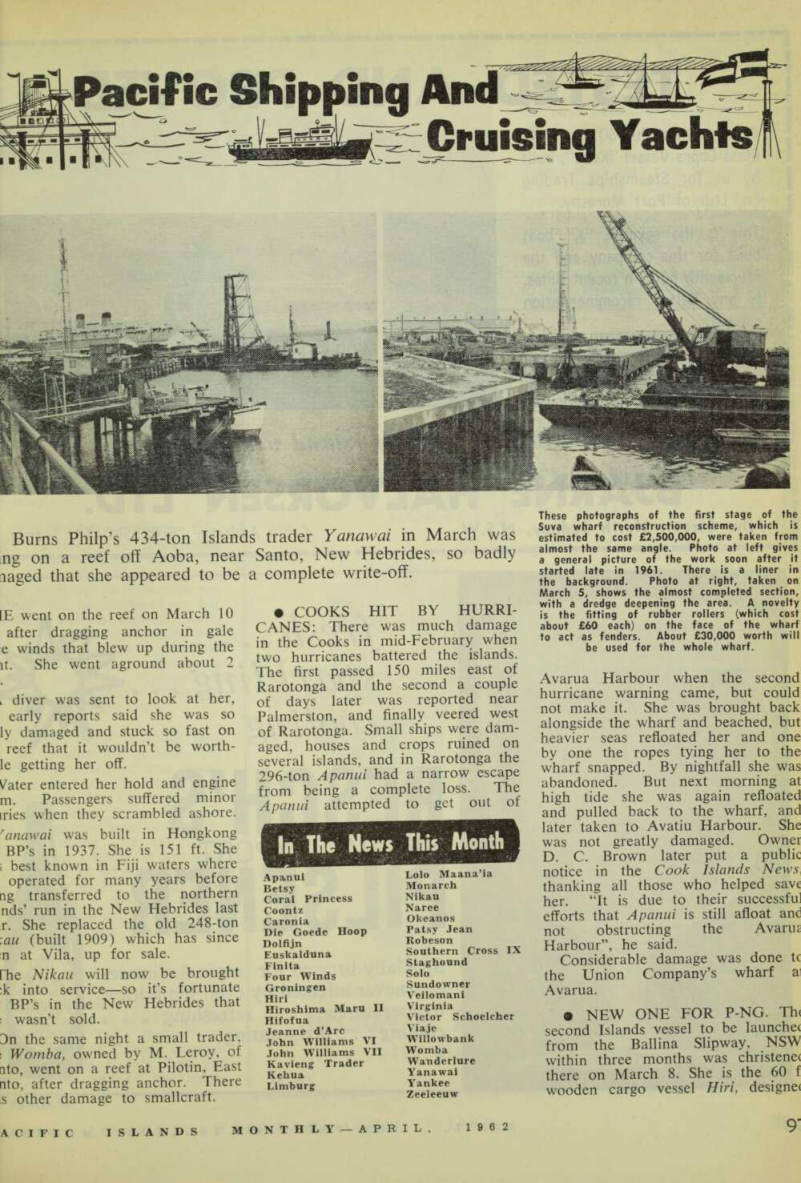
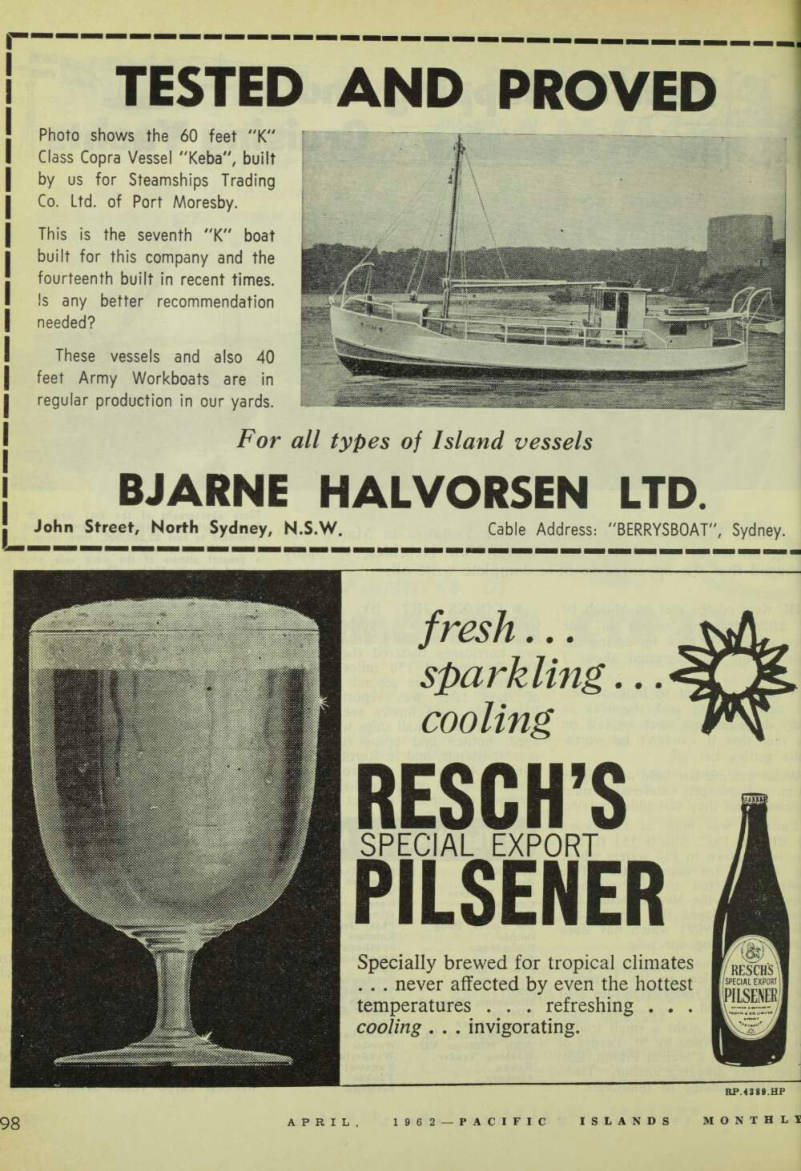
These photographs of the first stage of the Suva wharf reconstruction scheme, which is estimated to cost £2,500,000, were taken from almost the same angle. Photo at left gives a general picture of the work soon after it started late in 1961. There is a liner in the background. Photo at right, taken on March 5, shows the almost completed section, with a dredge deepening the area. A novelty is the fitting of rubber rollers (which cost about £6O each) on the face of the wharf to act as fenders. About £30,000 worth will be used for the whole wharf.
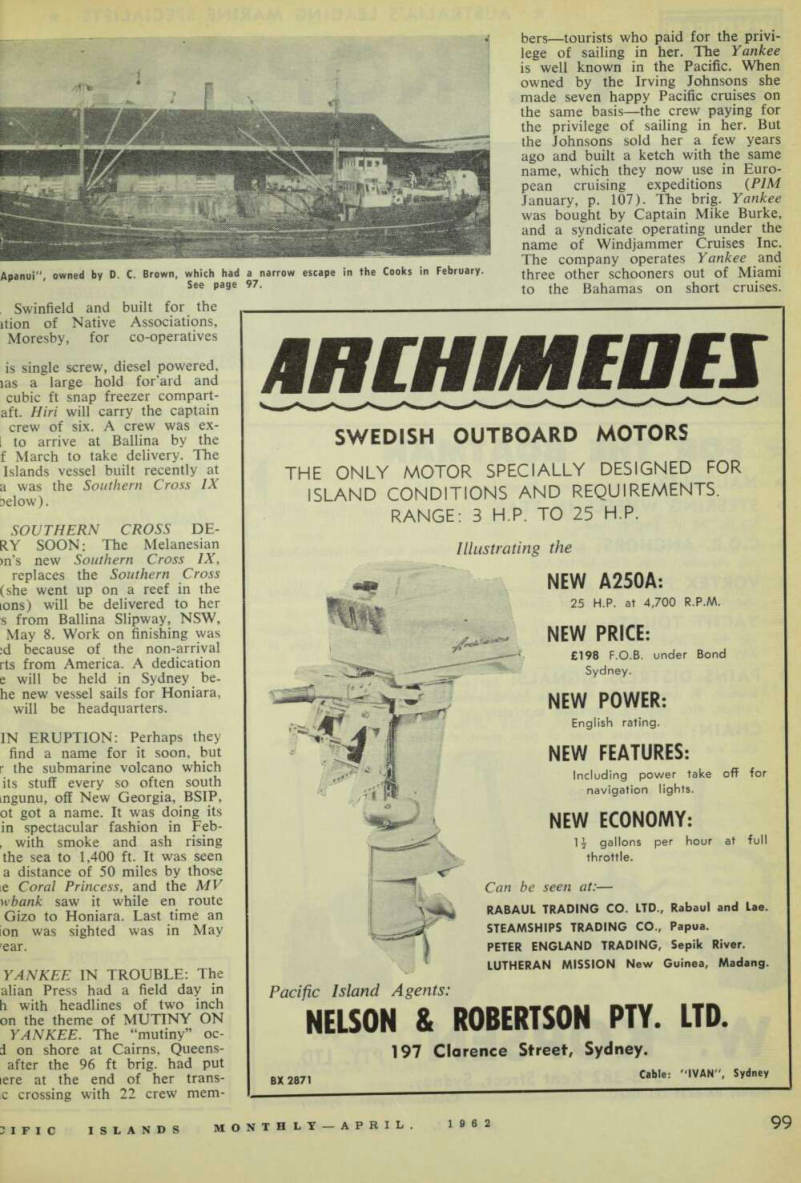
Swinfield and built for the ition of Native Associations, Moresby, for co-operatives is single screw, diesel powered, ms a large hold for’ard and cubic ft snap freezer compart aft. Hiri will carry the captain crew of six. A crew was ex i to arrive at Ballina by the f March to take delivery. The Islands vessel built recently at a was the Southern Cross IX oelow).
Southern Cross De
RY SOON: The Melanesian m’s new Southern Cross IX, replaces the Southern Cross (she went up on a reef in the ions) will be delivered to her s from Ballina Slipway, NSW, May 8. Work on finishing was ;d because of the non-arrival rts from America. A dedication e will be held in Sydney be he new vessel sails for Honiara, will be headquarters.
IN ERUPTION: Perhaps they find a name for it soon, but r the submarine volcano which its stuff every so often south mgunu, off New Georgia, BSIP, ot got a name. It was doing its in spectacular fashion in Feb , with smoke and ash rising the sea to 1,400 ft. It was seen a distance of 50 miles by those e Coral Princess, and the MV wbank saw it while en route Gizo to Honiara. Last time an ion was sighted was in May r ear.
Yankee In Trouble; The
alian Press had a field day in h with headlines of two inch on the theme of MUTINY ON YANKEE. The “mutiny” oc i on shore at Cairns, Queens after the 96 ft brig, had put iere at the end of her trans c crossing with 22 crew mem
bers—tourists who paid for the privi lege of sailing in her. The Yankee is well known in the Pacific. When owned by the Irving Johnsons she made seven happy Pacific cruises on the same basis—the crew paying for the privilege of sailing in her. But the Johnsons sold her a few years ago and built a ketch with the same name, which they now use in Euro pean cruising expeditions ( PIM January, p. 107). The brig. Yankee was bought by Captain Mike Burke, and a syndicate operating under the name of Windjammer Cruises Inc.
The company operates Yankee and three other schooners out of Miami to the Bahamas on short cruises.
"Apanui", owned by D. C. Brown, which had a narrow escape in the Cooks in February.
See page 97.
has been Yankee’s first round- Drld cruise under the new ship. Skipper is Captain Arthur erley. nkee this trip has visited Tahiti, Palmerston, Samoa and olomons, and was to head for esia after Cairns. There was of doubt in Cairns in March as aether she would make it be at least 13 of the crew told nen they intended to finish their ; at Cairns. The dissatisfied crew >ers had lots of allegations to , and as usual it was difficult to he wheat from the chaff. They lained the menus were bad, iin Kimberley “acted like a ination bucko mate and hard windjammer skipper” by for ig whistling because it brought lies, had put a ban on liquor, reated the cruise like a training : and had “tantrums” whenever uthority was questioned. ier crew members were firmly e side of the Captain (including dfe, who started off as a crew ?er and married him en route), any case the split was so great Captain Burke flew from the o Cairns to see what he could nd the dissatisfied crew members ptly got legal advice ashore. were advised by the lawyers mp ship and sue for a refund, e crew presented Captain Burke a list of demands, including the cement of Captain Kimberley, ;r stays in port, the right to : alcohol aboard ship. Captain e agreed most demands were cal”. The result: Captain aerley was relieved of command 'ankee and the brig, advertised tie Australian Press for a new
captain. Yankee was still in Cairns in late March, her movements in doubt.
9 Ng Berthing Priorities:
The thorny question of shipping priorities in New Guinea has raised its perennial head with a circular letter from Australian West Pacific Lines to their Lae, Madang and Rabaul agents.
Claiming that the “unusual and discriminatory” berthing priority sys tems as enforced in the Territory are placing AWPL at a disadvantage, the letter asks for Chamber of Com merce and Planters’ Association sup
port in having the priority systems lifted.
Trunkline ships of the Burns Philp and China Navigation Lines do cer tainly enjoy priority berthing at ter ritory ports while engaged on a territory voyage. Three Burns Philp vessels and three China Navigation vessels have this privilege, conten tion being that they are wholly and solely engaged in supply and service to the Territory.
Any of these ships, however, auto matically loses priority if it proceeds beyond Territory ports and does not regain priority until its next voyage begins from an Australian port.
AWPL vessels which admittedly carry some essential supplies and perishables besides passengers to the Territory from Australia, do not ply solely in the Territory and thus do not become eligible for priority berthing.
However, they do have the option, as do other shipping companies, of travelling to alternate ports should berthing not be immediately avail able at their regular port of call. In this manner port and demurrage dues are minimised though more time may be spent on the round voyage.
AWPL claim that reasons given for the existence of the priority sys tems (i.e., that trunkline ships must be privileged to run to regular schedules with subsequent expeditious movement of passengers, foodstuffs and other supplies) is “far-fetched”.
They contend that AWPL vessels perform exactly the same service and contribute as much to the prosperity
brig. "Yankee" under full sail. She struck trouble in Cairns—but not with the sails.
See page 99.
Territory as do trunkline ships, i is not the view of Canberra has repeatedly knocked back mtations by AWPL that the itionally recognised “first come, erved” system be adopted, PL are not the only company ;er by the present system. Even ikers which one would suppose carrying urgent and essential have had to wait as long as days to berth and discharge demurrage charges rose to )0. that as it may any suggestion axing priority regulations would ily be prefaced by an assess of cargo tonnage discharged at ory ports by all vessels, says haul correspondent, who adds Jurns Philp and China Naviga vessels could well win hands on this point alone.
Wrecked On Clipper-
When the eighty-foot tuna r Monarch, of San Diego, ered on February 6, one of the inown French Pacific posses made the front pages of Ameri newspapers with “Robinson >e” stories. s Monarch’s crew—a mixed i of ten American and Mexican i—eked out a living for 22 days tiny and isolated Clipperton 1. The Mexican trawler Finita, >mpany with eight other small vessels, discovered the survivors ipperton, February 27, but were e to take them off. The United 5 destroyer Robeson left San ) immediately on the 1400 mile to make the rescue, e men of the Monarch were re d in “generally good” condition the destroyer took them off )erton early in March. They
lived for three weeks on fish, wild pigs and birds, they said.
Monarch, valued at over $lOO,OOO, sailed from San Diego January 18 with a five week fuel supply. How she met trouble was not known, pending arrival of survivors in the US.
Clipperton is known to fishermen for its 62-foot high “mountain”, Clipperton rock, which gives the appearance of a “vessel under sail” from the distance. The coral atoll, some 670 miles southwest of Acapulco, Mexico, is in a well-used tuna fishing area. Now uninhabited, it has a peculiar history. It got its name
from John Clipperton, a crewman of William Oampier who mutinied in 1704 and, with 21 others, turned pirate, using the atoll as his head quarters. Possession of the island was disputed between France and Mexico in the 19th century, but France ob tained sovereignty in 1930.
Prior to World War I, Clipperton was inhabited by some 100 persons, including a Mexican Army garrison and employees of a British phosphate firm. After the outbreak of the war, the island was forgotten and no supply ship was sent to it for three years. Many persons died of starva tion. An attempt to sail for help was
the small boat which left the was never heard of again. The use keeper murdered remain ;n and enslaved the women, ly after a young woman suc in killing him, an American er arrived to rescue the few ing women.
\A Vieng Trader’S Maid
3YAGE: A green parrot in a . . a portable garden . . . ing sunset ... a Chow who ed to accompany its owners nd a mystery of two missing egs combined to give a New i maiden voyage a truly Islands on March 9. kling with the newness of ack and white paintwork was of the comedy, the Kavieng . Once a broad-beamed North Irifter under a Dutch flag, g Trader was taking to the after three month’s refit at Shipyards, Rabaul. e was the neat curved contour stern, hidden under a new referred to by one onlooker ig reminiscent of a “block of Gone were the refrigerated fish replaced by cargo holds. Gone er original name, Die Goede neatly re-lettered to read g Trader. vart her foredeck under lashed lins were part of the posses >f Mr. and Mrs. Eric Sundin—a led Vauxhall, a houseproud ion of neatly barbered pot and a screeching parrot in a wire cage. jen decks, all of eight pas ; strained the confined cabin all but the Sundins who were
on transfer to Kavieng BP branch, going along for the thrill of a maiden voyage and the promised razz-amatazz welcome at Kavieng.
Mr. Sundin will manage the Kavieng branch. The Sundins are very well known in Fiji, where Mr. Sundin managed the Levuka branch of Burns Philp until he was transferred to Rabaul a few years ago.
In the lockers were the pennants and flags for dressing the ship on arrival—but missing were two kegs of beer which it had been hoped to broach on the Kavieng wharf.
Disappointedly watching prepara tions for departure was 18-stone Geoff Stone, BP’s liquor manager . . .
Geoff had hoped to trundle the miss ing barrels ashore and assist in the broaching.
Nursing a bandaged hand from dog bite, Eric Sundin and wife Sunny boarded the happy ship minutes be fore she cast off, an hour later than scheduled.
Cars, people and dogs crowded BP’s narrow wharf to wave a last goodbye to this popular couple who have spent the last two years making firm friends in Rabaul.
A rare glowing sunset over the harbour illuminated the squat work manlike vessel as she pointed her bows toward the Beehives. A husky toot from her hooter and she was away to ply her trade between Rabaul, Kavieng and Lorengau ports.
Earlier the 45-foot Betsy had left for Kavieng with a Rabaul welcoming party which would greet the Kavieng Trader on arrival. A whingding party was scheduled despite the non-arrival of the kegs—Kaviengers being re nowned hosts in this regard. (Over)
with new paint New Guinea's "Kavieng Trader" begins her first voyage for Gona [?]g carrying a bird in a cage, a couple moving house —but alas, no beer! See below.
ieng Trader, purchased in late Gona Shipping to replace the d Veilomani, pushes along at knots with eight foot draft, is t in length, 18 ft 6 in. in beam, mge is 14 hours steaming, her icy increased by her ducted which Captain Bill Carruthers to give 20 per cent, better mance than orthodox screws. / one not participating in fare ind good wishes to ship and is was “Tui”, handsome Chow i Sundin household, he last moment “Tui” reneged agreement to transfer kennel deng, up and bit the hand that m and had to be calmed with Risers. These not having the 1 effect “Tui” is now in line for sive knockout drop before be rlifted to his new home, by ement with old New Britainite Barrie.
Jew Ireland Wreck; The
ints of a pinnace which foun off New Hanover, New a, in March had lucky escapes death. The pinnace was later ashore by the MV Naree and :d. Details are in the “Pacific t” section, p. 111.
FISSILE SHIP: A new sort of p of the future was in Pago March 10-11 on her way home i United States after visiting ilian ports and having training >es with the Royal Australian was the USS Coontz (DLG-9), led missile frigate which means he is just a bit larger than a itional destroyer and is heavily led with electronics gear, in g radars and computer s”. Coontz visited Perth and y, Melbourne and Sydney on idwill trip”. She also acquainted {AN with her missile capa-
The 520-foot vessel—commis sioned at her builders, the Puget Sound Naval Shipyard at Bremerton, Washington, less than two years ago —is armed with “Terrier” guided missiles which are mounted on fan tail launchers. Her crewmen include a new breed of US Navy enlisted ratings, very highly trained elec tronics and missile technicians who are, altogether, a rather bookish and studious group of young men. Coontz will do 34 knots. • COPRA FIRE: When fire broke out in the hold of the Greek ship Virginia while it was unloading copra in San Francisco on February 27, Assistant Fire Chief Dante Milani of San Francisco knew a thing or two. He told his own men, ready with hoses, to wait, and ordered a city fireboat to pump only salt water into the hold. As a result, damage to the cargo was slight—a few tons of copra were removed from the hold and spread out to dry.
Chief Milani explained to in terested local newsmen that copra fires weren’t uncommon at all in San
Francisco, and experience had taught them that fresh water will possibly cause combustion and fire, but salt water won’t hurt it.
The fact that “fresh water will cause combustion” and salt water won’t is news to PlM’s tame panel of copra experts. They all agree that the fire chief did the right thing in using salt water, because a salt water bath does no harm at all to copra.
Fresh water spoils it, but the experts have no reason to suppose that there is a better chance of causing com bustion. • CARON lAS TOUR: Cunard’s world cruise liner Caronia, 34,000 tons, whose wealthy passengers have always without fail objected to being called wealthy, was in Port Moresby in March at the end of the South Pacific stretch of the current cruise.
Vavau was included this trip, and Nukualofa Harbour Master Captain John Sutherland made a special voyage to Pago Pago, at the request of Cunard, to pilot the big vessel into Tongan waters on February 21.
• First “Hovercraft” Ser
VICE: The world’s first Hovercraft service will start in Britain in Sep tember. British United Airways will introduce the Vickers “VA3” on a route between Rhyl in North Wales, and Hoylake in Cheshire, over the Dee Estuary. Hovercraft is a regis tered name these days. • OFF THE REEF; Pulled off the reef at Waikiki, Hawaii, in March by a team of US Navy salvage tugs and barges was the grounded Jap anese tuna boat Hiroshima Maru 11.
She still had 300 tons of tuna aboard, kept frozen with electricity from a diesel generator ashore, fed through a waterproof cable to the ship. She was severely damaged underwater and will be examined in a Honolulu
[?]n the Sooth Pacific in March, the new United States' missile ship USS "Coontz”.
See below.
The Japanese tuna boat "Hiroshima Maru II" is towed into Honolulu after being salvaged from the reef in March. See this page.
:k and offered for sale. She bandoned by her owners after intity of electronic and other >le gear was recovered by heli- DOING WELL: The Tongan ifofua is doing well as a busi enture. The vessel and the oil Lolo Maana’ia by the end of ary had made 11 trips from ith bulk oil products.
Wen A In Good Shape:
. W. R. Richmond, owner of ading schooner Miena, which ;ured on the BSIP’s 6d stamp, from the Shortlands to point that Miena has not been ped”, nor has she reached the of her usefulness”. PIM in ■y, p. 95, used both these words sport about Miena’s fascinating k Mr. Richmond says that is in the hands of the brokers, ale. She was laid-up after ;e to her rudder-post at sea, would be correct to say she d up and out of commission”. a’s usefulness is not finished”, ds. “For a Tasmanian built n vessel of 26 years, she is lalf-way through her life. She nittedly, in disrepair.”
French Cruisers On
. Seen in the South Pacific in iry-March, the French cruiser ■ d’Arc and the escort vessel Schoelcher. The Jeanne d’Arc jilt in 1930 and was last seen New Hebrides (where it visited ip) in 1938. The escort vessel at into service only last year, vo ships were making an att aining cruise around the world. d’Arc displaces 9,900 tons as a complement of 580, plus idshipmen. The Victor Schoel iisplaces 2,000 tons and has a ;ment of 165, plus 28 cadets, scort vessel visited Santo at me time as the cruiser was in ’eanne d’Arc later met up with sort vessel at Santo and both company for Port Moresby.
John Williams Nears
The LMS John Williams VI • make her last voyage to the ts in March. She will be sold ugust. Her replacement, a r John Williams VII, is now built in Lowestoft and is ex to be named by Princess Mar in a ceremony at the Pool of n on October 4. The new ship ; based on Tarawa, serving the t and Ellice and making a trip Cook Islands every two years.