Luke On Britain's Unsought
pp. 85-89 · Read in the full issue

S. Pacific Territories
Many interesting, and shrewd, and off-the-record observa tions about conditions in the Territories of the South Pacific are made in Islands of the South Pacific, by Sir Harry Luke, KCMG, who was Governor of Fiji from 1938 to 1942.
SIR HARRY is a tireless writer and is responsible for many books. His inquiring mind seems to have three favourite studies —the history of the ancient nations around the Mediterranean; men and affairs around the world and the political set-up and history and economy of tropical Islands, especially in the South Pacific and the West Indies.
An Australian writer named Paul McGuire, in Westward the Course, said: “Downing Street has sometimes achieved empire, but often has had empire thrust upon it”. That, says Sir Harry Luke, after examining most of the Pacific Territories from the Solomon Islands eastward to French Polynesia, is a truth that needs to be more publicised than it has been by critics of British colonial history and method.
Britain Didn't Grab He is completely right. The re cords show that in not one solitary instance did England, in last century, grab at any of the South Pacific archipelagos. The 20th century found the British in possession of most of them—but in practically every case possession had not been sought by Downing Street, and in cases, the acquisition was resisted.
It was the shouting of the Aus tralian colonies, for example, which drove Britain originally into New Guinea, and the New Hebrides; and it was the screaming of New Zealand, plus the demands of the indigenous races, which brought Britain into Fiji and some of the Polynesian groups.
Sir Harry Luke now has written four books about the South Pacific Islands; and, in the opinion of this writer, this latest one is the most interesting of the lot, from the point of view of the general reader, and by far the roost valuable as a well documented and well-indexed book of reference.
One would judge Sir Harry Luke to be a ceaseless worker, with a prodigious memory. Within this volume one gets a very handy summary of the history of Hawaii, French Oceania, Fiji, Solomons, New
Hebrides, New Caledonia, Gilbert and Ellice, Nauru, Tonga, East and West Samoa, and of a whole mis cellany of islands like Easter, Pitcairn, Norfolk and Galapagos.
Naturally—because Sir Harry was
there as Governor for four years— the story of Fiji is very well and authoritatively told. But, in one way, it is disappointing. Sir Harry, being the Governor, and a very well informed man in the science of Colonial Government generally, must have seen what was coming from the inevitable clash between the rapidly growing communities of Fijians, who own Fiji’s lands, and of the recently introduced Indians, who now repre sent more than half the population.
But he merely records the facts of known history, and makes little comment and no forecast.
That is rather a pity—his opinions could have been valuable in this time of political crisis in Fiji.
Apart from its value as a work of reference, this is a “readable” new book—and well worth the attention of people who like to be well-informed.
Rwr.
(Islands Op The South Pacific.
Published by George G. Harrap & Co. (Australasian Publishing Co., Sydney). 31/-.)
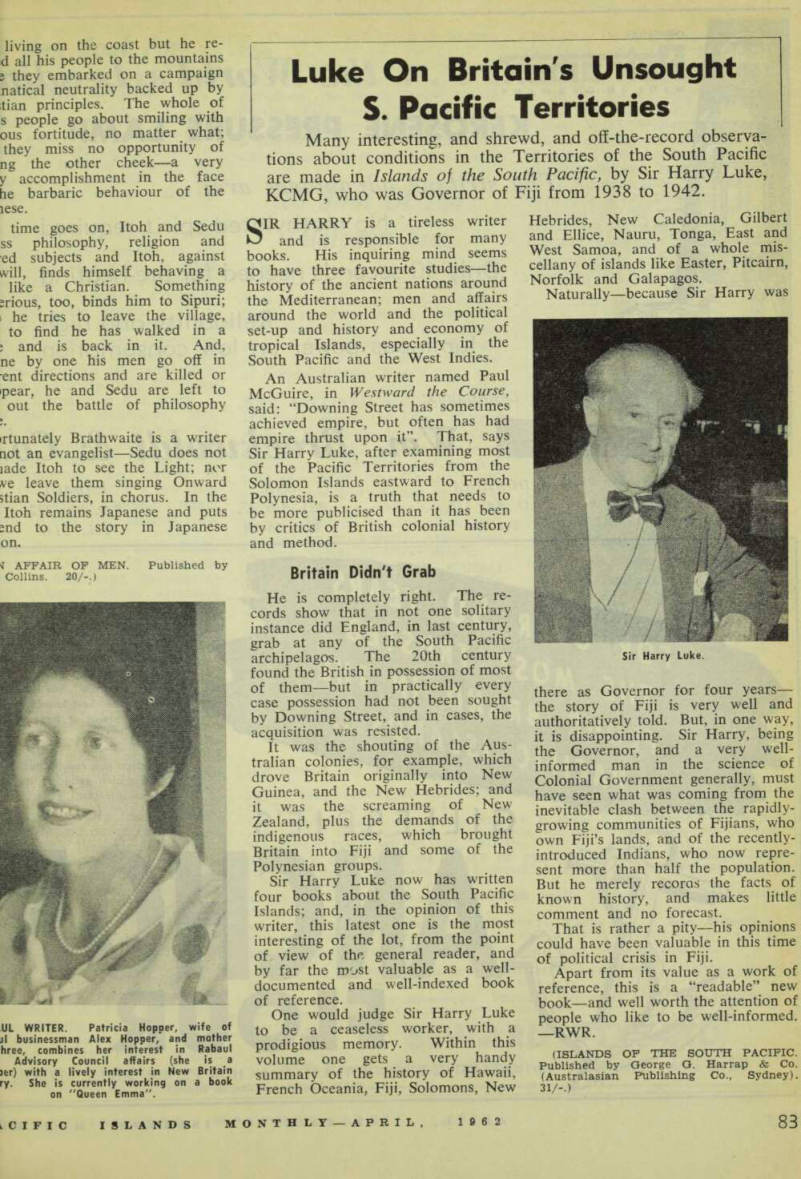
Sir Harry Luke.
1 New Book For
Pacific Cooks
lough she spent less than two in Fiji, Mrs. June Hoar will nembered for many years to It’s hard to measure the to one’s immortality, if like Hoar, you’ve written a cookery ' in March, the South Pacific ookery Book promises to sell lot only in Fiji but in other il areas. Orders have already 1 from the Solomons, Cook and t and Ellice Islands. 4/6 Fijian (cost price) the is a bargain. Every recipe was (ally tested by the author and fers numerous alternative ways ring practically every dish from 010 Sakosako to Kai Soup, v back in Melbourne, Mrs. is sorry she had to leave the 5 for health reasons. Fiji has happy memories for her. As Summerton, she arrived in i, 1960, and within a few days er husband, a publisher’s repre ive, whom she married that er. graduate of the Emily erson College of Domestic uny in Melbourne, she went to is a home science extension t for the South Pacific Health e. well as preparing the cookery she lectured extensively to its and women’s clubs in is parts of Fiji and accompanied Marjorie Stewart, South Pacific tiission’s Womens’ Interests r, to other Islands territories, jerfully she wrestled with the dictable moods of a “biscuit fen” to help the village women some of the cakes they all , and her book shows her nination to give them not only that would be good for them, Iso meals they would enjoy, r example, she has included a er on Chinese foods because aund they were so popular with 'ijians. other chapters, she deals with recipes and methods of cook all sorts of food including left and tinned foods, bread, pickles chutneys, foods for babies and ids, packed lunches and the general topic of meal-planning, ere are the well-known Fijian s such as palusami and rourou, many exotic Pacific concoc , and for those keen on Indian > there are such recipes as “Beans
in Coconut” and Madras Mutton Pilau.
Only fault to be found with the book on first sight is, that as its publishers, the South Pacific Health Service, Fiji, were anxious to keep the price as low as possible, it has a very soft cover which would soon
come to grief in most kitchens.
DB.
NG Birds Of The
Telefomin Area
An impressive quarto volume of 100 pages, complete with much tech nical data and many excellent photo graphs, has been received from Mr.
E. Thomas Gilliard, associate curator of the department of ornithology, part of the famous American Museum of Natural History, New York.
MR. GILLIARD was an outstand ing figure of the Natural History Expedition to New Guinea in 1954; and this volume, Birds of the Victor Emmanuel and Hinden burg Mountains, New Guinea, is still another published addition to the ex pedition’s incomparable records. The Natural History Museum has been engaged on this scientific exploration of New Guinea for three decades.
The birds which Mr. Gilliard describes were found in the almost inaccessible Telefomin area, in the mountains near to the headwaters of the Fly and Sepik Rivers, and not far from the point where the borders of Papua, Trusteeship New Guinea and Dutch New Guinea meet.
Expeditions led by Karius and
Champion, Ward Williams, Taylor and Black, and others got through there; and, in 1943, the Americans, preparing an air fleet for the attack on the Philippines, built a fine air field in the Telefomin, where gold seeking Ward Williams had con structed a small one in 1936. That US airfield was abandoned, but later was reconditioned and used by the P-NG Administration. Mr. Gilliard heard of it in 1950 —and that was the beginning of the expedition which carried out so much research and produced this book.
Incidentally, how many people know that Jack Thurston, in 1942, led
y poorly-equipped party of New ea refugees, with some 70 car from the Sepik to the Fly, through this same Telefomin try? It was one of the outstand “escape stories” of the Pacific The party comprised Messrs. J.
Tiurston, Harold Hindwood, L. rs, K. Atkinson, E. Petterson, ickwell, Theo Mason and a Pole r n usually as “Jimmy the One”; the cruel journey took them hs.
w for a Bit of
om garded by some people who are dedgeable in such matters as of the foremost of Australian
r, William Baylebridge wasn't
of the popular verse makers, died in 1942 and the present ration has scarcely heard of him.
E Trustees of his estate are, however, correcting this over and publishing six volumes of vork—the first, This Vital Flesh, ars this year and there will be her volume in each of the five 5 ahead. ke most poets, Baylebridge was a “philosopher and a prophet” a pretty gloomy one to boot, e-making is obviously one of least joyful of the arts, and if ondency makes for genius, then ebridge was amongst the top t. ic present volume also contains ; of his prose, in which he under -5 to reform the Australian nation ;hat it is dedicated entirely to casing itself. To this end, he wed the principles of eugenics ild be applied rigorously, that riage should have only one end— begetting of children; and that len who are “the sacred vessel of ;rnity” should apply themselves ;he business of reproduction to exclusion of all else, e did not see migration as a tion to Australia’s population >lems and no doubt would be rised to know that something 2,000,000 people have been fired by that painless method s the end of the war, without the ale of the species having to ifice herself unduly. does not say anywhere in this ime how many hostages Bayle ge himself left to fortune—but he es like a bachelor and a first-class HIS VITAL FLESH. Published by as and Robertson. 30/-.)