Joseph Banks
pp. 83-84 · Read in the full issue
The Month's New Reading
With Judy Tudor
Australia Says Thanks To Joseph Banks
Although the task has waited over 190 years, the publication of The Endeavour Journal of Joseph Sanks, in full, for the first time has now become reality. It is an historical milestone as well as a iterary one and it is fitting that New South Wales, vhich Banks god-fathered, should have done the job.
JE original manuscript, hand written by Banks on quarto ;ts during the three years of his age with Captain Cook, came into possession of an Australian col or in 1894 and from him, in 6, to David Scott Mitchell whose >nificent bequest has given the pie of NSW one of the famous aries of the world. The Endeavour rnal, in its original MS, is one the treasures of the Mitchell rary, Sydney.
Tie first effort in NSW to provide itting memorial to Banks was in 5; a fund was started and, ac- Jing to the fashion of the day, a ue was to be erected. Something r £I,OOO was collected in six years the idea lapsed, to be revived in in 1943 when the NSW Parlia it passed a Memorial Act, which up a Trust. The job of the Trust i to decide what form the mem il would take; in the event, this mblication of the Journal itself.
Beaglehole's Editorship
'he idea took almost 20 more rs to come to fruition—but at we have it in two important umes edited by Dr. J. C. Beagle e, of Victoria University, Welling , NZ; and illustrated by original wings made on the voyage, mostly Sydney Parkinson, Banks’ ughtsman. 3anks was a young man of quality 1 considerable wealth who had the tinction of attending both Harrow 1 Eton and, although he went to ford, of collecting his own instruc from the rival establishment of mbridge. [t is suggested in Dr, Beaglehole’s :>k-length introduction, The Young nks, that Banks turned to botany a relief from the classical educa-
Jnless otherwise stated, all prices are Australian currency.
tion that young gentlemen of the day were supposed to absorb.
Unless contemporary portraits of the young man lie, he was a per son of good looks and considerable presence; he was moreover, more than ordinarily attractive to women.
But at the age of 23, although there was no need for him to bother him self with anything of the sort, he went off on a botany expedition to Newfoundland. This must have whetted his appetite because when an expedition under Captain James Cook to observe in Tahiti the transit of Venus was planned, he applied to the Royal Society to sponsor his in clusion in the party.
Banks embarked on the Endeavour with his party of eight, amongst them Dr. Daniel Carl Solander, the Swedish naturalist with whom Banks’ name was thereafter to be linked; and Sydney Parkinson, whom Banks hired for a salary of £BO per year to draw specimens as they were col lected. (Parkinson did not survive the voyage.) . , .
The Endeavour reached Tahiti m April, 1769, having made calls at Madeira, Rio de Janeiro and rounded the Horn, but Banks began his long journal on the day Endeavour left Plymouth—August 25, 1768.
He continued it until July 12, 1771 —a marathon piece of composition that manages to be continuously in teresting, shrewd of observation and, at times, exciting, but nonetheless is almost as distinguished for the things omitted as for those included.
One may judge that the young Mr.
Banks—only 26 when he left Ply mouth —had pretty much a specialised mind. He was interested in flora and fauna—including the human kind— but of other sciences or geography, not at all.
Although this First Voyage of Cook’s achieved a great more than the observation of the transit of the planet Venus across the Sun, this was its primary purpose. But Banks gives it scant room in his journal.
When the time approached foi the transit, in June, 1769, Cook de cided that it should be observed froir three points in Tahiti—from Pt Venus, Matavai Bay; from a pom eastward of that; and from the islanc which Banks calls “Imao”, Cook “Eimoo”, and which today is knowr as Moorea.
Banks elected to go with the part> to Moorea, but appears to have spen his time there “examining the pro duce, etc.” and buying food, includ
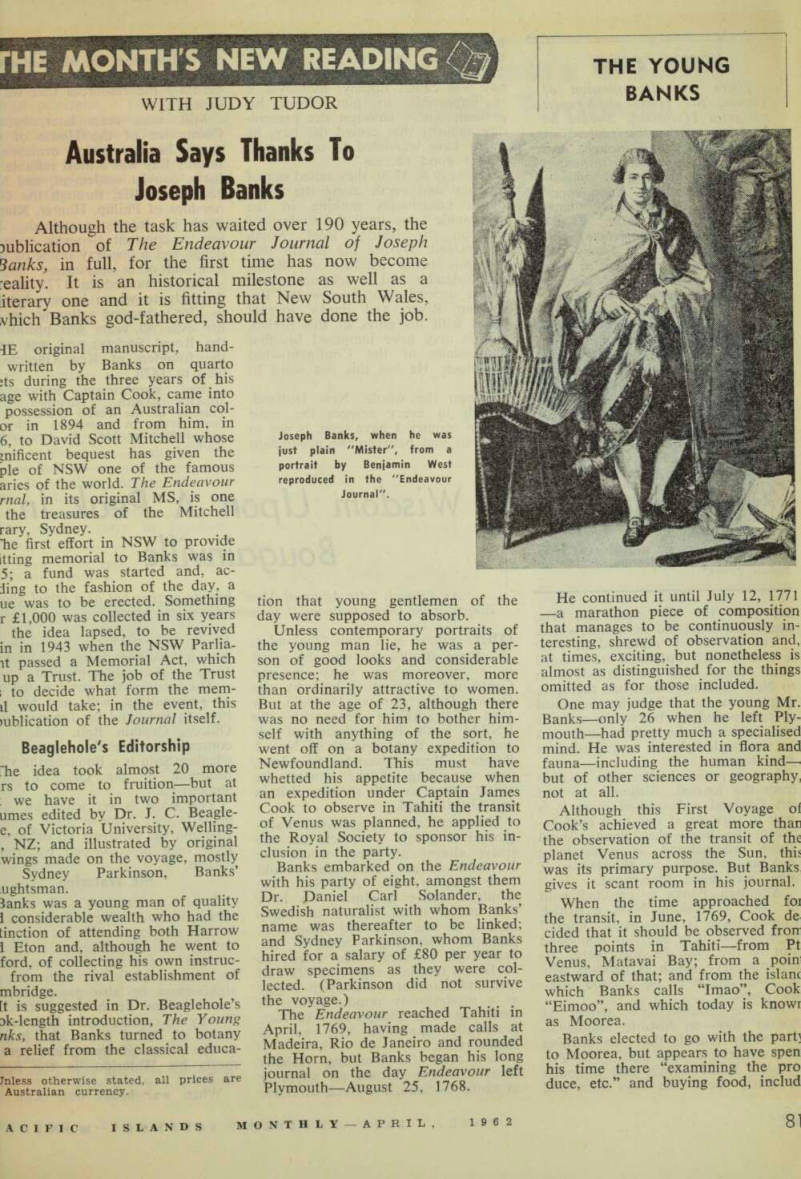
Joseph Banks, when he was just plain "Mister", from a portrait by Benjamin West reproduced in the "Endeavour Journal".
The Young
Banks
ing pigs, for the expedition. The transit he dismissed in a few words.
The Endeavour remained in what is now French Polynesia from April until August and then sailed south to New Zealand. Banks had therefore ample time to collect his botanical specimens and to observe the customs and habits of the people and what he saw and deduced he recorded at great length.
Nor is personal adventure missing from the journal. Although he had left England a betrothed man, it is easy to surmise, if one may read be tween the lines, that Banks found Tahiti womanhood as entertaining and as available as thousands of other men have done since.
Although Banks is credited with the idea of making NSW a British Colony there is little in his journal to show that it in any way impressed him at the time he was there. To the contrary—which is perhaps why he later felt it to be a good place for convicts.
Of the Endeavour’s arrival at Botany Bay—an historic moment— le merely records that “an opening ike a harbour was seen”. The En deavour sailed within and although he party spent nine days there and
Banks wrote copiously of the flora, the animals and the aborigines, he makes no mention of the fact that the bay was called Botany; moreover it is impossible to plot, from his journal, where amongst the present day suburbs that crowd the bay, he might have wandered to collect with “usual good success”.
On May 6, 1770, they sailed out of the bay and north along the coast.
Banks contributes nothing in the geographic sense until the Endeavour ran on the Barrier Reef, North Queensland. During the month that she was being patched up, Banks and Solander had a botanical spree ashore around what is now the En deavour River, and Banks’ journal brims with his notes of this period.
This may have tempered his first impressions of the Continent—but not much. He has this last word to say: “Upon the whole, New Holland, though in every respect the most barren country I have seen, is not so bad but that between the production
of sea and land, a company who 1 the misfortune to be ship-wrecl upon it, might support themsel even by the resources that we h seen. . .
Still, nine years later, before Committee of the House of Q mons, he was giving evidence t Botany Bay was a most suitable pi for a convict settlement, and to end of his life, through the Go>
norships of Phillip, Hunter, King j
Bligh his interest remained. Th was a constant two-way corresp dence and a one-way traffic of bot ical and other specimens.
Banks married in 1779 (but the lady to whom he was betrotl in 1768); became a Baronet in 17 for over 40 years was president the Royal Society; and was one the founders of Kew Gardens, died in 1820.
(The Endeavour Journal ,
JOSEPH BANKS. Published by Trustees of the Public Library of 1 South Wales in association with An and Robertson Ltd., in two volur £6/6/-.)