Memories Of
p. 73 · Read in the full issue
Pacific Islands Monthly
Magazine Section
Old Tulagi
By R. A. Lever
Probably no other capital of any British dependency could •laim as late as 1934 to be without a school, church or cinema, mt that was the case with Tulagi, capital of the British Solomon slands Protectorate, when I knew it.
EMORIES of old Tulagi came flooding back to me when I 1 Bill Baverstock’s article pub ed last August. In it he talked ut Elkington’s pub. ipart from playing billiards in the e club at the point about the only jrtainment in Tulagi after dark ; drinking at Elkington’s, or one two places in Chinatown.
Jut the six-weekly call of the Burns Ip steamer from Sydney was al /s worth waiting for, of course, provided iced beer and new faces look at. rhere was no light in Tulagi, ex it in a few key places such as the ipital, residency and wireless tion. The rest of us managed with affin lamps.
Sovernment bachelors, I remem -, were accommodated in a dark rrack-like structure. Had the hitect been commissioned to de
sign a series of photographic dark rooms, he would have gained full marks. An officer with experience in Malaya said the building was similar to the Tamil labour lines on a rubber estate. Eventually a commission from Fiji condemned the unsightly edifice, and bachelors on the breezy slopes of present-day Honiara don’t know their luck.
Greens Were Browns There was golf, tennis and boating, and a few cricket matches were played on a concrete pitch in what later came to be called the King George V Memorial Ground. But when I last saw that piece of turf, it rejoiced in the name of the Admiral Halsey Baseball Ground!
The little nine-hole golf links, on which so many young men were first introduced to golf, had no greens—
but “browns” made from lateritic soil.
This was carefully rolled each after noon by a few good - conduct prisoners, since the Police Commis sioner was also secretary of the golf club.
The little course managed to ap : pear in American Life magazine in 1942, when readers were informed that it had been built by the occupy ing Jap garison. But if there was one thing the Nips did not build on their temporary bases it was a golf course.
The Japs were no strangers to Tulagi in the mid-Thirties. They regularly poached immature shell in sampans powered with modern diesels. It was then considered bad form to suggest that the Japs were there for any other purpose but to fish, but officialdom learned how wrong it was in 1942.
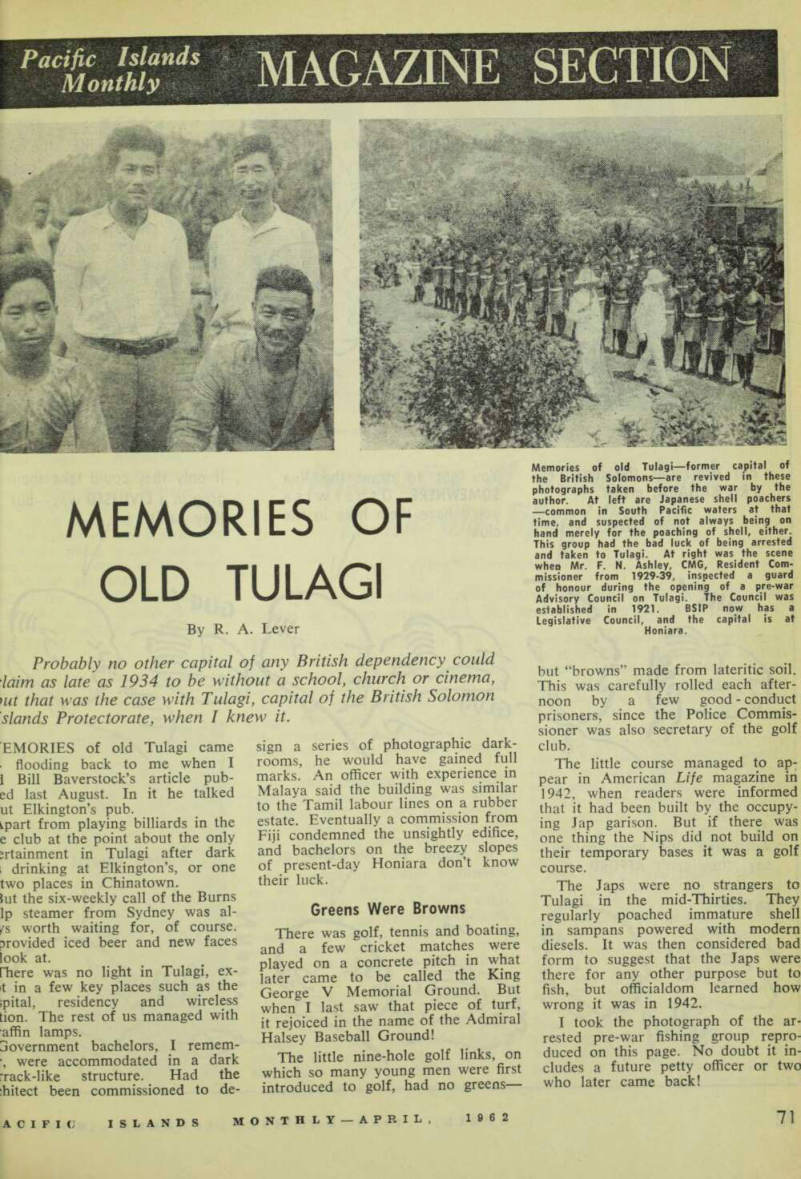
I took the photograph of the ar rested pre-war fishing group repro duced on this page. No doubt it in cludes a future petty officer or two who later came back!
Memories of old Tulagi—former capital of the British Solomons —are revived in these photographs taken before the war by the author. At left are Japanese shell poachers —common in South Pacific waters at that time, and suspected of not always being on hand merely for the poaching of shell, either.
This group had the bad luck of being arrested and taken to Tulagi. At right was the scene when Mr. F. N. Ashley, CMG, Resident Com missioner from 1929-39, inspected a guard of honour during the opening of a pre-war Advisory Council on Tulagi. The Council was established in 1921. BSIP now has a Legislative Council, and the capital is at Honiara.