Of Tuna
pp. 69-71 · Read in the full issue
Check On The Sex Habits Of Tuna
From a Correspondent
Suva.
t present in the South Pacific ie Honolulu-based American ries research ship, Charles Gilbert. Her mission is to ss the sexual maturity of line-caught albacore in the ;ral area of New Caledonia, Tonga and Samoa to define spawning of South Pacific core. Does that sound in sting?
ELL, Mr. Tamoi Otsu, the chief scientist in the party, said the core was very important to the ed States and Japan, and there-
fore there was co-operation between the two countries in research.
He said to PIM: “The United States has a big market for albacore. It is the most valuable of the tuna species.
“We are studying the population structure to find out the life history, how it spawns, and how safely it can be fished without depleting the fishing areas. We hope to be able to find out the birth rate, and the mortality rate, but unlike the human popula tion which can be counted, this is something we can only estimate.”
Mr. Otsu said it had been found out in the North Pacific that the albacore spawned only a single popu lation. He was not very sure whether there was a relationship between North and South Pacific albacore, but according to some information he had he thought each species was separate.
“That is something we are trying to determine on this trip,” he said.
The Charles H. Gilbert left Hono lulu on January 15 and arrived jn
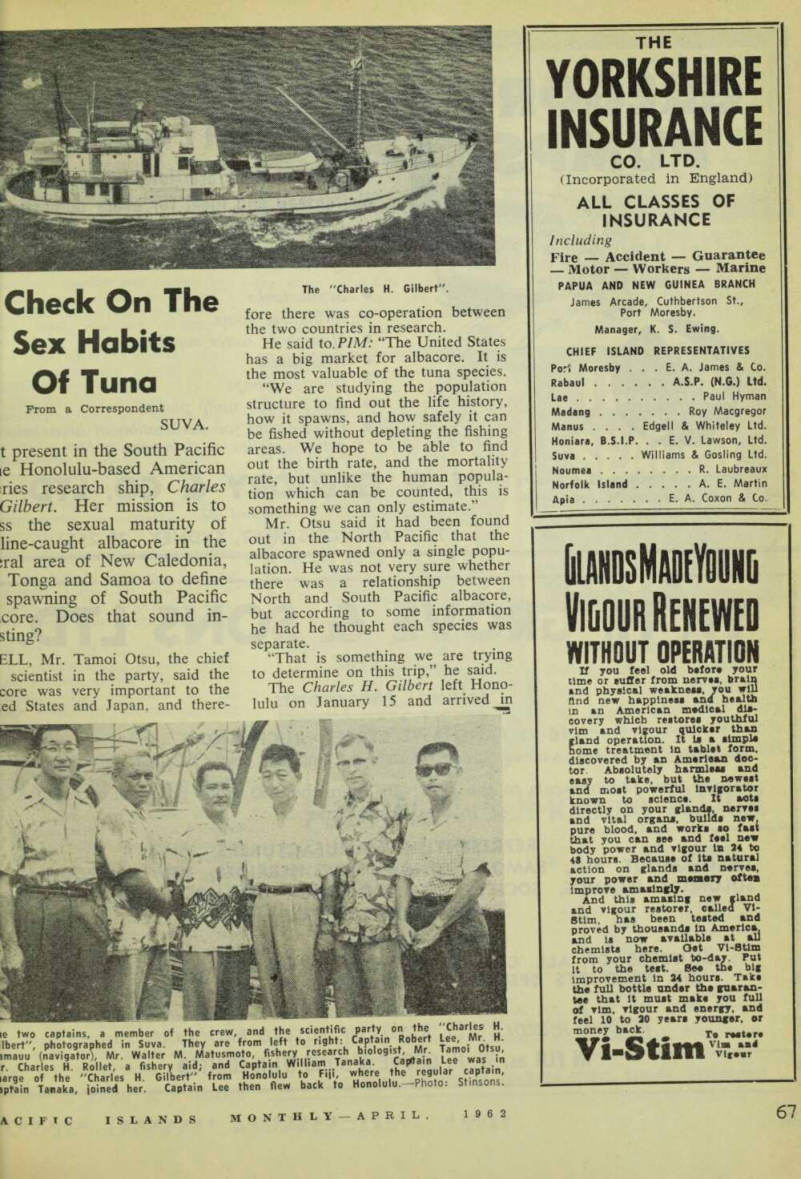
The "Charles H. Gilbert".
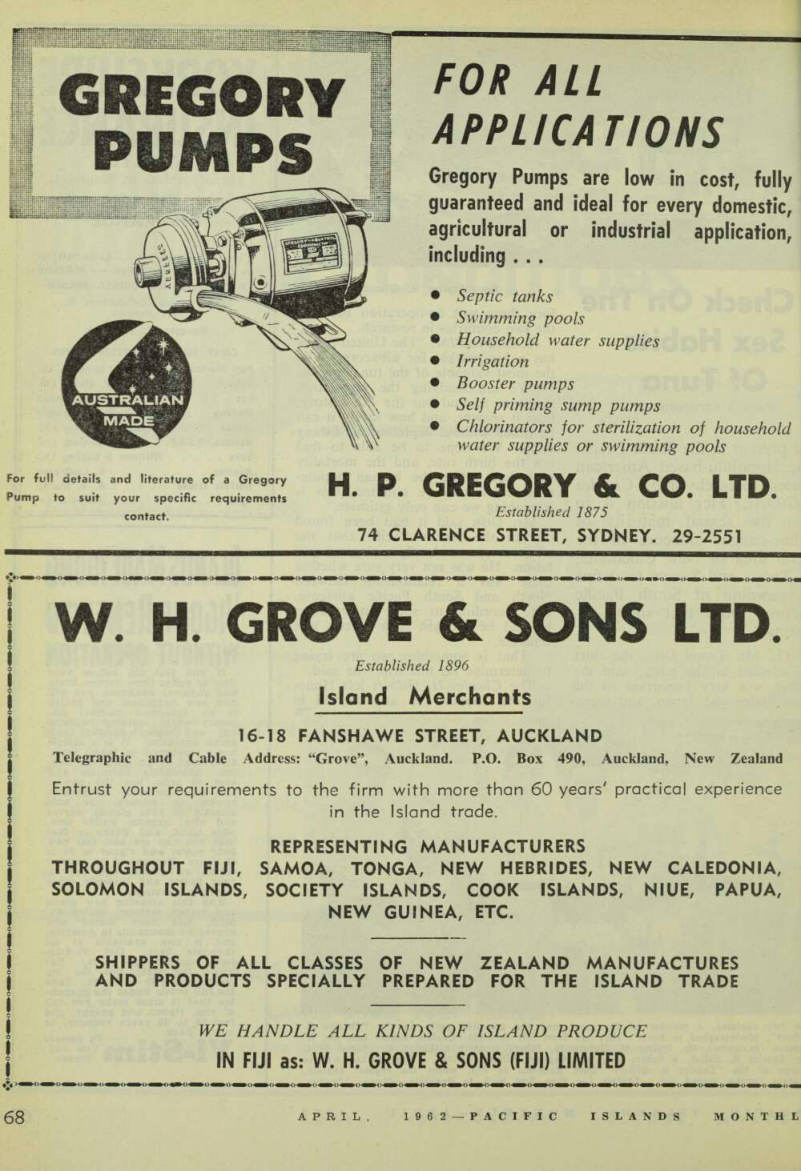
[?]e two captains, a member of the crew and the scientific party on the Charles H. [?]lbert", photographed in Suva. They are from left to right: C aptain Robert Lee, Mr. H. [?]mauu (navigator), Mr. Walter M. Matusmoto, fishery research biologist, Mr. Tamoi Otsu, [?]r. Charles H. Relief, a fishery aid; and Captain William Tanaka Captain Le e was in [?]arge of the "Charles H. Gilbert" from Honolulu to Fiji, where the regular captain, [?]aptain Tanaka, joined her. Captain Lee then flew back to Honolulu. -Photo: Stinsons.
, via New Caledonia. In New edonia waters the Gilbert co irated with the Orsom 111, a re rch ship of the Institut Francais •ceanie. tfr. Otsu said that the results of trip would depend on final micro pic research in the laboratory at nolulu. The scientists on the fage would not start making their essments till then.
Vlr. Otsu admitted that the trip far as research was concerned 1 not been very successful up till ival in Fiji. They had not caught many fish as they expected. When ; left Suva on February 20 the Ibert was to fish in waters between i and the Gilbert and Ellice Group, e was then to work back to Tonga, d finally to Samoa before going :k to Honolulu.
On her voyage between New Cale nia and Fiji the Gilbert ran into j fringe of a hurricane which swept •ough the Pacific about 90 miles ath of Kadavu and experienced nds up to 40 knots.
The Gilbert is equipped with the ;est scientific equipment for her esent task. Both fore and aft are nervation chambers, about six feet low water level, which enable the ientists to make direct observation fish.
“They are unique as a research
unit,” Mr. Otsu said.
Other equipment enables the scientists to determine at which depths various species of fish live, to take samples of fish, fish eggs and larvae at various depths, and to measure the temperature of the water to a depth of 900 feet.
As for the Gilbert herself she is 122 feet long, is 198 tons gross, and 88 tons net. Her cruising speed is nine knots, and her maximum speed is 101 knots. She is radar equipped.
One of her captains described her as the only ocean going vessel he knew of which did not have a steer ing wheel. She has Sperry compass automatic steering. She also steers semi-automatically and uses both A/C and D/C power.
If both fail there is a jury rig, but this has never had to be used. The Gilbert has been operated automatic ally since 1959 and in that time has covered about 90,000 miles without giving trouble.
Captain Robert Lee was in charge of the Charles H. Gilbert on the voyage as far as Suva as the regular captain, Captain William Tanaka, had to stay behind to attend to busi ness in Honolulu. Captain Tanaka re sumed charge at Suva and Captain Lee flew home. Both captains were full of praise for assistance given them at Suva by American Consulate officials, by the Acting Suva Harbour Master (Captain Peter Hough) and the Naval Liaison Officer (Lieutenant Alan Akins).