Outcry Over
p. 59 · Read in the full issue
"Back-To-Ships"
Outcry Over P-NG Airfare Increases
■om a New Guinea Correspondent icreased air fare charges in
ited by major territory air
operators TAA and Ansett- L have so antagonised a
ip of Kokopo planters that
are turning to small ships to sport their native labour.
ADER in the “back to ships” movement is outspoken Kokopo ' chairman Ron Levi who an iced he would save 50 per cent, importation and rehabilitation ; of native labour by using small 5 instead of aircraft, ever one to mince words, Levi ned in council that by increasing fares, in some cases as much as >er cent., TAA and Ansett-MAL ; “exploiting the Territory”. The ;ases had, he said, placed an age rise of 40 per cent., higher Dme instances, on the importation rehabilitation of plantation ur. Recruiting costs had risen nuch as 20 per cent, pecific fares quoted by Mr. Levi ved these increases: ladang to Rabaul: Previous rate 16/-, new rate £l4/3/-. Wewak Rabaul: Previous rate £B/15/-
new rate £l2/3/-. Goroka to Rabaul: Previous rate £9/8/-, new rate £l5.
Claiming that the increases vitally affected primary industry in the terri tory Mr. Levi urged an inquiry be taken as far as “ministerial level”.
Captain Lionel Thrift, TAA terri tories manager and Mr. Phil Sted man, Ansett-MAL chief, brushed off Mr. Levi’s charges, stating the in creases were the first made since 1952 and were long overdue for profitable operation.
Suggestions of exploitation were wholly unjustified, said Mr. Stedman.
Ansett-MAL had made many efforts to reduce air transport costs.
These sentiments were echoed by Captain Thrift who said his airline had purchased JATO equipment and Bristol freighters to counteract re duced payload conditions imposed by the 1961 weight restrictions.
Efforts to absorb costs of weight reducing programmes carried out on aircraft in accord with the 1961 ruling had not been successful, Captain Thrift said. Fare increases were inevitable and had been ap proved by DC A. However modifica tions to aircraft to restore payload capacity had in some cases resulted in larger payloads than previously being carried.
These replies did not pacify Mr.
Levi. TAA were obviously using profit from increased fares to pur chase new aircraft, he claimed.
Capital to replace obsolete DC3 air craft was being raised by this means, he charged further.
“When Qantas changed to 707’s they did not increase their fares,”
Mr. Levi said.
“We are now negotiating with two shipping lines which will provide us with three and possibly four ships each carrying about 120 passengers.
They will operate on fortnightly schedules to Wewak, Aitape, Lae and right to the plantations concerned.
“I will cerainly make use of this shipping service—and concensus of opinion is that many more planters will use them instead of aircraft.”
Mr. B. Strange of Bougainville Company, owners of Polurrian and Kilinailau, confirmed that his com pany had been approached by the Planters’ Association of New Britain to transport native labour.
“We have always carried a number of boys to and from plantation jobs,”
Mr. Strange said, “but now we expect the number to increase, Kilinailau can carry 180 passengers, Polurrian 125—a1l to Bougainville and BSIP ports.”
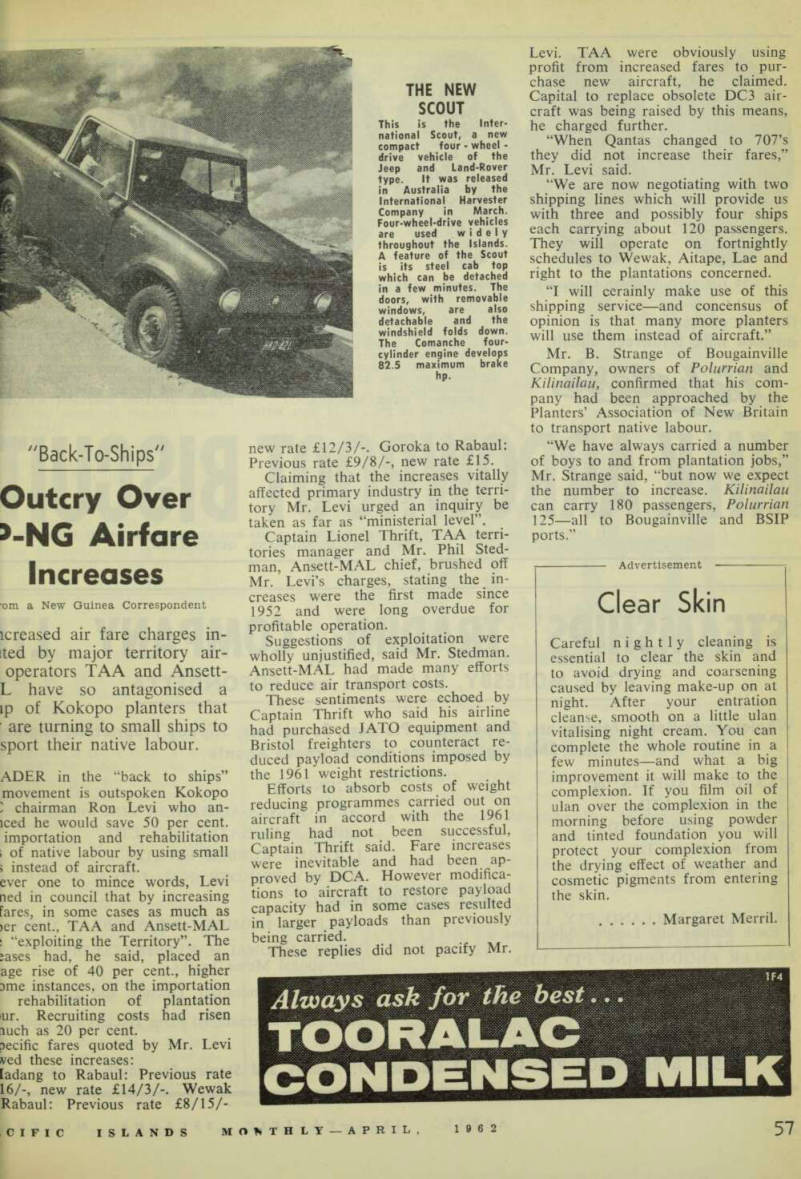
The New
Scout
This is the Inter national Scout, a new compact four - wheel drive vehicle of the Jeep and Land-Rover type. It was released in Australia by the International Harvester Company in March.
Four-wheel-drive vehicles are used widely throughout the Islands.
A feature of the Scout is its steel cab top which can be detached in a few minutes. The doors, with removable windows, are also detachable and the windshield folds down.
The Comanche four cylinder engine develops 82.5 maximum brake hp.