Problem: How To Attract Tourists
pp. 51-53 · Read in the full issue
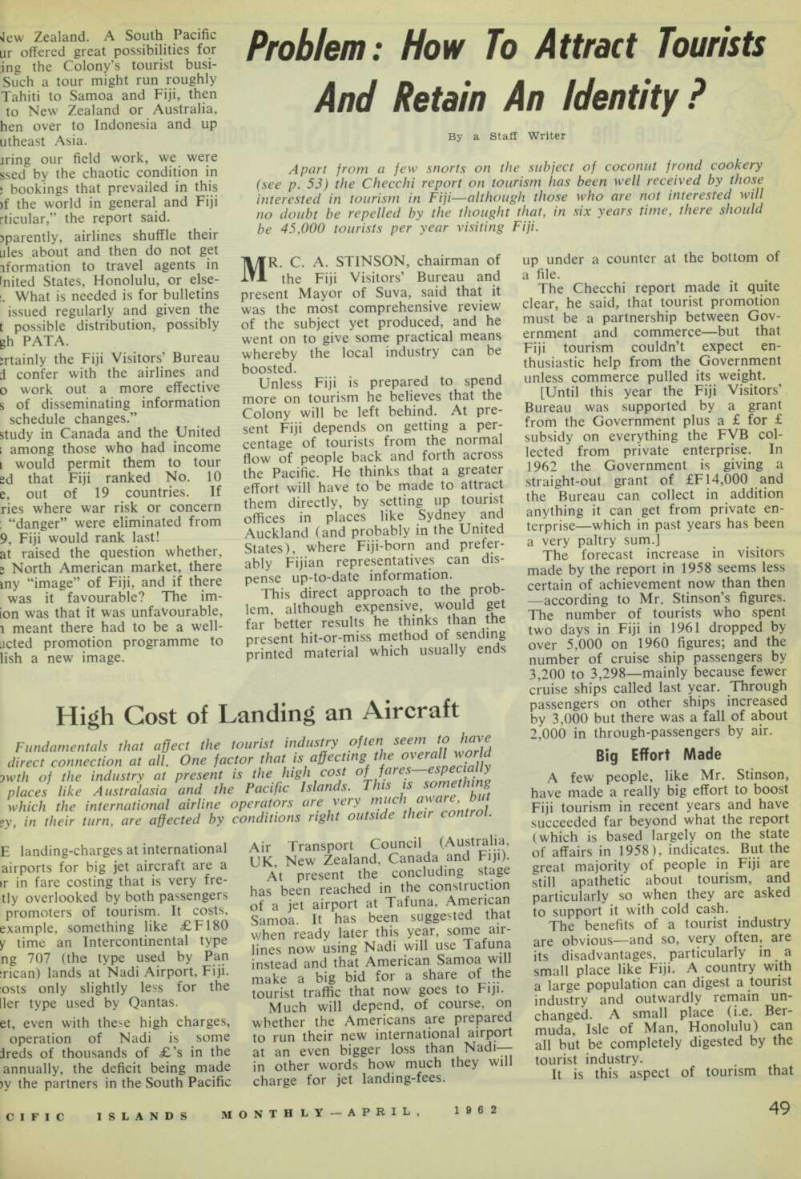

And Retain An
By a Staff Writer
Apart from a jew snorts on the subject of coconut frond cookery (see p. 53) the Checchi report on tourism has been well received by those interested in tourism in Fiji—although those who are not interested will no doubt be repelled by the thought that, in six years time, there should be 45.000 tourists per year visiting Fiji.
MR. C. A. STINSON, chairman of the Fiji Visitors’ Bureau and present Mayor of Suva, said that it was the most comprehensive review of the subject yet produced, and he went on to give some practical means whereby the local industry can be boosted.
Unless Fiji is prepared to spend more on tourism he believes that the Colony will be left behind. At pre sent Fiji depends on getting a per centage of tourists from the normal flow of people back and forth across the Pacific. He thinks that a greater effort will have to be made to attract them directly, by setting up tourist offices in places like Sydney and Auckland (and probably in the United States), where Fiji-born and prefer ably Fijian representatives can dis pense up-to-date information.
This direct approach to the prob lem, although expensive, would get far better results he thinks than the present hit-or-miss method of sending printed material which usually ends
up under a counter at the bottom of a file.
The Checchi report made it quite clear, he said, that tourist promotion must be a partnership between Gov ernment and commerce —but that Fiji tourism couldn’t expect en thusiastic help from the Government unless commerce pulled its weight, [Until this year the Fiji Visitors’
Bureau was supported by a grant from the Government plus a £ for £ subsidy on everything the FVB col lected from private enterprise. In 1962 the Government is giving a straight-out grant of £F 14,000 and the Bureau can collect in addition anything it can get from private en terprise—which in past years has been a very paltry sum.] The forecast increase in visitors made by the report in 1958 seems less certain of achievement now than then —according to Mr. Stinson’s figures.
The number of tourists who spent two days in Fiji in 1961 dropped by over 5,000 on 1960 figures; and the number of cruise ship passengers by 3,200 to 3,298— mainly because fewer cruise ships called last year. Through passengers on other ships increased by 3,000 but there was a fall of about 2,000 in through-passengers by air.
Big Effort Made A few people, like Mr. Stinson, have made a really big effort to boost Fiji tourism in recent years and have succeeded far beyond what the report (which is based largely on the state of affairs in 1958), indicates. But the great majority of people in Fiji are still apathetic about tourism, and particularly so when they are asked to support it with cold cash.
The benefits of a tourist industry are obvious —and so, very often, are its disadvantages, particularly in a small place like Fiji. A country with a large population can digest a tourist industry and outwardly remain un changed. A small place (i.e. Ber muda, Isle of Man, Honolulu) can all but be completely digested by the tourist industry.
It is this aspect of tourism that
ces certain elements in Fiji quail thought of 45,000 tourists romp through the Colony—even when y are realistic enough to appre e the material benefits that accrue refrom. And they quail even more in the demand is to make the ce over to suit tourists who desire rything “like it is back home” s a few touristy gimmicks. Other :ific territories, notably West noa and the Cooks, feel even more mgly on this.
Fourism is, in many respects, a
vicious circle and tends to destroy the very things that attract in the first place. The American tourists who enjoys Fiji most today are just those who abominate Honolulu —yet the tendency all the time is for Fiji to copy-cat the lures of Waikiki.
Probably the biggest task Fiji tourism will have to solve in the end is not a monetary one but how to find the correct formula for re maining essentially Fijian while still managing to catch more and more sophisticated international travellers.
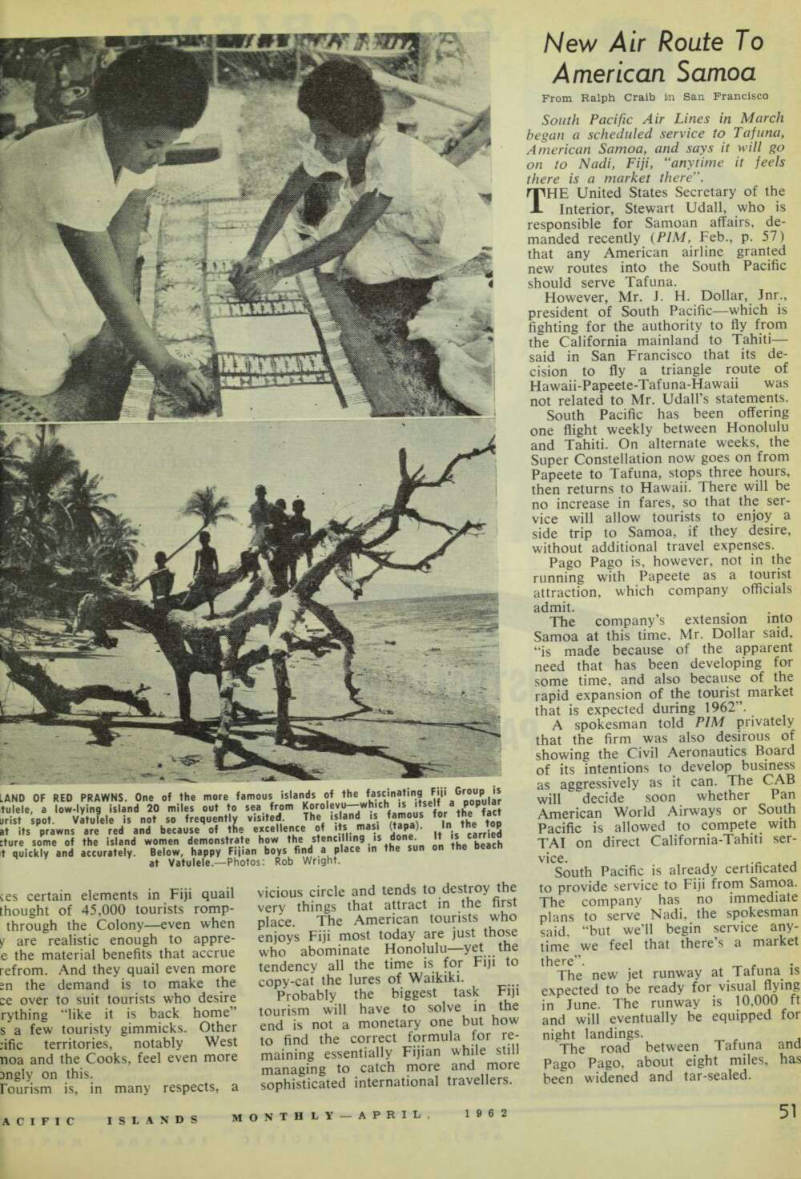
[?]LAND OF RED PRAWNS. One of the more famous islands of the fasconating Fiji Group is [?]tulele, a low-lying island 20 miles out to sea from Korolevu— whi ch . f or the popylar [?]urist spot. Vatulele is not so frequently visited The island is famous for the tact [?]at its prawns are red and because of the excellence of its masi (tapa). carried [?]cture some of the island women demonstrate how the stencilling is done. beach [?]t quickly and accurately. Below, happy Fijian boys find a place in the sun on he at Vatulele.—Photos: Rob Wright.