Potential
pp. 47-51 · Read in the full issue
Fiji Looks At Its Tourist Potential
From a Suva Correspondent In terms of national income, wages and salaries, taxes, and
foreign exchange earnings, the
failure of Fiji to develop its tourist potential would be an
“economic tragedy”.
SO says a report of a tourist survey of Fiji prepared by Checchi and Company under contract with the United States Department of Com merce, and co-sponsored by the Pacific Area Travel Association. Mr.
Harry G. Clement, vice-president of Checchi and Company, Washington, DC, directed the project which was started in September, 1958. Field work began in January, 1959, and was completed in May, 1960, but most of the figures quoted in the report refer to 1958, and some there fore are already out of date in 1962.
Tourist spending by 1968 could
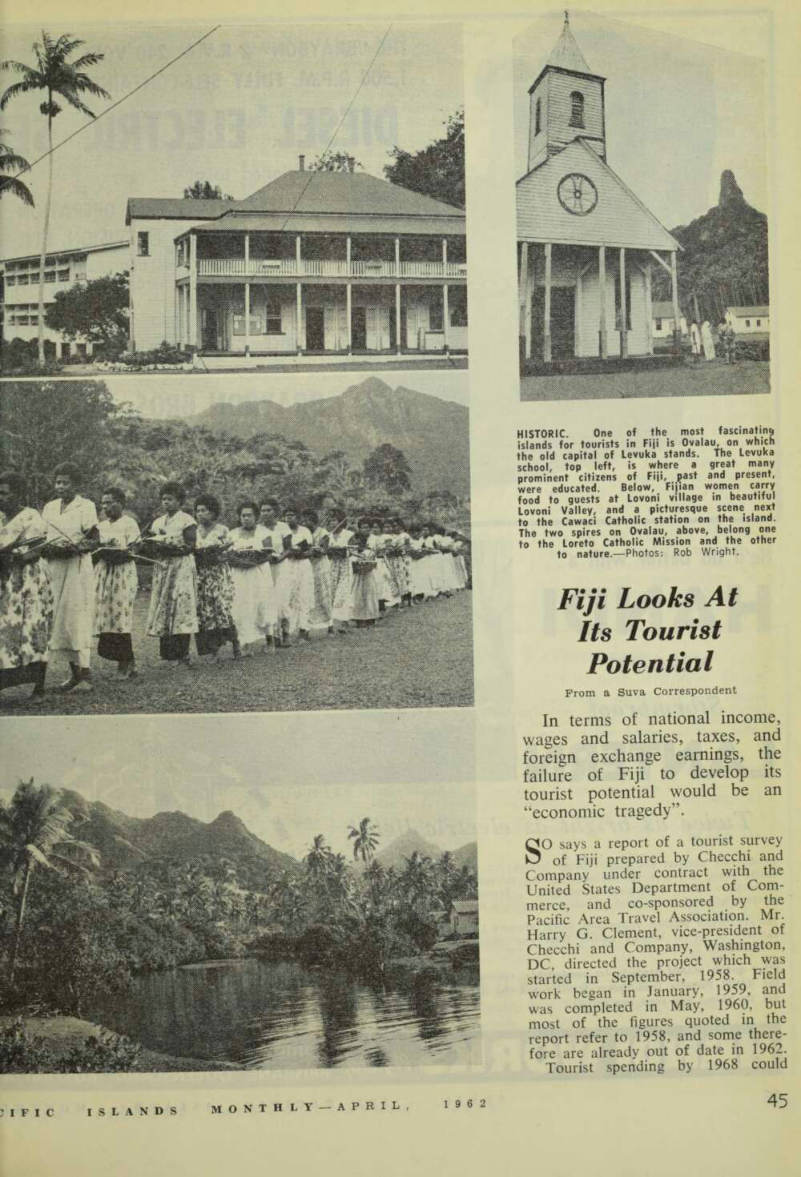
HISTORIC. One of the most fascinating islands for tourists in Fiji is Ovalau, on which the old capital of Levuka stands. The Levuka school, top left, is where a great many prominent citizens of Fiji, past and present, were educated. Below, Fijian women carry food to guests at Lovoni village in beautiful Lovoni Valley, and a picturesque scene next to the Cawaci Catholic station on the island.
The two spires on Ovalau, above, belong one to the Loreto Catholic Mission and the other to nature.—Photos: Rob Wright.
more than 60 million dollars, eport says, and tourism could ise the national income by 20 ;ent. Taxes gathered over the i 1958-68, on business generated mrism should run to about 20 m dollars, and wages and salaries out on business generated by ;m should be about 33 million rs. e report chides the Fiji Govern for its lack of financial help ourism. For example, business ated by tourists in 1958 paid out t 1.3 million dollars in salaries wages. From this the Govern collected about 800,000 dollars xes. In return the Government out not quite 25,000 dollars to ce the activities of its official st organisation (the Fiji Visitors’ au). Thus the Government got 32 dollars for every dollar ;, a cost-benefit ratio sufficiently to suggest serious under cing of tourism development in Colony.
Nadi Too ie report boldly suggests that the ;rnment, by 1968, will have to the budget of the Fiji Visitors’ au to about 410,000 dollars, and then it would get back seven irs for every dollar spent on the ist programme. ie report estimates that to cope 45,000 international tourists by !, Fiji will have to build about first-class rooms at key points in Colony. These would probably n the Suva area and also around
Nadi, if Nadi is developed as a tourist attraction. The total capital for all requirements would be about six million dollars.
Other suggestions in the report are: • The Fiji Visitors’ Bureau should provide technical help in developing entertainment; • As Fiji had few flowers the FVB might stimulate a women’s garden club or persuade existing clubs in Fiji to launch flower-planting pro grammes; • Fiji should create a distinctive drink which will be identified as be ing Fijian; • The present village improvement programme should be extended; • As most tourists are interested in local food and local dishes, the FVB should try to persuade hotels and restaurants to feature such dishes, for example, as “fish baked in coconut leaves”, vegetables cooked in coconut milk, tapioca as a vege table, yams, and prawns; • Development of anything dis tinctively Fijian. For example, at Nadi Airport, see that a number of Fijians with the traditional “big hair” are employed. This practice should be increased at Nadi and introduced at other places visited by tourists.
The report pertinently points out that Suva needs a good swimming pool, a good restaurant, and perhaps a garden restaurant or a sidewalk cafe. The expansion of the tourist industry would require additional eat ing facilities in Suva.
Water taxis, the report says, might be encouraged in the area round Suva, consideration might be given to developing a first-class outdoor aquarium, a convention hall was needed for group meetings, festivals, etc., at Suva, and a training pro gramme is needed for hotel staff, restaurant staff, taxi drivers and guides.
The report suggests that Fiji should make every effort to get itself in cluded in package tours to Australia
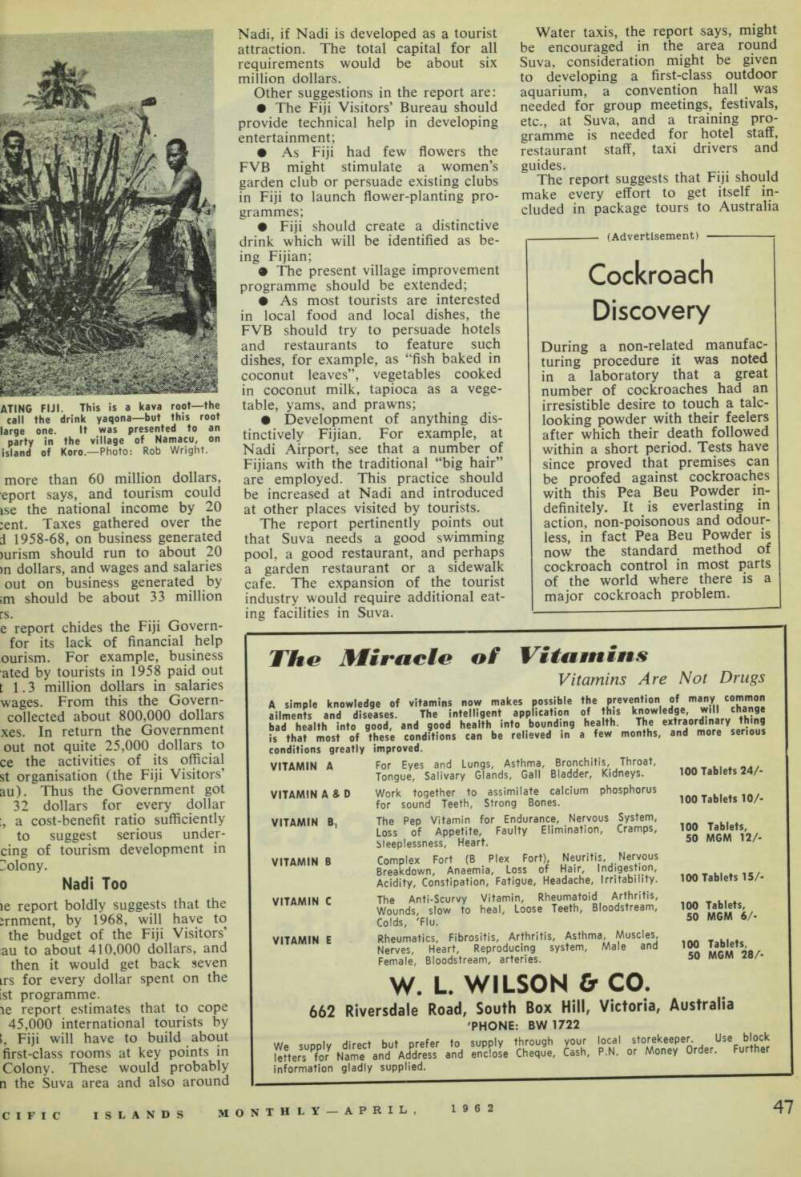
ATING FIJI. This is a kava root—the call the drink yaqona—but this root large one. It was presented to an party in the village of Namacu, on island of Koro.—Photo: Rob Wright.
4ew Zealand. A South Pacific □r offered great possibilities for ing the Colony’s tourist busi- Such a tour might run roughly Tahiti to Samoa and Fiji, then to New Zealand or Australia, hen over to Indonesia and up utheast Asia. iring our field work, we were ssed by the chaotic condition in ; bookings that prevailed in this >f the world in general and Fiji rticular,” the report said, jparently, airlines shuffle their ales about and then do not get iformation to travel agents in fiiited States, Honolulu, or else ;. What is needed is for bulletins issued regularly and given the t possible distribution, possibly gh PATA. ;rtainly the Fiji Visitors’ Bureau i confer with the airlines and 0 work out a more effective s of disseminating information schedule changes.” study in Canada and the United 1 among those who had income i would permit them to tour ed that Fiji ranked No. 10 e, out of 19 countries. If ries where war risk or concern ; “danger” were eliminated from 9, Fiji would rank last! at raised the question whether, 3 North American market, there my “image” of Fiji, and if there was it favourable? The im ion was that it was unfavourable, i meant there had to be a well jcted promotion programme to lish a new image.