Territories TALK-TALK
pp. 42-47 · Read in the full issue
With Tolala
The tax evasion incident at Hahalis on the east coast of Buka started old-time Islands skipper, Captain W. J. Buckley, recalling, in a Sydney Sunday newspaper, some of the events of his early days in Buka and the BSIP.
HE must have a fund of material for an interesting book dealing with the early years of this century among the Islands; not the least of which would be the period he skippered the good ship Sideia, a Burns Philp auxiliary vessel, with the firm’s plantation expert, the famous W. H.
Lucas, aboard inspecting estates in the British Solomons and buying land in Bougainville, which was later to com prise the Choiseul Plantation Ltd.’s holdings.
To the present generation Lucas is probably an unknown quantity, but during the first decade of this century he was the Big Wheel in Burns Philp’s plantation interests throughout the Pacific. During War I he was Technical Adviser on Pacific Affairs
to the Commonwealth Government and later became chairman of the Expropriation Board.
It was in November, 1912, down in Kieta that I first saw the trim lines of Sideia swinging to her anchor in that lovely little harbour and first met Lucas. For me it was an eventful time. I was getting married. I was walking down from the Residency, where my fiancee was staying with the Kiap (Capt. Doellinger) and his wife, when I was overtaken by a tall, loose-limbed figure in whites who blurted out: “I nearly lost my bloody sole chasing you!” At the same time he displayed a shoe with the sole half detached!
He introduced himself as Lucas, of whom I had never heard at that time; asked me to join a party he was holding on board Sideia that afternoon. It was then that I met Captain Buckley and his engineer—a chap named Talty—and saw Lucas in action as host on an Islands schooner. And no one could have been more tactful or considerate with his guests.
He was an excellent raconteur; his repertoire was most extensive. In later years I was to appreciate how he adapted himself to every strata of Islands society in the telling of his anecdotes, whether it was to a missionary, a Government official or an ordinary trader/planter. He was all things to all men and old Capt.
Buckley, more than anyone else, would be able to tell of these varied parties.
One outstanding idiosyncracy of Lucas which I remember on these schooner trips was his insistence at all times at mixing his own mustard.
A Kieta Incident While on the subject of S first visit to Kieta I am ren of an incident that occurred s after my meeting with Lucas, were walking up the hill togeths when passing the Kiap’s offic were asked to step inside by Doellinger, who offered p apologies to Mr. Lucas ov< incident which had been repori him as Sideia entered the ht earlier that day.
Sideia, flying the British e had naturally dipped when p the Government station fla£ with the German flag flutter! the breeze, but there had be( acknowledgement from the The watch-boy, whose duty i to return such courtesies, had in his job.
Capt. Doellinger, an old r mariner and a strict disciplin took a very dim view of thh so we were asked to be present punishment for this bread etiquette was administered, to six strokes of the cane.
And so international protoco served.
A Tight
Schedule In Minister Hasluck’s 11 wander through the Territor February he certainly coven great deal of ground and cont many people in the least po time.
It enabled him to obtain a
picture of conditions and re in order to deal with any is in the forthcoming Parlia / session. The focal point, hted in the Australian Press, 5 desire of the native people >me incorporated as an Aus- State, which of course proved ere was general contentment the present Administration, as his story and he stuck to tour must have been an ing ordeal for the Minister, ly when one realises, after MLC Lloyd Hurrell’s story of the New Guinea news describing the tour, the low ite of questions aimed at the r by the native people, y of these questions that have been dealt with at Council level, and one cannot wondering whether such a scheduled tour pays off, Hy considering the stress and which the Minister has to or such a small return, undoubtedly a fact that Paul k is getting too much piled on ite. He has the Northern ry (with its many vexed ns at the moment); P-NG its neighbouring smoulderings one hand, and UNO on the Nauru (and what’s going to to ’em?); besides Christmas acos Islands to the West and k Island in the East, to say y of a WA constituency ding, at least, a modicum of m to the people who make his ssible. unately he is comparatively a man, although he is nudging i was 57 on the first of this Many happy returns!) but schedules shorten life and, all the brick-bats heaved at om time to time, it would be
difficult to obtain from either side of the House, a better qualified man for the job.
German Colonial
Stamps
In February PIM I made some mention of the values of old German colonial “Yacht” series stamps.
Front page news in Sydney in March was the fact that £525 was paid for an overprinted Samoan stamp of the same series. It might be worth while, you philatelists, to take a look through your collections. (See p. 29.)
Straightening
The Record Having an appreciation for keep ing the record straight and often pointing out errors committed by others, I had better hasten to correct a mistake of my own, which ap peared in February Talk-Talk (p. 34) where I mentioned an E. W. Pearson in conjunction with Ron Wayne as being responsible for translating the Jap proclamations after the fall of Rabaul. The name should have read E. W. Pearce, who was the accoun tant with the Methodist Mission in Rabaul. The Rev. H. J. Pearson was the MM minister in Rabaul at the time and was also a Montevideo Maru victim.
Paul Mason Turns The Clock Back I see where the member for NG Islands in the Legco, Paul Mason, has had something to say about the Hahalis business and dubbed in a bit of realistic background of both the place and the people. No one more knowledgeable than the same Paul for evaluating the situation. He has lived not far distant from Hahalis, on Inus plantation, for the past 37 years (the War II years excepted, of course).
His remarks about the sophistica tion of the Buka is only too true.
Not only was the Buka greatly sought after in the more populated areas of the German colony as a house- and personal-servant, thus acquiring an intimate knowledge of the ways of the whiteman, but many of them were “recruited” for work in German Samoa, where they remained for years in contact with Polynesian culture.
Parenthetically I would say the Buka IQ is about the highest in TNG and which, no doubt, will present a problem if and when Self Determina tion becomes an actuality.
Mr. Mason referred to his pre decessor having been murdered by a
Mr. Lloyd Murrell, MLC.
Buka lad in 1925. The murdered man was “Wee Bobbie” Scott, a likeable character in many ways with one arm. He was a frequent contri butor to the “Abo” page in the Sydney Bulletin.
In 1930 I had a trading station at Gagan and the murderer was a constant visitor to my store; docile and ingratiating, eager to assist in brooming the road and emptying baskets of copra and ivory nuts. He was eager to “sign on” for the job, but having been “deported” to his place he was ineligible and was com pelled at that time to report each week to the Government station at Buka Passage.
Incidentally, only a few weeks ago I received a letter from Leslie F.
Gill (an old-time frequent contri butor to PIM from the BSIP) who mentioned his own associations with Inus plantation in the early Twenties and whom Paul Mason succeeded as inspector for Associated Plantations Ltd., whose head was old Captain (“Squeaker”) Hamilton. The com pany also had plantations on Choiseul Island in BSIP as well as Inus.
I fully support all Paul Mason said in the Legco, with the exception of his remarks about there having been a Government station at “Buka Passage for 50 years”.
I was on Buka in 1912 and there was no station at the Passage then, nor during the German days. That would bring it to December, 1914. for the Australians did not take rv r Buka and Bougainville until that date, when they landed at Kieta where they expected to meet opposition, but this did not occur My own first introduction to °
Government station at Buka Passage was in January, 1921, when I went down from Rabaul in Wunatali to take over German plantations in that area for the Expropriation Board.
At that time the station was located on the Bougainville mainland (not Sohano Island but in the vicinity).
The official in charge (ADO or PO, I know not which) was a fussy, little fellow who entertained me to lunch, which he himself insisted on cooking.
His name was Cecil Levien. After wards, of course, he went to Morobe and . . . hence the goldfields and the aerial transport system which surprised the world, and the bust which has recently been erected in Lae. (Oh, dear! How diverse can we become? We started out at Hahalis and ended up at Bulolo! Memory lanes have many turnings.) In the Name
Of Progress
There are going to be a few head aches amongst the P-NG tall poppies within the next six months unless I am much mistaken.
We have the passing of the Trades Union Bill in the recent P-NG Legco; the forthcoming visit of the UN mission and also the formation of the United Australia Movement, pressing for a “voice” in th~ House
of Representatives.
Modern politics and primitive people do not mix, and 1 not referring to the small percentage of sophisticates in the Terri'rr’ vho ar' the vocal section.
The Trades Union P ; ' ” its preset form is nremat 1 * °s
B. Fairfax-Ross pointed out at I And that gentleman is inva; right, for the simple reason h practical experience and brains.
The UN Mission visit is of c a perennial headache but with eyes on this portion of the woi the moment it will feel it has more than ever critical, whethe the benefit of the people of TN not probably won’t come int< picture, too much.
The UAM set-up is something It wants to obtain a “voice’
Papua in the Canberra House whatever benefit I wouldn’t hs clue. (NT doesn’t seem to get far with that privilege).
It wants protection of invest! in TNG, which appears to me wants compensation for properl taken over by an independent i government; or for owners have not seen the writing or wall.
But, as the Minister tells nobody wants us to leave TN why worry about it? Incider UAM reminds me of the move in Western Samoa in the Tw and Thirties—the MAU, onl reverse
My Lady Nicotine
In P-Ng
It would seem that both B and Australia are worrying ; the incidence of lung cancer result of smoking cigarettes.
Statistics from P-NG shoul interesting when one considers the usual practice of native chi is to start smoking as soon as relinquish the maternal breast, refer to the unsophisticated foil
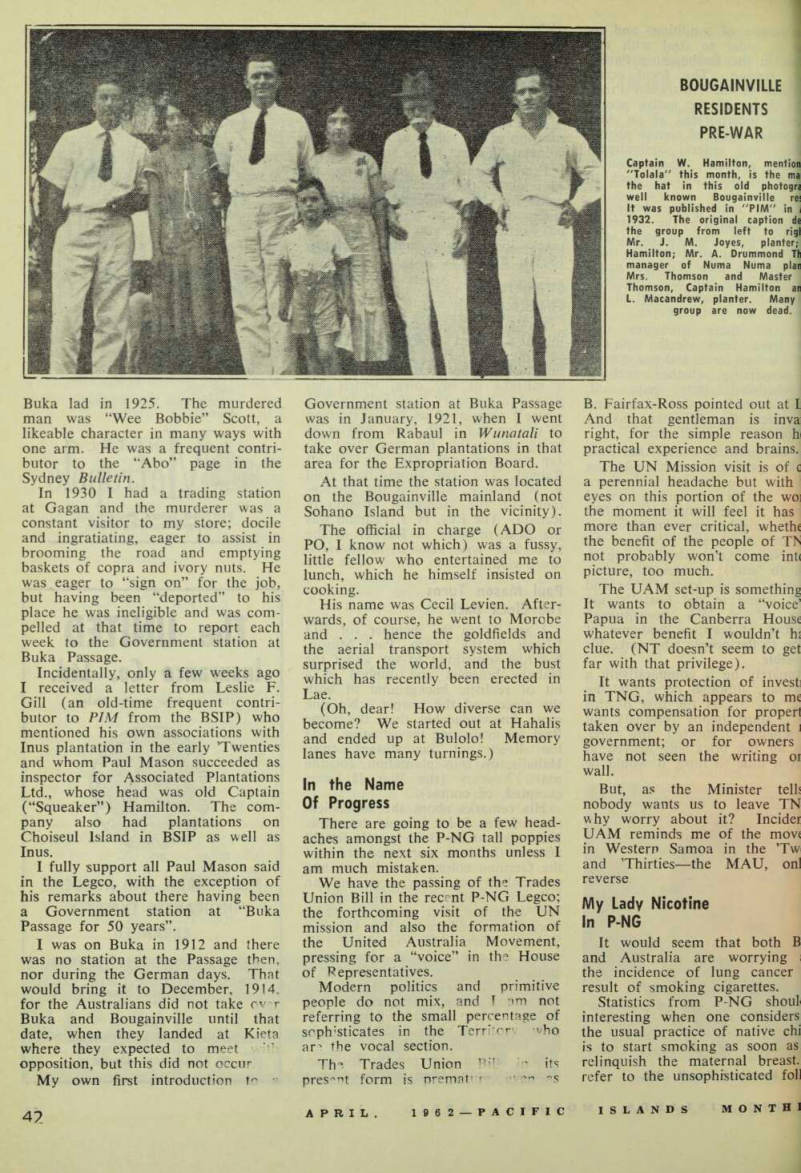
Bougainville
Residents
Pre-War
Captain W. Hamilton, mention "Tolala" this month, is the ma[?] the hat in this old photograph well known Bougainville res[?] It was published in "RIM" in [?] 1932. The original caption de[?] the group from left to rig[?] Mr. J. M. Joyes, planter; Hamilton; Mr. A. Drummond Th[?] manager of Numa Numa plan Mrs. Thomson and Master Thomson, Captain Hamilton an[?] L. Macandrew, planter. Many group are now dead.