Empire Builder
pp. 33-34 · Read in the full issue
Sydneysider Goes Walkabout Lament From An Empire Builder
These days around Nadi airport and the new hotel, the alters, clerks and hired-help say “Uh huh” and “Yah” and Sure” and “Hi”. Some of the part-European clerks in the air ays offices even talk with an American accent; and the plump tdian behind the counter in the coffee shop at the hotel could -according to his get-up, anyhow—be a hamburger dispenser om just about anywhere in the United States.
E other morning when I was leaving Nadi I went into the -free shop to buy whisky for my “How much is the whisky?” sked the woman behind the iter, in a voice that no one has aken yet for anything but plain Zealand-Australian. 2.25,” she said. “And it’s per if you take three.” want two —and what’s the price ijian?” le told me and began to write the docket. Besides me was a :set American who had just come the plane. Although it was 6 , he was smoking a cigar 10 es long and—apart from a silly sh prejudice that cigars are
smoked only after dinner at night— there was no reason why he shouldn't.
He was talking to an Indian clerk.
“What is this place, anyhow—huh?
A British protectorate?”
“No,” said the clerk, in his soft Indian voice. “It’s a British Crown Colony.”
“Colony—huh? Huh!”
By now my docket was ready.
“$4.50”, said the woman behind the counter, “collect the liquor just be fore you board your aircraft”.
The milk of human kindness is curdled in me before 10 in the morning (and at many other times besides): “Never mind the dollars”, I said rudely, “What’s it in Fijian?
Is this an American Colony or some thing?”
The woman looked at me with ladylike disapproval and the Ameri can took his cigar out of his mouth and turned round and stared. I took myself off to the lower lounge and pulled myself apart. Why did I have to be rude like that? The man with the cigar had a perfect right to conclude that I was just another of these anti-American Britishers. Was I?
I thought of the young US airmen who had swarmed over the new Mocambo Hotel the previous night.
Pleasant, good-looking, good mannered, intelligent, there is a constant stream of them coming through Nadi on Antarctic and U 2 missions these days, and making over night stops at the Mocambo. No country could have more charming ambassadors.
And I thought of every other
American I know. Not a stinker amongst the lot of them. No, I wasn’t anti-American. But when it was boiled down I certainly was anti something. Anti what America is trying to do to us; anti-dollar imperialism.
That America should have been the chief architect of the break-up of the British Empire is one thing.
They don’t like colonies, so that’s fair enough. But the insidious wash ing-machine and juke-box culture that is rushing in to fill the vacuum is something else again. On that I’m dead “anti”—and fighting a losing battle.
The British Vacuum “Wherever we pull out,” said an Englishman to me a couple of weeks ago in Suva, “the Americans go in.
Not with government, directly. But with money and power and pull. It’s the power that matters. What’s it matter whether it is directly through administration, or by influence? We can’t be ourselves any more—we’ve got to be for America or against her.
The only counter to Americanism is Communism”.
One thing our Englishman forgot, of course, is that there couldn’t be any Americanisation filling up the British vacuum if the English them selves hadn’t let it happen by default.
The average Englishman, in England, wouldn’t look up from his pint of mild beer if the whole of the Commonwealth cracked off and sank into the deep. He’d go on discuss ing his football pools and the newest thing in racing cars and never notice the difference—and, by all present
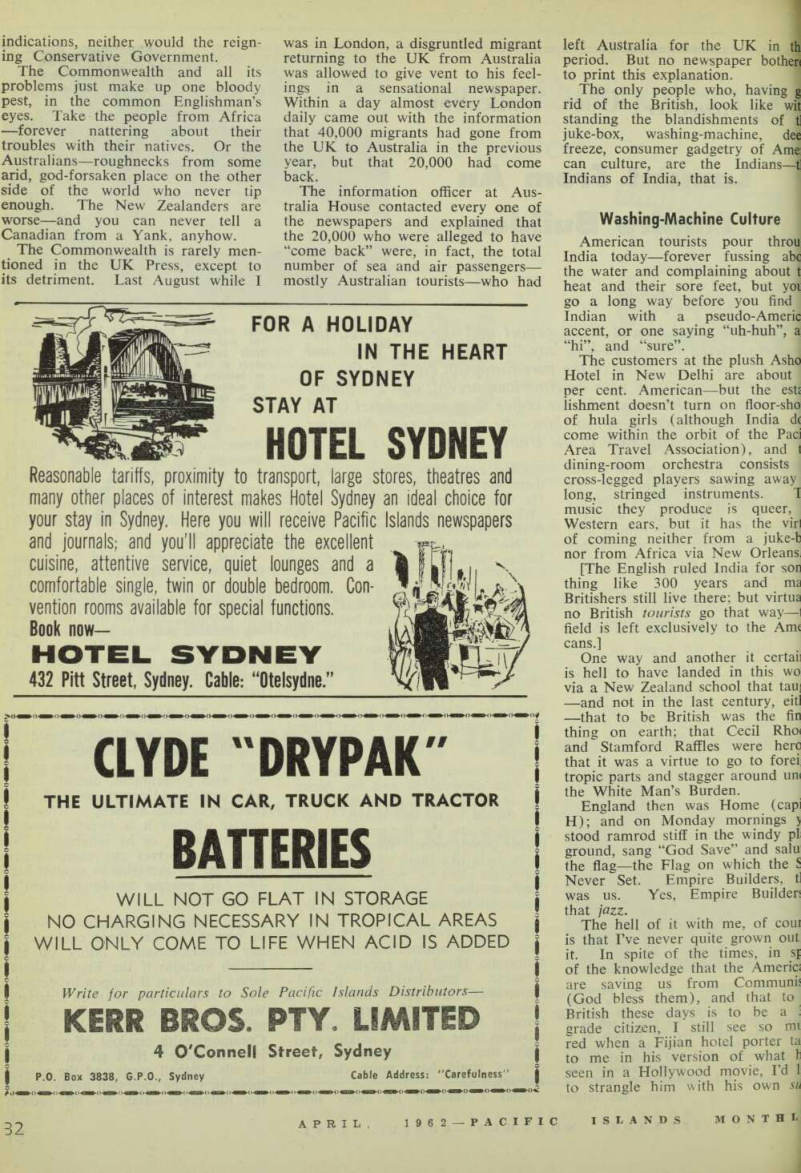
UE FOR LIBRARY. Mr. John Harrison, b Council representative in Fiji, in March to Mr. P. D. Macdonald, Fiji Colonial tary (left) a cheque for £Stg.20,000 as a from the Council for the erection of a [?]y at Lautoka. About £5,000 of the will provide an initial stock of books, building will be erected between the station and Administration offices.
Photo: Rob Wright
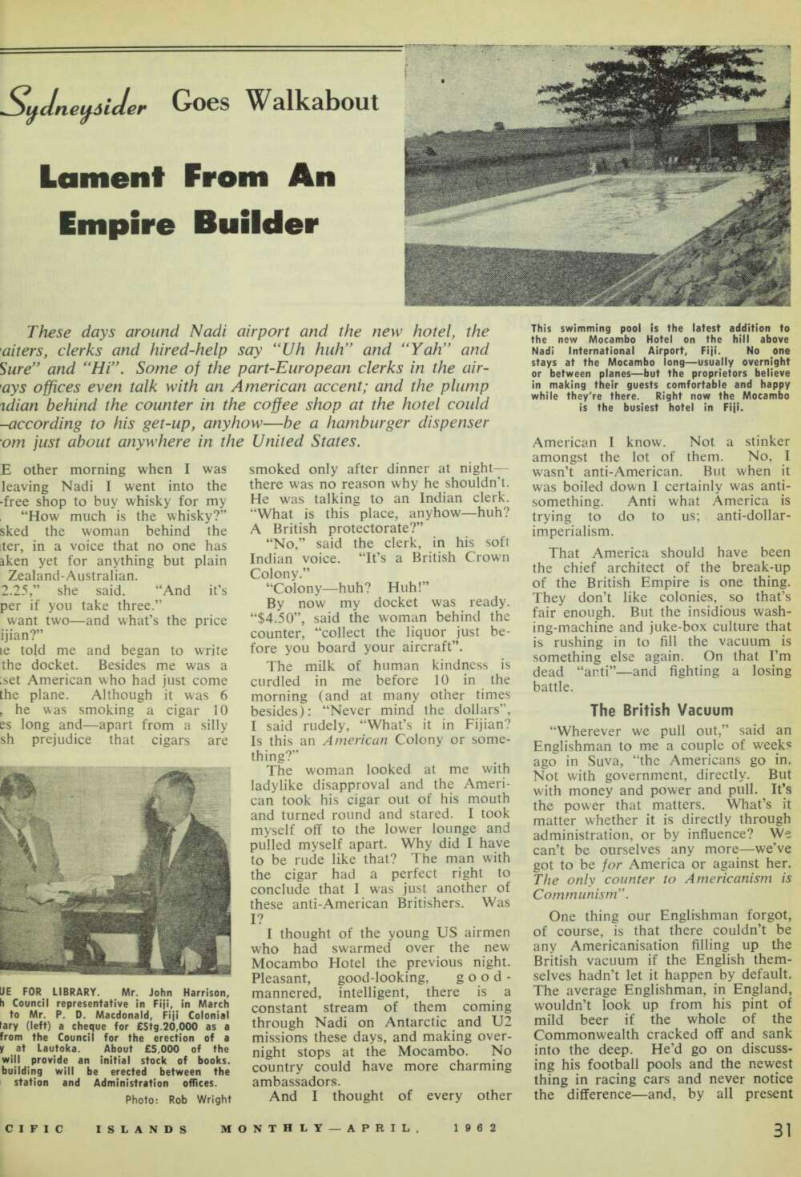
This swimming pool is the latest addition to the new Mocambo Hotel on the hill above Nadi International Airport, Fiji. No one stays at the Mocambo long—usually overnight or between planes—but the proprietors believe in making their guests comfortable and happy while they're there. Right now the Mocambo is the busiest hotel in Fiji.
indications, neither would the reigning Conservative Government.
The Commonwealth and all its problems just make up one bloody pest, in the common Englishman’s eyes. Take the people from Africa —forever nattering about their troubles with their natives. Or the Australians—roughnecks from some arid, god-forsaken place on the other side of the world who never tip enough. The New Zealanders are worse—and you can never tell a Canadian from a Yank, anyhow.
The Commonwealth is rarely mentioned in the UK Press, except to its detriment. Last August while I
was in London, a disgruntled migrant returning to the UK from Australia was allowed to give vent to his feel ings in a sensational newspaper, Within a day almost every London daily came out with the information that 40,000 migrants had gone from the UK to Australia in the previous year, but that 20,000 had come back.
The information officer at Aus tralia House contacted every one of the newspapers and explained that the 20,000 who were alleged to have “come back” were, in fact, the total number of sea and air passengers— mostly Australian tourists—who had
left Australia for the UK in th period. But no newspaper bother* to print this explanation.
The only people who, having g rid of the British, look like wit standing the blandishments of tl juke-box, washing-machine, dee freeze, consumer gadgetry of Ame: can culture, are the Indians —i Indians of India, that is.
Washing-Machine Culture
American tourists pour throu India today—forever fussing abc the water and complaining about t heat and their sore feet, but yoi go a long way before you find Indian with a pseudo-Americ accent, or one saying “uh-huh”, a “hi”, and “sure”.
The customers at the plush Asho Hotel in New Delhi are about per cent. American —but the est£ lishment doesn’t turn on floor-sho of hula girls (although India dc come within the orbit of the Paci Area Travel Association), and 1 dining-room orchestra consists cross-legged players sawing away long, stringed instruments. T music they produce is queer, Western ears, but it has the virl of coming neither from a juke-b nor from Africa via New Orleans, [The English ruled India for son thing like 300 years and ma Britishers still live there; but virtua no British tourists go that way—l field is left exclusively to the Amt cans.] One way and another it certaii is hell to have landed in this wo via a New Zealand school that tauj —and not in the last century, eitl —that to be British was the fin thing on earth; that Cecil Rho* and Stamford Raffles were hero that it was a virtue to go to forei, tropic parts and stagger around un< the White Man’s Burden.
England then was Home (capi H); and on Monday mornings > stood ramrod stiff in the windy pi ground, sang “God Save” and salu the flag—the Flag on which the S Never Set. Empire Builders, tl was us. Yes, Empire Builders that jazz.
The hell of it with me, of coui is that I’ve never quite grown out it. In spite of the times, in sf of the knowledge that the Americi are saving us from Communis (God bless them), and that to British these days is to be a ; grade citizen, I still see so mi red when a Fijian hotel porter ta to me in his version of what b seen in a Hollywood movie, I’d 1 to strangle him with his own su