Quandary
p. 23 · Read in the full issue
NG Patrol Officers in a Quandary
By a Staff Writer
Few primitive countries have been introduced to civilisa n with as little bloodshed as Papua-New Guinea. It has been loint of honour with Australian field service personnel that overnment” should be taken to the country by a process of ceful penetration and that arms should be used only as a t desperate measure to protect lives.
AY the areas of uncontrolled rritory in Papua-New Guinea jadily shrinking, but the prob •f the men who have to go into to take law and order to the ve stone-age inhabitants are, thing growing. le man in charge of a patrol in areas finds himself forced to lefensive action and shoot a he often ends at the wrong a Supreme Court action, with newspaper publicity that that at home and abroad, e patrol officers, it is alleged, •aid to enter some native areas e of the legal action and :ty that results if there is an dable clash, whole problem was aired at it meeting of the P-NG Legis- Council in March by men who id practical experience of pat in hostile country. The i was, said Mr. lan Downs :r but once an outstanding
field-officer of the Native Affairs Department) that the Territory, in this matter, “was being swept by an excessive hyper-sensitive legalism”.
He was supported by Mr. Lloyd Hurrell, now a Wau coffee planter and farmer, but an ex-ADO who also had distinguished field service.
Said Mr. Hurrell: “Any patrol-officer in these areas ... is a fool to accept live ammunition. If he has to use it, it is almost certain that he will end up on a serious charge that will de stroy years of hard work.”
He thought that while the present system exists patrol officers should re fuse to go into uncontrolled areas.
He alleged that dozens of native police and patrol officers were be wildered by the situation. “In a com mendable effort to secure better re lations with the P-NG natives, the Administration is bringing itself into contempt by its failure to enforce the law and to secure justice.”
Somo Sigob, elected native Mem ber for the NG Coastal Electorate, who was a Sergeant-Major in the NG Constabulary for 18 years, said he understood the problem at first hand and was concerned at the risk of legal action that a patrol officer or police ran when forced to fire on natives to defend a patrol.
He said that he would like to see the United Nations or Australian Government representatives trying to make contact with these wild people and making a better job of it.
When everyone had had their say, Mr. I. K. McCarthy, Director of Native Affairs, promised to investi gate the alleged fear of legal reper cussions. Probably there is no one better qualified to do it. He joined the New Guinea Department as a young patrol officer in 1927 and in his time had some of the toughest patrolling assignments, some of which ended in conflict between the natives and the patrol.
All clashes between patrols and natives are supposed to be reported whether they end with fatalities or not, and they have always been sub-
ject to departmental inquiry. But the risk of landing in the Supreme Court is a recent development—and most Territorians see in it a reflection of the Australian Government’s sensi tivity on United Nations criticism.
By the time a man is asked to lead a patrol into hostile country he should have been well tried by the “system” and his superiors should have every confidence that he will carry out his task in the best tradi tions of the Service and be jealous of its fine reputation.
If he then finds himself in a posi tion where the only way to protect his patrol is to shoot, there should be no doubt in his superiors’ minds that what he did was the only thing to do. In this event there would 1 be no need for court action.
If the man has not been tried by* the “system”, or if he is psycholr gically unfitted to be in control of at patrol in that sort of country, if is surely the “system” and his superiors that should go on trial, and not the patrol officer.
Officer In The Making. This Is
Bou, 21, a Papuan, who returned to [?]resby from Sydney in March after [?] a course at the Australian School [?]ic Administration. He now becomes first native cadet patrol officer. He educated at Rigo and Queensland.
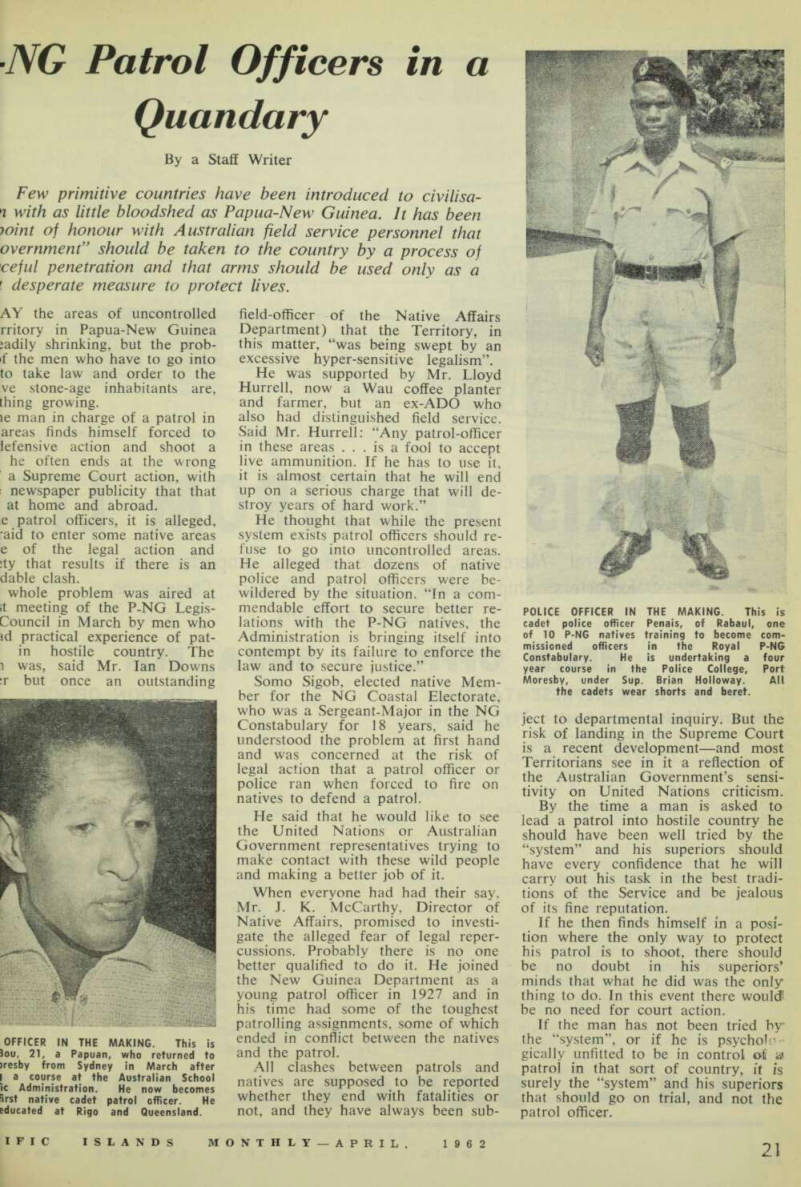
POLICE OFFICER IN THE MAKING. This is cadet police officer Penais, of Rabaul, one of 10 P-NG natives training to become com missioned officers in the Royal P-NG Constabulary. He is undertaking a four year course in the Police College, Port Moresby, under Sup. Brian Holloway. All the cadets wear shorts and beret.