UN Mission To Nauru And NG
pp. 17-18 · Read in the full issue
Has "Mind Of Its Own"
From our Canberra Correspondent The UN Trusteeship Councils Visiting Mission to the Trust Territories of Nauru and New Guinea looks as though it may achieve more results than some earlier missions.
THE chairman, Sir Hugh Foot, made it clear when he arrived in Canberra in March that the mission would not be content with merely being led around to inspect the physical manifestations of “develop ment”.
Asked whether the mission would seek the views of the Nauruans on their future, he put the position tersely: “We want to put the emphasis on meeting people rather than on seeing hospitals and schools,” he said.
“It is more important to meet people and find out what they are thinking than to see things.”
Sir Hugh, with 30 years of colonial administration behind him—including a term in the very hot seat of Gover nor of Cyprus—does not appear to be the kind of man who can be misled by “eyewash”.
He went to Nauru with a clear memory of that day in the Trustee ship Council when Cr. Raymond Gadabu —the first man from an Aus tralian Trust territory to be sent to New York—rose and told the Coun cil in plain terms that his people did not want the Australian plan to as similate them in the Australian com munity.
Problem of Elite And in New Guinea he was fully conscious of differences in Australian opinion on the question of whether political and social progress should be brought about by raising an elite of the “dynamic few” or by a general raising of standards to a less am bitious level.
On this question he can draw on his experience of differing colonial systems in Africa. Those who met him early in his tour of the South Pacific area believe that he might well contribute a thoughtful, middle-of the-road view in his report to the Trusteeship Council.
In his early interview in Australia Sir Hugh showed himself fully aware of the difficulties facing Australia in New Guinea.
“You have a people who were as backward as any, and with great difficulties of terrain,” he said.
“It is a classical case of the most difficult colonial problem in the world.
“How it is beinp tackled is ex tremely interesting.
“The searchlight of international
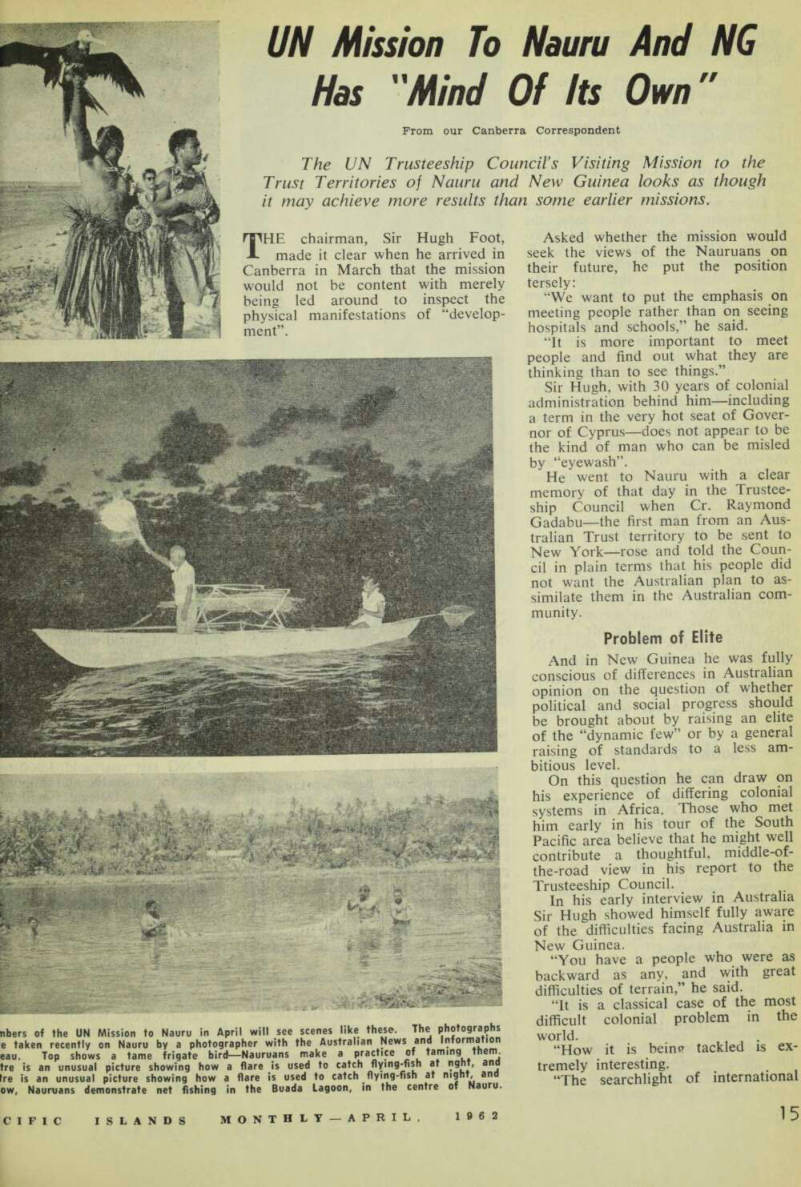
[?}bers of the UN Mission to Nauru in April will see scenes like these. The photographs [?]e taken recently on Nauru by a photographer with the Australian News and Information [?]eau. Top shows a tame frigate bird—Nauruans make a practice of taming them [?]tre is an unusual picture showing how a flare is used to catch flying-fish at nght, and [?]re is an unusual picture showing how a flare is used to catch flying-fish at night, and [?]ow, Nauruans demonstrate net fishing in the Buada Lagoon, in the centre of Nauru.
opinion, after being concentrated on Africa, is swinging very much to the Pacific.”
Another member of the mission, Mr. Delmas H. Nucker, of the United States, also has a background of colonial administration, with particu lar experience in a related Pacific area. He is a former High Com missioner of the US Trust Territory of the Pacific Islands.
Other members of the mission are Ambassador Carlos Salamanca, the Bolivian representative on the Trus teeship Council; and Mr. A. B.
Bhadkamkar, Counsellor at the Indian Mission to the UN. Mr.
Bhadkamkar was included when earlier it was announced that Mr.
M, Rasgotra (India) had withdrawn.
The mission spent some time in Canberra talking with ministers and senior officials and left Sydney for Nauru on April 3 in a chartered air craft, via Honiara, to begin the Nauru tour. The mission was due to leave Nauru on April 8 by the same air craft for Buka, Bougainville, where the six weeks’ New Guinea tour would begin. The mission will visit all districts of New Guinea and re turn to Canberra on May 15 for further talks. The next meeting of the Trusteeship Council is in July.
At least one member of the mission staff is an old hand at New Guinea visiting missions. He is Mr.
James Lewis of the UN Secretariat —one of four officers accompanying the party. This will be Mr. Lewis’ fifth visit to New Guinea on a UN mission and fourth visit to Nauru.
In Federal Parliament in March, the Minister for Territories, Mr. Has luck, said in answer to a question,
that Nauruan leaders had agreed after inspection last month that Prince of Wales Island and Fraser Island, off the Queensland coast were both un suitable as a new home for the Nauruans (PIM Feb. p. 17, Mar. p. 20).
Mr. Hasluck described the talks in Canberra with the Nauruan dele gation in February as friendly and frank and said that both the Nauruans and the Australian Government would continue to work towards an arrangement which would be satis factory to both.
Nauruans have been working for weeks to prepare for the arrival of the mission aircraft. There was a big clean-up going on throughout the island with rubbish fires burning every night. Many buildings were re painted, the airstrip was graded and white marking put down (Nauru has no air service and the strip is virtu ally only for visiting missions). A correspondent reported that there was a “spirit among the Nauruans to really impress the visitors”.
Extensive damage—estimates put its value at more than £lOO,OO0 — was done to the power house at the Emperor goldmines, Vatukoula, Fiji, in March following an accident there. Work at the mines was curtailed to conserve power.
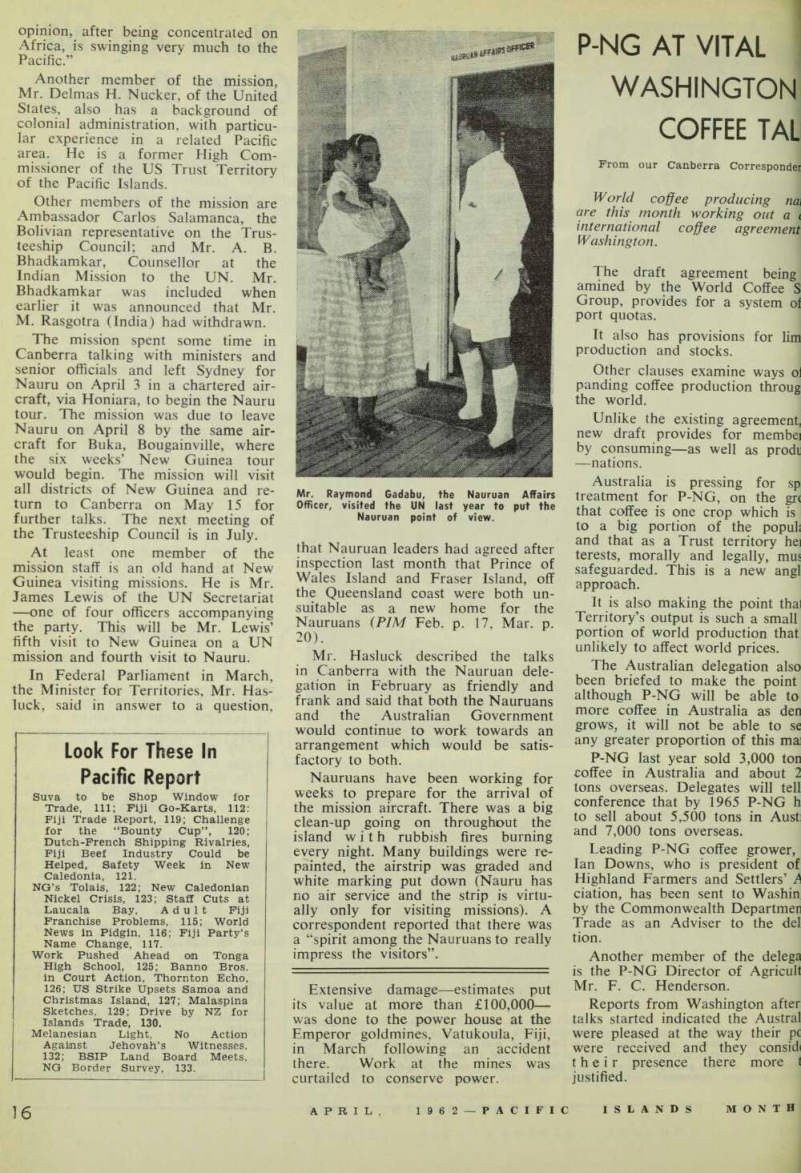
Mr. Raymond Gadabu, the Nauruan Affairs Officer, visited the UN last year to put the Nauruan point of view.