Pacific Commerce and Produce
pp. 147-148 · Read in the full issue
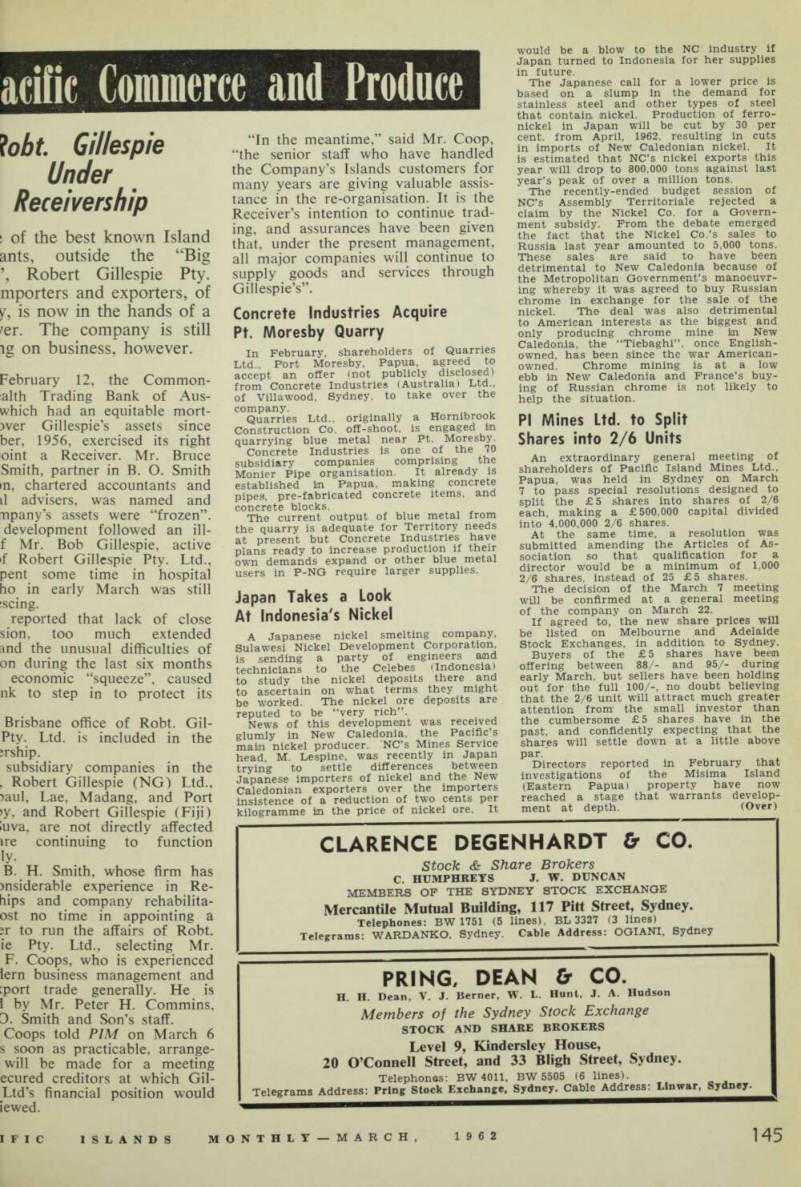
Robt. Gillespie Under Receivership
; of the best known Island
ants, outside the “Big
Robert Gillespie Pty.
mporters and exporters, of y, is now in the hands of a The company is still
ig on business, however.
February 12, the Common alth Trading Bank of Aus which had an equitable mort >ver Gillespie’s assets since ber, 1956, exercised its right oint a Receiver. Mr. Bruce Smith, partner in B. O. Smith m, chartered accountants and d advisers, was named and npany’s assets were “frozen”, development followed an ill f Mr. Bob Gillespie, active I Robert Gillespie Pty. Ltd., pent some time in hospital ho in early March was still :scing. reported that lack of close sion, too much extended and the unusual difficulties of on during the last six months economic “squeeze”, caused nk to step in to protect its Brisbane office of Robt. Gil- Pty. Ltd. is included in the jrship. subsidiary companies in the , Robert Gillespie (NG) Ltd., >aul, Lae, Madang, and Port >y, and Robert Gillespie (Fiji) luva, are not directly affected ue continuing to function ly- B. H. Smith, whose firm has >nsiderable experience in Re hips and company rehabilita ost no time in appointing a jr to run the affairs of Robt. ie Pty. Ltd., selecting Mr.
F. Coops, who is experienced lern business management and :port trade generally. He is 1 by Mr. Peter H. Commins, 3. Smith and Son’s staff.
Coops told PIM on March 6 s soon as practicable, arrange will be made for a meeting ecured creditors at which Gil- Ltd’s financial position would iewed.
“In the meantime,” said Mr. Coop,
“the senior staff who have handled
the Company’s Islands customers for many years are giving valuable assis tance in the re-organisation. It is the Receiver’s intention to continue trad
ing, and assurances have been given
that, under the present management,
all major companies will continue to
supply goods and services through
Gillespie’s”.
Concrete Industries Acquire
Pt. Moresby Quarry
In February, shareholders of Quarries Ltd., Port Moresby, Papua, agreed to accept an offer (not publicly disclosed) from Concrete Industries (Australia) Ltd., of Villawood, Sydney, to take over the company.
Quarries Ltd., originally a Hornibrook Construction Co. off-shoot, is engaged in quarrying blue metal near Pt. Moresby.
Concrete Industries is one of the 70 subsidiary companies comprising the Monier Pipe organisation. It already is established in Papua, making concrete pipes, pre-fabricated concrete items, and concrete blocks.
The current output of blue metal from the quarry is adequate for Territory needs at present but Concrete Industries have plans ready to increase production if their own demands expand or other blue metal users in P-NG require larger supplies.
Japan Takes a Look
At Indonesia's Nickel
A Japanese nickel smelting company, Sulawesi Nickel Development Corporation, is sending a party of engineers and technicians to the Celebes (Indonesia) to study the nickel deposits there and to ascertain on what terms they might be worked. The nickel ore deposits are reputed to be “very rich”.
News of this development was received glumly in New Caledonia, the Pacific’s main nickel producer. NC’s Mines Service head M Lespine, was recently in Japan trying to settle differences between Japanese importers of nickel and the New Caledonian exporters over the importers insistence of a reduction of two cents per kilogramme in the price of nickel ore. It
would be a blow to the NC industry if Japan turned to Indonesia for her supplies in future.
The Japanese call for a lower price is based on a slump in the demand for stainless steel and other types of steel that contain nickel. Production of ferro nickel in Japan will be cut by 30 per cent, from April, 1962, resulting in cuts in imports of New Caledonian nickel. It is estimated that NC’s nickel exports this year will drop to 800,000 tons against last year’s peak of over a million tons.
The recently-ended budget session of NC’s Assembly Territoriale rejected a claim by the Nickel Co. for a Govern ment subsidy. From the debate emerged the fact that the Nickel Co.’s sales to Russia last year amounted to 5,000 tons.
These sales are said to have been detrimental to New Caledonia because of the Metropolitan Government’s manoeuvr ing whereby it was agreed to buy Russian chrome in exchange for the sale of the nickel. The deal was also detrimental to American interests as the biggest and only producing chrome mine in New Caledonia, the “Tiebaghi”, once English owned, has been since the war American owned. Chrome mining is at a low ebb in New Caledonia and Prance’s buy ing of Russian chrome is not likely to help the situation.
PI Mines Ltd. to Split
Shares into 2/6 Units
An extraordinary general meeting of shareholders of Pacific Island Mines Ltd., Papua, was held in Sydney on March 7 to pass special resolutions designed to split the £5 shares into shares of 2/6 each, making a £500,000 capital divided into 4,000,000 2/6 shares.
At the same time, a resolution was submitted amending the Articles of As sociation so that qualification for a director would be a minimum of 1,000 2/6 shares, instead of 25 £5 shares.
The decision of the March 7 meeting will be confirmed at a general meeting of the company on March 22.
If agreed to, the new share prices will be listed on Melbourne and Adelaide Stock Exchanges, in addition to Sydney.
Buyers of the £5 shares have been offering between 88/- and 95/- during early March, but sellers have been holding out for the full 100/-, no doubt believing that the 2/6 unit will attract much greater attention from' the small investor than the cumbersome £5 shares have in the past, and confidently expecting that the shares will settle down at a little above par.
Directors reported in February that investigations of the Misima Island (Eastern Papua) property have now reached a stage that warrants develop ment at depth. (Over)
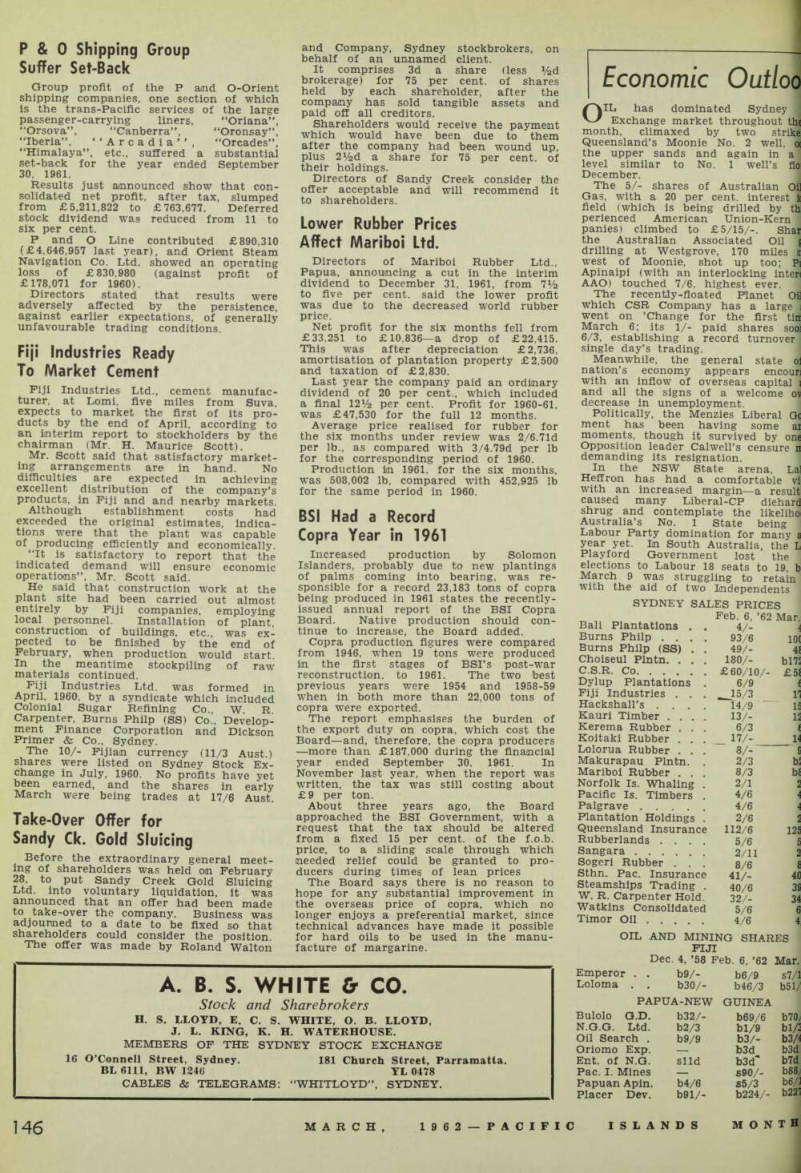
P & 0 Shipping Group
Suffer Set-Back
Group profit of the P and O-Orient shipping companies, one section of which is the trans-Pacific services of the large passenger-carrying liners, “Oriana”, “Orsova”, “Canberra”, “Oronsay”, “Iberia”, "Arcadia”, "Orcades”, “Himalaya”, etc., suffered a substantial set-back for the year ended September 30, 1961.
Results just announced show that con solidated net profit, after tax, slumped from £5,211,822 to £763,677. Deferred stock dividend was reduced from 11 to six per cent.
P and O Line contributed £890,310 (£4,646,957 last year), and Orient Steam Navigation Co. Ltd. showed an operating loss of £830,980 (against profit of £178,071 for 1960).
Directors stated that results were adversely affected by the persistence, against earlier expectations, of generally unfavourable trading conditions.
Fiji Industries Ready
To Market Cement
Fiji Industries Ltd., cement manufac turer, at Lomi, five miles from Suva, expects to market the first of its pro ducts by the end of April, according to an interim report to stockholders by the chairman (Mr. H. Maurice Scott).
Mr. Scott said that satisfactory market ing arrangements are in hand. No difficulties are expected in achieving excellent distribution of the company’s products, in Fiji and and nearby markets.
Although establishment costs had exceeded the original estimates, indica tions were that the plant was capable of producing efficiently and economically.
“It is satisfactory to report that the indicated demand will ensure economic operations”, Mr. Scott said.
He said that construction work at the plant site had been carried out almost entirely by Fiji companies, employing local personnel. Installation of plant, construction of buildings, etc., was ex pected to be finished by the end of February, when production would start.
In the meantime stockpiling of raw materials continued.
Fiji Industries Ltd. was formed in April, 1960, by a syndicate which included Colonial Sugar Refining Co., W R Carpenter, Burns Philp (SS) Co., Develop ment Finance Corporation and Dickson Primer & Co., Sydney.
The 10/- Fijian currency (11/3 Aust.) shares were listed on Sydney Stock Ex change in July, 1960. No profits have yet been earned, and the shares in early March were being trades at 17/6 Aust.
Take-Over Offer for
Sandy Ck. Gold Sluicing
Before the extraordinary general meet ing of shareholders was held on February 28, to put Sandy Creek Gold Sluicing Ltd. into voluntary liquidation, it was announced that an offer had been made to take-over the company. Business was adjourned to a date to be fixed so that shareholders could consider the position.
The offer was made by Roland Walton
and Company, Sydney stockbrokers, on behalf of an unnamed client.
It comprises 3d a share (less y 2 d brokerage) for 75 per cent, of shares held by each shareholder, after the company has sold tangible assets and paid off all creditors.
Shareholders would receive the payment which would have been due to them after the company had been wound up, plus 2y 2 d a share for 75 per cent, of their holdings.
Directors of Sandy Creek consider the offer acceptable and will recommend it to shareholders.
Lower Rubber Prices
Affect Mariboi Ltd.
Directors of Mariboi Rubber Ltd., Papua, announcing a cut in the interim dividend to December 31, 1961, from IV2 to five per cent, said the lower profit was due to the decreased world rubber price.
Net profit for the six months fell from £33,251 to £10,836—a drop of £22,415.
This was after depreciation £2,736, amortisation of plantation property £2,500 and taxation of £2,830.
Last year the company paid an ordinary dividend of 20 per cent., which included a final 12V 2 per cent. Profit for 1960-61, was £47,530 for the full 12 months.
Average price realised for rubber for the six months under review was 2/6.71d per lb., as compared with 3/4.79d per lb for the corresponding period of 1960.
Production in 1961, for the six months, was 508,002 lb, compared with 452,925 lb for the same period in 1960.
BSI Had a Record
Copra Year in 1961
Increased production by Solomon Islanders, probably due to new plantings of palms coming into bearing, was re sponsible for a record 23,183 tons of copra being produced in 1961 states the recently issued annual report of the BSI Copra Board. Native production should con tinue to increase, the Board added.
Copra production figures were compared from 1946, when 19 tons were produced in the first stages of BSl’s post-war reconstruction, to 1961. The two best previous years were 1954 and 1958-59 when in both more than 22,000 tons of copra were exported.
The report emphasises the burden of the export duty on copra, which cost the Board —and, therefore, the copra producers —more than £187,000 during the financial year ended September 30, 1961. In November last year, when the report was written, the tax was still costing about £9 per ton.
About three years ago, the Board approached the BSI Government, with a request that the tax should be altered from a fixed 15 per cent, of the f.o.b. price, to a sliding scale through which needed relief could be granted to pro ducers during times of lean prices The Board says there is no reason to hope for any substantial improvement in the overseas price of copra, which no longer enjoys a preferential market, since technical advances have made it possible for hard oils to be used in the manu facture of margarine.