Travel
pp. 136-137 · Read in the full issue
Being Different In Fiji
Talk
With a decade of tourism behind it, Fiji is finding that although the majority of tourists are pretty much slaves to the beaten track, there is also the discriminating minority who’d do anything to get off it.
COLONY tourist organisations are now catering for the minority as well as the majority and you can get away from it all—and other tourists —in comparative comfort and with out undue effort, as for example, to Vanua Levu, the next biggest Fiji island to Viti Levu.
From Suva’s airport at Nausori, the flight by Fiji Airways is just 50 minutes to Savusavu, on the south side of Vanua Levu. It’s 10 minutes further on, over the spiny mountain backbone of the island, to Labasa on the north coast.
The difference between Savusavu and Labasa is that the former is in the high rainfall area and is lush green with coconuts; the latter is on the dry side of the island, and has sugar-cane country scenery.
There are small hotels in Labasa and Savusavu. The Grand Eastern in Labasa is built on the banks of the river, has its own swimming pool and 10 rooms each with bathroom.
The Hot Springs Hotel at Savu savu is on a hilltop with a spectacular view over the Savusavu harbour right out the front, and of the steaming hot-springs to one side. It has eight modest rooms and has recently ac quired anew licensee, Mr. A. Gio vanelli, who is improving existing facilities rapidly.
You will get surprisingly good food at these hotels at remarkably low rates (Grand Eastern, £2 daily for bed and breakfast; lunch and dinner 7/6 each; Hot Springs Hotel, £l/15/daily including meals). If you like meeting local people away from the tourist beat and seeing how they take their leisure, this is as good a way as any to do it.
If you want to be more isolated,
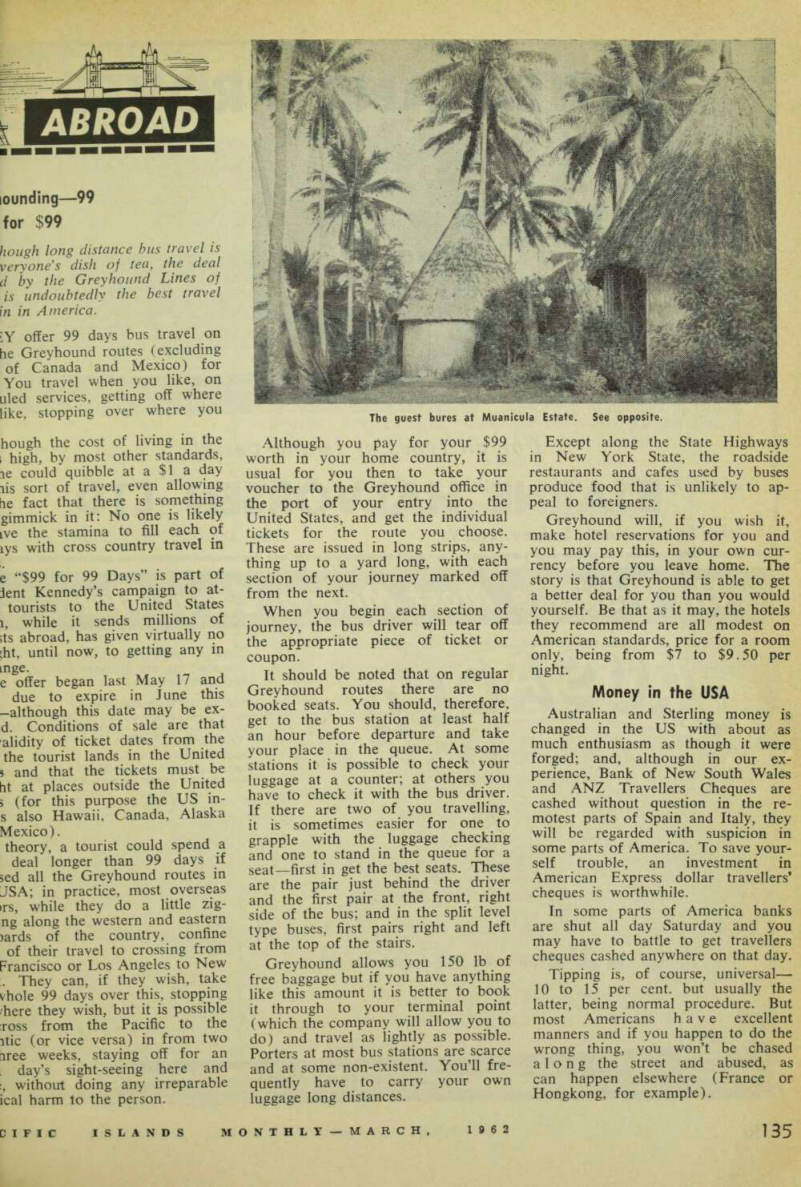
7i miles by road east from Savusavu is the Muanicula Estate Reefside Re sort, run by Mr. and Mrs. Guy Parr and their son, David. The Parrs’ main business is running a small coco nut plantation, but plantation affairs never seem to be so pressing that there is not someone available to organise a picnic, a fishing party, a run up the Hibiscus Highway 30 miles to Buca Bay or closel-at-hand Natewa
Bay; or to go into Savusavu to the club, the stores, the post office or the pub.
The Parrs’ have two guest-bures (thatched native
The
Pacific
style outside, European within), at present, with plans for more.
Each has two beds, built in dressers and wardrobes in all bamboo and local materials and each with its own private bathroom. They are surrounded by green lawns and there’s a pretty view of the sea and the reef through the coconuts. Guests eat with the family—home baked bread and local food, cooked in 57 different ways but especially with coconut cream.
Inclusive charge, accommodation and meals, £2/10/- per person per day. There is a Volkswagen Kombi available for excursions and trips, at moderate charges. Planes are met.
The plantation staff turn up and put on musical evenings when the spirit moves them.
Guy Parr is an enthusiastic shell collector. Interested guests are in structed how to collect some for themselves from local reefs and how to clean and care for them.
Savusavu, because it is connj with a good road to Buca Bay beyond, is a good centre for excui to native villages and plantation! is also comparatively easy to r nearby islands like Taveuni and : (which was purchased for a g of Ellice Islanders when theirl home island in the Gilbert and I Islands Colony became overp lated).
Savusavu has Fiji Airways connections with Suva every] except Friday. Single fare, 30 1 luggage, £5/15/-; return £ll/ (If you want to take 66 lb of lug] it’s £7/2/- each way.) On a fine the plane ride alone is worth price of admission as it is ovei reefs and islands of the Koro Sei Note: No fancy clothes are n sary for a visit to these island re but serviceable shoes with sen heels are.
Keep House
By the Lagoon
People who like to keep hous< themselves have now got se choices within 80 miles of Suva Viti Levu.
A year ago we described here cottages owned by Mr. and Mrs
Baxter, at S Point, near 1 toka, about miles along road west of S These seem to be attrai hosts of sati
customers.
In addition, there is the Lom Holiday Resort, on the beach 55 i west of Suva (about eight mile the Suva side of the Korolevu B Hotel). There are six individual I (or native style houses) with sho\ toilets and cooking facilities, li crockery and cutlery supplied, w can be rented for £l/10/- per i or £9/15/- per week. Bookings information through the House ol Lei, McGowan’s Buildings, S Fiji.
Another beach holiday-house r( goes by the very English name o: Anne’s-on-Sea, and is in the s locality as the Baxter cottages. T houses are of concrete construe and everything is supplied (ex food) for four people for £lO/ per week. Bookings: E. F. Corl P.O. Box 2, Sigatoka. (All prices quoted above are Fijian currency. £FI = £A 1/2/6 approximately 17/6 Stg. or NZ.
US is equal to 7/8 Fijian.)
The "Pacific Islands Monthly" is a member of the Australian National Travel Association (ANTA) and the Pacific Area Travel Association (PATA), which are pledged to promote tourist travel in their areas.
Abroad
lounding—99
for $99 hough long distance bus travel is veryone’s dish of tea, the deal d by the Greyhound Lines of is undoubtedly the best travel In in America. • Y offer 99 days bus travel on he Greyhound routes (excluding of Canada and Mexico) for You travel when you like, on □led services, getting off where like, stopping over where you hough the cost of living in the ; high, by most other standards, le could quibble at a $1 a day lis sort of travel, even allowing he fact that there is something gimmick in it: No one is likely ive the stamina to fill each of lys with cross country travel in e “$99 for 99 Days” is part of lent Kennedy’s campaign to at tourists to the United States i, while it sends millions of ;ts abroad, has given virtually no ;ht, until now, to getting any in mge. e offer began last May 17 and due to expire in June this -although this date may be ex d. Conditions of sale are that alidity of ticket dates from the the tourist lands in the United » and that the tickets must be ht at places outside the United > (for this purpose the US in s also Hawaii, Canada, Alaska Mexico). theory, a tourist could spend a deal longer than 99 days if sed all the Greyhound routes in JSA; in practice, most overseas irs, while they do a little zig ng along the western and eastern >ards of the country, confine of their travel to crossing from Francisco or Los Angeles to New . They can, if they wish, take vhole 99 days over this, stopping 'here they wish, but it is possible toss from the Pacific to the itic (or vice versa) in from two aree weeks, staying off for an day’s sight-seeing here and ;, without doing any irreparable ical harm to the person.
Although you pay for your $99 worth in your home country, it is usual for you then to take your voucher to the Greyhound office in the port of your entry into the United States, and get the individual tickets for the route you choose.
These are issued in long strips, anything up to a yard long, with each section of your journey marked off from the next.
When you begin each section of journey, the bus driver will tear off the appropriate piece of ticket or
coupon?
It should be noted that on regular Greyhound routes there are no booked seats. You should, therefore, get to the bus station at least half an hour before departure and take your place in the queue. At some stations it is possible to check your luggage at a counter; at others you have to check it with the bus driver.
It there are two of you travelling, it is sometimes easier for one to grapple with the luggage checking and one to stand in the queue for a seat-first in get the best seats. These are the pair just behind the driver and the first pair at the front, right side of the bus; and in the split level type buses, first pairs right and left at the top of the stairs.
Greyhound allows you 150 lb of free baggage but if you have anything like this amount it is better to book it through to your terminal point (which the company will allow you to do) and travel as lightly as possible.
Porters at most bus stations are scarce and at some non-existent. You’ll frequently have to carry your own luggage long distances.
Except along the State Highways in New York State, the roadside restaurants and cafes used by buses produce food that is unlikely to ap peal to foreigners.
Greyhound will, if you wish it, make hotel reservations for you and y OU ma y p a y this, in your own cur rency before you leave home. The story is that Greyhound is able to get a better deal for you than you would yourself. Be that as it may, the hotels they recommend are all modest on American standards, price for a room only, being from $7 to $9.50 per night.
Money in the USA , Australian and Sterling money is changed in the US with about as much enthusiasm as though it were for ? ed; and although in our ex- P er . ,en f<, ® a " k of „ New South Wales and ANZ Travellers Cheques are cashed without question in the re molest parts of Spam and Italy, they w '>l be regarded with suspicion m some parts of America. To save your “lf trouble, an investment in American Express dollar travellers cheques is worthwhile, In some parts of America banks are shut all day Saturday and you may have to battle to get travellers chec l ues cashed anywhere on that day.
Tipping is, of course, universal— -10 to 15 per cent, but usually the latter, being normal procedure. But most Americans have excellent manners and if you happen to do the wrong thing, you won’t be chased along the street and abused, as can happen elsewhere (France or Hongkong, for example).
The guest bues at Muanicula Estate. See opposite.