Pacific Report
pp. 115-132 · Read in the full issue
Discusses Future Fisheries
The month’s round-up of news and pictures of people and vents, from PIM correspondents in the South Pacific.
proposal that a research institute et up in the South Pacific to study improvement and control of ry resources of coral reefs, a i source of food for many islands ilations, was one of many made fisheries technical meeting held i February 5-13 at the head ters of the South Pacific Corn ion in Noumea. The meeting’s i purpose was to study and re e the Commission’s 10-year-old ramme for developing South Seas ries. lirteen fisheries experts attended i nine Pacific territories, the ed States and Australia, and from Food and Agriculture Organisa of the United Nations and the -Pacific Fisheries Council. Dr. ion E. Brock, Director of the Bio :al Laboratory, United States :au of Commercial Fisheries, hington, was chairman, reviewing progress made since 1952 Fisheries Conference the ;ing noted that industrial tuna ries had been established at Pago ), American Samoa, and at Santo le New Hebrides, sheries co-operatives had been led and were operating success in several territories, including Solomon Islands, New Caledonia the United States Trust Territory, e new or improved fish markets shore facilities had been provided ie Solomons, New Caledonia, Fiji, lerlands New Guinea, Papua and Guinea, and the United States t Territory. s well, fisheries departments had established in French Polynesia, »a, Cook Islands, British Solomon ids, Netherlands New Guinea, m and New Guinea, and the ed States Trust Territory, ie urgent need for extensive re :h into the fisheries resources of South Pacific, and for the nbly of economic information,
was stressed. Short-term research was needed to maintain subsistence re sources for local populations, and also long-term research to close the main gaps in scientific knowledge and to provide information on which long term planning can be based. The Commission’s role was to help define the needs and help the territories ob tain financial assistance and technical aid for the task.
The meeting considered that while reef stocks were invariably limited, the stocks of deep-water fish could be ex ploited to a much greater degree than at present. More efficient fishing gear and methods were needed, to gether with biological research on the species concerned.
In considering special areas for re search, the Committee urged that urgent steps be taken to provide the means for research on the Spanish mackerel and the big-eyed scad. The meeting also stressed the need for
further information concerning the two groups of tuna—those forming surface schools and the deep swimming varieties upon which the flagline fishing industry depends. A study of bait resources was needed in connection with the exploitation of surface schools.
In reviewing ways of expanding shell resources in the region, the meeting stressed the need for enlisting the help of overseas experts in de-
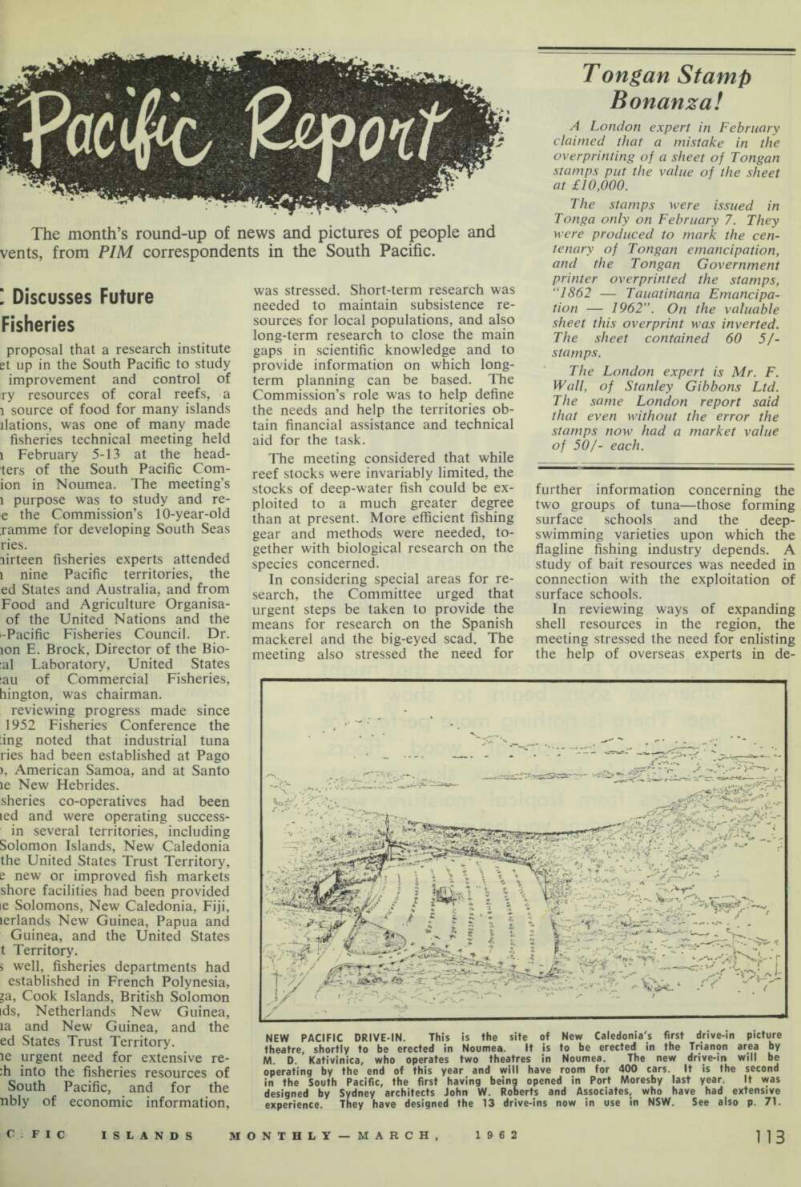
NEW PACIFIC DRIVE-IN. This is the site of New Caledonia's first drive-in picture theatre, shortly to be erected in Noumea. It is to be erected in the Trianon area by M. D. Kativinica, who operates two theatres in Noumea. The new drive-in will be operating by the end of this year and will have room for 400 cars. It is the second in the South Pacific, the first having being opened in Port Moresby last year. It was designed by Sydney architects John W. Roberts and Associates, who have had extensive experience. They have designed the 13 drive-ins now in use in NSW. See also p. 71.
veloping breeding techniques \ pearlshell. It also considered t while present prices for trochus longer ensured reasonable returns,i steady demand for green snail si warranted further attention being p to the development of this fishery.
It was also felt that, particularly the more isolated islands and ate small cash incomes for the 1c population might be develo] through the marketing of the num of minor items such as coral sp> mens, sea shells (both complete i carved), carved or polished trod and similar products.
The meeting noted the rec marked increase in the number amateur shell collectors, and i growth, particularly in Europe i America, of small businesses dea] in shells. The Commission was! quested to seek information on tt markets.
The meeting studied the vari problems encountered in the hand] and processing of catches in the tt major types of fishery—subsistei commercial and industrial, S sistence fishermen ordinarily catch for their own consumption, or barter, and normally it is consul fresh. Problems encountered in commercial fisheries in the Sc Pacific include the cleaning and k of fish and its transport to mark the provision of ice for fishing bo and, in remote areas, the preserval of fish by converting it into fish n or flakes. Fish for industrial marl are either frozen or processed export, and here as well facilities largely lacking in the region.
The meeting suggested that assistance of FAO naval archit could be sought in the solving basic problems in the design construction of fishing boats for Pacific. It was also emphasised 1 there was need for a careful sti of the widely-varying fishing c ditions throughout the region.
The meeting stressed that un present conditions, mechanisation traditional fishing craft was quickest, most practical way of creasing catches, and urged the C( mission to publish as much ini mation as possible on the subject.
Fatality Aboard
Abandoned Ship
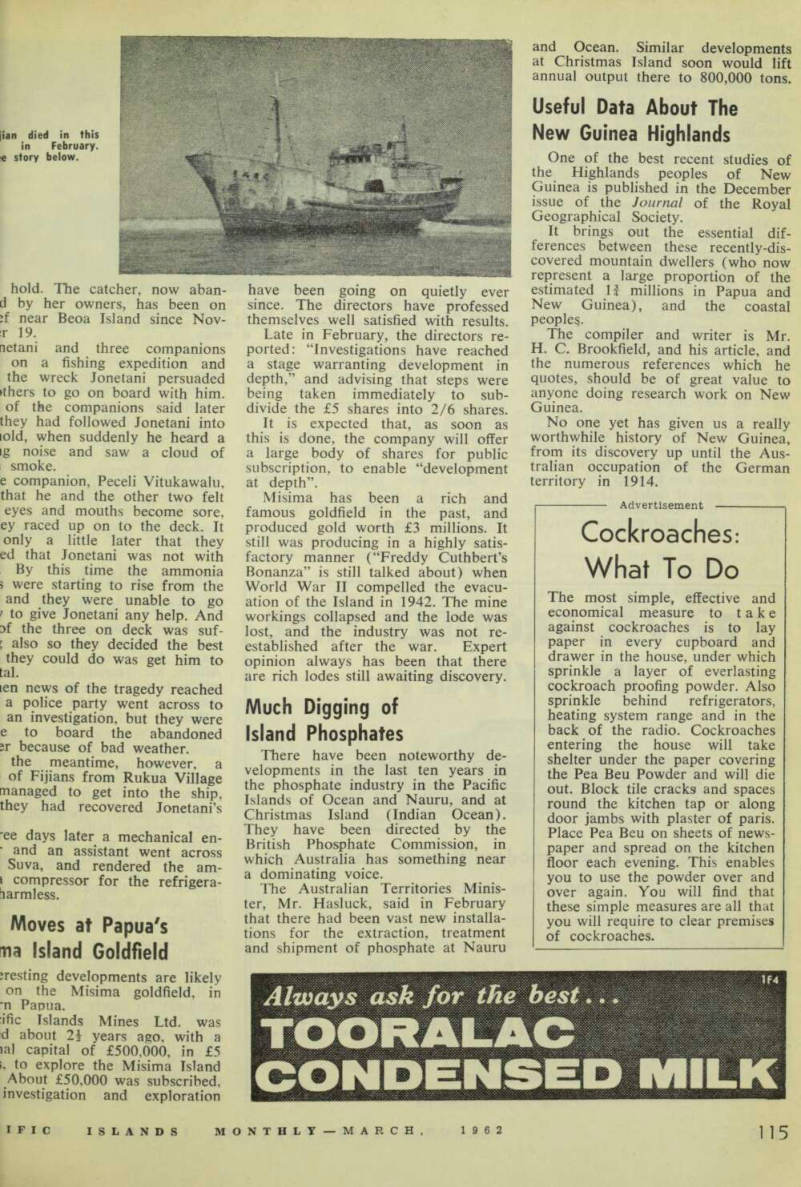
The wrecked Japanese fish catcher, Kyoei Maru No. 2 was scene of a tragedy in Fiji on F ruary 20, when Jonetani Kucuva, Rukua Village, Beoa, died of s monia poisoning in the ship’s i
hold. The catcher, now aban d by her owners, has been on it near Beoa Island since Nov :r 19. netani and three companions on a fishing expedition and the wreck Jonetani persuaded others to go on board with him. of the companions said later they had followed Jonetani into lold, when suddenly he heard a ig noise and saw a cloud of smoke. e companion, Peceli Vitukawalu, that he and the other two felt eyes and mouths become sore, ey raced up on to the deck. It only a little later that they ed that Jonetani was not with By this time the ammonia 5 were starting to rise from the and they were unable to go ' to give Jonetani any help. And :>f the three on deck was suf ! also so they decided the best they could do was get him to tal. icn news of the tragedy reached a police party went across to an investigation, but they were e to board the abandoned ir because of bad weather, the meantime, however, a of Fijians from Rukua Village managed to get into the ship, they had recovered Jonetani’s •ee days later a mechanical en • and an assistant went across Suva, and rendered the am i compressor for the refrigera iarmless.
Moves at Papua's
na Island Goldfield
cresting developments are likely on the Misima goldfield, in •n Papua. ific Islands Mines Ltd. was d about 2i years ago, with a lal capital of £500,000, in £5 ;, to explore the Misima Island About £50,000 was subscribed, investigation and exploration
have been going on quietly ever since. The directors have professed themselves well satisfied with results.
Late in February, the directors re ported: “Investigations have reached a stage warranting development in depth,” and advising that steps were being taken immediately to sub divide the £5 shares into 2/6 shares.
It is expected that, as soon as this is done, the company will offer a large body of shares for public subscription, to enable “development at depth”.
Misima has been a rich and famous goldfield in the past, and produced gold worth £3 millions. It still was producing in a highly satis factory manner (“Freddy Cuthbert’s Bonanza” is still talked about) when World War II compelled the evacu ation of the Island in 1942. The mine workings collapsed and the lode was lost, and the industry was not re established after the war. Expert opinion always has been that there are rich lodes still awaiting discovery.
Much Digging of
Island Phosphates
There have been noteworthy de velopments in the last ten years in the phosphate industry in the Pacific Islands of Ocean and Nauru, and at Christmas Island (Indian Ocean).
They have been directed by the British Phosphate Commission, in which Australia has something near a dominating voice.
The Australian Territories Minis ter, Mr. Hasluck, said in February that there had been vast new installa tions for the extraction, treatment and shipment of phosphate at Nauru
and Ocean. Similar developments at Christmas Island soon would lift annual output there to 800,000 tons.
Useful Data About The
New Guinea Highlands
One of the best recent studies of the Highlands peoples of New Guinea is published in the December issue of the Journal of the Royal Geographical Society.
It brings out the essential dif ferences between these recently-dis covered mountain dwellers (who now represent a large proportion of the estimated 1| millions in Papua and New Guinea), and the coastal peoples.
The compiler and writer is Mr.
H. C. Brookfield, and his article, and the numerous references which he quotes, should be of great value to anyone doing research work on New Guinea.
No one yet has given us a really worthwhile history of New Guinea, from its discovery up until the Aus tralian occupation of the German territory in 1914.
[?]ian died in this in February. e story below.
School Bungle Brings
Protest from Parents
Official muddling led to about 200 children being turned away at the opening of the new school year at the Numaka Public School, Nadi Airport, Fiji. The school, which is inter-racial, can only accommodate 140 pupils, whereas it was planned to take 320.
The Fiji Government decided to build the school from materials of the old Mocambo Hotel, when the NZ Civil Aviation Authority advised it could not cater for an increasing roll at the Nadi Airport School.
The Standing Finance Committee (unofficial members of the Legislative Council with the Financial Secretary as chairman) voted £lO,OOO to the new project. Work went ahead in 1961 with the target date of February 6, when the school was to open. The opening was delayed for a week be cause the building was not completed.
Then the money ran out, and work stopped. Parents formed themselves in to a working bee to keep the grounds in some sort of order. They cleared some of the tall grass, so that the children could find their way to the school.
According to an official statement, another £2,000 was needed to finish
the school, and this could only be granted by the Standing Finance Committee. Originally £9,500 had been granted on a preliminary esti mate.
The extra money was needed partly because wet weather caused delays, and partly because when the surplus buildings were dismantled defects, which could not be seen earlier, be came apparent. Thus new material had to be ordered.
That, of course, was another way of saying that someone had made a fine old mess.
Then the soothing syrup—offi dom was taking steps to bring matter before the Standing Fin Committee as quickly as possible Parents left the Government ii doubt about their feelings. I: strongly worded telegram to Colonial Secretary and the A< Director of Education they among other things: “Children (only 140 out of ! commenced school in appalling ditions.”
Trouble With The
Drains Is The Drains
Administration officials are ah a target for criticism but P-NG’s sistant Administrator for Econ< Affairs, Mr. Harold Reeve, left 1 self wide open with his commen flooding at Port Moresby’s hot settlement of Hohola in Februar During seasonal (and hence pected) rains, many of the ho in this growing suburb, which is habited by native and mixed people, were literally awash.
The residents complained, 1 chief protest being that draii works in the area had never 1 completed. Then Mr. Reeve cam< with his classic reply—“Of co residents in this area must re that some flooding will occur, drainage systems have not been c pleted,”
“Just what does he think we complaining about?” asked the dents, almost as one.
Reported a Port Moresby coi pondent: “It surely would have 1 more beneficial (and more sooti to troubled waters) had Mr. R< given some assurance that draii would be completed, and when, are residents expected to dig t own moats (with one eye on
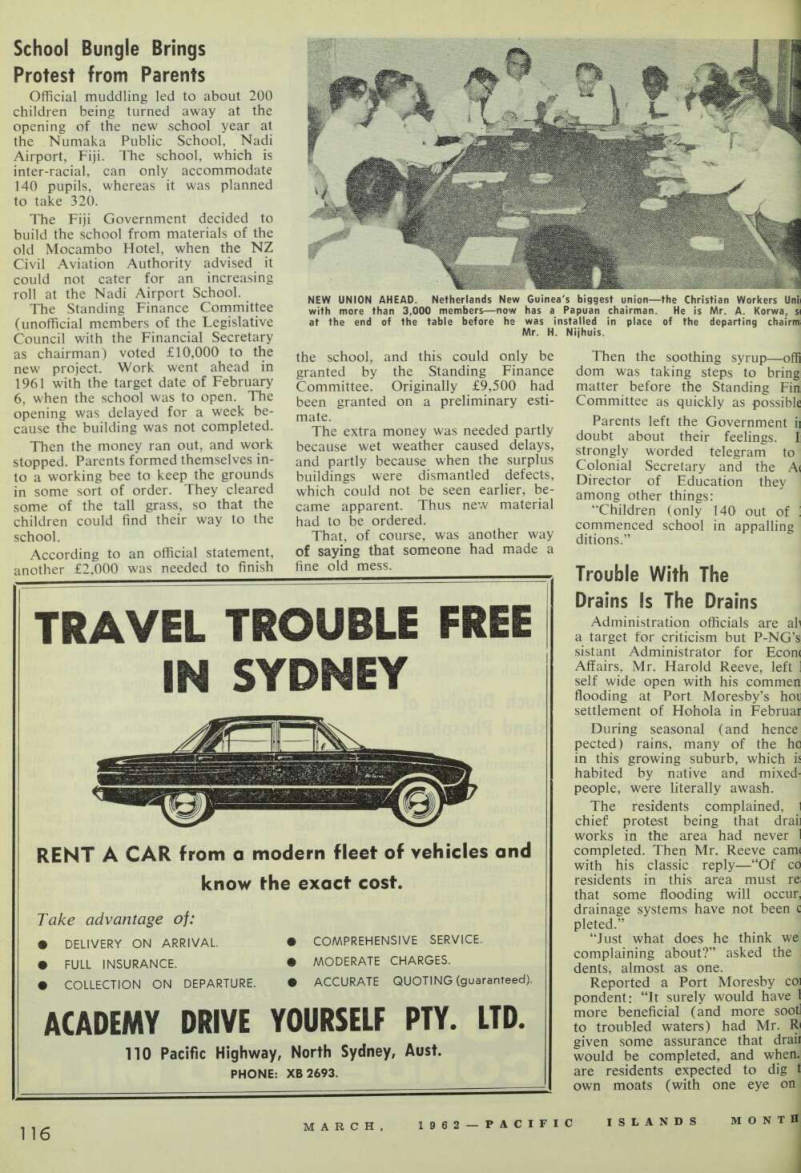
NEW UNION AHEAD. Netherlands New Guinea's biggest union—the Christian Workers Uni[?] with more than 3,000 members—now has a Papuan chairman. He is Mr. A. Korwa, s[?] at the end of the table before he was installed in place of the departing chairm Mr. H. Nijhuis.
*r), at the same time mounting ne guns to mow down the ; of mosquitoes which descend ves at sundown every day?”
-running" Alleged
;w Caledonia
imea, New Caledonia, in Feb was still much interested in nysterious affair of the cart ’. About 40,000 cartridges and fles were seized from a small on its arrival from Australia, essel had been bought for use Islands trade, itor Lafleur’s weekly newspaper i that a Chinese was connected the matter, and calls for an / to find out where the ammu was headed.
ions in March
Vallis & Futuna
re are to be at least four can ; for what a Noumea corres it describes as “one of the 5 cushiest political jobs”—par tary representative for the and Futuna Islands in the i Chamber of Deputies, tions will be held on March i they follow the islands’ ad n to the French Republic on a tatus. Previously they were a 1 dependency administered y from Noumea. » of the candidates are ian and two of European de nwhile on March 4 the Wallis utuna islanders will elect their [’erritory Assembly. There are ndidates for 20 seats. All ex- Dne are Wallis islanders—the ne is a retired French Govern servant. islanders are to be encouraged mt coffee to supplement cash :opra. Special seed from Africa 2 sown in nurseries in the two
:h Cruiser On
Showing Tour
French cruiser De Grasse Toulon Naval base in France fly March on a world flag ig cruise that includes the i South Pacific possessions, cruiser will call at little visited rton Island, 1,800 miles due )f the Panama Canal, followed mch Polynesia, New Caledonia, 'Jew Hebrides Condominium, ayalty Island, Wallis and Fu- She will return to France via dian Ocean but is not expected it Australia.
Notable N. Guinea Painting—
And Some History
A very excellent portrait in oils of Paul Mason, of Bougainville, New Guinea, by Mrs. Olive Kroening, of Emira Plantation, Emirau, New Guinea, was accepted for exhibition in the Archibald section of the National Gallery in Sydney in Janu ary. It did not win a prize, but it has been warmly praised, and has at tracted a lot of attention. Another painting by Mrs. Kroening, a land scape, was not accepted for exhibi tion.
The portrait was regarded—by popular vote —as one of the best paintings in the Rabaul Art Society’s exhibition in November, and Mrs.
Kroening’s admirers were disap pointed that it did not get a prize.
Mrs. Kroening is an Englishwoman of talent, who visited New Guinea a few years ago, and remained as the wife of well-known Bruno Kroening, who has Emira Plantation on lease.
Emira was developed by the late C. L. B. Wilde in the old German times, and he knew some happy years there. It was there that Wilde buried his Juanita—his “well-beloved wife”.
who was a popular figure 50 ago—the headstone he erected i there on Emirau.
It was on Emirau that the Ge raiders landed 500 prisoners sunken Allied ships, in Dece 1941.
Eddie Ward Sues
John Fairfax & Sons
Memories of a 15-years-old Guinea scandal were being re as this PIM went to press, b appearance in Sydney’s Su] Court of former Territories Mi Eddie Ward, claiming that he been defamed by an article John Fairfax publication, Aust Financial Review.
In an article in October, 195 newspaper said Mr. Ward ha fused to give evidence befor Royal Commission on the Guinea Timber case, in 1949. in his Supreme Court action, pi out that he had in fact givei dence before the Commission had been specifically absolved blame by the Royal Commiss The hearing may be protra Eddie Ward was Minister foi ritories in an Australian L Government from 1943 to 194‘ he had associated with him fo of that time, as a sort of seen offsider, a well-known Leftist tician, Jock Garden.
Garden and a man named E Farrell induced a Queensland 1 company, Hancock and Gore to believe that the Commom Government had granted a ti getting licence over a large ai Bulolo country in NG to Ray the well-known New Guinea and Hancock and Gore Ltd. upon bought “timber conces from them, for £50,000. It alleged that Ward had approve issue of the licence to Parer had received £5,000, and a pi of another £15,000.
Minister Ward gave very le evidence at the Royal Comm and was held to be blameless Parer was acquitted of a char conspiracy; but Jock Garden many years a prominent polii and who had served at least one in Australia’s Parliament, was to gaol for three years for fo and disappeared from public 1 Hancock and Gore’s £50,000 was recovered, nor traced, were strange circumstances surr ing the scandal —such as the ft Farrell, and the mysterious ' pearance of a bank clerk whe given evidence about safety-del
defy Eats
thday Cake
members of the Pacific Islands , in February, quietly cele the 25th anniversary of the ig of the Society in 1937. A y cake provided by the Presi ivas solemnly cut by three I members (Mrs. Beasley, Mr. lennings and Mr. R. W. Rob and the couple of score of Islanders present spent a ivening, comparing memories, also was the Society’s annual meeting; and it re-elected all :e-bearers. The President (Mr.
Foxcroft) and Mrs. Foxcroft las been the Society’s indefa- Hostess for years), leave shortly on a world tour; but jmbers insisted that they re eir positions, tour or no tour, ibers recalled that the Society’s valuable work probably was i the years 1942-46, when the ans were forced out of the estern Pacific Territories by panese invasion, and means ought of keeping the “evac n touch with each other, and ieir homes.
ious Fiji
ards Condemned
ommittee set up by the Fiji ment to study fair rents, has mt with a report which does are rapacious landlords, and re many of them in the urban Some glaring cases of exploi of those in unfortunate cir aces were brought before the lee. of the worst was where the d charged 3/- for every bucket ir supplied to five persons liv half a tin shack with a corm ron partition. The shack had :hen, no water laid on, no ity and no lavatory, and the as £2 a month. ; rightly, the committee called rt of thing “capitalisation of ’, and “one of the many ex of profiteering from the ns that others have suffered”, committee heard evidence that cent, of Suva families lived room, 60 per cent, in over d conditions, and that rented aodation gave a return of 10 1. and more on invested capi ere was a case where the re as 150 per cent, e is a fair rents court, but >cedure is not simple enough )se who have most need of top of that landlords when
likely to be taken before these courts for readjustment of rents often re sorted to threats of violence and eviction, to stop the case going on.
Landlords, much better off than their tenants were able to afford legal rep resentaton in court—the tenants were not.
The committee made a number of recommendations to overcome what has developed into a social problem of some magnitude. The ball is now back in the Government’s court to do something about the matter with suitable legislation.
They Don't Want To
Be Recognised, Thanks
Papua-New Guinea natives think it would be “a sorry state of affairs” if civic leaders had to wear uniforms so that they would be recognised more easily.
The third conference of Native Local Government councils rejected overwhelmingly the suggestion that Council presidents and vice-presidents wear a uniform or some other in signia.
“Councils are not an army,” said
Councillor Boga, of the Port Moresby Council. “They are here to help the people. If the people need any tag on presidents to know them, that would be a sorry state of affairs.” Fifty of the other 52 delegates agreed with him.
P-NG Will Get An
Information Director
The Minister for Territories, Mr.
Hasluck, appears to be lifting his sights on the cost of publicity.
The P-NG Public Service is seeking a Director of Information and Ex tension Services and is offering up to £3,625 (for a married man).
This salary is more in line with the responsibilities of the job than amounts the Territories Department has thought appropriate for publicity in recent years.
When the Department set up its own publicity section not so long ago it offered a salary which suggested that its requirements were modest in deed.
Qualifications for the Port Moresby job indicated a much more realistic assessment of what is needed.
The P-NG Public Service is look ing for someone with good academic qualifications and with experience in mass communications.
If possible he should know some thing of the work of spreading infor mation among illiterate and semi literate people, and be able to train native staff.
The wording of the advertisement suggests that the Administration is planning an all-out drive to spread the information available in its de
partments out to the people through development of extension activities.
This is in line with the known atti tude of Mr, Hasluck, who places more stress on explaining the Govern ment to the native people than he does on explaining the Territory to the outside world, including Aus tralia.
The Navuneram inquiry of a couple of years ago showed up many weak nesses in P-NG’s internal public re lations—and Mr. Hasluck stated at that time that he was “planning to do something about it”. Thus the new department won’t be the kind of national publicity department that tourists and visiting journalists have come to expect of various countries.
The present post of Public Re lations Officer in P-NG, which has been held by hard-working Miss K.
Vellacott-Jones since the post was created in 1953, is expected to be absorbed into the new department.
Miss Vellacott-Jones, known through out the Territory as “VJ”, has always done an excellent, most conscientious job as a Press officer, despite a big handicap from shortage of staff. She is a journalist of long experience.
Another War in Fiji's
Cane Sugar Industry?
There are 12,500 sugar-growers (mostly Indians) in Fiji. If two thirds of them accept the contract between the growers and the millers (Colonial Sugar Refining Co.), which was drafted last year by the Trustram Eve Commission, and which was ac cepted on February 12 by the Sugar Advisory Council by 13 votes to 4, that will establish the conditions under which the industry will be car ried on until 1970.
Representatives of the independent Sugar Board—mostly field officers of the CSR—began calling upon the sugar-growers individually on February 13, and reports indicate that, by February 28, a satisfactory proportion of the growers had signed.
The four members of the Council who opposed the contract are repre sentatives of the A. D. Patel-Swami Rudranand group, who have caused much unrest in the sugar industry in recent years. It is clear from reports in Jagriti, and other Indian journals supporting Mr. Patel, that growers are being urged by these and other “leaders” to reject the contract.
There is provision in the new sugar industry set-up for the punishment of persons “interfering” with the in dustry in a way considered improper.
The progress of the Patel-Rudranand campaign, consequently, is being watched with interest.
Swami Rudranand officially priest attached to the Ramaki Mission; but he appears to a lively interest in journalism politics in recent years as ai swerving supporter of Mr. Pate] The following report was writ Fiji the day after the Sugar O met in Lautoka on February 12 The first meeting of Fiji’s : created Sugar Advisory Council to agree on the first five of 10 ci in a proposed new contract fo purchase of cane for 1962-70. cording to a dry statement i after the meeting, some grc representatives wanted numeroi terations and amendments to draft contract.
The millers’ representatives adamant that there should b change. As it became clear
Independent chairman of the Fiji Sugar Air Chief Marshal Sir Arthur Sander and Secretary of the Board, Commander Finlay. Photos: Rob Wright.
ious advice could not be given wers the meeting did not dis he remaining five clauses as ould not alter the situation, independent chairman (Air- Marshal Sir Arthur Sanders) 6 the situation by asking each ual member what he con . should be recommended to Dwers. Thirteen of them were rour of recommending they accept the contract as drafted. * of them, mostly from the group, considered they could [vise the growers to sign be iroposed amendments and vari to the draft contract had not ccepted. The remaining mem 3uld not vote because all 10 had not been discussed and d to his satisfaction.
Arthur, with a majority in of the new contract, then the millers to present the draft :t to individual growers without and endeavour to obtain their res. aid that provided a majority of s freely accepted the contract, rowing, harvesting and crush cane could proceed in an or nanner. All concerned would jceive a just reward for their ;. His own opinion was that raft contract was fair and ible, and that it adequately irded the interests of both s and millers. \rthur, earlier, in his opening to the Council, said he con it had two perfectly simple aightforward aims: fo promote the stability and ity of the sugar industry; and b ensure that there were fair for all out of the proceeds of manufactured in Fiji, whether •roceeds were large or small, emphasised that the Council’s ns were advisory only. It lot take decisions or executive The way to achieve its aims give the best possible advice problems affecting the industry.
Arthur told the Council that ;h he was the independent an of the industry he did not himself as a super boss. He :d himself as its servant, and not act as a dictator, or im is will or opinions against the of the majority.
Sugar Council’s office would >uva because most of the con dth the industry, the Govern ;he CSR headquarters, and the I’s independent accountant 11 at, or near, Suva. However meetings would be held at Lautoka or Nadi.
Sir Arthur said it was no part of his functions or of the Advisory Council to reopen any of the matters dealt with by the Sugar Inquiry Com mission of 1961, The report of the commisison, and the ordinance which set up the Council, were the stand ing orders.
“Some of the commission’s recom mendations are not compulsory, but it is our duty to stick to them as far as we can. I cannot see that we can get anywhere if we try to start a new sugar inquiry,” he said.
Batteries, Matches To
Be Made in Suva
Pacific Manufacturers Ltd., which will soon start the manufacture of safety matches in Fiji, is associated with a new project to manufacture electric storage batteries.
The Fiji Legislative Council early in February declared the manufacture of the batteries a protected industry.
Associated with Pacific Manufac turers are Banno and Company and the Japan Storage Battery Co., of Kyoto, makers of the GS brand bat teries.
The Japan Storage Battery Co. will provide all the technical staff, and Banno and Co. will take an active part in the enterprise. The capital outlay will be round the £F200,000 mark.
The factory will be at Suva and will employ a large number of local people.
New Fiji Legco Hours
As an Experiment
The Fiji Legislative Council has decided to do something about con trolling marathon sittings of Council.
The Council normally sits from 10
a.m. till 12.30 or 12.45 p.m., and then from 2.15 or 2.30 pm., till 4.
But caught up with a lot of con tentious legislation, plus a long de bate on the Budget, the members of the Council found themselves towards the end of the December session, called on to assemble at 9 a.m., go as late as 4.30 in the afternoon, and then return to their labours at night.
Naturally, with the long sitting hours in extreme heat, tempers be came ruffled, and the House saw some of the stormiest scenes, often on racial matters, in its history.
Yet those evening sessions saw big attendances of the public, against a mere handful during the day sessions.
For years the Government has been trying to induce the public to attend, but with little success, obviously be
cause the Council met during or dinary commercial hours.
For the April session the Council will try the experiment of meeting from 10 a.m. to 12.30 or 12.45 p.m., and then again from 4 p.m. to 8 p.m.
The unofficial members will thus have some time during the day to attend to private business, but the officials will not be so fortunate.
When the Council finishes for the lunch break they will have to go back to their desks till the normal Govern ment finishing time of 4 p.m., and then back to the Council chambers— four hours overtime each day while the Council sits.
New Judges in the
South Pacific
New judicial appointments of im portance have been announced.
Mr. John Levy Macduff has been appointed Chief Justice of Fiji, in succession to Sir George Lowe, who is retiring. Mr. Macduff is at present Puisne Judge in Kenya. He expects to take up his Fiji appointment in June.
Mr. G. G. Briggs, Puisne Judge in the Unified Judicary of Sarawak, North Borneo and Brunei, has been appointed Chief Justice to the High Court of the Western Pacific. He is expected to arrive at Honiara in
April. Mr. Briggs is unmarried Mr. D. R. Barv/ick arrived his family in Tarawa in Feb where he is taking up his post!
GEIC's first Judicial Commis and Legal Adviser.
Fiji Group Makes
Air Tour of India
A party of 20 businessmen, fa and teachers from Fiji were t( India in February as guests o India International. The trip wi ganised by Mr. Albert Jayant India’s district sales manage Suva. The airline in May will duce 707 Intercontinental jets < Sydney-Bombay-London-New service. Air India operates in with Qantas and BOAC.
Games Award Winner
Is Stamp Designer
Mrs. Pamela March Presco Port Moresby, who has designe symbol to be used for the first Pacific Games in 1963, is no sti to designing. She has designed stamps for Papua-New Guinea, of which have already been issui Mrs. Prescott receives an awj £4O sterling for her Games s; (p. 123). Hers won from 107 c received at Suva from 12 coi and territories. Second prize-v was N. L. Joe, of Suva.
The judges said that g< standard of entries was good many contained a symbol whic plied to one territory only.
The winner of the Games s] design is the wife of Papm Guinea’s Administration arc She has been interested in art since she left school and es under her maiden name, P Carnielo.
She was born in London, but to Australia when she was five, leaving school she became a drai man and studied lettering and i colour at the Sydney Ted College.
In her spare time she studiei art and exhibited with the Co porary Art Society and the ■ Art Society in Sydney.
She married in 1947, wei England in 1950, where she spec further years studying.
Mrs. Prescott has been in Moresby since 1957, She says she finds the coloui surroundings “stimulating”. Sine ing in New Guinea she has won prizes, has made a further trip al (to study in Holland, France Spain), and is at present enj
cuting about 300 drawings for c to be published by the South Commission. . Prescott is especially interested trait painting in oils, but also watercolours. She plans to hold libition of her work later this South Pacific Games are to be at Suva under the general es of the South Pacific Commis in August-September, 1963.
Government of Fiji has ap -1 grants totalling £15,600 to e improved facilities for athletes ipectators at Buckhurst Park, will be the main centre for the s. new grandstand, with showers hanging rooms, is being built, er with basketball and tennis , and entrance booths, rk has begun on outdoor ter seating accommodation for tors.
Education Department has 1 to make Government school s at Suva available for housing ;titors, and an accommodation ittee is to organise an accom ;ion information service, publicity committee is planning :as advertising and other forms blicity for the Games.
Market Research
Guinea
earch into fish marketing in i-New Guinea is currently be irried out by Mr. John van der :n, Lecturer in Agricultural eting at the University of New nd, Armidale, NSW. The work ing done with the help of a 0 grant from the Reserve Bank astralia. . van der Meulen left Armidale ew Guinea in early March, and ts to spend 10 weeks in the ;ory. He will visit the main js and hopes also to visit rai and Daru. Mr. van der ;n has not previously visited
P-NG but had experience with mar keting problems in Indonesia, where he once lived.
Dr. R. B. Madgwick, Vice- Chancellor of the University, said research will include investigations into the problems in meeting demand for fresh fish in the Territory, the need for cool storage facilities and the organisation of markets. It will also deal with demand for preserved fish and the possibility of developing export markets for fish and in par ticular for prawns and crayfish.
Dr. Madgwick said that it was ex pected that the study would be directly helpful to the Department of Territories and the Administration in planning the future development of the P-NG fishing industry. It would also contribute to a better un derstanding of the role of marketing in the process of economic develop ment generally.
Imports of fish and fish products into Papua and New Guinea, said Dr. Madgwick, were increasing rapidly and there appeared to be a shortage of fresh fish in urban centres in the Territory and a large unsatisfied latent demand in rural areas. The value of fish imports rose from £207,000 in 1955-56 to £411,000 in 1959-60.
Reports by the Division of Fisheries indicate that considerable quantities of fish are present off the coast of Papua and New Guinea, in particular tuna, mullet and mackerel and that there are probably also commercial quantities of prawns and crayfish. The principal problems as sociated with the establishment of a fishing industry appear therefore to be not biological in nature but rather in the economic organisation of pro duction and marketing. The results of Mr. van der Meulen’s investiga tions will indicate the best way of overcoming these obstacles to de velopment.
Uncertainty About Future
Of Investments in NG
Until the Australian Government gives practical thought to some form of assurance or guarantee to en courage the confidence of private enterprise in the future of New Guinea, the plans of Australian in vestors for further business expansion in the Territory are likely to remain stationary.
This was the reaction of people interested in the Territory to the pre sent uncertain situation, Mr. K. E.
Noblet told a PIM representative in Melbourne in February.
Mr. Noblet, who is the represent ative of Messrs. Mac. Robertson Pty.
ning design for the South Pacific Games symbol. See below.
Ltd. in New Guinea, and manage) the company’s “Wanaru” plantat near Lae, added: “We are impat that the Commonwealth Governn has not grasped the situation.”) He stated that the big con
tionery-manufacturing corporation]
planned further development of cocoa plantation, but those p were now suspended, and this was 1 common attitude in business cii throughout the Territory since] West New Guinea trouble and o developments had created uncerta about the future.
Mr. Noblet pointed out that the Government had made good mud the losses sustained by their natioi as the result of political trouble: Cuba and, he understood, had I made arrangements to assist 1 nationals in similar circumstai elsewhere in the world.
A Rabaul correspondent rep Mr. Noblet’s views are supported many business people there, who that the Indonesian moves aga NNG have raised many busii doubts as to just what the fui holds for a private enterprise wl has to invest many thousands] pounds in stock and equipment.' Meanwhile, Australian Govi ment Trade Commissioner for Pacific Islands, Mr. D. M. Wal returned to Sydney in February the news that Australian expor would have to pay continued at tion to New Guinea market needs else lose out to foreign trade in 1 area.
He said many exporters wroi assumed that P-NG was merely; extension of their mainland trad: But in fact the P-NG market wa highly competitive one in which A tralia enjoyed no preferences, but advantages of proximity.
Energetic inroads were being m into the P-NG market by expon from Hongkong, Japan, New 2 land, West Germany, and the I and Australia’s percentage was f mg.
Australia’s share of the P-1 market was now 61 per cent, cc pared with 67 per cent, five years a Mr. Walker warned that Austral exporters needed a “more dynai approach, with greater attention pricing and packaging, and w frequent visits by lop executives, the market is to be held and panded.”
Neptune Crash-Lands
At Nadi
The crew of seven escaped unhj when a United States Navy Neptu
ift crash-landed at Nadi Airport, in February. the plane landed there was a jr of sparks and the Neptune ff the runway. The pilot brought lane to a standstill but there was Jerable damage.
itonga's Deep Sea
ing Experiment
rotonga’s growing population Iways demanded more fresh fish the local single-seater canoe could usually provide. A local grew up that there was no fish ie deep Pacific around Raro . There are fish, but they cruise pths beyond the reach of fisher in outrigger canoes. In mid iry, a serious attempt at deep ishing was commenced, vate enterprise supplied the en-hulled yacht, Siren, owned ikippered by Don Silk. Mr. Silk partner had bought and re tioned the Siren which had I for some years on Avarua’s i. They had used her for some in inter-islands trading before ping over to deepsea fishing, e Cook Islands’ Government ied diesel fuel, long-line fishing and the services of Mr. Ronald 11, Fisheries Officer.
Siren began cruising off Raro ’s coasts, trailing a long length panese flag line baited with 100 >. The bait, a species of small fish, was caught by Mr. Powell, is was the first time that flag : had been tried in that part of acific and results have been en ging. The score for the first four was:
First day, 1 tuna, 1 dolphin, 3 sharks. Second day, 1 marlin, 1 dolphin, 4 sharks. Third day, 2 marlin, 2 dolphin, 5 sharks. Fourth day, 2 marlin, 1 shark.
The Siren tied-up at Avarua wharf each evening and the fish is sold readily there at 1/- or 1/6 lb. Shark is the least popular but still sells we ll The experiments have proved that the standard Japanese gear used is not strong enough for local conditions. Part of it was lost one day when one marlin got away, and more gear was broken the following day when three marlin escaped.
Tnlal Trlhnto Fnr lOldl lilDUie TO!
Cktpr Gilbert
, t ... f ... j Of all the tributes of gratitud appreciation paid to pioneers in various fields of Papua-New Guinea work, that paid to Sister Edna May Gilbert by a group of T’olai mothers is surely amongst the most sincere.
Sister Gilbert left Port Moresby in February for Brisbane, on retirement.
Sister Gilbert has long been known as a champion of Infant Welfare Work in all parts of the Territory.
She established the first Infant Weifare Training Centre for native girls.
She also was responsible for the care of many mothers and children rendered homeless by the Mt. Lamington eruption in 1951.
Native women in many parts of Papua and New Guinea, have come
to know her, and have expressed their sorrow at her leaving. The mothers of two villages in the Vuna didir Council area, near Rabaul, went one better, and held a big fare well party, though the guest of honour was many miles away in Moresby. They also took up a col lection to buy a gift, and a silver milk jug and sugar bowl were pre sented to a delighted Sister Gilbert, on their behalf.
The real worth of their gesture is not fully appreciated until you realise that none of these New Britain women had ever met or seen Sister Gilbert. Merely through hearing the talk” about her, on the radio, through the Press, and above all, from the Infant Welfare Nurses who have trained under her they realised the debt they owed her, and in this small wa y, did something about it. c n nmntl khnfW n*PS JOlOmon ISianaer LOSeS f our * Anneal v.uu..
An appeal by a Solomon Islander against a sentence of seven years im pnsonment for having wounded with intent to murder was dismissed m the Fiji Court of Appeal in February. . Ongi Nefelesi had been convicted in Honiara after he had attacked with an axe the uncle of a girl whom he was courting. He had inflicted terrible stomach wounds on the man, who later made a good recovery.
The Suva appeal judges were told that at the Honiara trial the District
Iman had said that; Ongi from to time had a sort of madness. [e gets like this in a row, after w or if someone makes him f,” the Headman said. “When kind of madness comes he will his knife or axe and go into the i and does not want to talk to me or eat. He is not violent, knows this and when he is this they never tease him in any There is a lot of this madness y district and Nefelesi’s family e in which it is.” igi had told Dr. Gurney that he subject to epileptic fits during i he did not know what he was e appeal judges said they were d to the conclusion, by the nee, that Ongi knew at the time e attack that he was doing wrong was mentally capable of form an intention. The verdict was ied and there was no substance te contention that the sentence excessive. It was a crime of gravity which, in their view, was lore than adequately punished by itence of seven years’ imprison
f Hebrides Aviation
the Move
ere were successful negotiations Mew Hebrides Airways at turn, New Hebrides, in February, he construction of a small air on Sandy Island in Anelgehot The arrangements mean that all islands in the New Hebrides i of Efate (where Vila is situ will now have landing facilities mall aircraft. ie growing importance attached iternal air service in the New ides is reflected in plans for an isive tour of the group in March Ir. A. G. Corbin, BSIP Superin :nt of Aviation, and Monsieur jot, French Civil Aviation rep tative.
liara Now Better
/ed by Shipping
miara, capital of the British non Islands, once neglected by >ing is fairly well served nowa —vessels of no less than seven ic shipping companies call there, irns Philp and Co.’s Tulagi has the main Sydney-Honiara link years, but she carries only 12 ;ngers and her accommodation is ys in demand. The situation was /ed somewhat when Soochow )0 gross tons) of the New Guinea
Australia Line added Honiara to her itinerary in December and thus put first-class accommodation for another 25 passengers at the disposal of BSI residents wanting sea connection home from Sydney.
Soochow, on a once - every - five weeks schedule, takes eight days from Sydney or about four and one-half days from Brisbane to Honiara. She then goes through New Guinea and Papua ports before returning to Austra^a - The new Slagen service by Karlander NG Line, which started m February (see page 95 this issue), carries cargo only.
Australia-West Pacific Line (Wilh.
Wilhelmsen Agency), making a quarterly call at Vanikoro Island (in
the south-east of the Protectorate) to load kauri logs on one of Milos, Delos, Samos or Tenos, always calls at Honiara beforehand, Two of the three China Navigation Company’s cargo vessels (Chungking and Chekiang ) on the Japan-Pacific run call at Honiara, about five weeks apart.
The Bank Line makes a regular monthly visit to load copra, as part of its UK-P-NG service.
Once a month, a Dutch vessel of the joint Royal Rotterdam Lloyd- Nederland Line, puts into Honiara G n her way from New Caledonia to P-NG, when crossing the Pacific from east to west on her way from UK, via Panama Canal, to Netherlands New Guinea.
Has New
imander
w commanding officer of Papua- Guinea’s Pacific Islands Regi will be Lt.-Col. K. S. McKenzie, nstructor at the Staff College, nscliff (Vic.). ; replaces Lt.-Col. J. W. Nome, has held the post for three years, 01. McKenzie was a company nander in the PIR from 1955-59, served in Wewak as a platoon nander with the 2/sth Infantry ilion in the closing months of d War 11, just after he had jated from the Royal Military ;ge, Duntroon.
ister Hasluck
P-NG Tour
istralian Minister for Territories, Paul Hasluck, made another of jeriodic visits to P-NG in Febf —this one involving 11 days a great deal of territory. He :d Mt. Hagen and several posts, ak, Maprik, Yangoru, Goroka, Rabaul, Kirwina, Popondetta Port Moresby—which is virtually one end of the Territory to the Wewak he opened the district’s d new 376-bed £768,000 hospi but his main task was, he ex ied at a Port Moresby Press con ice at the end of it all, to “hold
discussions with leaders of the native people”
“Approximately 600 of the most significant men and women took part in the various discussions and were encouraged to speak freely and frankly They themselves chose the subiects they wished to raise. They talked for their people firmly, clearly and often with eloquence.”
He said it was great ment to know that th s young country is producing m centres men and women of strong character to speak clearly for them .
Everywhere, speakers said they were concerned about the West New Guinea position, and the future of the Territory.
Mr Hasluck told them any talk of other people coming to the territory was “rubbish talk”. Australians were there and were staying there while the locals still wanted them. up was asked on other occasions whether it was possible when the Tern’torv obtained self government
Isti 2Se A-J.-. »»
sms
H Mr John Stuntz, MLC, told Mr.
Hasluck during the tour that a zonal nothing for the tax tlJy paid, and
their costs were higher because of their remoteness.
Mr. Hasluck heard Port Moresby sawmiller Tom Flower describe the situation for local timber mills as “critical”. Timber prices had dropped and sales had fallen. Brick, concrete and aluminium were being used in house building m the Territory, and this was helping to cripple the in du^’L^dM^urrX mIC, who ac cQ nied the Minister on part of reported later that the chief subjects discussed by the natives were money? dr j n k, labour condi tions, discrimination and the coun try’s security. j n some cases, particularly in the Sepik, said Mr. Hurrell, writing in the New Guinea Times Courier, the people seemed generally perturbed by fear of Indonesia, There was also some pressure on Mr. Hasluck to secure a representa tive in the Australian Parliament, Mr. Hurrell said the approach to alcohol was uniform except for the S 3 “S
skss st s rua
showed an “almost fanatical desire for drink looks as Port Moresby Mr. Hasluck answered
MR. HASLUCK IN RABAUL The Divisional Commissioner for Guiding in the New Britain area Mrs M R Hayes, introduces the Minister for Territories to Erima Levi, a full time girl guide trainer, during the Minister's visit to Rabaul. About 100 native and European guides and brownies gave a demonstration to Mr. Hasluck. Native interest in guiding is keener in the Rabaul area following the appointment of a full time European trainer and two native trainers.
questions from local Pressmen, one of which brought from him a tart reply. He was asked if he would consider directing that in future Ad ministration-organised conferences be open to the Press.
“Freedom of the Press is a lot of nonsense—you have no greater rights than any citizen,” the Minister said.
“In these modern times the Press has got completely false notions as to what it can do.
“I contest the claim that Pressmen represent the public—they represent profit-making organisations,” he said.
Mr. Hasluck said Administration conferences were private affairs and the Press had no right to attend.