A Famous
pp. 75-76 · Read in the full issue
Glass Door For Sale
A Gauguin painting, which the famous English novelist Somerset Maugham bought in Tahiti in 1916 for 200 francs, vill be auctioned at Sotheby’s, London, on April 10. rHE painting, which was done on the glass panel of a door, will be sold with 34 other art treasures from Maugham’s Riviera lome.
The whole collection is expected to net about £500,000, or an werage of nearly £14,300 each.
Maugham bought the Gauguin painting while he was in Tahiti gathering material for his novel The Moon and Sixpence, which is broadly based on Gauguin’s life.
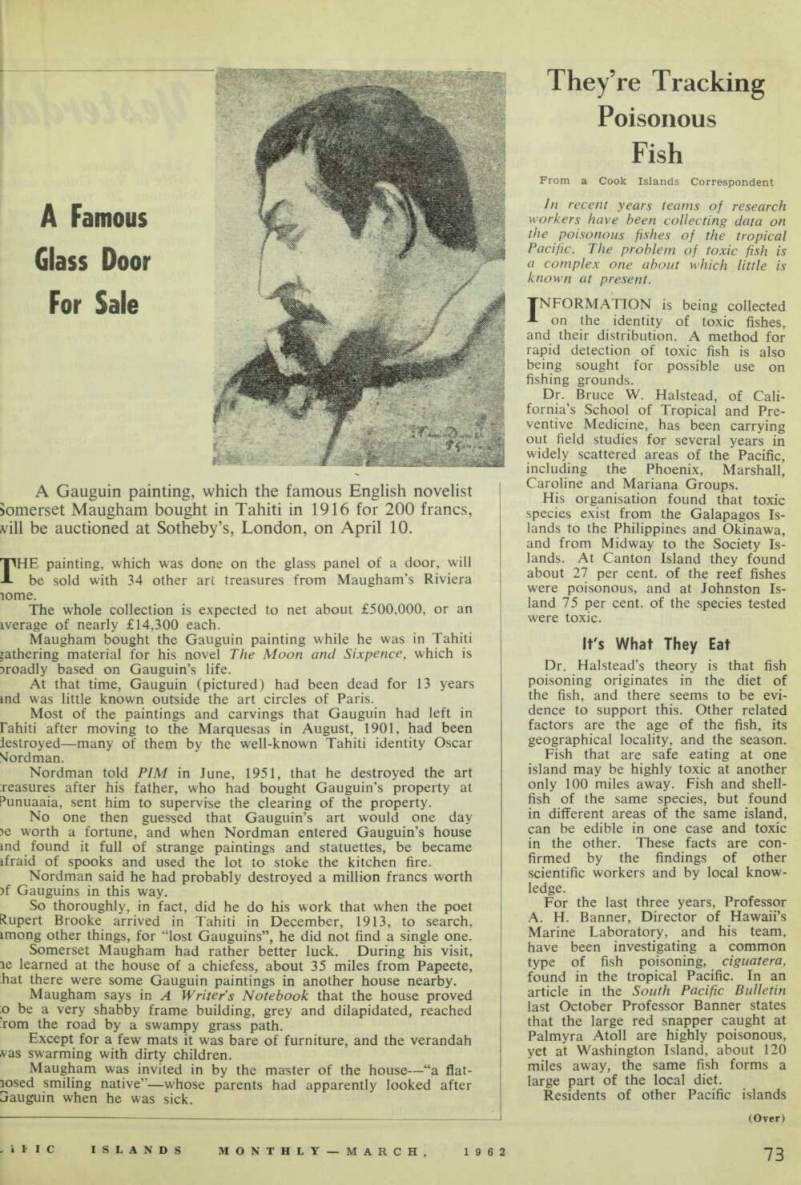
At that time, Gauguin (pictured) had been dead for 13 years md was little known outside the art circles of Paris.
Most of the paintings and carvings that Gauguin had left in Pahiti after moving to the Marquesas in August, 1901, had been lestroyed—many of them by the well-known Tahiti identity Oscar Mordman.
Nordman told PIM in June, 1951, that he destroyed the art reasures after his father, who had bought Gauguin’s property at Punuaaia, sent him to supervise the clearing of the property.
No one then guessed that Gauguin’s art would one day >e worth a fortune, and when Nordman entered Gauguin’s house md found it full of strange paintings and statuettes, be became ifraid of spooks and used the lot to stoke the kitchen fire.
Nordman said he had probably destroyed a million francs worth )f Gauguins in this way.
So thoroughly, in fact, did he do his work that when the poet Rupert Brooke arrived in Tahiti in December, 1913, to search, imong other things, for “lost Gauguins”, he did not find a single one.
Somerset Maugham had rather better luck. During his visit, le learned at the house of a chiefess, about 35 miles from Papeete, hat there were some Gauguin paintings in another house nearby.
Maugham says in A Writer’s Notebook that the house proved .o be a very shabby frame building, grey and dilapidated, reached Tom the road by a swampy grass path.
Except for a few mats it was bare of furniture, and the verandah vas swarming with dirty children.
Maugham was invited in by the master of the house—“a flat bed smiling native”—whose parents had apparently looked after 3auguin when he was sick.
The artist had repaid this kindness by painting pictures on the glass panels in the upper part of three doors of one of the bungalow’s rooms.
The children, however, had since picked away the paint of two of these pictures so that hardly anything of them remained, but the third picture was in “tolerable preservation”.
Maugham says that the owner of the house “took no interest in the pictures as such, but merely as remembrances of the dead guest”.
He was prepared to sell the third picture after Maugham had told him that he could keep the other two—the only difficulty being that he would have to buy a new door.
The native said a new door would cost 100 francs. Maugham offered him 200 and so clinched the deal.
But just in case the native should change his mind, Maugham decided to take the door with him.
So he got out the tools of the car he had come in, unscrewed the hinges and carried the door away.
The lower part of the door was later sawn off at the house of the chiefess, and Maugham took the panel with the painting back to Europe. It was almost certainly the last worthwhile example of Gauguin’s work in Tahiti.
At the time, Maugham probably could not have resold his purchase for more than a few pounds. But the publication of The Moon and Sixpence in 1919 helped to create world-wide interest in Gauguin’s life and work, and before long his paintings, which had been sold in his lifetime for a few francs, were changing hands for thousands of pounds.
Maugham, who is renowned for his cynicism, probably smiled many a cynical smile as he watched the prices soar following his excellent publicity work.
And in April, if his glass panel fetches a five-figure sum—as it probably will—perhaps he will feel rather like a man at the Stock Exchange who announces an oil strike and then cashes in his shares
at a handsome profit.
Robert Langdon.