Jeep-In, Fly-In Movies
pp. 73-74 · Read in the full issue
A Night at Ward's Truck-In, Jeep-In, Fly-In Movies
• In the mail the other day came a clipping from the "St. Louis Post-Dispatch" of an article headed, "News That New Guinea is Acquiring Drive-in Theatre Brings Back Memories". The writer was an ex-GI Theodore P. Wagner, now on the "Post-Dispatch" staff, who was browsing through a recent copy of "PIM" when he saw the news that Port Moresby had built the South Pacific Islands' first drive-in picture theatre, on the site of the old Ward's bomber strip. It brought him a flood of memories. We don't know why writer Wagner reads "PIM", but our subscription department has regular proof that hundreds of Americans subscribe to it because for them it's a friendly link with the Good Old Days and the Not So Good Old Days when the South Seas were home to a million wartime Gl's. Not all our subscribers, though, have the ability to recreate the old scenes as colourfully as Theodore Wagner does in his friendly piece, and for that reason we are reprinting it in full.
By Theodore P. Wagner, in the St. Louis Post-Dispatch
Ward’s Strip once was one of the busiest bomber bases in the Southwest Pacific. The United States Fifth Air Force flew from Ward’s Strip at Port Moresby, New Guinea, from 1942 through 1945. Then peace, and quiet, and grass settled over Ward’s. It would be quiet there still had not an American-style intrusion taken place. A drive-in movie has now been opened at the old air base.
Pacific Islands Monthly,
a news magazine with consider able back-fence charm, reports that the drive-in is the first in the South Pacific. This will dismay thousands of Americans who served there. They have filed Port Moresby in their memories as a charming town with streets of dust, without drive-ins.
They remember the natives, who would have been over-dressed in a T-shirt, and they remember the rock dust kicked up by prop wash and bulldozers and the confused comings and goings of men busy with a war.
The landscaping was just as nature had dumped it on the area, but with busy airstrips added.
Now, according to Pacific Islands Monthly, the Skyline Drive-In is “asphalted, piped-in (music), Ameri can type . . . white overalled Papuans lined up to wave us to our parking space with the aid of long, impor tant-looking electric torches. We found no scent of frangipani, but there was the comfortable smell of fish and chips, coffee and ham burgers.”
Americans who were at Port Moresby during World War II will remember the movies they saw there.
Technically, the new drive-in isn’t the first. There were movies almost every night near Ward’s Strip during the war and the audience jeeped in, trucked in, and walked in. Accom modations were not elegant, but neither were the pictures.
The American airmen at Moresby claimed to be the world’s foremost authorities on “B” pictures because they had seen them all. According to the Pacific Islands Monthly, Ward’s Strip still has an irresistible pulling power for old movies. The new drive-in features what the trade calls “second releases”.
Australian promoters of the American-style drive-in hint that they feature “second releases” because they are thoughtful of their custo
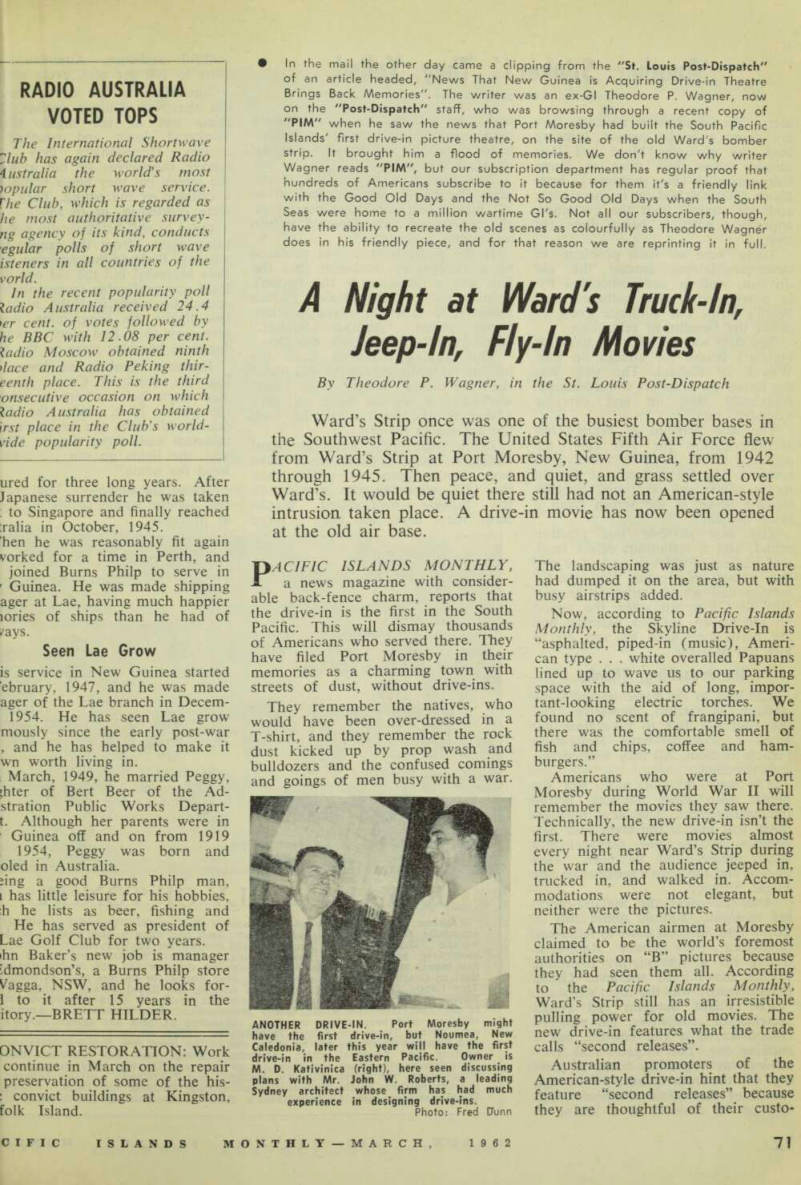
ANOTHER DRIVE-IN. Port Moresby might have the first drive-in, but Noumea, New Caledonia, later this year will have the first drive-in in the Eastern Pacific. Owner is M. D. Kativinica (right), here seen discussing plans with Mr. John W. Roberts, a leading Sydney architect whose firm has had much experience in designing drive-ins.
Photo: Fred Dunn
mers. The promoters indicate they are doing a public service, bringing back the pictures “Mum and Dad missed when they were at home baby-sitting”. The promoters have about $200,000 tied up in the theatre and are anxious that the customers appreciate what is being done for them.
There were no such problems of customer-relations among the old drive-in, walk-in and sometimes fly in movie crowd that gathered near Ward’s Strip, The audience knew all about the benefits of relaxation.
The strip was the take-off point for bombers bound for attacks on Lae, Wewak or Rabaul. The strip was the haven for bombers inward-bound, frequently shot up and carrying wounded men.
The new drive-in at Ward’s has accommodation for 300 cars; the audience bring its own upholstered comfort. The GI audience at the old movie shows sat on rough benches looking down at the screen from a small hillside.
The new drive-in has piped-in sound, and a restaurant offers steak and barbecued chicken and wine and beer served on a patio. Well, the GI movies had sound, anyway; practic ally all GI sound when the action on the screen got too patriotic and the hero announced he was off to join the Marines.
No Preaching, Thanks The men in the audience had some standing as patriots, themselves, and they did not like to take time out from a war to have Hollywood preach to them. All they wanted was entertainment.
The new drive-in must sop the public with short subjects, before the main event. The new manage ment will match the style and per sistence of the old management’s short subject and its hero. Ano pheles, and the hero’s spokesman, the Flight Surgeon.
Anopheles was the malaria-carry ing mosquito, and no doubt still is.
The Flight Surgeon used to tell some horrifying tales about Anopheles during his almost nightly preamble to the showing of whatever Grade B monstrosity was the night’s feature.
The Flight Surgeon did rough sketches of Anopheles. He pictured Anopheles as a vile coward, but a cunning one. The surgeon said Ano pheles was a guerilla adept at pick ing off the rear guard. His rough sketch of the villain Anopheles, set ting up an ambush in a latrine at
night, got a better audience response than any tactical situation ever illus trated in either the Infantry Journal or Mack Sennett.
The feature went on the screen after the Flight Surgeon had made his highly individual commercial on the benefits of daily doses of atebrin to counter malaria.
If the main feature was prefaced by a Hollywood statement that the film was a donation to the nation’s fighting men by the Motion Picture Industry, there was a mixed reaction.
Some yelled, “Another Stinker.”
Some yelled, “Bring back the Doc.”
The running comment from the hillside GI audience always was better than the movie’s script. More artists worked on it, for one thing, and gave advice to the hero when he took the heroine in his arms.
In a way, they were an ideal audience because while there have been kinder cop>s of critics than the GTs attending the movies on the hillside overlooking Ward’s Strip, there never has been a more
faithful audience. Attendance close to 100 per cent, every night Australian troops came, too. did the New Guinea natives. T came out of the night, silen hunkered down and watched movies. Occasionally they spi among themselves of the antics the screen but they never voluntee a critique of the acting. They eit were gentlemen, or in shock.
Drive-in movies generally suffer rainy nights; from the family tn anyway. Perhaps the new one wil Port Moresby, but the old one did Rain was preferable to moonlight cause the more foul the night, less likely the programme was give way to a Red alert, a wart Japanese bombers were on the wt Japanese bombers no longer low the Southern Cross, spread Red alerts before them to inten the show. Now, states the Pen Islands Monthly, the evening’s en tainment ends more simply: “Bet you, the lights go out ... as ; head for home.”
“Head for home—.” That was real hopeful ending to the old mo’ at Moresby.