Magazine Section
pp. 71-72 · Read in the full issue
Pacific Islands Monthly
The Asmats: They Hunt Your Head Because the Spirits Say So
From Ralph Craib, in San Francisco You go up to the headhunter country from Merauke, sailing right into the big blank areas of the map aboard one of the small 66-foot patrol vessels that the Dutch use to govern, patrol, supply md serve the outposts along the coast and up the jungle rivers.
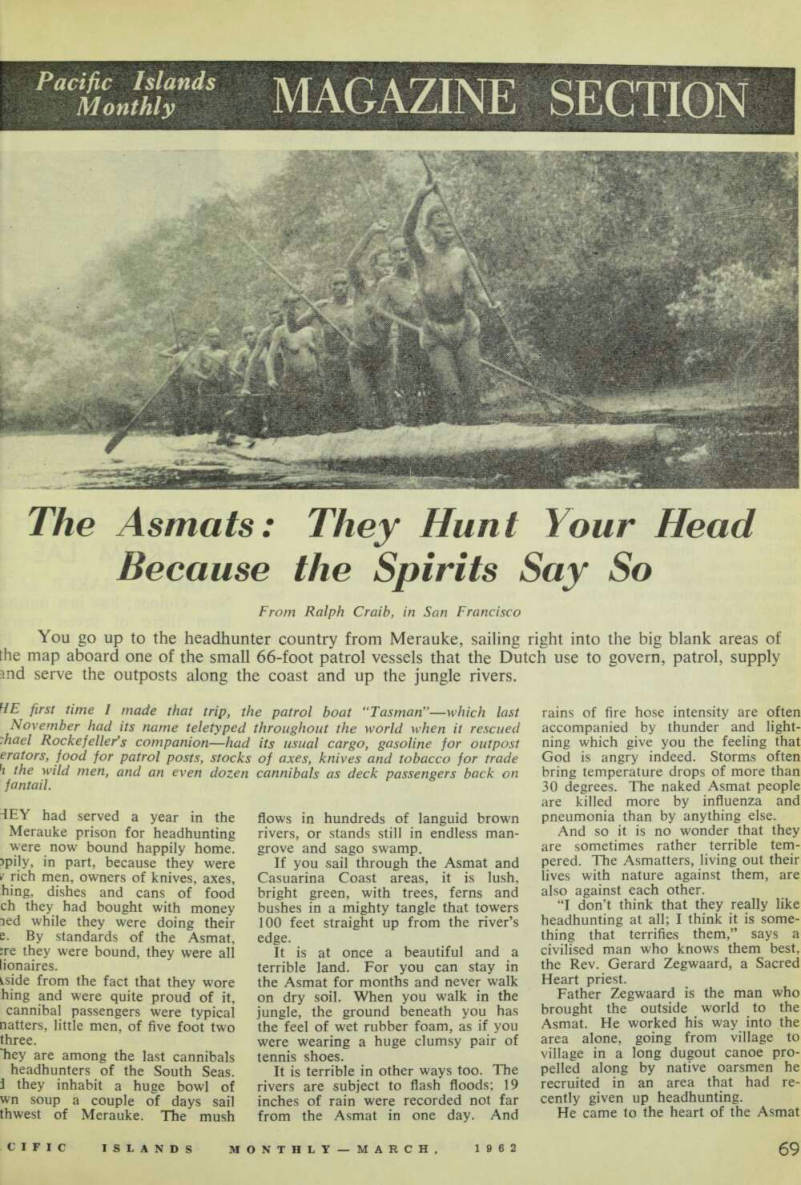
HE first time I made that trip, the patrol boat “Tasman” —which last November had its name teletyped throughout the world when it rescued :hael Rockefeller’s companion—had its usual cargo, gasoline for outpost erators, food for patrol posts, stocks of axes, knives and tobacco for trade h the wild men, and an even dozen cannibals as deck passengers back on fantail.
-lEY had served a year in the Merauke prison for headhunting were now bound happily home, jpily, in part, because they were v rich men, owners of knives, axes, hing, dishes and cans of food ch they had bought with money led while they were doing their e. By standards of the Asmat, :re they were bound, they were all lionaires. kside from the fact that they wore hing and were quite proud of it, cannibal passengers were typical natters, little men, of five foot two three.
Tiey are among the last cannibals headhunters of the South Seas. 3 they inhabit a huge bowl of wn soup a couple of days sail thwest of Merauke. The mush
flows in hundreds of languid brown rivers, or stands still in endless man grove and sago swamp.
If you sail through the Asmat and Casuarina Coast areas, it is lush, bright green, with trees, ferns and bushes in a mighty tangle that towers 100 feet straight up from the river’s edge.
It is at once a beautiful and a terrible land. For you can stay in the Asmat for months and never walk on dry soil. When you walk in the jungle, the ground beneath you has the feel of wet rubber foam, as if you were wearing a huge clumsy pair of tennis shoes.
It is terrible in other ways too. The rivers are subject to flash floods; 19 inches of rain were recorded not far from the Asmat in one day. And
rains of fire hose intensity are often accompanied by thunder and light ning which give you the feeling that God is angry indeed. Storms often bring temperature drops of more than 30 degrees. The naked Asmat people are killed more by influenza and pneumonia than by anything else.
And so it is no wonder that they are sometimes rather terrible tem pered. The Asmatters, living out their lives with nature against them, are also against each other.
“I don’t think that they really like headhunting at all; I think it is some thing that terrifies them,” says a civilised man who knows them best, the Rev. Gerard Zegwaard, a Sacred Heart priest.
Father Zegwaard is the man who brought the outside world to the Asmat. He worked his way into the area alone, going from village to village in a long dugout canoe pro pelled along by native oarsmen he recruited in an area that had re cently given up headhunting.
He came to the heart of the Asmat
area in 1952 and set about building a house and a church and making friends with the headhunters. In the three years after his arrival in 1952, he recorded 750 deaths in headhunting raids in a population estimated at 20,000.
The priest is a towering six-footer; a giant alongside any Asmat man.
His size and his white skin awed them. And they could only explain his presence among them in terms of what they already knew and be lieved.
He was obviously a god, an an cestor returned. In one instance, they had real reason to believe this. A patrol plane searching for the priest flew low over a village; a few days later, there was a measles outbreak.
The villagers thought that any man who could sprinkle red spots on them from the sky must be super natural.
"Necessary"
The Asmat culture, Father Zeg waard learned, rather revolves around the spirits, both good and bad, and they cause almost all things to occur.
The Asmat people headhunt, Father Zegwaard explains, because of what their father’s fathers learned from the spirits. And their cultural pattern has evolved from this knowledge handed down by word of mouth from generation to generation. Today, they quite believe it is absolutely neces sary to have a new human head for proper initiation, to insure fertility in marriage, to give a newborn baby the name and the strength possessed by the head’s former user, and to propitiate the spirits of any person in a village who dies.
Headhunting and cannibalism are thus highly ritualistic with the Asmat people. The butchering of a human victim with a razor-sharp bamboo knife is governed by niceties of proto col which dictate how and where cuts will be made and where, when and by whom bits and pieces will be
eaten. The taking of victims also involves a neatly regulated ritual, al though it is much more flexible.
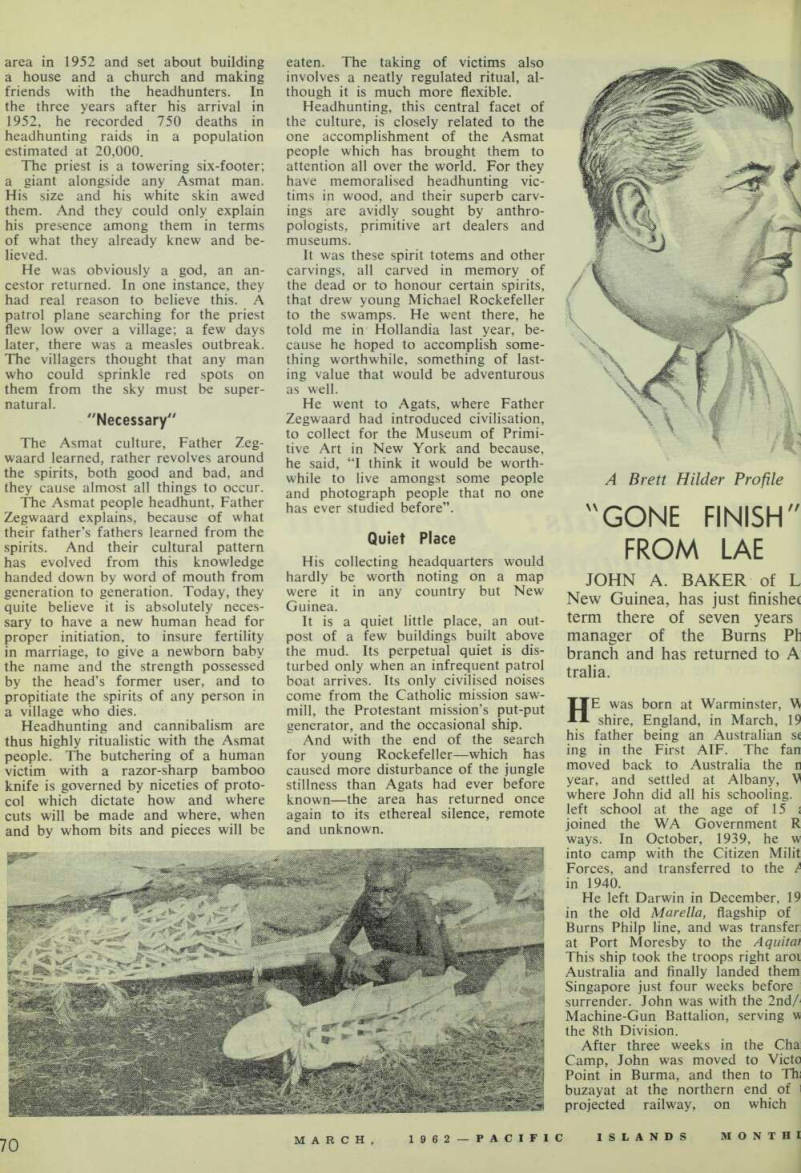
Headhunting, this central facet of the culture, is closely related to the one accomplishment of the Asmat people which has brought them to attention all over the world. For they have memoralised headhunting vic tims in wood, and their superb carv ings are avidly sought by anthro pologists, primitive art dealers and museums.
It was these spirit totems and other carvings, all carved in memory of the dead or to honour certain spirits, that drew young Michael Rockefeller to the swamps. He went there, he told me in Hollandia last year, be cause he hoped to accomplish some thing worthwhile, something of last ing value that would be adventurous as well.
He went to Agats, where Father Zegwaard had introduced civilisation, to collect for the Museum of Primi tive Art in New York and because, he said, “I think it would be worth while to live amongst some people and photograph people that no one has ever studied before”.
Quiet Place His collecting headquarters would hardly be worth noting on a map were it in any country but New Guinea.
It is a quiet little place, an out post of a few buildings built above the mud. Its perpetual quiet is dis turbed only when an infrequent patrol boat arrives. Its only civilised noises come from the Catholic mission saw mill, the Protestant mission’s put-put generator, and the occasional ship.
And with the end of the search for young Rockefeller —which has caused more disturbance of the jungle stillness than Agats had ever before known—the area has returned once again to its ethereal silence, remote and unknown.