Malaria Can
pp. 65-67 · Read in the full issue

Be Beaten
Malaria still exerts a strangle hold on many millions of the world's population yet the ex perts can see complete eradica tion in the foreseeable future. In jrder to underline this conten tion, the World Health Organisa tion recently devoted a special ssue of its magazine “World Health” to the disease. [ALARIA is one of the oldest diseases of man—he probably fered from it before he came down ; of the trees—but it was only k'ards the end of the last century ,t the cause of it was discovered: >od parasites transmitted from man man by the bite of the female )pheles mosquito.
Fhe name—malaria—gives the key what, before that, was believed to the cause. It is an Italian word i simply means “bad air”. The asmas of swampy places were be /ed to bring on fever but some iv or other the fact that these ces also bred mosquitoes was con tently over-looked, in recent centuries malaria has in confined mostly to the tropical 3 semi-tropical areas of the world t in earlier times it was also wide ead in Europe. As most school ildren know, Holland was ilarious and William of Orange io became King of England suffered
from the disease. So did Oliver Cromwell; it is said to have been a complicating factor in his death.
Man knew the cure for malaria before he knew what caused it. In fusions from the bark of a certain South American tree were effective and this knowledge was passed on by the Indians to their Spanish con querors. The bark was one of the many things—including potatoes and tobacco —which the New World gave to Europe.
The bark reached Europe about 1630 and the tree from which it came was named Cinchona, after a Spanish noblewoman, wife of the Viceroy of Peru, who was cured of the fever by an infusion of the bark. Her name was Dona Francisca Henriquez de Ribera, and he was fourth Count of Chinchon as well as Viceroy. The tree’s name, in the course of the centuries, was corrupted to Cinchona and it was found in time that the extract from it, quinine, not only could cure a bout of malaria but, if taken regularly, could prevent it.
Dutch Monopoly
Towards the end of last century and early in this, plantations of cinchona trees, from seeds brought from South America, were started in many tropical countries but it was most successfully grown by the Dutch in their East Indies and be-
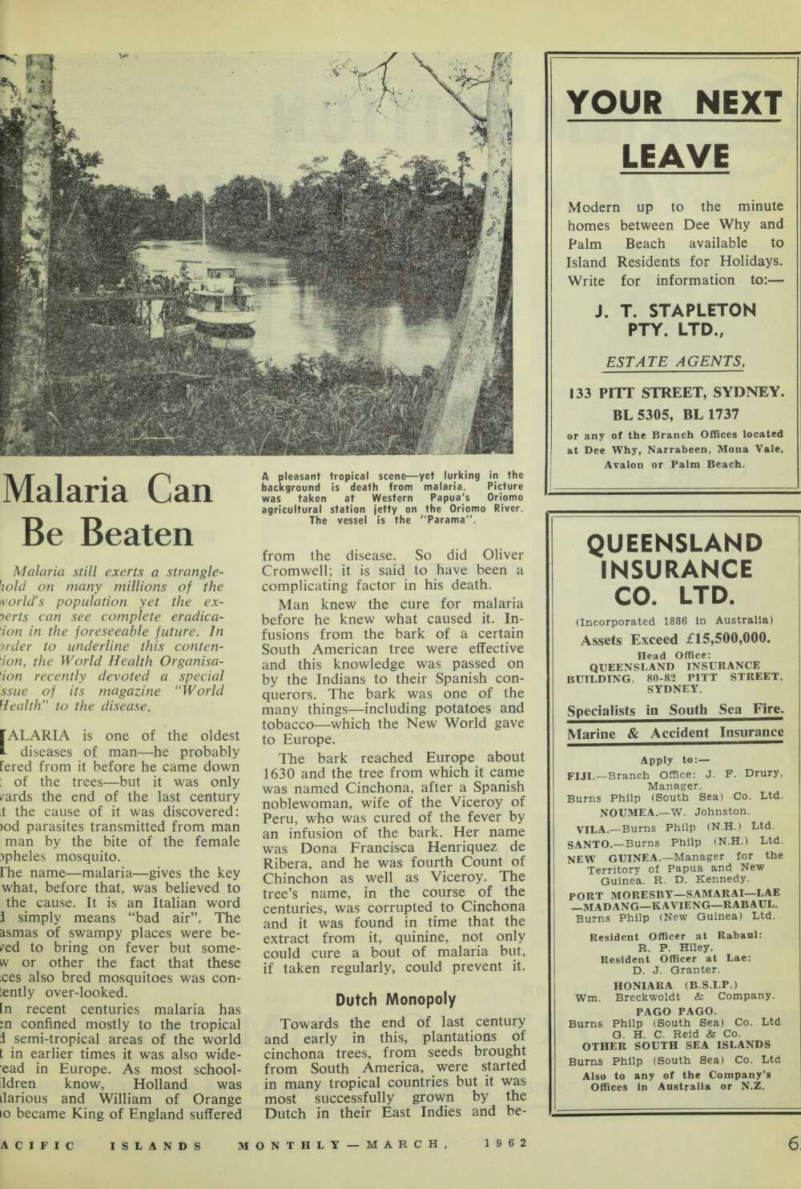
A pleasant tropical scene —yet lurking in the background is death from malaria. Picture was taken at Western Papua's Oriomo agricultural station jetty on the Oriomo River.
The vessel is the "Parama".
F een the wars they had a virtual onopoly of it.
It was the First World War and t fact that the Germans had been t off from supplies of natural inine for their troops in Africa, at stimulated the first efforts to irds manufacturing a synthetic.
The German chemists of the I.
Farben company were the first come up with an ersatz, a deriva e of coal-tar. In the late 1930’s refinement of this, atebrin, became ill-known in malarial countries :h as New Guinea and the Solo ms, although one unfortunate side ect of this drug was the bright, indiced yellow skin-colour that lowed treatment in most patients.
When the Japanese over-ran the itch East Indies during the Pacific ar, the bulk of the world’s supplies quinine fell into their hands and : Allies were in the same position ; Germans had been in the First ar —they had to make do with syn dics. Fortunately, the composition atebrin was well-known and the Jge of service in the South West cific theatre of war came to be an brin-yellow complexion.
It's Preventable As time went on, other synthetic :i-malarials were perfected, lead : to such drugs as paludrine, camo in and others in use today.
So effective are modern drugs that such places as Papua-New Guinea laria is now regarded as an en fly preventable disease—so long the correct drugs are taken ;ularly as suppressives.
Fhe modern treatment of malaria medicine has been paralleled in ny countries by an onslaught on 1 breeding places of the carriers mass spraying of DDT and other verful insecticides from the air I ground.
Vlan himself, of course, provides pool of infection but it is calcu -2d that if this chain can be broken I transmission continuously in rupted for three years, malaria i be said to have been eradicated m a given area. It then needs only ilance to see that there is no re
ection from neighbouring areas.
Fhe difficulties of malaria eradica n from areas of crowded, under vileged populations are not diffi t to imagine. The disease itself :eds apathy and inertia and even it were only a question of pro ling the necessary pills many uld fail to take them out of sheer lorance or carelessness. Various :ans of overcoming this in under vileped societies have been tried one of the most successful ways
being the addition of anti-malarials to all cooking salt. In this way the whole community gets them whether they want them or not. This has been tried in Brazil, certain countries in Asia and Africa and in Dutch New Guinea.
Malaria Control Areas In areas like Australian New Guinea, the Administration has pinned its faith almost entirely in residual spraying and not attempted mass medication with malaria sup pressives. In certain areas of the Territory—notably the Maprik sub district of the Sepik—a special branch of the Department of Health has undertaken spraying of every hut, house and building for a certain distance up the inside walls. The theory is that after feeding, the anopheles mosquito immediately flies to a wall and rests there, within three or four feet of floor level. The residual insecticide that has been sprayed there does the rest—contact ultimately kills off the mosquito.
It is obvious that with the anti malarial measures now available— drugs, insecticides and new tech niques with both—malaria could be stamped out. But as the countries where malaria is rife are usually the most primitive and backward the difficulties of the campaign on a world scale are equally obvious.
But even where control is only partial, the results show clearly an increase in the vigour and produc tivity of the people, better general health and—above all—lower infant mortality and increased birth rate.
It is this last that makes the big, big question mark. The total eradica tion of malaria will cause world populations to explode with an even bigger bang than at present. Is this a good thing? The World Health Organisation says yes. Hard-bitten realists might think otherwise.