New Guinea's
pp. 61-63 · Read in the full issue
War Is Not Yet Over
From a New Guinea Correspondent A man with one of the few “live dangerously” jobs left in these comparatively civilised days of Papua-New Guinea is Corporal Alan Brown, 37, of
the Royal Australian Engineers.
HE’S a full-time Australian Army expert in the bomb disposal busi ness, and he can be seen just about anywhere in the coastal regions of P-NG, hot on the trail of forgotten explosives.
He has plenty of work to do. Ex plosive dumps and odd bombs are being uncovered all the time, despite the fact that it’s now 16 years since the war ended. A 1,000 lb bomb was uncovered recently by a bulldozer on a main road from Rabaul —and was found to be too dangerous to move.
Alan Brown detonated it where it lay.
Alan Brown estimates he has dis
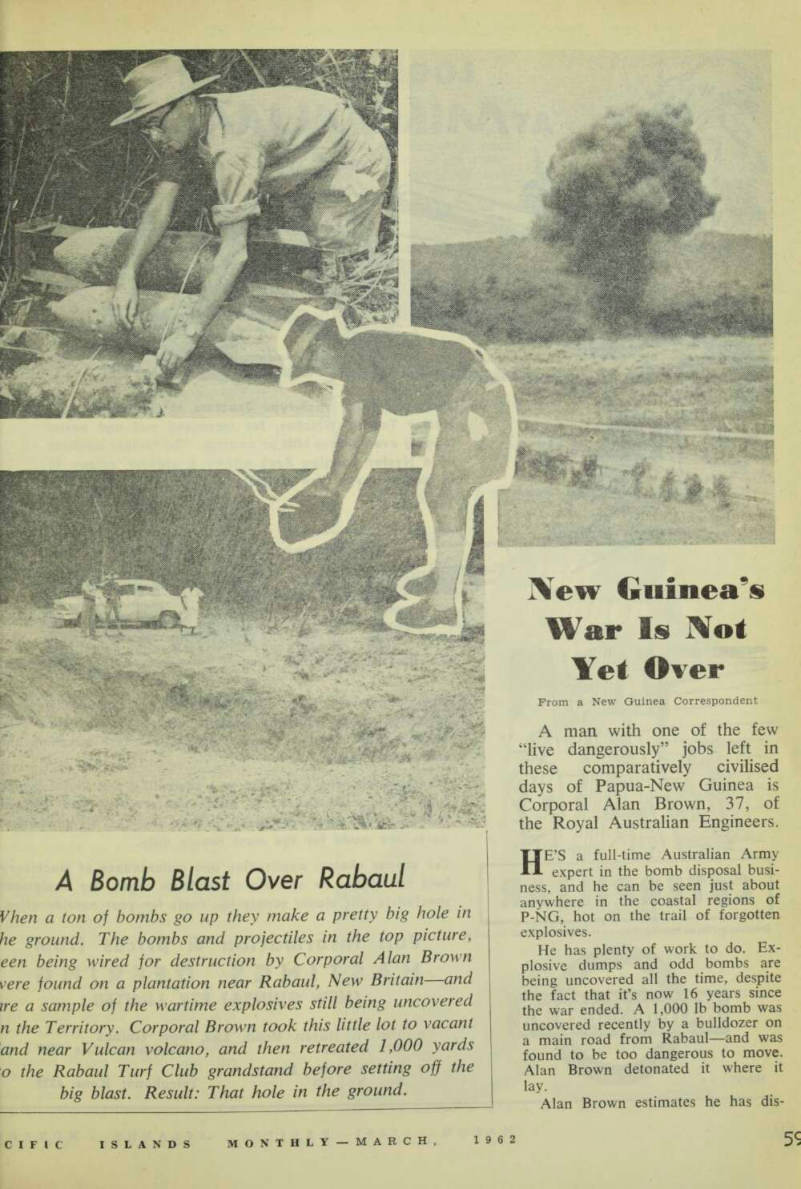
d of about 460 tons of wartime osives in P-NG—his biggest single being the detonation of 42 1,000 tombs at Cape Gloucester, New lin. He does not always explode bs —often he dumps them, s a man who knows better than t just how dangerous old ex ves can be, he repeatedly warns ile to be careful in burning-off, icularly in the Gazelle Peninsula of New Britain. And he can’t srstand the stupidity of people remove explosive from bombs use it to blast fish. He says it’s a I way of losing a hand or two, there are plenty of cases to prove hen recently I heard he was g to “blow” about 2,500 lb of bs and projectiles that had been >vered on a plantation about four s from Rabaul, I joined the party 2e the corporal at work, ormally if a bomb or projectile ife to transport, Cpl. Brown pre to dump it at sea, but on this sion no vessel was available and only other course was to detonate lot on land adjacent to the aul Amateur Turf Club’s race se at the foothills of Vulcan ano, a few miles from Rabaul.
Observatory Warned
the bombs —Japanese and ;rican—were stacked, pyramid ion, in a small crater from a ious blast, Alan Brown placed e slabs of TNT amongst them, connected these—by a fuse-like nating charge, which itself ex les at 2,000 metres per second— n electrical cable. Native helpers this cable to the grandstand about K) yards away, where we all took ter against fragments and shrap he blast was set down for 11 a.m.
Rabaul vulcanological observa was advised of this so that any irding made on the seismographs ild not be confused with earth cements. As the hour approached, . Brown blew a warning signal, connected a generator to produce current required to travel those )0 yards and explode the detonat charge. romptly at 11 a.m. he completed circuit. Instantly there was a liant fiery flash, and a roar, as lust cloud started to climb sky ds. Almost immediately, a blast air rushed around us, and pieces shrapnel began to fall near the ndstand. dan Brown tilted his hat back, ed his sweating forehead, and for
a moment appeared grateful that another blast had gone off well.
The blast had widened the crater to 35 ft., and to a depth of about 15 ft., and had cut a swathe of kunai grass right around the crater.
We found a stunned but very much alive toad in the bottom of the crater, hopping about. As clouds of sand flies swarmed around us in ven geance, we beat a retreat back to Rabaul to a cool beer.
Corporal Alan Brown, who went to Australia from England 11 years ago, looks what he is—a quiet family man.
He likes his job. “It gives me a chance to see the Territory,” he ex plains.