Needs Help
pp. 33-37 · Read in the full issue
Papua's Milne Bay
From a Milne Bay Correspondent The Milne Bay district of Papua—once the Papuan Terri fy’s economic mainstay—is in serious trouble. There is gloom er the district—there is unhappiness and frustration in the y nous headquarters island of Samarai.
-NE Bay is stagnating, and there is no hope of arresting it the Government solves the two problems that have caused the ;y are: The need for air communica- The need for a new head ers in place of the 57-acre island amarai which has long been ng at the seams, tiarai, one of Papua-New :a’s biggest copra shipping is the heartbeat of a district takes in 82,000 square miles of lainland of eastern Papua, 160 1 islands and 500 scattered and atolls. ;re are 87,000 natives in this t—among the most advanced
in the Territory, with the literacy rate comparatively high. Their wealth is second only to that of the much publicised Tolai of Rabaul.
Value of exports from Milne Bay for 1960 was more than £1 million, and trade turnover was closer to £1,750,000.
Yet officially Milne Bay seems to be regarded as a “dying district”, ac cording to planter John Stuntz, MLC for Eastern Papua. Mr. Stuntz, a battler for this district—and the dis trict certainly needs one—leads a group of businessmen, planters, Gov ernment officers and just plain ordin ary residents who have been press ing for action from the Administra tion.
There are plenty of bright pros pects—especially from tuna fishing—
if only the district can be given the shot in the arm it needs from the Government.
Samarai, once the “Pearl of the Pacific”, is developing slum aspects because of its lack of living room.
In its 57 acres it houses 254 Euro peans and some of the 900 natives employed on the island. The others live on nearby islands and travel to work by boat.
Samarai has two sizeable stores, overseas wharves, storage depots.
Shell and Vacuum oil installations, two hospitals, a school, churches and all the adjuncts of a small town.
But, it has only one direct air link —the weekly Catalina flying-boat from Moresby—doomed to extinc tion when the aged Catalina is re tired.
The alternative is a four-and-a-half to six-hour trip by workboat to the nearest land plane at Gurney air strip at the head of Milne Bay. There
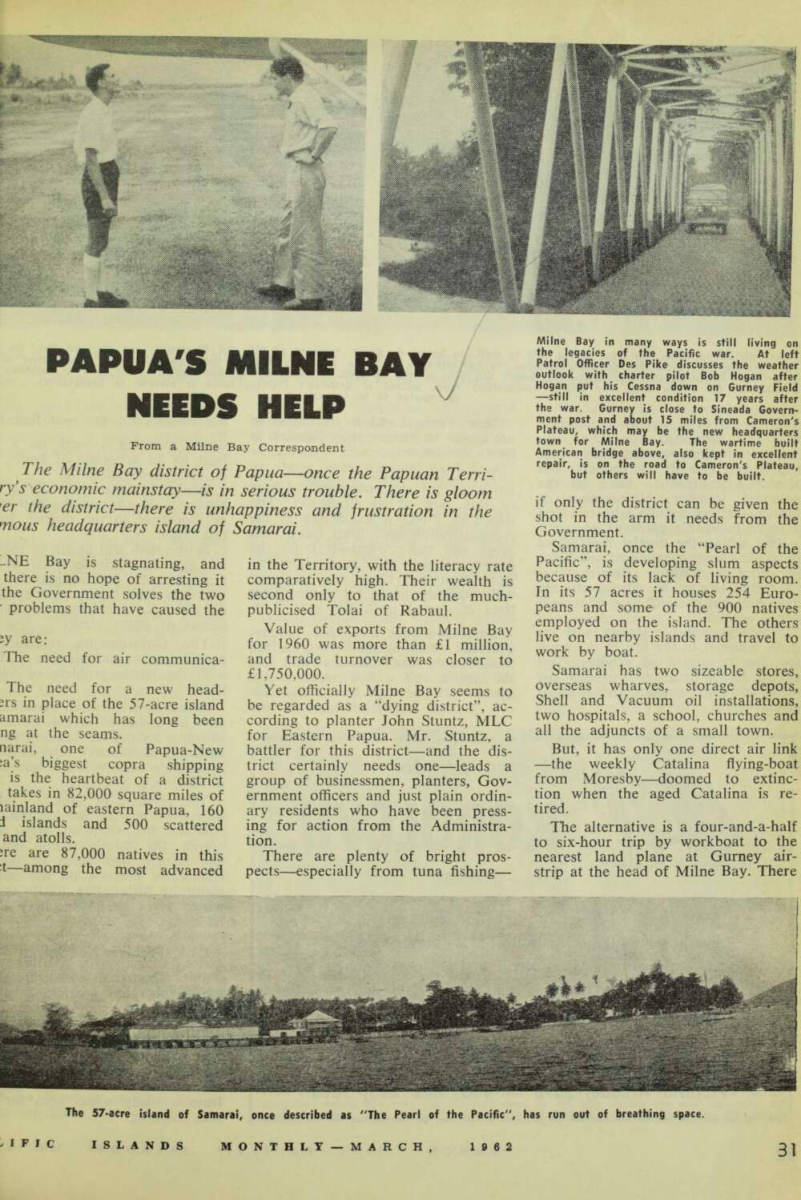
Milne Bay in many ways is still living on the legacies of the Pacific war. At left Patrol Officer Des Pike discusses the weather outlook with charter pilot Bob Hogan after Hogan put his Cessna down on Gurney Field —still in excellent condition 17 years after the war. Gurney is close to Sineada Govern ment post and about 15 miles from Cameron's Plateau, which may be the new headquarters town for Milne Bay. The wartime built American bridge above, also kept in excellent repair, is on the road to Cameron's Plateau, but others will have to be built.
The 57-acre island of Samarai, once described as "The Pearl of the Pacific", has run out of breathing space.
a DCS makes a weekly connection with Port Moresby.
The slow, hot, uncomfortable boat trip is bad enough for residents but almost guaranteed to head off the potential investor, businessman or tourist—in fact anyone who can find a more accessible place to go.
And within the district itself there is no air communication at all! Since it’s been a maritime district from its earliest days, the official attitude has been that it might as well remain one.
Water transport certainly will re main essential to the life of the area, for the movement of produce, and stores, but aircraft are needed for mails, personal contact and medical emergencies.
New York, London and Moscow are closer to Sydney than Samarai is to its outstations.
The Administration suffers as much as private enterprise because of this lack of air transport. The whole of P-NG is expanding as the Administration finds itself faced with more and more demands from the native people, and more hurry-up from Australia. There are Territory wide staff shortages, yet Government time is wasted in Milne Bay.
Correspondence on vital matters can take weeks by small boat surface mail. Boats can’t always wait for the replies, so a few more weeks go by until the next boat calls. Offi cers making inspection trips to iron
out matters on the spot find th< selves spending a week on a sr boat to do a couple of hours w at their destination.
While this state of affairs ex prospects of encouraging new cap or industries to the district are too bright.
In the rush and bustle of the 1 air age, few private firms or e Government instrumentalities afford to send highly paid execut: on surveys which may involve sences of many weeks.
The Government’s reluctance provide air communication is lin with the whole problem of Sam itself.
Department of Civil Aviation veys have shown there is no suits site near enough to Samarai for ( struction of a heavy aircraft strip reasonable cost. Sites for lig" airfields are available.
The problem of Samarai could solved by moving headquarters t new site. But where to? After a 1 search, the Administration not 1 ago bought 365 acres of land Cameron’s Plateau, on the nortl shore of Milne Bay itself—the which gives the Milne Bay disi its name.
Problem Not Solved But Cameron’s Plateau doe really solve the problem at all, cording to the people of the M Bay district. There is mounting n tance to this site.
It is about 3i hours by boat f Samarai, twelve road miles from j time Gurney airstrip and six n from a likely wharf area for o seas shipping.
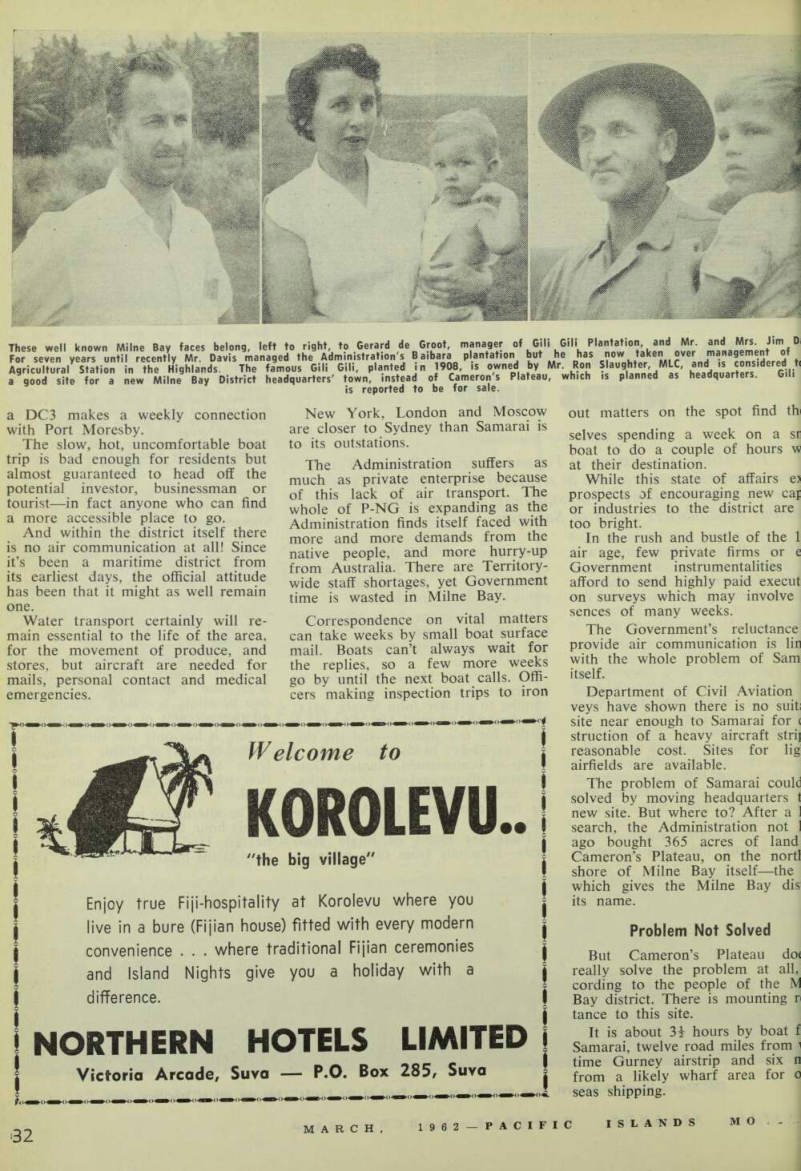
These well known Milne Bay faces belong, left to right, to Gerard de Groot, manager of Gili Gili Plantation and Mr and Mrs Jut 1 For seven years until recently Mr. Davis managed the Administration's Baibara plantation but he has now taken over t[?] Agricultural Station in the Highlands. The famous Gill Gill, planted in 1908, is owned by Mr. Ron Sl au ghter, MLC, and is considered t[?] a good site for a new Milne Bay District headquarters' town, instead of Cameron s Plateau, which is planned as headquarters. G is reported to be for sale.
far, some land has been cleared work is expected to start soon onstructing a small number of pean houses and native quarters, to be followed by a hospital school. As a first step, some rnment staff will move from xai when the houses are avail and this will help to relieve sland’s acute housing shortage, the March meeting of the Milne District Advisory Council, bers spoke out strongly against :hoice of Cameron’s, and un ausly adopted a motion calling “immediate consideration” of sites nearer to Gurney air and harbour facilities. Mem requested the Administrator to the area to inspect the sites, hen confer with the Council, e motion reaffirmed the Coun belief that a relief town should ;stablished —but made it clear Cameron’s wasn’t it.
Varied Arguments
guments against the site are 1. Some think 365 acres doesn’t for expansion and that as the rnment encountered difficulty aalising purchase of even that from the natives, the prospects btaining more are not bright, think Cameron’s in the distant 2 could become another rai. Some claim it’s too far from ey airstrip twelve miles away, the wharf site and native ughfares, and that anchorages nadequate. tether the Government goes I with Cameron’s Plateau or it is obvious that many years elapse before the new town, ;ver its site, can become a sub ; for Samarai or even an im nt satellite.
Funds and equipment which could accomplish the job along the lines of southern high pressure town de velopment schemes simply aren’t available there. Samarai can’t be de serted overnight, and is unlikely to be deserted at all.
The danger, as people like Mr.
Stuntz see it, is that the development of the new township could over shadow the immediate and urgent problem of providing Samarai and Milne Bay District as a whole with an aerial network.
Local people claim business would support a three or four times weekly air service between Port Moresby and Samarai carrying passengers, mails and freight. This should be carried out by light aircraft based near Samarai.
The strip could also be a base for a small twin engined aircraft for use within the district.
At Goodenough, the Trobriands and Woodlark islands there are already good wartime tarmac strips in good condition. There are light aircraft strips at Raba Raba on the mainland’s north-east coast, Agaun in the mainland mountains, Cape Vogel on the north coast.
Other strips could be built at no great cost to serve isolated communi ties such as Misima and provide a network to give the district the means of direct contact it must have to ex pand.
The Department of Civil Aviation has surveyed a site at Loani on the mainland opposite Samarai where its officers reported a strip could be put
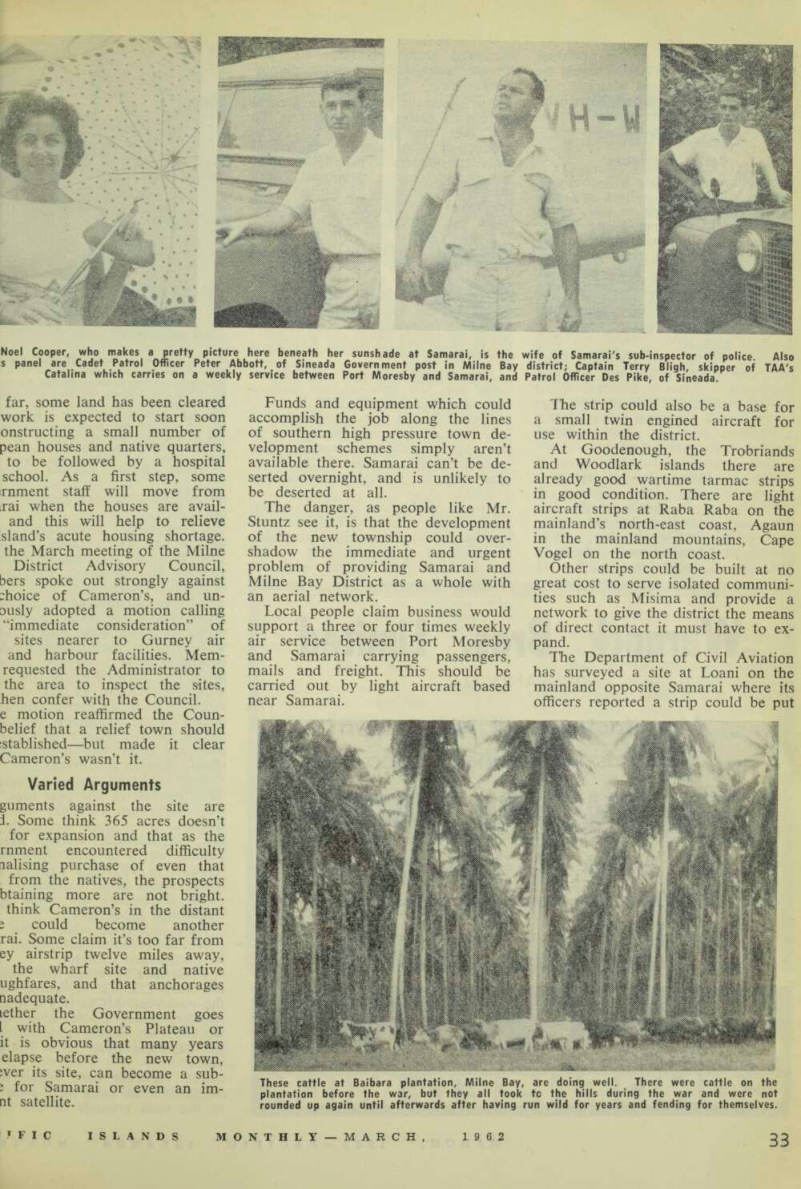
Noel Cooper, who makes a pretty picture here beneath her sunshade at Samarai, is the wife of Samarai's sub-inspector of police. Also s panel are Cadet Patrol Officer Peter Abbott, of Sineada Government post in Milne Bay district; Captain Terry Bligh, skipper of TAA's Catalina which carries on a weekly service between Port Moresby and Samarai, and Patrol Officer Des Pike, of Sineada
These cattle at Baibara plantation, Milne Bay, are doing well. There were cattle on the plantation before the war, but they all took to the hills during the war and were not rounded up again until afterwards after having run wild for years and fending for themselves.
in at a cost of not more than £30,000. An extra £lO,OOO would be needed for a road and wharf.
But this site and others have been turned down for one reason or an other.
Battle Continues Meantime the battle will continue.
John Stuntz and others are pre paring fresh ammunition with which they hope to hammer home to the Minister the importance of Milne Bay District and the need for recog nition of its needs. They have the backing of most of the community.
Facts and figures on the area’s actual production and general po tential which they have already as sembled include: Copra : In the past five years there has been a steady increase in copra shipments from Samarai—from 82,000 bags in 1957 to 100,000 bags in 1961 with a current value of half a million pounds, notwithstanding present low copra prices.
The impression that the copra in dustry in Milne Bay is dying is erroneous, says John Stuntz. It probably has its origin in the fact that many plantations are old, dating back to the first World War, and in consequence production has declined.
But, this is being largely offset by
increased native plantings arid im proved techniques on other planta tions.
An important point in the general pattern of native development is the fact that one eighth of all copra production is marketed by individual native producers. This figure does not include native produced copra marketed through native co operatives and traders, which would make the percentage much higher.
Rubber: There are 5,000 acres of unoccupied Crown land in Sagarai Valley which has already proved it self good rubber land on the results of rubber plantings already estab lished in the valley. The valley is accessible from Mullins Harbour and could be linked to Milne Bay by a few miles of road.
The district’s present rubber ex ports are 370 tons a year with a current value of £105,000.
Cocoa: In the past ten years cocoa has been introduced. Production of this crop is steadily increasing. Pre sent production totals 70 tons per year with an approximate value of £15,000.
Cocoa production has been exclu sively in the hands of European en terprise, which is steadily increasing plantings of this crop. But it will no doubt attract natives who are
already showing keen interest in c fee.
Coffee: Coffee production from district has now reached 20 tom year with an approximate value £5,000. Though small, the indus is steadily increasing.
It is being fostered in the inli areas to give the people a source revenue. In the past they’ve lob with envy at their copra produc coastal brothers and see in co: prospects of wealth for their c area. At Wedau, £4,000 was p out this year to native coffee p ducers in the mountains behind centre. In five years time when r plantings come into production should develop to £30,000.
Shell: Without organised effort direction natives last year took tr the sea about £20,000 worth trochus, green snail, beche de n etc.; in addition several thous; pounds worth of gold lip shell 1 shipped to Highland centres wh local natives prize it greatly.
All these then are some of established industries.
New industries which offer gi potential if capital investment cc be encouraged include: FISHERIES: While the Territ imported £525,029 of canned fish the past year, Milne Bay district ; adjacent areas house some of world’s best fishing grounds, wh the Japanese have been fishing years.
The Japanese have found it ] worthwhile to send their tuna fl( to the tuna grounds of the Jom
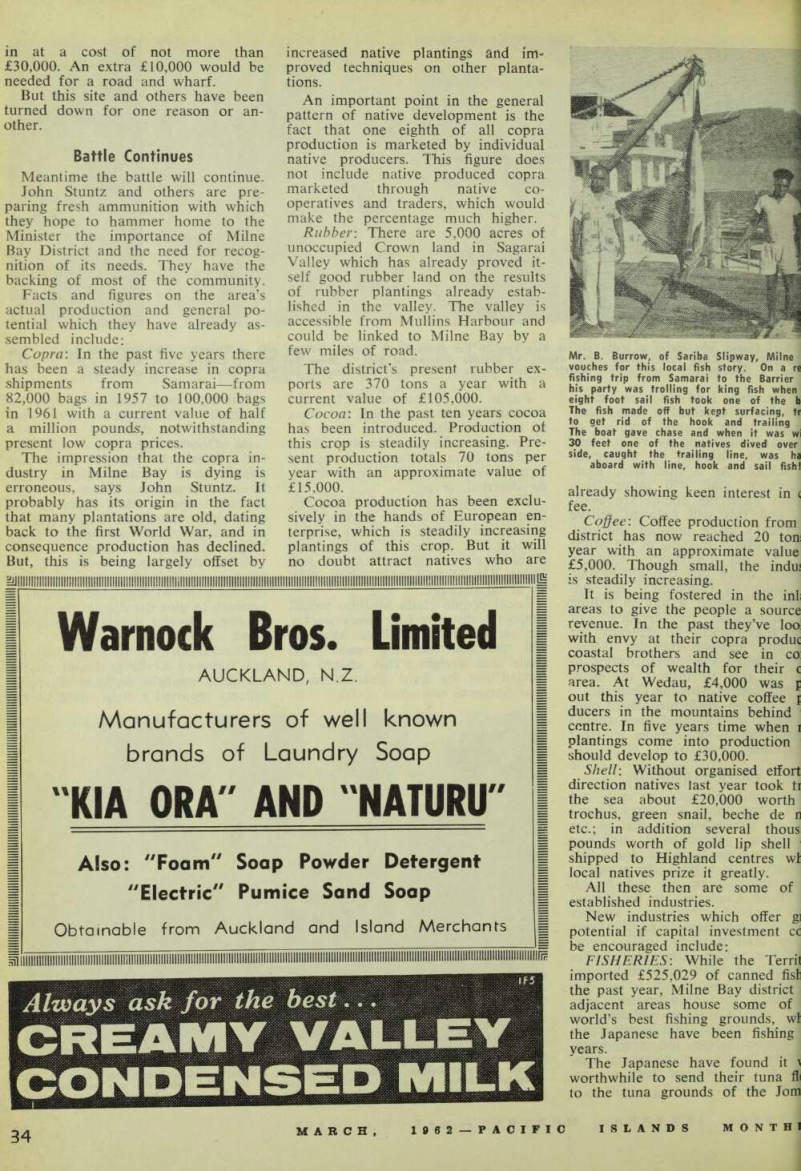
Mr. B. Burrow, of Sariba Slipway, Milne vouches for this local fish story. On a re fishing trip from Samarai to the Barrier his party was trolling for king fish when eight foot sail fish took one of the b[?] The fish made off but kept surfacing, [?] to get rid of the hook and trailing The boat gave chase and when it was wi[?] 30 feet one of the natives dived over side, caught the trailing line, was ha[?] aboard with line, hook and sail fish!
ge, some 70 miles east of Sam where their radio signals can eked up almost any time, squently their boats have called injured seamen or for other aid :rews have reported the grounds >est they have ever encountered, i of the tuna imported to the tory may well come from its waters.
Government officers and private individuals alike would like to see some of this lucrative business flow ing into the district. They believe that if Australia can’t or won’t finance the industry the Japanese should be invited to set up canning and freezing plants in the Milne Bay district.
They believe also that Papuans should have the opportunity to train with the Japanese fleets as has been done in other Pacific Islands. They claim some development is better than none, and industry creates em ployment.
Apart from tuna, fisheries experts have described prawn beds at Oran gerie Bay as the best yet discovered.
Only capital expenditure on equip ment and snap freezing facilities are needed.
The area also has good mackerel trawling grounds and crayfish pros pects could be worth investigating.
Gold : From early in the century to World War II Woodlark and Mis ima islands were big gold producing areas. Since, there has been no great activity but odd rich pockets have been discovered and small quantities of gold still come into Samarai from these areas. At Misima and nearby Sudest, a company will shortly re open the gold mining industry.
At Woodlark Island test drilling and surveying with a view to iron ore production is in progress. The company concerned is believed to be interested in exporting iron ore to Japan.
Other Hopes
Hopes are held for increased ac tivity in these industries: Pumice Deposits ; Pumice dust for lightweight structural concrete abounds in the Esa’ala area. A geo logist recently surveyed the area and samples of the dust are being examined. If the pumice is suitable and markets can be found a sizeable industry could develop with provision of equipment and wharf facilities.
Sulphur: Lease of an area on Fer gusson Island for sulphur mining on a royalty basis was recently gazetted.
Timber : There are valuable timber stands in various parts of the district which have not been fully exploited.
Tourism : If the rest of the Terri tory is jumping on the tourist band waggon, Milne Bay has immense po tential historically, culturally and scenically as well as from the view point of its excellent big game fish ing.
Milne Bay stagnate? Nonsense!
Milne Bay needs—and deserves— help. From there on, it will look after itself—and the rest of the Territory too.
monument on overgrown Turnbull Field, Bay, close to Cameron's Plateau, marks southernmost point of the Japanese ce in the South West Pacific. The reproduced here was erected by Aus [?] forces before the war ended, but the nent is still kept tidy and the surround rass cleared, despite the fact there is sparse population in this part of Milne It's an area which saw some of the fiercest fighting of the war.