Fiji Has A New
pp. 21-22 · Read in the full issue
Newspaper
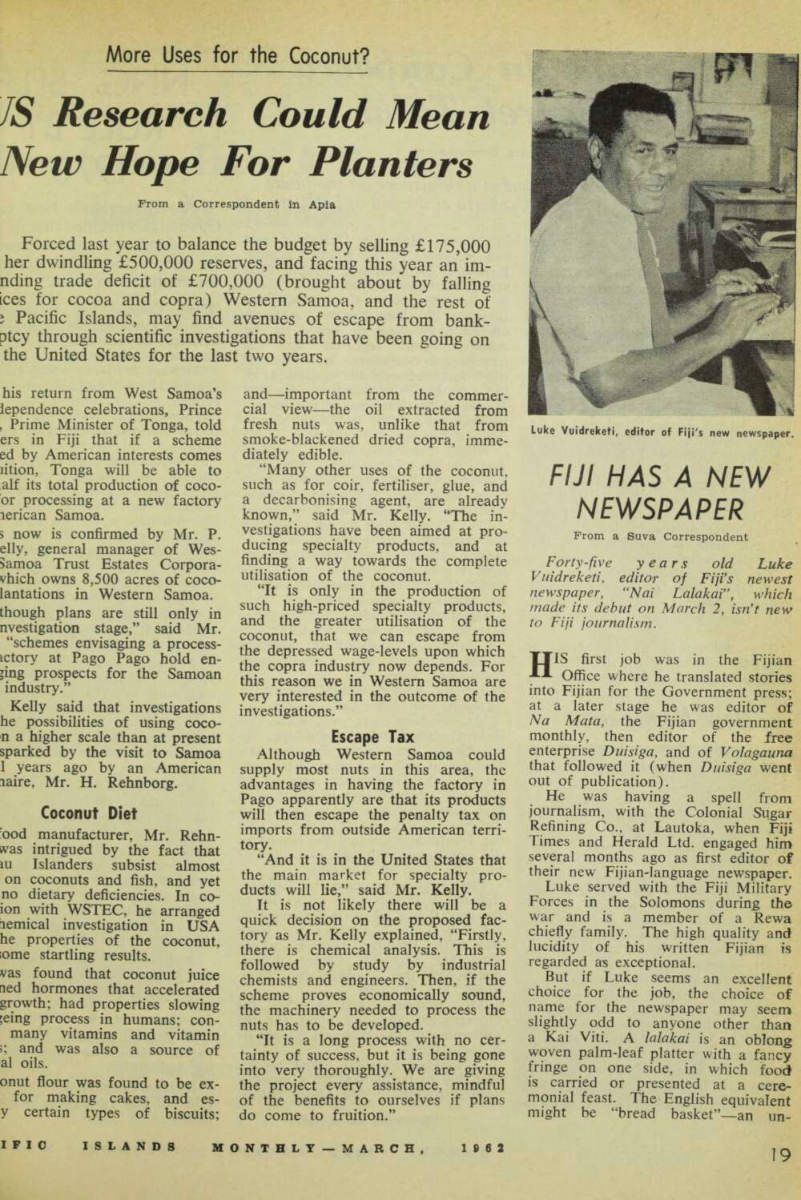
From a Suva Correspondent Forty-five years old Luke Vuidreketi, editor of Fiji’s newest newspaper, “Nai Lalakai”, which made its debut on March 2, isn’t new to Fiji journalism.
TJIS first job was in the Fijian Office where he translated stories into Fijian for the Government press; at a later stage he was editor of Na Mata, the Fijian government monthly, then editor of the free enterprise Duisiga, and of Volagauna that followed it (when Duisiga went out of publication).
He was having a spell from journalism, with the Colonial Sugar Refining Co., at Lautoka, when Fiji Times and Herald Ltd. engaged him several months ago as first editor of their new Fijian-language newspaper.
Luke served with the Fiji Military Forces in the Solomons during the war and is a member of a Rewa chiefly family. The high quality and lucidity of his written Fijian is regarded as exceptional.
But if Luke seems an excellent choice for the job, the choice of name for the newspaper may seem slightly odd to anyone other than a Kai Viti. A lalakai is an oblong woven palm-leaf platter with a fancy fringe on one side, in which food is carried or presented at a cere monial feast. The English equivalent might be “bread basket”—an un
Luke Vuidreketi, editor of Fiji's new newspaper.
likely name for any English language newspaper.
But lalakai, in its newspaper context here, means also “food for the mind and the spirit”, and was •chosen from 800 entries in a com petition run by Fiji Times to find a name for the Fijian language paper.
Nai Lalakai has overseas and local news, with a bias towards special Fijian interests; feature articles, with •the same bias; two serials; plenty of pictures; and a heavy emphasis on sport, overseas and local, in which all Fijians take a big interest.
The new paper rounds out the company’s newspaper enterprises to .cover all three main communities in Fiji. The daily Fiji Times, in English, was established in 1869; Shanti Dut C(SFanti = Pacific; Dut = Herald), a weekly, in Hindi, was established in 1935. Nai Lalakai is also a weekly.