Project in
pp. 19-20 · Read in the full issue
Big New Missile Project in Marshalls
From Ralph Craib in San Francisco One of the largest Pacific Island construction projects undertaken in peacetime—and almost certainly the most hush-hush—is almost finished.
It is the three-year, $75 million construction of a huge missile launch ing complex at Kwajalein, some 4,200 miles southwest of San Francisco and 2,700 miles northeast of Sydney in the Marshall Islands.
The big installation will go into use “sometime this summer”, when tests of the Army’s Nike-Zeus anti missile-missile will begin.
Nike-Zeus is designed to be able to hit enemy missiles in space. The installation at Kwajalein will launch the Nike-Zeus against target nose cones launched towards Kwajalein from Vandenberg Air Force Base in Southern California.
A total of 47 Atlas and Titan inter continental ballistic missiles are to be
fired during the test series, each repre senting an investment of several million dollars. v The target nose cones will be inter cepted by electronic means, not
actually by Nike-Zeus explosive war heads.
The United States Department of Defence has clamped rigid secrecy restrictions on the outcome of the tests. It isn’t going to say what hap pens high over the Pacific when the tests are underway.
The Army has given high priority to Kwajalein. The Corps of En gineers, using contractors from Hono lulu, Alaska and San Antonio, Texas, has built rocket launching cells, radar transmitters of such power that humans can not be allowed within several hundred feet (access is by a 290-foot tunnel), and a huge water supply system.
A 200 x 200 feet building was built to house technical offices, scientific and machine shops. The main radar building alone is a steel and concrete structure 100 x 100 feet and 40 feet high which is air conditioned throughout.
The Army, Navy and Air Force are all involved in the Kwajalein ex periments. The Army will attempt to catch missiles fired by the Air Force down the Pacific Missile Range, which is operated by the Navy.
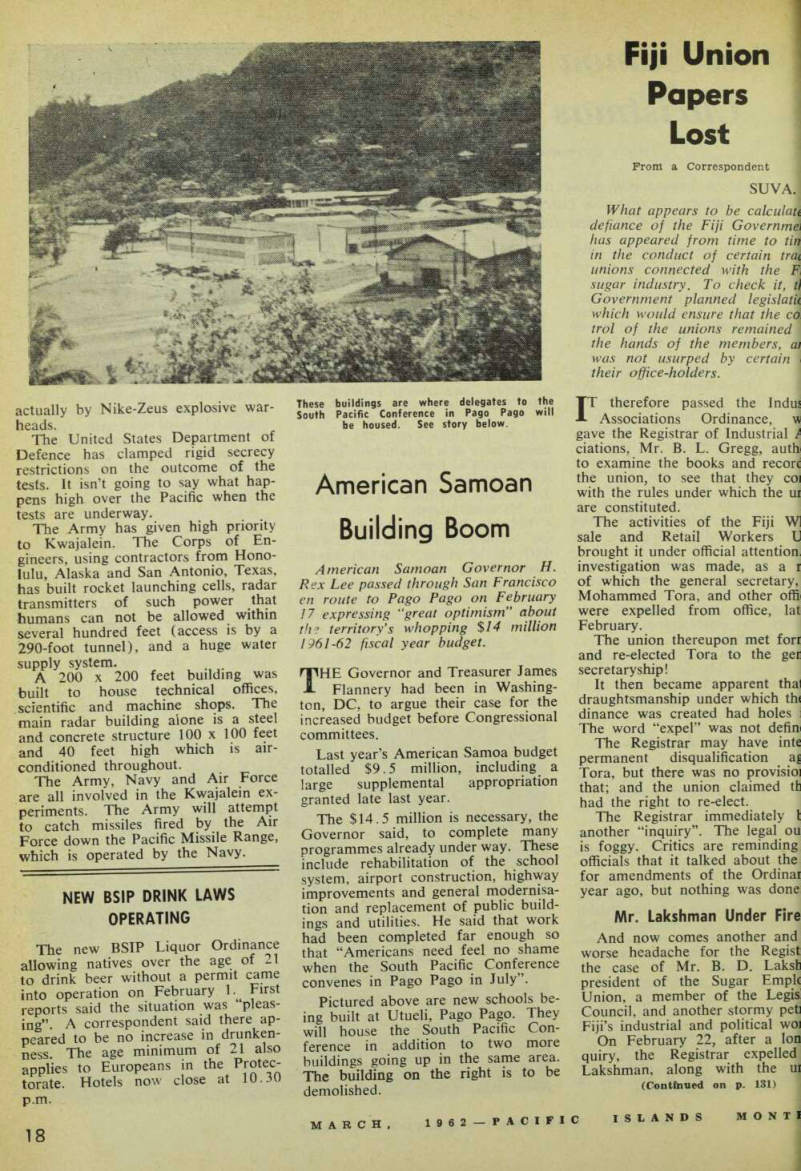
These buildings are where delegates to the South Pacific Conference in Pago Pago will be housed. See story below.