Explodes!
pp. 17-132 · Read in the full issue
Buka Tax Trouble Explodes!
Prom a Correspondent
Rabaul.
Sohano Island (population 45) was bursting at the seams .he end of February with police, Pressmen and well over 600 ives appearing before Madang magistrate Mr. R. Ormsby, d had flown over especially for the occasion.
ALL were charged with riotous be haviour arising out of two in cidents some days earlier when more than 1,000 villagers at the small hamlet of Hahalis, on the east coast of Buka Island, had attacked police sent to arrest some of their number for tax evasion.
In a short space of time what had begun as a “breakaway” movement by a native group terming themselves the Hahalis Native Welfare Society had swelled into a cause celebre which ricocheted in headlines around the world.
It had all the news angles—sex practices, rebels, a rebel leader with a Castro-like beard, all of whom marched left-right-left around their stronghold and even resorted to the abduction of a visiting journalist in order to give their side of the story to the Press.
Missionaries told of having warned the P-NG Administration months be forehand. The same Administration, at first hesitantly, then with rapidly increasing firmness, took a stand.
Police were airlifted to Buka; at first 70, then 70 more—finally another
400 in a grand airlift of a dozen planes which carried, in addition, medical staff and tons of first-aid sup plies.
There was a sharp pitched battle in which the natives, following the traditional Buka style of battling, used women and children in the front line to confuse the “enemy”. Then came another, fiercer clash in which more than 50 villagers and police were hurt, some seriously.
It was very much an anticlimax when, a few days ago, the leaders and men of the Hahalis tax rebels went to the police camp and sur rendered ignominiously.
Their number, 101, was quickly swelled to 170 following police mop ping-up operations in nearby villages.
Then, some days later, a further 170 arrests made at isolated parts of the
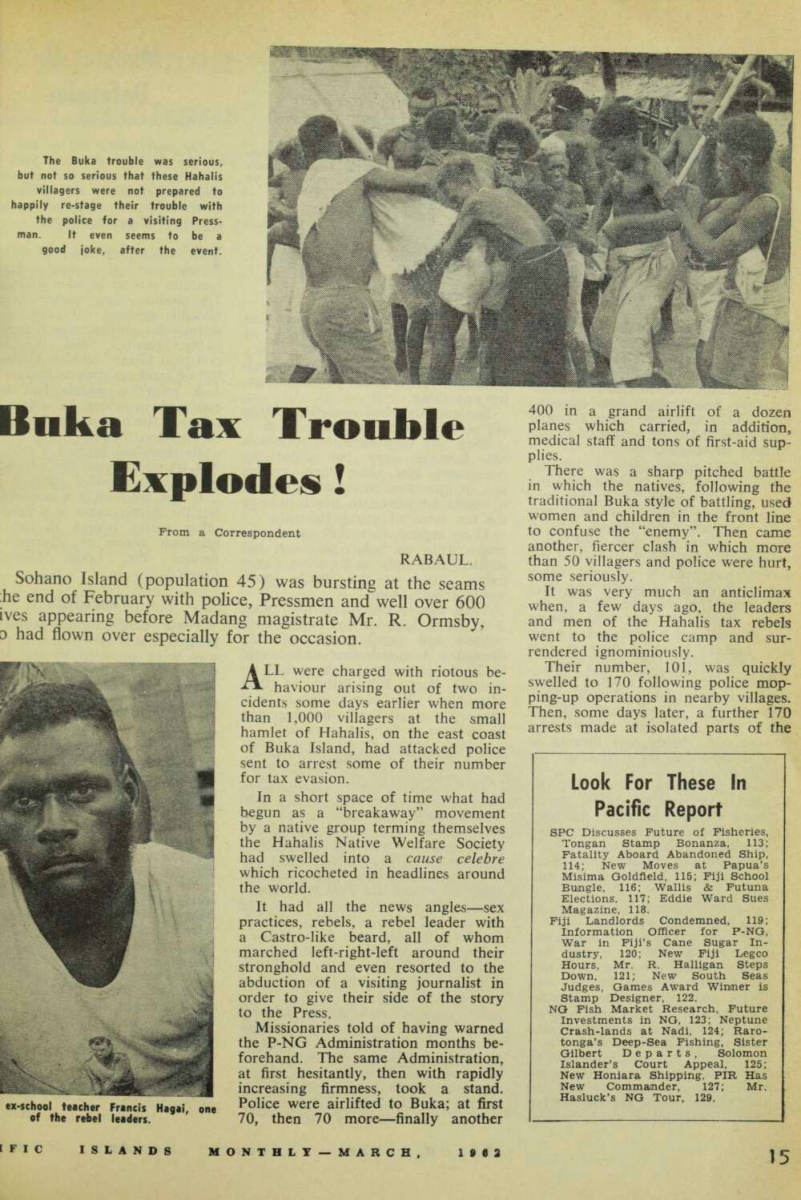
The Buka trouble was serious, but not so serious that these Hahalis villagers were not prepared to happily re-stage their trouble with the police for a visiting Press man. It even seems to be a good joke, after the event.
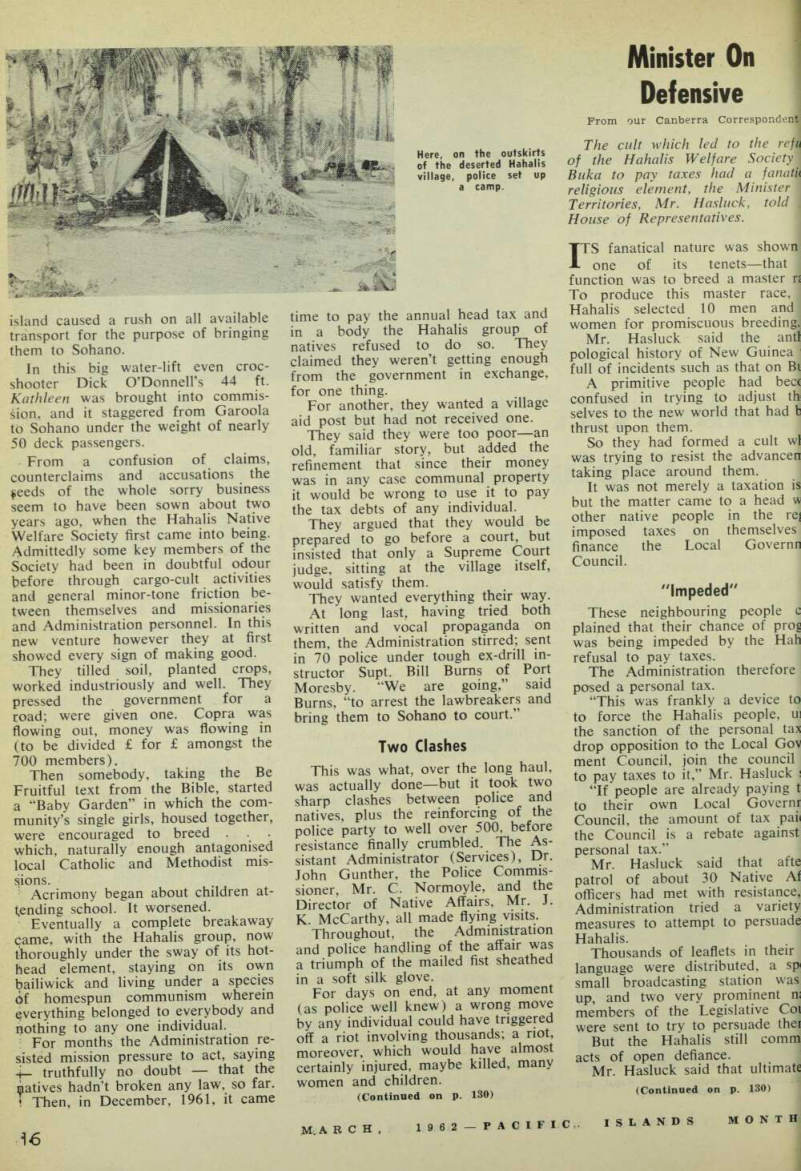
ex-school teacher Francis Hagai, one of the rebel leaders.
island caused a rush on all available transport for the purpose of bringing them to Sohano.
In this big water-lift even croc shooter Dick O’Donnell’s 44 ft.
Kathleen was brought into commis sion, and it staggered from Garoola to Sohano under the weight of nearly 50 deck passengers.
From a confusion of claims, counterclaims and accusations the seeds of the whole sorry business seem to have been sown about two years ago, when the Hahalis Native Welfare Society first came into being.
Admittedly some key members of the Society had been in doubtful odour before through cargo-cult activities and general minor-tone friction be tween themselves and missionaries and Administration personnel. In this new venture however they at first showed every sign of making good.
They tilled soil, planted crops, worked industriously and well. They pressed the government for a road; were given one. Copra was flowing out, money was flowing in (to be divided £ for £ amongst the 700 members).
Then somebody, taking the Be Fruitful text from the Bible, started a “Baby Garden” in which the com munity’s single girls, housed together, were encouraged to breed . • • which, naturally enough antagonised local Catholic and Methodist mis sions.
Acrimony began about children at tending school. It worsened.
Eventually a complete breakaway came, with the Hahalis group, now thoroughly under the sway of its hot head element, staying on its own bailiwick and living under a species 6f homespun communism wherein everything belonged to everybody and nothing to any one individual.
For months the Administration re sisted mission pressure to act, saying -j— truthfully no doubt that the natives hadn’t broken any law, so far. ♦ Then, in December, 1961, it came
time to pay the annual head tax and in a body the Hahalis group of natives refused to do so. They claimed they weren’t getting enough from the government in exchange, for one thing.
For another, they wanted a village aid post but had not received one.
They said they were too poor—an old, familiar story, but added the refinement that since their money was in any case communal property it would be wrong to use it to pay the tax debts of any individual.
They argued that they would be prepared to go before a court, but insisted that only a Supreme Court judge, sitting at the village itself, would satisfy them.
They wanted everything their way.
At long last, having tried both written and vocal propaganda on them, the Administration stirred; sent in 70 police under tough ex-drill in structor Supt. Bill Burns of Port Moresby. “We are going,” said Burns, “to arrest the lawbreakers and bring them to Sohano to court.”
Two Clashes This was what, over the long haul, was actually done —but it took two sharp clashes between police and natives, plus the reinforcing of the police party to well over 500, before resistance finally crumbled. The As sistant Administrator (Services), Dr.
John Gunther, the Police Commis sioner, Mr. C. Normoyle, and the Director of Native Affairs, Mr. J.
K. McCarthy, all made flying visits.
Throughout, the Administration and police handling of the affair was a triumph of the mailed fist sheathed in a soft silk glove.
For days on end, at any moment (as police well knew) a wrong move by any individual could have triggered off a riot involving thousands; a riot, moreover, which would have almost certainly injured, maybe killed, many women and children.
(Continued on p. 130)
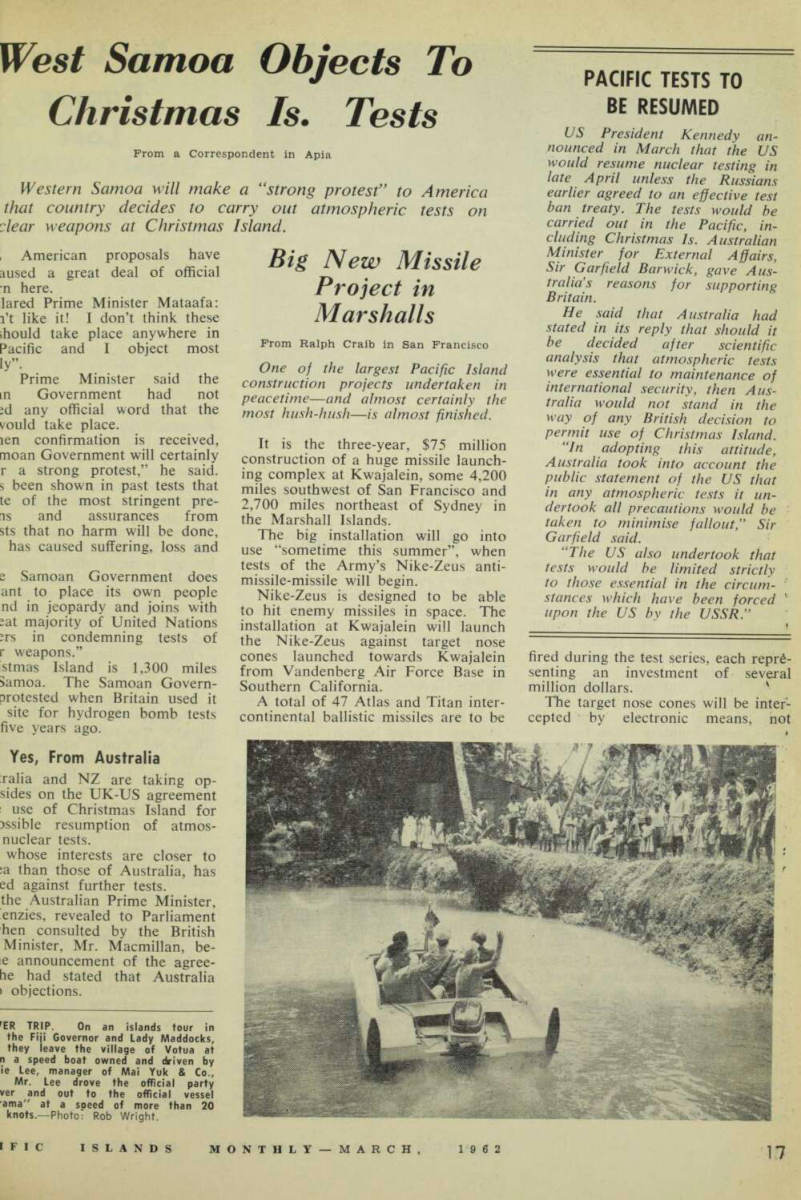
Here, on the outskirts of the deserted Hahalis village, police set up a camp.
Properly applied, the labour of these lithe, dark, intelligent Buka people can be a valuable attribute to the Territory of New Guinea. From their leaders may well come the future leaders of a New Guinea nation.
But left to run riot, confused by a hodgepodge of half-truths, abortive re ligion and unbalanced intolerance of the white man these same qualities— as they are being shown—can only fill the gaols.
Out of the medley of thoughts given rise to by the Buka incident are two well worthy of consideration: - • Can the Administration not find some way to stamp out a small brush fire in future before it follows its natural course of swelling into a blaze? • Do the missions, close to the
natives as they are, teach an adequate blending of social consciousness to marry with the out-and-out dogma on which natives seem to seize with avid ease?