erritories TALK-TALK
pp. 31-35 · Read in the full issue
With Tolala
“Liberator” Soekarno has certainly made world news since put up his Dutch New Guinea smoke-screen to cloud the easy issues around his own home-fires. I refrain from corn anting on future developments; much can happen in this anging world between Now and Date of Publication.
?OMMENT I will make, how :ver, is the danger of the West ating the actions of the East, aaking attempts at analysing rn thinking and logic, according e Western yard-stick of ethics tandards. must not fail to realise that, our own Halls of Learning are with Eastern students, absorb er thoughts, ideas, standards and al Know-How, we as the nant West (as we are pleased to ourselves) know nothing of rn Ways, or are unable to “think rn” as they are able to “think ;rn”, and so act accordingly, ing only too well what our re is will be. They have the “wood ” in this respect, and we should s it. s a thought tossed into the Pool eduction and one to remember estimating the value of Eastern is and words. It also applies, ally, to the evaluation of our P-NG natives. How many of us, after years of association with aative people, are capable of dng native”? after of jmics nouncements made by the Joint s of State of Western Samoa that country’s independence had proclaimed, referred to the in lacy of Samoa’s economy to the demands of its fast-growing ation, despite the generous aid ised by New Zealand, stralian Minister for Territories, hasluck, who was present at the lony, must have felt that such inouncement was a possible fore :r of what New Guinea Heads ate would remark on their inde mce when, and if, he attends :eremony. ere are several analogies between srn Samoa and New Guinea: A jered German colony, placed ■ the League of Nations; the lishment of a Public Service ic with which to administer the
area; the subject of sniping from the League and UNO, and periodically a certain amount of internal unrest.
Although, admittedly, the Samoans are of a higher intellect, their ten dency for intrigue probably is matched by the New Guineans’ primitive mode of life and reasoning.
But what will be the result when New Guinea attains its independence and starts constructing its internal budget?
To begin with, Australia, as mentor and guide, is proud of the fact that it has one of the world’s highest standards of living, and in tutoring the world’s most primitive people in the ways of “civilisation”, it accus toms them to expensive pre fabricated houses and paying some of them at the rate of £l4O a month.
How will the independent New Guinea government be able to meet such expense without colossal grants to maintain such a standard? Is the Australian taxpayer prepared, out of the goodness of his altruistic heart, to foot such a bill?
With the UNO on our back we are, at present, cutting a very fine figure (or we hope we are), but once inde-
pendence is granted will our gene rosity still continue, even prompted by the fear of Communism?
At the moment in New Guinea we have such economic machinery as the Madang Economic Committee.
Does it comprise New Guineans?
No. It consists of the District Com missioner, the District Officer, the District Agriculture Officer, the Registrar of Co-operatives and the ADO Local Government. All are officials in the higher income bracket.
Is this a coterie suitable for prepar ing a primitive people in the intricate ways of present-day economics?
As an indication of the absurdity to which native economic thought may extend —based on our tuition—one does not need to seek further than the extravagant statement by the chair man of the Hanuabada Council when he informed the meeting that the price for brides was £l,OOO in goods
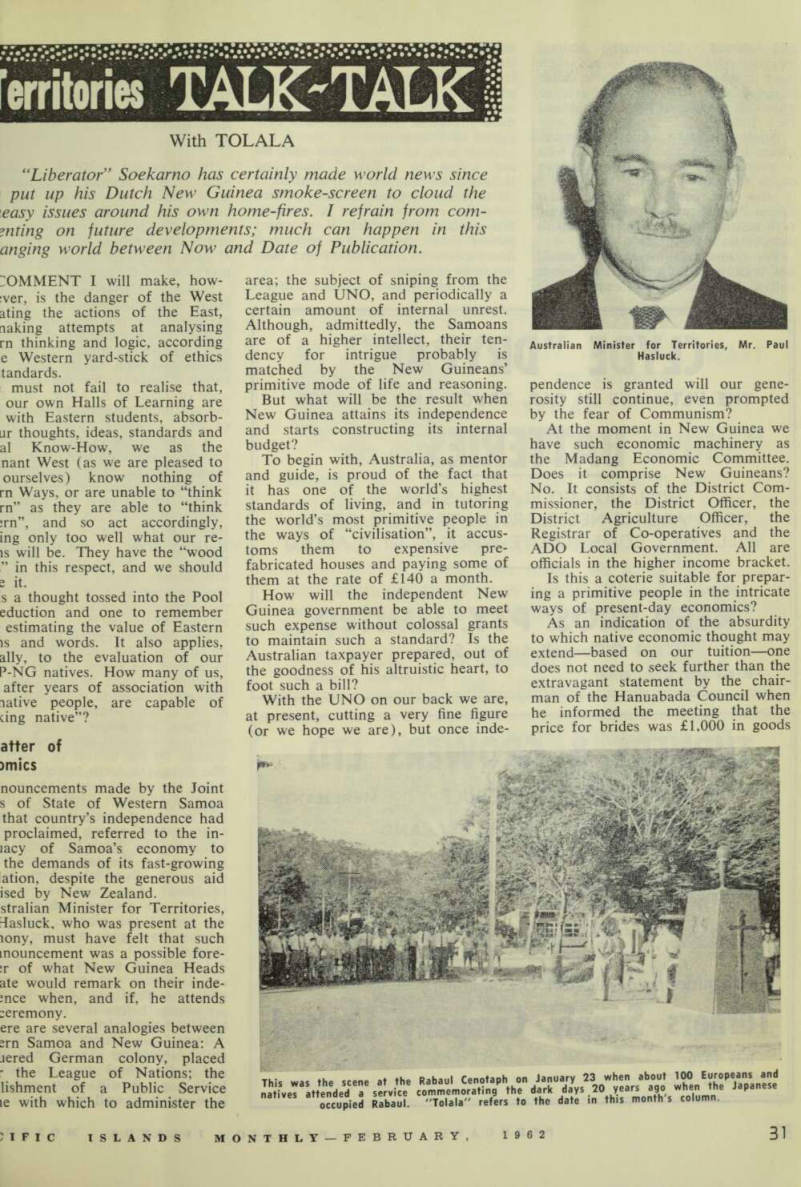
Australian Minister for Territories, Mr. Paul Hasluck.
occupied Rabaul. "Tolala" refers to the date in this month's column.
and money. Fortunately Rabaul representatives, residing in not such close proximity to Konedobu, later reported that £lO was an average price for a bride in New Britain and New Ireland.
Another feature of our economy comes from the report of a Tolai who is prevented from erecting his own cocoa fermentary, owing to the fact it does not conform to the Tolai Cacao Project protective laws. Surely such restrictions do not conform with democratic ideals. Or do they?
For centuries (how many I would not venture to say) the New Guinea native has made his own simple
economy of bartering and living off the land and sea. The fact that he has “got by” with such a system is proved by the mere fact of his sur vival and the fine physique of the most primitive types when first con tacted by Europeans, And now, in this present age, we are trying to “civilise” him and thrusting on him our own method of western economy; an economy, which even the expert realises, is anything but perfect and which is changing almost from day to day, because it has become so complicated and lack ing in co-ordination, It is this with which we are re
placing the old simple system of thd New Guinea economy.
It makes one think. Or should make one think, anyway.
New Guinea Art In December a Mr. L. R. Webb who lives in Hawaii, is reported t<l have said in Port Moresby: “I havi\ been trying to convince the Adminis tration that it has a nation of nativ-, artists like nowhere else in the world) If only it realised this it would mak more out of it than coffee.”
General Cariappa, then India 1 ) High Commissioner to Australia realising the potentialities of Net Guinea art, presented a shield a fet years ago to encourage such a trend It was first won by the Sogeri Edu cation Centre under the able guid ance of Teacher K. Little. Mr. Littl did not interfere with the native idea of art.
A critic of the exhibition this yeai however, remarked that “it is a tragi disappointment. The once flourishin plant has withered and died. Only th vestige remains here and there . .
One gropes in vain for the nativ legend in the picture of the Sydne Harbour Bridge or the coastal worl boat . . . A far cry indeed froi the strange beauty of emerging it digenous art seen in the 1955 Littl paintings . . . Has the flame bee allowed to die out?”
The obvious remark is: The clas of cultures. But surely it is possibl to permit the native art and its e: pression to travel hand-in-hand wit Western education along the roa of social development?
Where are many of the old-tire treasures so patiently and proud! worked by the natives of yesteryeat The flying-fox teeth tambu-money j Buka; the white sticks of Aua, whalu bone and shark vertebrae with ii laid mother-of-pearl; the King spea| of Buin; the weaving of the Mortloc Islanders; the beetle-leg necklaces j Emirau and the tortoise-shell fingt rings with silver inlay from Matuj Islanders? And these are but a fe of the old artifacts which pleas* the eye of the pioneer, but now suppose have gone with the wind « change. i Let’s hope, at any rate, that tl exploiters are not permitted to d! nude the Territory of all its natr art objects before the local museuir have had their pick.
There was a time in TNG wh< native arts were a prohibited expo; and a close check was kept on then Let’s hope it still exists and, wfaf is more, it is well policed.
nty Years
got a shock this morning when rned the leaf of my bunch of \ calendar and read “January 23”. istant bell was ringing in the y of my memory. I paused a lent . . . and then I realised it was 20 years ago—January 23, —that the Japs occupied Rabaul. was of all the town’s dark days darkest and most tragic, and for : few who have survived a day
never to be forgotten, whether they were fighting on the beaches, shelter ing in Refuge Gully or starting out on a hazardous journey down the coast, which ended in freedom for some and for others, death.
I wonder whether there will be any formal ceremony to observe the day in Rabaul?
Postscript: A few days later came a letter from a friend in Rabaul. He wrote: “23/1/62. Twenty years later!
I am going to an RSL Service at Cenotaph at Rabaul at 5 p.m.” And, after speaking to Mrs. Foxcroft, President of the Sydney NG Women’s Club, on the following day, she told
me that about a dozen old NG resi dents assembled at the Sydney Ceno taph at 10 a.m. and wreaths were laid. The Club, she added, received a Message of Remembrance from Mrs. Una Adams in Rabaul.
The day was not forgotten.
Another
Postcript
This deals with Rabaul’s 20th anniversary of its darkest day.
I have only just now read Steve Simpson’s “Conquerors Who Squealed Like Pigs” in the NG Times Courier of 24/1/62 which was a
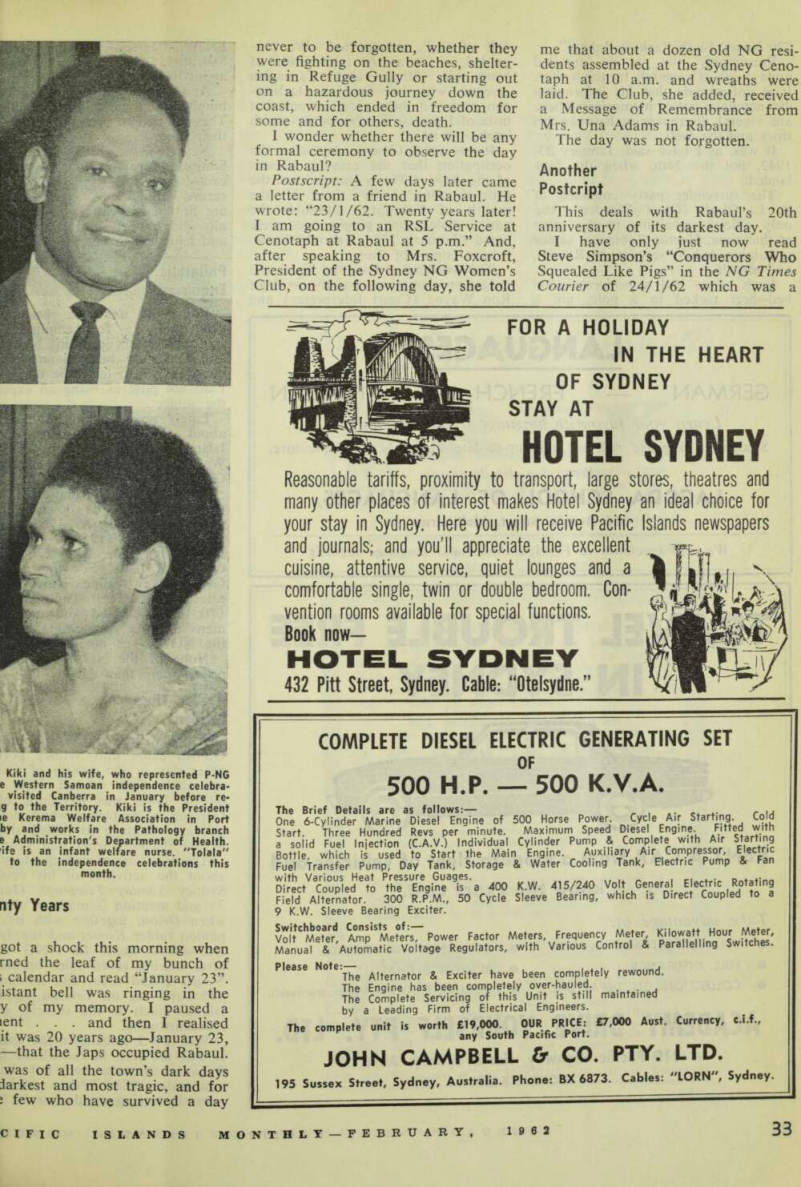
Kiki and his wife, who represented P-NG [?]e Western Samoan independence celebra visited Canberra in January before re [?]g to the Territory. Kiki is the President [?]e Kerema Welfare Association in Port by and works in the Pathology branch [?]e Administration's Department of Health, [?]ife is an infant welfare nurse. "Tolala" to the independence celebrations this month.
“20 Years’ Flash Back at Rabaul”.
Presumably the article entailed quite a lot of research by the writer.
It is unfortunate that his informants did not have better memories. There are several discrepancies between his story and the facts: It was, as I have said, January 23, 1942, not the 24th, when the Japs landed.
The surrender party consisted of R. L. Clark (Chief Warden), the only official remaining in the town at that time, Hector Robinson, senior remaining public servant in Rabaul, and myself.
Each of us had a perfectly good bed-sheet tacked to a pole, not a
“bit of rag”, as reported. We pro ceeded as far as the intersection of Namanula Street and Casuarina Avenue, when we faced a machine gun nest and there received our first taste of Japanese Co-Prosperity—with knobs on it!
It was not until some days after the occupation that the printing presses of the Rabaul Times churned out the proclamations, some time in the month of February, although the native dialect and pidgin ones were dated “January 23”. I should know, I have copies of them.
The wording of both the Tolai and pidgin proclamations was the work of Ron Wayne (Court Interpreter) and
E. W. Pearson (of the Methodh Mission), who personally told m about their task.
And, incidentally, the Japs nevr bombed the town with high explosive They wanted to preserve the town their base.
Nevertheless, thank you, Ste\ Simpson, for your Flash Back. An excuse me for trying to keep tl record straight. As you say, the* are not many who know what ach ally did happen during that perioi and I happen to be one of the few.!
Philatelic
Enquiries
For some unknown reason I r ceive quite a few enquiries frcM stamp collectors regarding NG stamj and I do my best to answer the questions. But, let it be understood I do not pose as being an expert c the subject.
Lately several enquiries have bee about the old German Marsha Islands surcharged stamps of Wof War I—the Yacht series surcharge GRI with values.
For general information I quo; the highest values as shown in Stanfi Gibbons Catalogue, 1961 editio; 3/- on Mk 3, £125; 5/- on Mk £225 and 1/- on Mkl, £7O and 2 on Mk 2, £4O. For the respecti] German New Guinea issues they a: priced, £BO, £l5O (unused) £l7 £7O, £7O. Unused and used spec mens are the same value, exceptii the NG 5/- as noted.
None of the NG lesser values * priced more than £5.
A War Time Incident A link with World War II and Ne Guinea came into Sydney port tl other day in the person of Germs sea-raider Capt. Adolf Herz wh during 1940, was navigator of tl German raider Orion, which did co siderable damage to Allied shippil in the Pacific during that year. t There is an interesting story to about the activities of his vessel I Sydney Sunday Telegraph (Janua; 7) and mention is made of the tin when Orion, together with its cor panion raider Komet and supply sh Kulmaland, made for TNG watei after sinking seven ships around tl Nauru Island area, and landing tl 495 survivors on Emirau (Squalh Island, much to the surprise of tl Administration.
Well do I remember the incider It was all very hush-hush so far Rabaul was concerned, but the A ministrator (Sir Walter McNicql naturally seeing no danger in lettu
t out of the bag once the sur had been landed on Emirau, me over and gave me the de ir publication, ■omptly put into type and, as tie custom at that time, sub a press-proof to the Chief r who at that time was irer Orton Townsend. He 1 the item and the press I to roll off the issue; ay through, however, an urgent rom the Chief Censor told me d been forced to reverse his »n after confirming with Aus authorities. The news item ut. e than half the issue had been 1; newsprint was at a premium se days and I couldn’t bear to e waste of so much paper so d to obliterate the censored iy overprinting. The Censor ap -1 and everyone was happy, i I did hear later that in some : copies of the paper the item uite legible. survivors landed at Emirau later taken off by one of the A. liners and the manager of antation—a Mr. Cook, I think s —was probably as much re as the survivors.
Where Due the beginning of last month the conference of P-NG Native Government Councils was held lubada and Minister Hasluck i personal message giving them
a pat on the back and a pep talk.
Amongst other things he remarked: “It is 11 years now since the first Local Government Council was formed ...”
Such a remark is liable to give the impression that there were no Native Councils functioning earlier than 11 years ago. Certainly the Hanuabada Council was established in September, 1950, and the Ealeba one at Milne Bay in November, 1951, but in the Rabaul area 14 groups of villagers had established Councils in 1936!
Post-war officialdom should not try to hog all the credit.
[?]or Bagita, P-NG's most famous police [?]roudly shows a Port Moresby visitor [?] the medals and service stars gained [?]his 45 years in the police. Bagita [?]our chevrons and a cap as well as [?]ial badge of rank. The chevrons and [?]m to be his own idea, but Bagita [?]an institution in himself, with a [?]f loyalty and service—and efficiency— [?]sed, that it is not likely officialdom [?]r draw attention to his non-regimental attire.