Famous NG
p. 26 · Read in the full issue
Memorial To A Famous NG Pioneer
From a Correspondent
Lae
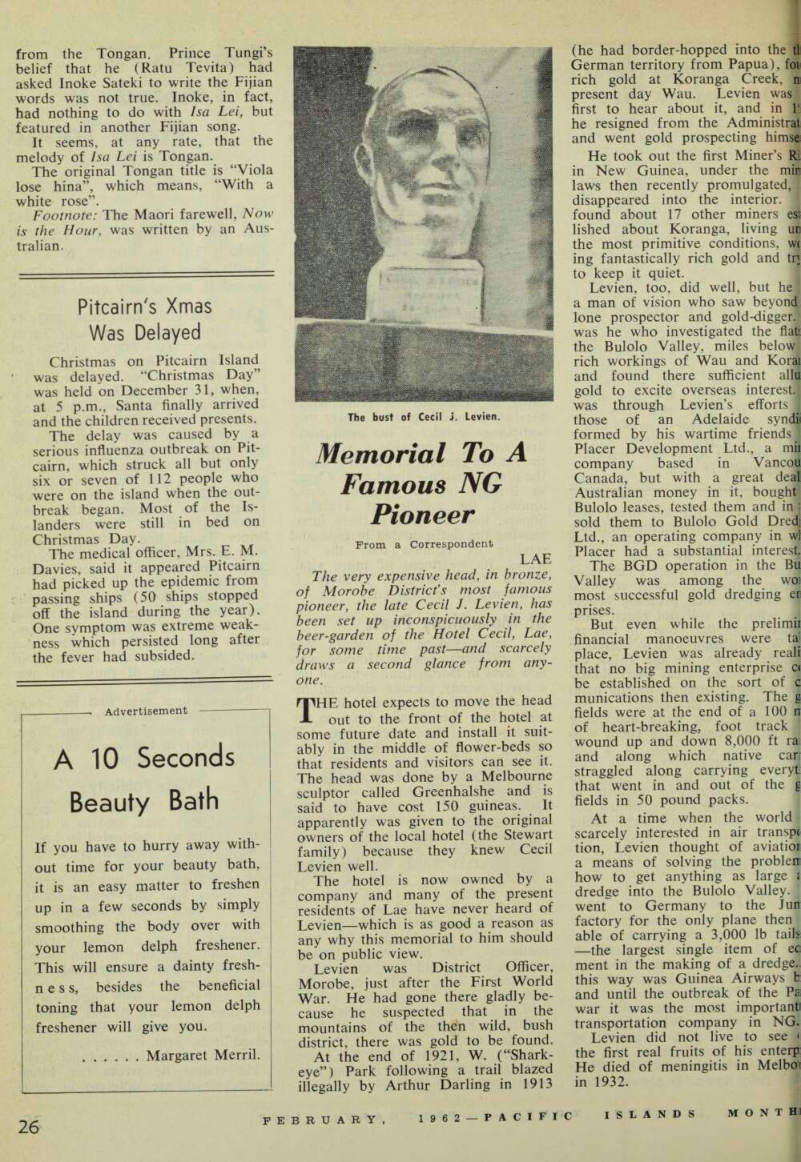
The very expensive head, in bronze, of Morobe District’s most famous pioneer, the late Cecil J. Levien, has been set up inconspicuously in the beer-garden of the Hotel Cecil, Lae, for some time past —and scarcely draws a second glance from any one.
THE hotel expects to move the head out to the front of the hotel at some future date and install it suit ably in the middle of flower-beds so that residents and visitors can see it.
The head was done by a Melbourne sculptor called Greenhalshe and is said to have cost 150 guineas. It apparently was given to the original owners of the local hotel (the Stewart family) because they knew Cecil Levien well.
The hotel is now owned by a company and many of the present residents of Lae have never heard of Levien —which is as good a reason as any why this memorial to him should be on public view.
Levien was District Officer, Morobe, just after the First World War. He had gone there gladly be cause he suspected that in the mountains of the then wild, bush district, there was gold to be found.
At the end of 1921, W. (“Shark eye”) Park following a trail blazed illegally by Arthur Darling in 1913
(he had border-hopped into the th German territory from Papua), fou rich gold at Koranga Creek, m present day Wau. Levien was first to hear about it, and in 1U he resigned from the Administra|j and went gold prospecting hims© He took out the first Miner’s Ri in New Guinea, under the min laws then recently promulgated, I disappeared into the interior. ] found about 17 other miners est lished about Koranga, living un the most primitive conditions, w( ing fantastically rich gold and trj to keep it quiet.
Levien, too, did well, but he a man of vision who saw beyoncj lone prospector and gold-diggerJ was he who investigated the flat the Bulolo Valley, miles below. rich workings of Wau and Korai and found there sufficient allu gold to excite overseas interest! was through Levien’s efforts I those of an Adelaide syndfi formed by his wartime friends 1 Placer Development Ltd., a mil company based in Vancoii Canada, but with a great deal Australian money in it, bought Bulolo leases, tested them and in i sold them to Bulolo Gold Dredjl Ltd., an operating company in wl Placer had a substantial interest] The BGD operation in the Bu Valley was among the wo* most successful gold dredging ec prises.
But even while the prelimii financial manoeuvres were tal place, Levien was already reali that no big mining enterprise c< be established on the sort of c munications then existing. The g fields were at the end of a 100 n of heart-breaking, foot track * wound up and down 8,000 ft rai and along which native can straggled along carrying everyti that went in and out of the g fields in 50 pound packs.
At a time when the world scarcely interested in air transp* tion, Levien thought of aviation a means of solving the problem how to get anything as large i dredge into the Bulolo Valley. 1 went to Germany to the Tun factory for the only plane then able of carrying a 3,000 lb tails —the largest single item of ec ment in the making of a dredge., this way was Guinea Airways b and until the outbreak of the Pa war it was the most important) transportation company in NG.
Levien did not live to see r the first real fruits of his enterp: He died of meningitis in Melbox in 1932.
The bust of Cecil J. Levien.