The Editors' Maillag
pp. 24-25 · Read in the full issue
How Do They Fix
Those Airline Fares?
A reader in Lae, New Guinea, who says that he likes travelling (and our Travel Talk section), wonders why air fares can’t be fixed on a mileage basis. He points out that the air fare from Sydney to Noumea, a distance of a little over 1,000 miles is £AS6/18/- first-class, single (£A4O/13/-, economy class); while that to New Zealand, something under 1,200 miles, is £AS3/12/-, first class, single (£A4I/3/- economy class).
We’ve been told by the airlines that all fares are fixed by the Inter national Air Transport Association and mileage is only one aspect in costing. To an increasing degree, air port charges are another.
When lATA met in Sydney for its annual conference last October its director-g ener a 1, Sir William P.
Hildred, said that the only way to get vacant seats full in international air craft was to get fares lower —but this was difficult when airport charges were always going up—an estimated 64 per cent, since 1957.
Some countries are whacking on tax more than others on the theory
that the air-traveller (like the motor of a previous generation) is amoir the new rich and always good for extra bob.
Every time a jet lands at Lono airport, its owners pay £375— highest landing charge in the wos (All outgoing passengers pay 5/- ea in addition). Sydney is amongst! highest priced airports in the work it costs £217 a time to land a there.
Maybe this answers part of I reader’s question—although he 1 still go on wondering why the fi class fare from Sydney to Noun is more than it is to Auckland,! the economy fare less.
Since 1945, we have been promi faster, better and cheaper air trai We’ve got the first but not the I and the only relief in that dep: ment has been, first, the introdud of tourist fares, and now econo fares. (Same thing, different nan First-class (it was the only class) NZ 10 years ago was £A39/| What’s more, although in those o the aircraft were slow, air travel were all pampered like VI] economy class travel today—if I happen to strike a full plane—has the austerity and discomfort o\ suburban bus ride.
Tolais "Just Bearing
The Brunt"
A little bit late (our fault) woman reader in Port More comments on Mr. J. R. Foldi’s cr ism of the New Britain Tolais the last meeting of P-NG Legisla Council. Mr. Foldi, District G missioner of New Britain, feels j the Tolais are his own partial cross, no doubt. Our correspond feels , on the other hand, that j can’t help being as they are, j more than they could help h born with lame legs. This is how '■ sums up: Mr. Foldi’s criticism (thougb could have been expressed m t kindly), is basically true, but no nr so for the Tolais than any o groups of native people, who doubtless, thankful they have Tolais to bear the brunt of it. j view that they are “unable to see; necessity for planning for the fut or for self-discipline” may be o accurate, but to criticise them for 1 is like criticising someone for b: born lame.
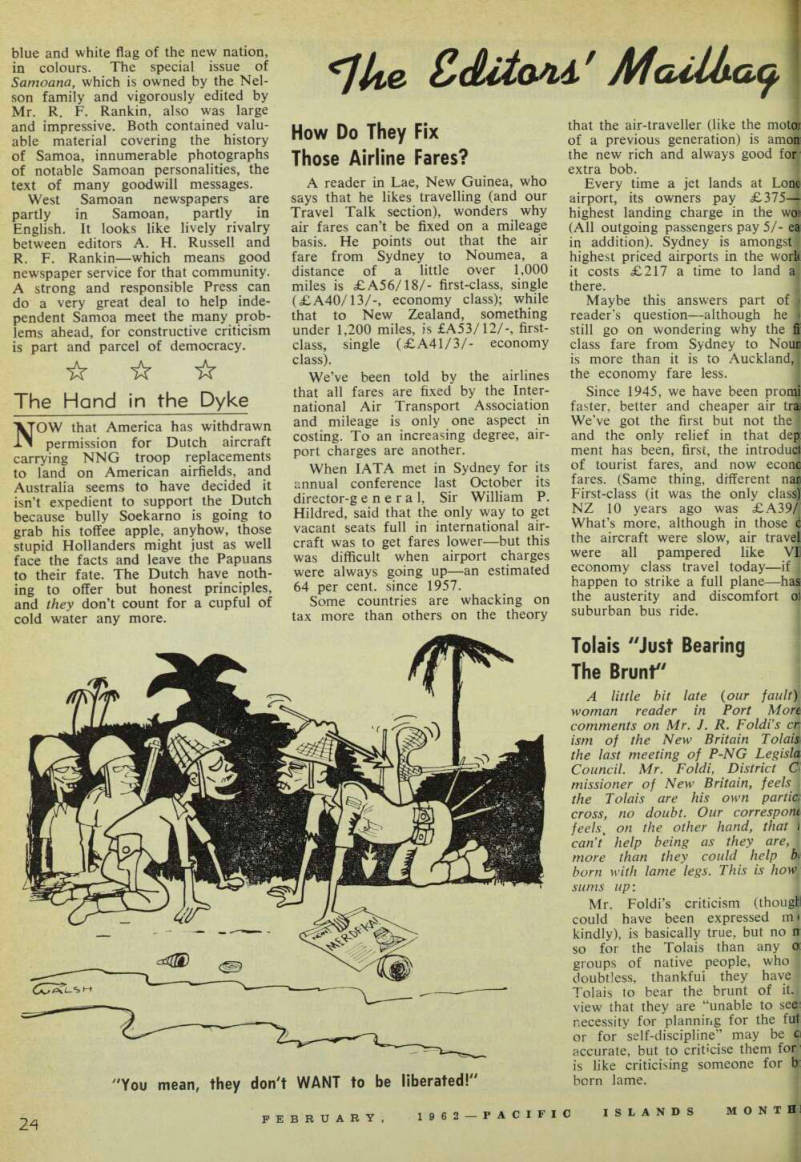
"You mean, they don't WANT to be liberated!"
ir way of life has never held lought of planning for the future '-discipline, as we know it. Can 3e expected to master this in meration? Or two? I can think my Europeans, with countless tions of such planning behind who are still not much more :ed than the Tolais in this re iVhat is being done to overcome fficultv? Or are the Tolais ex to “adapt” (that marvellously word, so often in use up here) e with the challenge? /ould be far more heartening ase Europeans and Tolais who muinely concerned, if a few il Members who let fly with barrage of criticism, came up some constructive criticism to 5 some hope of overcoming this rn, instead of just high-lighting tion which we all know exists.
\BC and
tivity
got ourselves in Dutch (no pun id), when we defended Aus- Broadcasting Commission’s Australia (January PIM ) as the “impersonal, unemotional, 'odied BBC approach”. A in Fiji comes back with this: lote that the PIM reply to a lint about ABC treatment of ickarno ranting says that the lews is detached, like the BBC’s, t fully agree. It always seems
to me that the ABC stuff is a reflec tion of the standards of Australian metropolitan dailies—the same sen sationalism and coloured reports.
During the war I was often horrified.
A lot of bulletins could have come from Radio Tokyo and there was obviously no discretion in the editing.
I don’t know who their corres pondents are elsewhere but here they use the staff of the Fiji Broadcasting Commission and as a result their Fiji reports are often incomplete and sometimes inaccurate because their correspondents are not trained re porters. My experience has been that there is a big difference between the objectivity of the BBC and ABC.”
That cuts the ABC, Australian newspapers and the FBC to size.
But the BBC is not blameless, either, and whatever objectivity it achieves with its overseas news services it undoes with some of its other activities—to the point where the listener and television viewer may sometimes wonder if the institution’s first duty is to provide a voice for the rat-bag element in the UK. Come the protest march —about once a week in Britain—or the sit-down strike amongst the puddles of Trafalgar Square, and the BBC is there inter viewing the duffle-coated brigade and sending its opinion over the air waves. Its treatment of more vital, British Commonwealth matters is frequently just as slanted.
Of Melancholy Poets
A letter during the month was from ex-Territorian Jos Holmes, who now lives in Dorset (and swears it has a lovely sunny climate although his wife, Florrie, in another letter de scribes how the curtains froze to the windows in the recent big UK freeze). Jos discusses Kendall, the Australian poet of last century, won ders why all early Australian poets had such a wide streak of melan cholia (probably because they were poets, and Australia in the mid-19th century was enough to give anyone the pip), then he goes on: “I see that Tolala, in December Talk-Talk has me down at Numa Numa, Bougainville—l was there, but in 1915 and not 1913 as he says. I was in the Solomons in 1913,”
He sends regards to Tolala and continues; “He had several poems published in an old Australian maga zine called Life, writing under the name of GELT. One of these began; “Did you ever chew the betel-nut Talking Pidgin-English to a chief, etc etc.”
Come’ in Tolala. Did you ever write anything like that in your mis spent youth?