Commentary
pp. 23-24 · Read in the full issue
Can Grow It—But
?re To Sell It?
M New Guinea eastward to ahiti there are at least ten and growing South Pacific >ries with a common problem, ti of them, urgently, is seeking of selling more of its primary :ts. Each has the embarrass of a growing population, or standards which are too low; :ombination of both, the publisher’s desk, at the it, are:— From W. Samoa, a Jy-compiled, forward-thinking by the Minister for Economic ipment. From New Guinea: is official documents describ epartmental activities. From Hebrides: Reports of attempts made to establish or expand ies. From the Solomons: I report of Council debates.
Fiji: Discussions of ways to age industries other than From Tonga: Indications of developmental planning by Tungi. have a common factor. All are ; new or better markets for ts now available, or being ►ed —copra, coffee, cocoa, is, oranges, peanuts—so that may be provided for raising standards, and feeding more and large, the population in rious Territories of the South has doubled in the 30 years this journal was established: e rate of increase is accelerat e are various organisations to assist the South Pacific es generally in their adminis problems. Most are based on ited Nations. The most prom s South Pacific Commission, ined by cash grants from Aus- France, Britain, USA, New i, and Netherlands. an extraordinary thing that, ill this planning, nothing has one to create a sort of central ing bureau or clearing-house >rmation, to which any South Territory—or, for that matter, ding-firm or individual—could reliable and statistics-supported ibout the markets available y Islands product or enter world markets for copra,
cocoa, coffee and similar leading crops are regularly reported on, and most Islands traders can supply a quotation.
But what of other crops which can be produced in the Islands, but the oversea buyers of which do not look to the Islands? Into that category come peanuts, beef, cotton, tobacco, forest products, mineral ores—an endless list of things. “We can produce it—but where can we sell it?” is a common cry.
There is constant liaison, and fre quent exchange of data between the various Territories’ Departments of Agriculture. It should not be diffi cult to add a marketing information section to each Department.
POSTSCRIPT: The records show that in 1959 the Commission offered to assist in the promotion of trade (including inter-territorial trade ) and industry, including tourism. It even offered to publish “guides to inves tors” and arrange inter-territorial studies of established industries. It repeated the offer in 1960 and again in October, 1961. . . . The trouble, of course, is that the development of inter-territorial (or inter-continental ) trade and industry calls for agencies much tougher and much more hard driven than anything seen these days in the comfortable planning rooms of high bureaucracy. ☆ ☆
High Finance of Some
High Bureaucracies
THE official report of the South Pacific Commission which met in late October shows that, in 1962, it is proposed to spend over £300,000; of which over £BO,OOO goes to “general administration”, nearly £200,000 to activities under the “Re search Council”, and £20,000 to cover the costs of the Fifth South Pacific Conference (which is held every three years, and this year, in July, will be held in American Samoa).
Australia provides 30 per cent, of the funds; Netherlands, New Zealand and Britain each 15 per cent.; and France and USA each 121 per cent.
In the mind of the cynical Aus tralian taxpayer, the 30 per cent, (nearly £100,000) goes into the same bin as the £l5 million allotted to Papua-New Guinea, and the many
millions given away each year under the Colombo Plan.
We have heard much about the many millions provided lately for Fiji’s help and development by Britain’s Colonial Development Fund.
A Fiji publication reminds us that the Sugar Stabilisation Fund was established in 1959, with deductions from the earnings of cane growers and millers. By December 31, 1960, there was over <£3,250,000 in the Fund—a little of it invested in Fiji, but most tucked away in London and in other Commonwealth countries.
By the end of 1961, this must have increased considerably.
The presumption that this fat Fund is available for financing by Govern mental instrumentalities outside of Fiji takes some of the glitter out of the lending of the money (over £5 millions) to Fiji by the so-called Colonial Development Fund. ☆ ☆ ☆
The Role of The
Press in Samoa
THE radio stations and newspapers of Fiji, Tonga and New Zealand gave much space and time early in January to a description of the way in which Western Samoa celebrated Independence Day (January 1) and to the fascinating story of how the Samoan community (reduced to 35,000 some 40 years ago) has now achieved nationhood with a popula tion of 115,000.
Australian public media almost ignored the event. Two or three newspapers published special, syndi cated articles about the appearance of the new nation; but the picturesque story of Samoa, which could have been most effectively presented, was practically neglected by radio and television. A notable exception was the ABC TV stations. When next Samoa organises such a celebration, it should include a massacre or two, and a couple of fights between screen celebrities, so as to capture world attention.
One commentator in an American weekly magazine reported that Apia folk crept around cautiously at mid night on December 31, fearful of an outbreak by thugs and revolutionaries; but that, strangely, Independence Day dawned without bloodshed. That’s the stuff to give them!
Western Samoa’s own Press registered a fine performance. Eugene Paul’s Samoa Bulletin’s special issue contained over 30 pages, enclosed in a cover which reproduced the red,
blue and white flag of the new nation, in colours. The special issue of Samoana, which is owned by the Nel son family and vigorously edited by Mr. R. F. Rankin, also was large and impressive. Both contained valu able material covering the history of Samoa, innumerable photographs of notable Samoan personalities, the text of many goodwill messages.
West Samoan newspapers are partly in Samoan, partly in English. It looks like lively rivalry between editors A. H. Russell and R. F. Rankin—which means good newspaper service for that community.
A strong and responsible Press can do a very great deal to help inde pendent Samoa meet the many prob lems ahead, for constructive criticism is part and parcel of democracy. ☆ ☆ ☆
The Hand in the Dyke
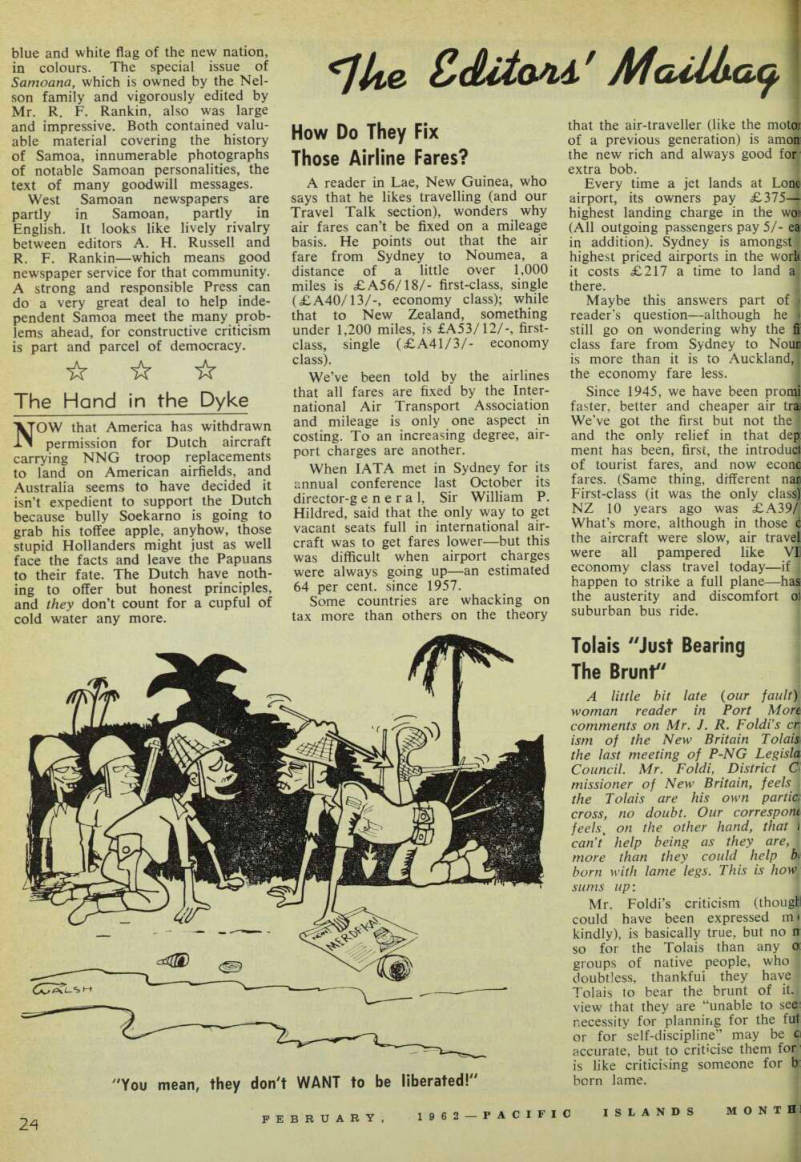
NOW that America has withdrawn permission for Dutch aircraft carrying NNG troop replacements to land on American airfields, and Australia seems to have decided it isn’t expedient to support the Dutch because bully Soekarno is going to grab his toffee apple, anyhow, those stupid Hollanders might just as well face the facts and leave the Papuans to their fate. The Dutch have noth ing to offer but honest principles, and they don’t count for a cupful of cold water any more.