Pacific Report
pp. 113-132 · Read in the full issue
The month’s round-up of news and pictures of people and vents, from PIM correspondents in the South Pacific.
li Hotel Too
nd for Them
ost overseas visitors would re- Nadi Hotel, in Nadi township, as a very modest establishment, when in December, Mr. M. J.
Saunders, Senior Magistrate, ted a rival hotel company a ce to operate the Coral Hotel, :he same locality, he said in t that local residents were em assed by Nadi Hotel because it too grand for them, lis was the reason why he ted Coral Hotel Ltd. a licence, aral Hotel Ltd. originally applied lune, 1961, and was opposed igly by Northern Hotels Ltd. by the owners of the Mocambo ;1, then operating in old premises Nfadi airport. r. R. G. Kermode made two ;1 objections on their behalf. One that the proposed licensee, Mrs. smary Jamnadas, under Fiji and as a female was debarred i entering the hotel at all! The being accessible from all the nd floor rooms, she would be mitting an offence every time went into the building, is second objection was that the ication was out of order as, un the English reading of Fiji laws, icences could be granted except he annual Licensing Court in ember. ther objections raised were that hotel design was below adequate lards, having only the minimum ber of letting rooms, and com al toilets and lavatories. Objec i by Mr. Kermode were later, iffy, over-ruled and judgment on application was reserved by Mr. iders. It was given on December md in granting the licence Mr. iders said: U 1 the objectors to this applica tive been organised by Northern fls Ltd., who fear that competi in Nadi may force them to :r their overheads and thus re
duce the standard of their Nadi Hotel. That company has spent a certain capital outlay to supply a reasonable hotel for tourists and they object to a lower standard hotel being built which may take away their trade.
“I can see the point of their ob jections but I do not think they are valid. They show, quite clearly, that there is a need for another hotel in Nadi district to cater for those who feel embarrassed at Nadi Hotel. And there is no point in shutting one’s eyes to the fact that some Fijians and Indians are embarrassed to go into the lounge of the Nadi Hotel, unless they do so while drunk or de liberately to provoke comment. The management of the Nadi Hotel is not
to be blamed for this. It can’t be helped, “As for the standard of the rooms and sufficiency of lavatories in the proposed hotel, I can only comment that it is being built for the local population and apparently the de signers do not consider that each
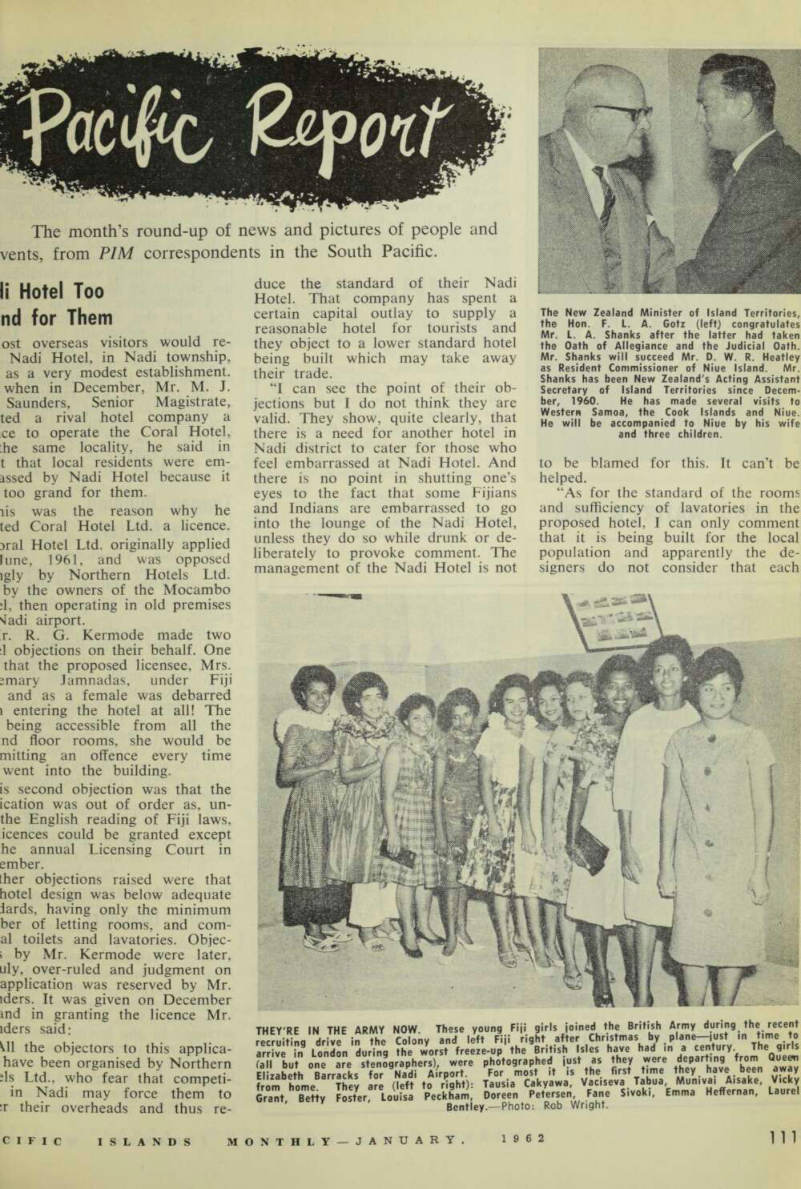
The New Zealand Minister of Island Territories, the Hon. F. L. A. Gotz (left) congratulates Mr. L. A. Shanks after the latter had taken the Oath of Allegiance and the Judicial Oath.
Mr. Shanks will succeed Mr. D. W. R. Heatley as Resident Commissioner of Niue Island. Mr.
Shanks has been New Zealand's Acting Assistant Secretary of Island Territories since Decem ber, 1960. He has made several visits to Western Samoa, the Cook Islands and Niue.
He will be accompanied to Niue by his wife and three children.
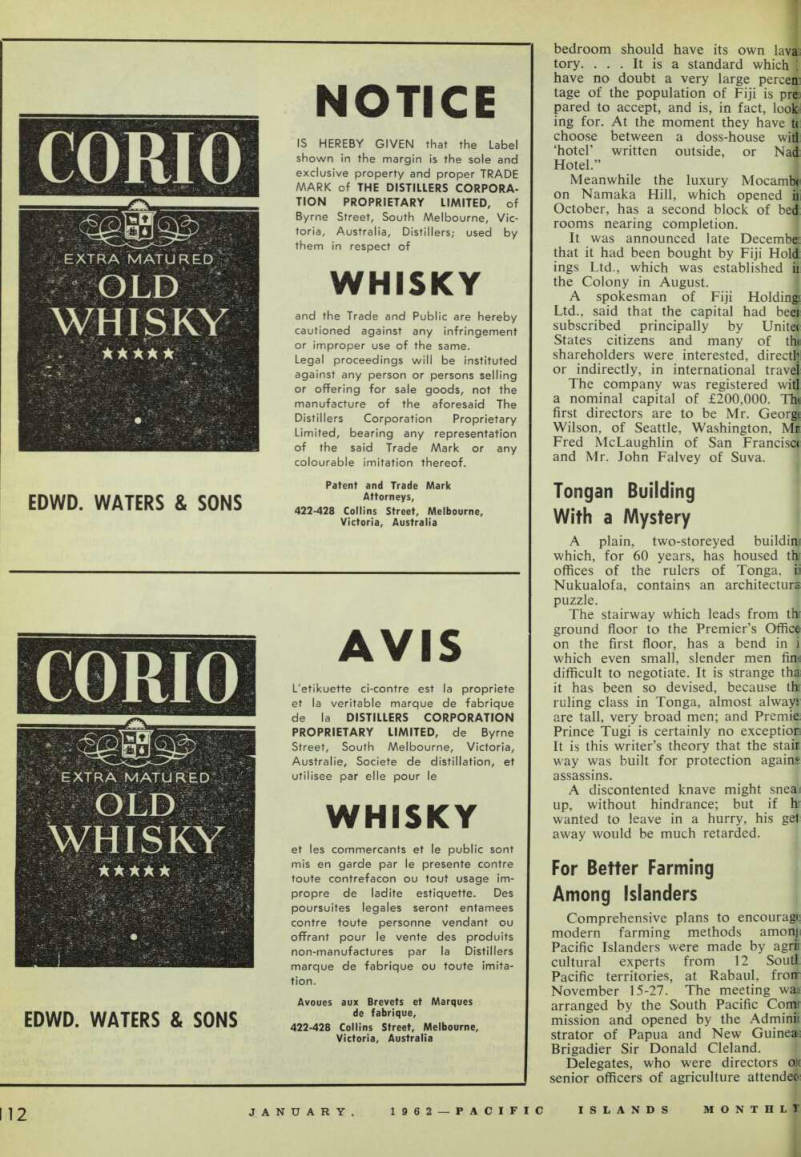
THEY'RE IN THE ARMY NOW. These young Fiji girls joined the British Army during the recent recruiting drive in the Colony and left Fiji right after Christmas by P lan -j ust in time to arrive in London during the worst freeze-up the British Isles have had in a century. The girls (all but one are stenographers), were photographed just as they were deputing Queen Elizabeth Barracks for Nadi Airport. For most it is the first time they have been away from home They are (left to right): Tausia Cakyawa, Vaciseva Tabua, Mumvai Aisake, Vicky Grant, H Betty Foster, Louisa Peckham, Doreen Petersen Fane Sivoki, Emma Heffernan, Laurel Bentley.— Photo: Rob Wright.
bedroom should have its own lava: tory. ... It is a standard which T have no doubt a very large percem tage of the population of Fiji is pre: pared to accept, and is, in fact, look ing for. At the moment they have t< choose between a doss-house will ‘hotel’ written outside, or Nad Hotel.”
Meanwhile the luxury Mocambj' on Namaka Hill, which opened iii October, has a second block of bed; rooms nearing completion.
It was announced late Decembefc that it had been bought by Fiji Hold ings Ltd., which was established i| the Colony in August.
A spokesman of Fiji Holding Ltd., said that the capital had beer subscribed principally by Unitec States citizens and many of thu shareholders were interested, direct! or indirectly, in international travel The company was registered witl: a nominal capital of £200,000. Th« first directors are to be Mr. Georg?
Wilson, of Seattle, Washington, Mr Fred McLaughlin of San Francisdj; and Mr. John Falvey of Suva.
Tongan Building
With a Mystery
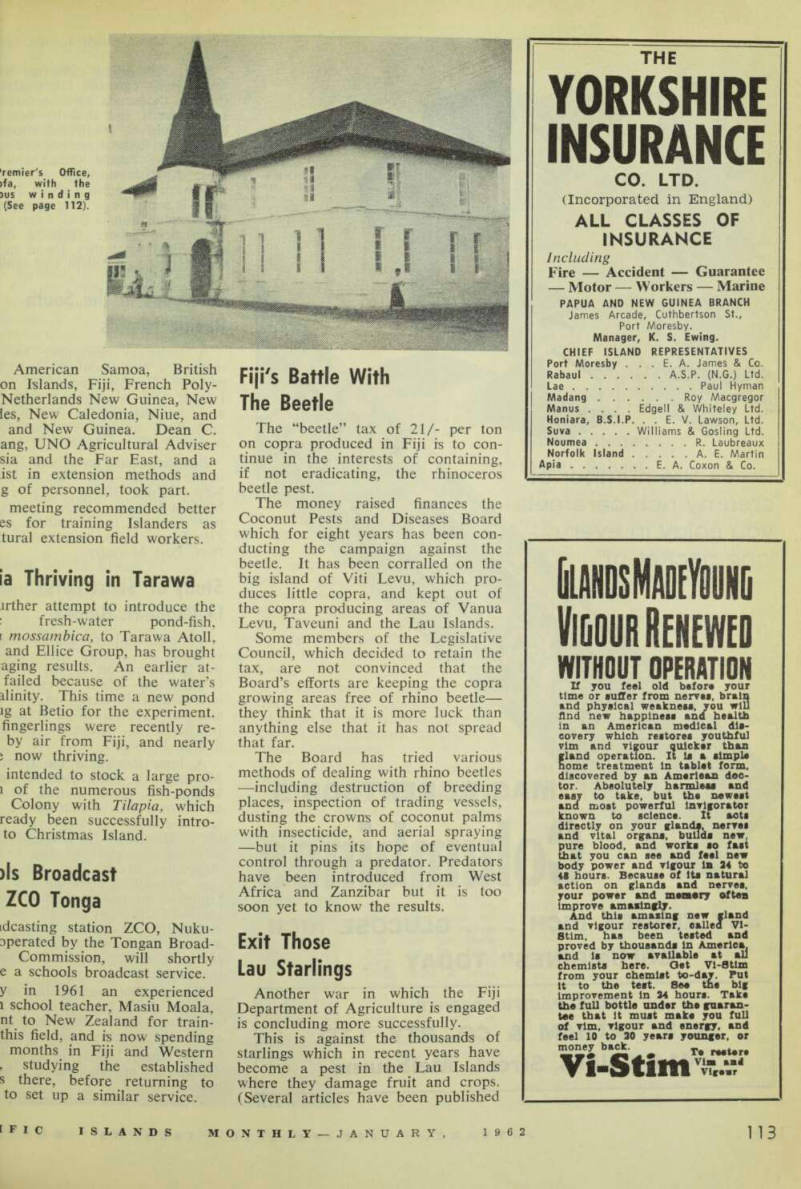
A plain, two-storeyed buildinj which, for 60 years, has housed thr offices of the rulers of Tonga, ii Nukualofa, contains an architectura puzzle.
The stairway which leads from thr ground floor to the Premier’s Office on the first floor, has a bend in i which even small, slender men fina difficult to negotiate. It is strange tha it has been so devised, because thr ruling class in Tonga, almost always are tall, very broad men; and Premie Prince Tugi is certainly no exception It is this writer’s theory that the stain way was built for protection agains assassins.
A discontented knave might snear up, without hindrance; but if hr wanted to leave in a hurry, his gel: away would be much retarded.
For Better Farming
Among Islanders
Comprehensive plans to encourage modern farming methods amonji Pacific Islanders were made by agrit cultural experts from 12 Soutl Pacific territories, at Rabaul, from November 15-27. The meeting was arranged by the South Pacific Cornr mission and opened by the Adminii strator of Papua and New Guineas Brigadier Sir Donald Cleland.
Delegates, who were directors ox senior officers of agriculture attendee;
American Samoa, British on Islands, Fiji, French Poly- Netherlands New Guinea, New les, New Caledonia, Niue, and and New Guinea. Dean C. ang, UNO Agricultural Adviser sia and the Far East, and a ist in extension methods and g of personnel, took part. meeting recommended better es for training Islanders as tural extension field workers.
ia Thriving in Tarawa
irther attempt to introduce the : fresh-water pond-fish, t mossambica, to Tarawa Atoll, and Ellice Group, has brought aging results. An earlier at failed because of the water’s dinky. This time a new pond ig at Betio for the experiment, fingerlings were recently re by air from Fiji, and nearly ; now thriving, intended to stock a large pro i of the numerous fish-ponds Colony with Tilapia, which ready been successfully intro to Christmas Island.
)ls Broadcast
ZCO Tonga
idcasting station ZCO, Nuku jperated by the Tongan Broad- Commission, will shortly e a schools broadcast service, y in 1961 an experienced i school teacher, Masiu Moala, nt to New Zealand for train this field, and is now spending months in Fiji and Western , studying the established s there, before returning to to set up a similar service.
Fiji's Battle With
The Beetle
The “beetle” tax of 21/- per ton on copra produced in Fiji is to con tinue in the interests of containing, if not eradicating, the rhinoceros beetle pest.
The money raised finances the Coconut Pests and Diseases Board which for eight years has been con ducting the campaign against the beetle. It has been corralled on the big island of Viti Levu, which pro duces little copra, and kept out of the copra producing areas of Vanua Levu, Taveuni and the Lau Islands, Some members of the Legislative Council, which decided to retain the tax, are not convinced that the Board’s efforts are keeping the copra growing areas free of rhino beetle— they think that it is more luck than anything else that it has not spread that far.
The Board has tried various methods of dealing with rhino beetles —including destruction of breeding places, inspection of trading vessels, dusting the crowns of coconut palms with insecticide, and aerial spraying —but it pins its hope of eventual control through a predator. Predators have been introduced from West Africa and Zanzibar but it is too soon yet to know the results.
Exit Those
Lau Starlings
Another war in which the Fiji Department of Agriculture is engaged is concluding more successfully.
This is against the thousands of starlings which in recent years have become a pest in the Lau Islands where they damage fruit and crops. (Several articles have been published
[?]remier's Office, [?]fa, with the [?]us winding (See page 112).
in PIM about them in the last 1 years).
The anti-starling campaign starte seven years ago and latest advice! that the thousands have been reduce to hundreds and that by next yej; they should be eradicated altogethe The Lau Islands are isolated spec]: out in the Pacific Ocean and ho: these English starlings got there-r they were first noticed about 20 yeai ago—is a mystery. The most reasojt able explanation is that a few of tl birds flew ashore from a passil ship, liked what they found in Lat and started to breed in vast number
Linotypes in the South
Pacific Islands
A technical newspaper has bee making a fuss about the installatw of new linotype machines in tl: Islands. It is announced that ok now is operating in Noumea, ai another is setting hymn-books, etd for the Lutheran Mission at Madari But there long have been linotyp in the Islands—they were in Fiji ai New Guinea 30 or 40 years ag Modern batteries (lines of linotype now function in the offices of T Fiji Times, Suva, and South Pad\ Post, Port Moresby.
Study of 'Short Cuts'
In Papua-N. Guinea
Various kinds of experts continr seriously to discuss what they c: the determination of the Australii Government —under pressure fro international interests —to give Pap: and New Guinea self-government at independence within a matter ] five or 10 years.
A long Reuter article from P< Moresby in December quoted 1 length Mr. C. J. Lynch, descritt as “Crown Law Department’s Ass tant Secretary for Legislative Drat ing”. Mr. Lynch, in grave officiate sets out in detail all the techniii difficulties in the way of teachi the present generation of Nt Guineans to govern themselves, indicated that it could be do eventually, but appeared to argue tl it could not be done within the till limits being set by the idealists a: the planners.
He said that the Assistant Admit strator, Dr. John Gunther, hi estimated 1984 as the earliest pract; able year for self-government.
“My study largely is limited to: discussion of short-cuts,” he marked.
Practical, do w n-to-earth K©
thy, old Territorian and now Jr of Native Affairs, was outspoken on the subject of vernment. “Too soon for New Guinea”, he said. ; must realise the tribes and iere still are suspicious of each -if international pressure forces lia out too soon, the tribes :vert to tribal warfare.”
Have a
in Tonga
IM corespondent in hot No •, walking through Nukualofa, of the small Kingdom of noticed that a police court was session. So he entered, removed politely, bowed to the magis md seated himself, was promptly approached by and very courteously but firmly d outside again. He was wear hite shirt, white shorts and gs the customary daytime e nowadays in the tropical it will not do for protocol us Tonga. “Very sorry—if you 1 go into court, you must wear id tie,” explained the Tongan lan.
iana Santa Claus
amoan Growers
)ugh the Western Samoa industry suffered a severe set arly in 1961 as the result of gales, the growers managed ort 547,000 cases to New [ in the year from December >, to November 30, 1961. uaring-up by the Department iculture showed that enough ad accumulated in the export to allow a bonus of 6d per all growers. Cheques totalling 1 were distributed before las.
Banana production now has re covered in Western Samoa. The ship African Reefer left Apia on Decem ber 6 for NZ with 33,124 cases—an all time record shipment,
Honiara C of C Gets
After Customs Dept.
The BSI Chamber of Commerce held its Annual Meeting at Honiara recently and Mr. A. J. Blum was elected president; Mr. W. Quan be came vice-president, Mrs, D. Fal coner secretary, and the following committee members: Mr. A. Bern hardt, Mr. E. V. Lawson, Mr. R.
Dyer, Mr. E. Evans, Mr. W. Mont gomery, Mr. Chan Chee and Mr.
P. Lowe.
The Chamber discussed some common problems, and seems likely to make an all out effort against the red-tape that is presently tying-up the Customs Department.
The Chamber feels that the De partment delays the release of car goes because of the time it takes to pass Customs Import entries. At the
moment, importers have to wait up to four days until their entries are “checked”.
Old Territorian
Leaves Rabaul
At the end of October, Mr. Frank Holloway finished up at the Govern ment Stores at Rabaul, New Guinea, and he and Mrs. Holloway flew to Australia where they will live at Redcliff, near Brisbane, in retire ment. Old friends in the Territory miss them both.
He went to New Guinea in 1935 and worked for Burns Philp & Co.
Ltd. Some years ago he entered the Government service and remained there for the rest of his stay in NG.
He was much interested in all sport ing activities—a member of New Guinea Club, Returned Soldiers’
League and a Life Member of Rabaul Golf Club.
He was born in NSW but as a youngster went to Roma in Far Western Queensland. It was a wild frontier town in those days and he learned a deal about horses, shooting and bush lore. This stood him in good stead later.
Came the first World War, and he was the first man to enlist in south-west Queensland, and the 223rd man in Queensland. He laer became No. 516 in “B” Coy in the famous “Fighting Ninth” Battalion of the AIF.
He is an original Anzac, in that he landed at Anzac Beach with his battalion on the morning of April 25, 1915. He was wounded in the leg by shrapnel that day but carried on, and was with the troops all through the Gallipoli hardships until near the evacuation, when he went to hospital in England. There he
Police Court, Nukualofa, out of which our corres pondent was ordered because he did not wear coat or tie. (See this page).
Three guesses—what is it? A honeycomb?
Oil drums? No —the photographer says it's "a pleasing pattern with light and shade made up by voivoi leaves drying on the village green at Tavua Island in the Mama nuca Group, Fiji".
Voivoi, or pandanus leaves, are used in making mats and other handicraft.
Photo: Rob Wright
read of his death in an Australl paper.
Subsequently he fought with •; battalion all through France; £ was wounded seven times in all!
More Samoans
In the United States
Samoan communities are estJ lished all along the Pacific seabo* of America (see December PI Ml 53), and now we have news of group in the State of Washingt and their social activities.
The Samoan Community of Pu Sound was organised by Sam| families living in the Seattle, Wa ington, USA, area. Membership( open to all Polynesians and to thr interested in retaining contact w the culture of the home islands. Monthly meetings are held on first Sunday of each month at 2|; South 146th Street, Seattle, I Washington.
With the Century 21 World’s P taking place in Seattle start April 1, 1962, the club hopes that visitors from down in the South P;' fic will feel free to contact the gr« for assistance in finding lodging: any aid possible.
The club held its annual Christ! party in December, when the I sident, Mr. John Reid, and his v Donna (formerly of Apia, West Samoa) were in charge of proce ings. They were assisted by M President Otto Galeai, who jcoi' originally from Leone, Tutuila. 1
Dr. G. Mukherji, President, Fiji Indian Tennis Association with D. D. Sharma, Ca[?] of the Nadi Tennis team, which succeede winning the Carfax-Foster Trophy for the time recently. The trophy was donate 1953, as an inter-district competitions
e model for Fiji’s famous, ■winning 4 /- stamp, the t from Kadavu, died a e of months ago far from native land. The bird, y, was the pet of Sir Id Garvey and his family he was Governor of Fiji, ten Sir Ronald’s term of ended, Cocky went with first to England and Sir Ronald became rnor of the Isle of Man, vernment House, Douglas, s there that he died—in indings as unike Kadavu vthing on this earth. even after he renounced 7 iji citizenship and had ie a New Manxman, 1 continued to get a lot of ’on. The Garveys have known to complain that apermen who went to nment House to discuss hing else, were usually ried away with the idea ? exotic bird from the luth Seas they couldn’t of much else. 4 /- Fiji stamp that bears ’s portrait is in full and won an inter il award last year for the beautiful stamp in a.
Save Tahiti
ousing-Up'
George McCadden, a well nerican journalist, left New French Polynesia, he was / an Australian friend that
ricans . . . are proceeding
ip Tahiti”, and that “Tahiti to become a suburb of and that “it won’t be long s bulldozers and concrete 5 in”. :Cadden, after spending a weeks in Tahiti, took a nistic view. He was sure :te’s new air-strip meant in ►urist traffic, but that “the iministration shows ample
determination to preserve Tahiti’s unique Franco-Polynesian character”.
Writing in Sydney’s Daily Mirror, Mr. McCadden said that “Tahiti will continue to delight tourists, so long as these conditions continue: • There must never be a town clock in Papeete. • The French continue to keep the lush and sparsely settled land for Tahitians and themselves and not for foreign opportunists, so that Tahitian newlyweds can buy land cheaply, as they do now. • Tahiti will never really be a land of the fast buck so long as the French maintain —or even shorten the existing six-months maximum residence allowance per head for foreign visitors. • Stringent foreign investment policies will continue to help the French preserve the unique Franco-Polynesian character of the islands.
“Today the only land foreigners can buy must be owned by other foreigners—who acquired it years ago.”
To Blast Coral for
G&E Atoll Anchorages
The tiny British Colony of Gilbert and Ellice Islands has lived for half a century mainly on the phosphatic rock dug out of Ocean Island—which geographically is not part of the double archipelago, but the isolated equatorial home of the Banabans.
The late Sir Albert Ellis stumbled upon the mighty mass of precious fertiliser in 1901; Ocean Island sub sequently was added to the G&E.
Royalties from same have kept the G&E Colony’s exchequer churning ever since. Now the mass is dwind ling, and in another 25 years it will be gone.
Then, how will the long string of G&E atolls support their people?
Already, they have increased to 45,000, and their maintenance is the chief problem of the British adminis tration.
The Colonial Office has made plans. The atolls, already notable mostly for coconuts, might grow a lot more coconuts, and produce a lot more copra. Atolls will produce little except coconuts that is commer cially useful.
But copra demands transport; and very few—if any—of the lagoons which the atolls enclose have en trances suitable for big, copra-carry
ing ships. Loading mostly is done in the uncertain sea, outside the reefs.
This month, it is reported, eight British soldiers, skilled in the use of explosives, sail for the Gilbert and Ellice Islands. Their job is to go from atoll to atoll; blast deep entrances into the lagoons; and, wherever necessary, blast away the coral heads within the lagoons, so that big ships may approach a wharf, or anchor safely.
It is part of the long-term plan under which copra production will be stepped up to replace phosphatic rock production, when the latter runs out.
D ura Health Course in
* Urai neaiTn m
VV. Samoa
For six weeks from November 2, IV assistant medical officers from nine Pacific territories studied the latest advances in rural health practice at a refresher course held at Apia, Western Samoa.
It was organised jointly by the World Health Organisation and the South Pacific Commission, and was directed by the acting Executive Officer for Health of the latter body, Dr. W. Norman-Taylor.
The first four weeks of the Course
were spent in lectures and discussf with practical exercises in cl laboratories or in the villages. I fifth week was given to a exercise, in which staff spent a week in a district ing the local health problem j existing facilities.
Coffee Production in
N. Guinea Highlands
In the Western Highlands of' Guinea, approximately two m coffee trees are bearing, or appi ing maturity. It is estimated!
European coffee production 1961-62 will be worth £400,000: native coffee production, £25,00 By 1965-66 European coffee: duction is expected to more double, to a value of £900,000 native production to increast times, to a value of £250,000.’
Noumea's and France's
First Drive-in Theatre
Final arrangements have I made for the construction in No of a Drive-in Cinema — the fii be constructed on French ten either in France or overseas.
An Australian architect is and ing the installation, and Aust equipment will be used. Di theatres are commonplace in tralia and in countries when climate is suitable, but not in B or Britain. The new site is c few minutes from the heaj Noumea.
The area originally was giver to a salt treatment plant, ru Japanese until World War 11. the extensive cement pans, which sea-water was evapo were abandoned. A large hill has been cut away, and shifteo to cover the salt-pans area, anc the level of the reclamation: an is now a fine site for the Drh A meeting of the adminis; body which controls entertain had to be adjourned recently, it was found that there is noth the French regulations to t Drive-in theatres. The promoi the new enterprise has tactful! gested that perhaps the officials \ get a copy of Sydney’s regull and apply them.
Fiji's Vital Need:
First-Class Roads
The interesting announcemen attempts are being made to get; the Colonial Development Fuir
inance to allow the construc a good motor road from Suva i was made by the Colonial er during a Legislative Coun ite in Suva in December, absence of such highways is gest single factor in retard icultural development in Fiji, ire very large areas of good land in the interiors of both m and Vanua Levu; but even are available for use, little lone with them because of in ility. said that, during World War Americans proposed to drive road right through the middle Levu, to connect the main with the capital; but for some Colonial Office Bumbledom and killed the plan. Anyone he inland Fiji Airways flight what such a highway could jant to Fiji today. vays must always be in the t of agricultural development , even in an archipelago like resent “motor roads” between d Nadi—whether the Queen’s king’s—are a motorist’s night really good highway would least £2,000,000.
Series of Irritating
Strikes in Suva
December 7 is “the day of infamy” which people in the Pacific remem ber, because of the “sneak” Japanese attack on Pearl Harbour 20 years ago. It since has acquired other un pleasant memories for Fiji.
December 7, 1959, saw the start of a strike by oil-workers at Suva and Vuda Point—followed on De cember 9 and 10 by serious rioting at Suva.
December 7, 1961, brought more strikes; and closely associated with them was Mr. Mohammed Tora, one of the leaders of the troubles in
1959. At the Carreras cigarette fac tory Tora called out about 50 em ployees (all but five of them women) and at Wahley’s Butchery he induced another 40-odd to go on strike.
Wahley’s Butchery agreed to T’ora’s demands for higher wages, etc.; but he found Carreras harder to crack. This “dispute” quickly got into a legal tangle as to whether the strikers could be members of Tora’s Wholesale and Retail Workers’ Gen eral Union. Tora said “Yes” and Carreras said “No”; and, after giving the strikers a day or two to return to work, Carreras began engaging new staff.
Mr. Tora then tried to paralyse the Suva transport system, but failed.
[?] years ago as the Japanese invasion [?]er New Britain, an army officer [?]ed an A/A battery on the hill near [?]ul observatory. He escaped with the of the Australian forces, after they [?]n up their guns, and they made [?] down the coast on foot, where they [?]er rescued in the "Laurabada I". [?] officer was David Selby, an Australian He returned to Rabaul in November [?]stice (Acting) of the Supreme Court [?]-New Guinea. Some years ago he [?]is war exploits in "Hell and High which was reviewed in "PIM" at the time.—Press-Pic Photo.
The fuel-station workers are now in another union, and plans made months ago ensure no stoppage of buses, even if all the drivers walk off.
Tora then marched his placard carrying strikers through Suva to Albert Park for a public meeting. But 20 police—one for every two strikers —marched with them, and insisted
the proceedings be limited to i hour. The event attracted little \ lie attention.
There was a third strike when Government Store employees wal off the job at Suva, demanding bt wages and conditions; but after m tiations with the Government returned four days later.
Mr. Tora worked hard, I achieved little. Most of the mi tobacco factory workers (worn lost their jobs.
Norfolk Is as a
Tax-Free Refuge
What is probably one of the i “desirable” places of residence in world lies within a short plane fi of Eastern Australia. It is salubi Norfolk Island.
It is a fertile and beautiful is! with an equable, sub-tropical din It has a permanent community over 1,000 friendly British peop partly retired Europeans, and p the descendants of the Pitcaii who settled there a century ago,.
Above all, it is probably cheapest place in the South Ps in which to live. There is no ino taxation, and a very light Cus; tax on imports—entry into the H tory is so easy that a visitor 01 tending resident pays no duty on introduction of a motor car.
A good many people are inten in settling in Norfolk Island, ano Administration now has annou that it will provide facilities for ting intending settlers know a available land. Persons who wis sell their Norfolk Island pro] have been invited to send all d< to the Government Secretary, Non Island; and such properties wil listed and sent to inquirers.
Norfolk Island is so situated miles from Sydney and 630 i from Auckland, with which citi is in regular air communication is such a pleasant place in whic live that it is surprising that population never has exceeded 1 Within its fertile 18,000 acres ( five miles long by three miles br it has room for thousands of p* who may be seeking a refuge : this increasingly tortured world.,
No Official Help for
Nl Bean-Seed Growers
Those who grow French beam the Australian vegetable market— their name is legion—usually sh<i preference for bean-seed from ■ seas; and the best quality, disease
is said to come from Norfolk J Norfolk Islanders want a sed price equal to £7/10/- to ;r bushel, and appealed to the alian authorities to arrange or subsidies accordingly. But ficial inquiry showed that “im of beans into Australia are too for increased duty to have a cant effect”; and “the Tariff could see no way of protect orfolk Island from the vagaries ; market”. ! Islanders were told they “must to produce a bean seed com -1 free from disease and of high f'. Which is what they thought lad been doing.
Colony to
Census in 1962
iew census of the population of ilbert and Ellice Islands Colony 5e taken in 1962. The last was taken in 1947, when the ition was 30,000. It is esti that, since 1947, the popula
tion has increased by 10,000. The two groups of atolls now are heavily peopled; and the problem of how to find more land for an increasing population is one of the major head aches of this Administration.
N. Guinea Certificate
And Tongan Scholar
The story of Roger Hau’ofa’s scholarship, as published in Austra lian newspapers, has added no glamour to the Australian Depart ment of Territories.
A year ago, Roger Hau’ofa, the
son of a Tongan missionary in New Guinea, was awarded a scholarship worth £4OO per annum by the Terri tories Department, and became a student at the Armidale High School, in NSW.
Recently, the Department dis covered that the Intermediate Certi ficate which Roger held in New Guinea was of a lower standard than the Australian Intermediate, which the Department requires. So Roger was informed that he must forthwith surrender the scholarship and return to New Guinea.
The Methodist Church promptly took action on behalf of the boy. It
was ascertained from the Armidas headmaster that he had been a ve: good student in all respects, and H examination results confirmed I The Church not only vigorously i sisted the Department’s ukase, b also offered to refund the £4OO i volved if the lad were allowed I carry through with the second ye of his studies.
The Department then had I change of heart and decided tl scholarship should run its full courr Why it was necessary to have tl performance in the open air, wr full publicity, when the matter cob have been adjusted privately with t Headmaster and the Method Church, is one of the min mysteries.
How Fiji Plans to "Settle
And Develop 7
The first task to which the n Fiji Development Commissioner 1 applied himself is that of ascerta ing where and how lands, which m are not effectively used, may 1 brought into use, for the aid of Fi growing population.
In this task, Mr. Bevington is ing helped by the Fiji Developmi Company. The FDC is a subsidi; of the Colonial Development C poration; and the latter is acting the manager of the Colony’s new created Land Development Author The FDC has issued a pampl explaining how a land developm scheme would work.
First, a group of selected sett! who have had land made availa to them would build a village,: which houses would be allocated! them by ballot.
Next, under the direction of Land Authority official, they wo cultivate plots of land around tl houses, for their own sustenance.
Then they would plant short-te cash crops; and then long-term crc such as oil-palms, rubber, coc coffee. When crops have b planted, the planted areas are 1 lotted out among the individ settlers.
All this is done under guidance LDA officials. The establishment; such a settlement might take years. The first cost is met by lo from the LDA, and each settler • repay his loan, over a period years, from the sale of his crops.*
What a Date-Line
Does To The Sabbath
Here are the ingredients of sociological mix-up, which some :
in the Central South Pacific nds find a little intriguing. > Samoa and Tonga are rather nly ruled by their Christian tors, especially in relation to bath observance. t Most Christian sects observe bath on Sundays; but the Seventh ' Adventist Church, which has a siderable following in the Islands, jrves Sabbath on Saturday. ► The “date-line” (180th degree Longitude) runs between Tonga ich lines up with New Zealand Fiji time) and Samoa (which s with the Hawaii or Tahiti ngement of the days). Conse itly, when it is Sunday in Tonga Saturday in Samoa; when Sun in Samoa, it is Monday in ga.
Both countries now have broad ng stations—Tonga’s is new and modern—and each broadcasts rtainment in English and in its language. Samoan and Tongan different languages, but not ly separated.
Tongan listeners easily pick up Samoan station, and the Samoans ide an increasing audience for ?a’s lively sessions. Transistor re ng sets have flooded into both ipelagoes. In Tonga, there is no ler’s licence—but the sale of ;istors is a Government mon- Y ', in Samoa, the dullness of a lay is relieved by listening in Tonga’s Monday programmes; on the Sabbath of “Holy
Tonga”, the bored villager can, if he dare, tune in to the rock-and-roll sessions of Samoa’s Saturday pro gramme.
In this radio-dominated age, the transistor-equipped SDA noncon formists seem to have the best of both worlds.
Some Good Horses
For N. Guinea Mainland
Two well-known residents of New Guinea Mainland, Mr. R. F. Bunt ing (Goroka) and Mr. Jack Maloney (Lae) have imported some thorough bred horses, the progeny of which may meet a growing need in the
Territory.
Mr. Bunting spent more than £I,OOO in shipping an Arab stallion and mare from Australia to Lae, and sending them in to Goroka by air.
Mr. Maloney imported three Arabs,
a stallion and two mares—and has established a stud near Lae. He hopes to breed not only pure Arabs, but also a worthy line of stock horses, for which a demand is grow ing, as the cattle industry becomes established in New Guinea. The cost of bringing in the two fillies alone was £7OO. (Over)
Fijian cricket team which is currently [?]ing a series of matches in New Zealand, [?]ing at Auckland from the TEAL plane in [?]ember. They played their first match [?]nst an Auckland team on December 18 lost handsomely to the home side by no than 206 runs. However, like Fiji foot [?]ers they are a cheerful lot, even in defeat, [?]land sporting commentators described them [?]a team of big hitters but said that their [?]ling, fielding and running between the wickets was weak.
Grave Menace to
P-NG Cocoa Industry
Although some years have passed since the fungus called “wilt”, or “die-back” began to attack the cocoa trees in New Britain plantations, and plant pathologists are supposed to have been working on the menace for two years, little seems to have been accomplished in halting the disease, and there is a mounting tide of criticism of “official inertia”.
Australia every year gives Papua and New Guinea at least £15 million for development, yet seems to be un aware that an industry valued at £8 millions (cocoa planting is now in second place to coconuts) is in really grave danger.
Wilt, or cocoa die-back, is a tropical fungus, and no stranger. Un til recent years it was found only in the dead wood of cocoa trees, and planters controlled it by cutting back.
Then, suddenly and without warning, it began to attack and destroy the green foliage of the cocoa trees, and now it is showing alarming activity among all the plantations of the eastern islands—it is especially virulent along 40 miles of New Britain’s northern coastline, between
Cape Hoskings and Talasea. It is reported that one plantation there has lost 30,000 trees since the disease appeared some four years ago.
After trying to shut their eyes to the danger for years, planters now have taken alarm and, through the New Britain Advisory Council, and other bodies, they are demanding that the affected areas be policed, to re duce the risk of infection; that Aus tralia’s CSIRO be invited to examine the situation; and that an expert plant pathologist be placed on the job of finding a means of checking the pest.
It is stated that there are 20 million cocoa trees now established in the New Britain area, and that three millions of them are owned by natives, as part of their developing agricultural economy.
Is Oil Ever to be
Found in Papua?
There is learned controversy in Australia on the questions; “Is Oil Search Ltd. Holding Back Informa-
Among pre-Christmas weddings in Rabaul, NG, were (Top), that of Mr. Malcolm Reid, of Bougainville, to Miss Heather Jane Rawson, of Christchurch, NZ. They were married by the Rev. Fr. A. Haley at St. George the Martyr's Church, Rabaul. They will live at Rugen Plantation, New Britain. — Photo: L. Chin.
Lower: Mr. Tony Redwood and Miss M[?] Stevenson were married at St. Francis Xavie[?] Church, Rabaul, by Father Franke. They [?] live in Buin.— Photo: Chin H. Meen.
n about Its New Guinea Opera ns? Has It Been More Successful ian It Is Prepared Publicly To Imit?”
Those are two headlines from Iney Financial Review of Decem • 5. They refer to statements by . G. B. Kater, chairman of Oil irch; Dr. Gerrit Mulder, of the stralian National University; and lator Justin O’Byrne; and the nt at issue is the testing of the i bore, in Papua. fhe discussions are very technical, 1 convey little to the layman. To legree, they give expression to re ts, heard now and again over the 30 years, to the effect that the spects of finding payable oil in ua really are better than so far been officially admitted, laybe, now that a big and ap mtly payable oil-flow has been overed and proven in South ensland, some final decision will reached about the 30-years-old ch for oil in Papua.
Services to
folk Island
be Ansett-ANA Airline still is ig to get from the Australian De ment of Civil Aviation permis to operate a regular air-service r een Australia and Norfolk id. le Norfolk Island Council re y appealed again to the two sters concerned (Civil Aviation Territories) for a licence for :tt-ANA, on the ground that the st trade can be best developed n organisation prepared to pro accommodation as well as trans-
The official reply was that so long as Qantas continued to provide a service to Norfolk Island, and on to New Zealand, it would not be fea sible to admit another operator to this field.
More to be Spent
In American Samoa
The American Samoan budget for 1962 will be $9.6 million, and much higher than any previous budget.
The bulk of the funds will go toward construction, including $1.3 million for building a new high school, five junior high schools and an auditorium. Samoa’s junior and
senior high schools are said to be “shamefully inadequate”.
About $H million will go for roads, including asphalt and heavy road building machinery, $2.3 million for completion of a jet runway, and $79 5 ,000 for rebuilding Samoa’s dilapidated power system.
Aircraft for
Fiji Airways
Fiji Airways may settle on the Max Holste Super Broussard to fulfil its needs for a more modern aircraft which can fly into rough fields under tropical conditions, says Aviation News Digest. Speculation
tias been rife in Fiji aviation circles about possible replacements for Fiji Airways’ regional fleet of three Herons, Series I, and two Drovers.
The airline’s management has been studying the matter for some time, without being able to find something suitable to meet all local needs and the needs of the inter-group services to the BSIP, Tonga and Western Samoa. The airline has compara tively long hauls and a low density of potential traffic.
It is possible that the airline may decide on the Heron, Series 11, when the time comes. The final decision will be made by Qantas, which manages the airline for itself,
Boac And Teal.
The Super Broussard, powered by two Bastan IV turbo-prop engines has a cruise speed of 210 knots, a range of 858 nautical miles, requires 985 feet for the take-off run and 720 for landing.
Copra Training for
Sepik Villagers
A marked improvement in the quantity and quality of village copra produced in the Sepik District of New Guinea is claimed, following the setting up early in 1961 of a copra training school at Aitape.
The school enrols 16 trainees at a time. Each group is given a six weeks’ practical course in setting out and managing village coconut planta tions, and in building and operating New Ireland-type copra driers.
The influence of the school is apparent in many villages, and there is now a waiting list of men wanting to enrol. The villagers are selecting the leaders of their communities to attend, explaining that the older men have the necessary authority and in fluence in the villages to ensure that what they learn during the course is put into general practice when they return.
Fertiliser for Fiji Farmers
A subsidy for fertilisers, weedicides and fencing wire is one of the ways in which the Fiji Government helps farmers.
Between the inception of the scheme in July, 1961, and the end of September, more than 3,250 applica tions under the scheme were ap proved by the Department of Agri culture. The cost, £5,341, was almost all devoted to the purchase of fertilisers.
The Department is now increasing its efforts to persuade farmers to use more fertiliser.
Advancement for P-NG
Native Public Servants
Twenty Papua-New Guinea natives next year will begin full time special
scholarship studies to equip them fo a greater role in the Territory’s Pub lie Service.
This was announced in Poi Moresby in mid-November by th Territory’s Public Service Commis sioner, Mr. N. Thomson.
“This is a very significant step i the Government’s policy to gh capable native officers a chance t improve their qualifications and s prepare themselves to accept great* responsibility in the Public Servic and in the Government,” M Thomson said.
Those eligible for scholarships ai already members of the Public Se vice.
Some News Items in Brief
Four Gilbert and Ellice Islanders le Tarawa recently in the motor vess "AAoanaroi" for further study in Fi They are the 1962 entrants to the Cent* Medical School for AMO training. Due lack of shipping all will travel via Ai * * * Mr. J. Holland, new G&EIC assista superintendent of police, arrived at Oce.
Island on December 14. He will becor Officer in charge of Ocean Island Divisic Colony Constabulary. Police headquarte will be transferred to Tarawa early 1962. (Continued p. 1*
Students of Adi Cakobau School at work weaving and making traditional costumes whic[?] were used by the school choir on its recent NZ tour. Fans, leis, tapa, and grass skirt[?] are some of the articles being made by the girls. The thirty-four members o f the cho[?] arrived at Whenuapai, Auckland, by TEAL on December 23 for a month in the North Islands The choir flew directly to Napier where they gave their first NZ P er formance. The N[?] visit was sponsored by Napier's 30,000 Club. The itinerary, which allowed for approximate[?] 18 concerts and church services, included Hastings, Waipukurau, Gisborne, Wairoa, Palmersto North, Wanganui, New Plymouth, Hamilton and Rotorua.
The choir returned to Fin on January 23. Photo. Rob Wrigh
* Vatukoula, Fiji, woman, Mrs. James tg, made a heroic attempt to rescue grandson who had touched a live e. The boy, James Nicholson, aged 8, 0 lives in Sydney and was on a visit, 1 climbed on to an outhouse and was ching for a pawpaw when he touched wire. companion ran for assistance and Ragg, showing great presence of id, wrapped a dry towel round his st and pulled him from the wire, ler work was in vain; although a :tor worked on the boy for an hour h oxygen apparatus, he was unable revive him. ♦ * * his month, the Tonga Broadcasting nmission commenced Sunday broad ting for the first time. This will be on ming transmission only and Tongan irch services and major musical works I be parr of the programmes. * * * Ar. and Mrs. F. S. Baker who spent 26 irs in Fiji before retiring 13 years ago, te to say that they have moved from erell, NSW, to Woolgoolga, NSW North ast —thus joining a number of ex-NG ritorians who live in the same district. ;y say they would be happy to supply :up of tea, etc., to any old Fiji friends ising that way. The name of the jse is "Korovou" and it's in Ocean eet. * * * Fhe GEIC's first publican's licence der the new liquor ordinance, was mted to the Wholesale Society's public r on Betio at a meeting of the Liquor ntrol Board on December 19. * * * Suva residents are now assured of a od, clean, water supply, since the ening, by the Governor, of a new ,040,000 water treatment plant. The mt, which is claimed to be as good, better than any other in the Southern misphere, is capable of purifying )00,000 gallons of water a day. * * * Tasmania's oldest island trading ketch, 5 "Margaret Twaits" (now at King and) may be sold to the Catholic ssion at Kavieng, New Ireland. Her /ner, Mr. E. C. Frecklington of Roma, jeensland, has just returned to Aus ilia following negotiations. * * * Monsieur Cohic, entomologist of the HO, New Caledonia, may pay a visit the New Hebrides group, to investi ite an insect, Axiagastus, which in its terpillar stage attacks the flowers of
coconuts and causes premature nut-fall.
Some parts of the New Hebrides are suffering from a plague of this insect.
There is no market for Piper methy sticum—from the roots of which the South Pacific native drink of kava is made—in either the United States or United Kingdom. Inquiries have recently been made on behalf of New Hebrides planters. It was hoped the tree might contain some anaesthetic drug. * * * The primitive art objects collected by American explorer Michael Rockefeller before he was lost off the south coast of West New Guinea last month have ar rived in Hollandia.
The art collection bought from native villagers of the Asmat region for tobacco and axes will be sent on to the Museum of Primitive Art, New York, and the Peabody Museum, Boston. Some items will be retained for a museum in Hol landia to be established with the aid of a $20,000 grant from Governor Rocke feller. * * * Eight students from the British Solomon Islands Protectorate are, with 201 Papuan and New Guineans, training as nurses in Port Moresby. * * * Port Moresby's 25,000 Papuans and New Guineans will be asked to fill in census forms in the Administration's latest attempt to find out how many are living in each home, and how many have de serted their villages for the lure of "city life". * * * A native team won the Papua Baseball Association's 1961 Title, when the Gazelles (Papuans and New Guineans) beat the Hawks (Europeans) 9-8 after being down 2-5. The Hawks held the Title in 1959 and 1960. The Gazelles were captained by John Kaputin. * * * Mr. W. F. Carter, Director of Posts and Telegraphs for P-NG, announced recently that there will be three commemorative issues of stamps made during 1962. These will be: An issue featuring the World Health Organisation's programme of Malaria Eradication (released on April 7); the Fifth Conference of the South Pacific Commission, to be held at Pago Pago, American Samoa, in July (release date July 9); and the issue featuring the British Commonwealth and Empire Games to be held at Perth in November (no fixed release date yet). * * * TEAL, NZ's international airline, has now opened its own office in Papeete, capital of Tahiti. The airline has been repre-
sented in Tahiti since it first pioneerec the island-hopping Coral Route by Solen flying-boat in December, 1951, but thi? is the first time it has had its own office * * * On December 14 the £250,000 Qanta: Airways international air cargo termina capable of handling up to 100 tons o cargo a day to and from 27 differen countries was opened at the Qantas Je Base, Sydney Airport. * * * The war against the toad has lapse< ("RIM", Oct., p. 19) and the battle agains giant termites has begun in Lae, Nevj Guinea. The hunt began when the La Chamber of Commerce, backed by tH P-NG Administration's Department cl Agriculture, offered £5 to those wh< found and reported new giant termit infestations. Termites have riddled tree in Lae, and have been particularly activj on the site reserved for a new nativj
hospital.
* * * The disappearance of Michael Rock* feller, son of New York's Governor, hg caused both Dutch and Australia
Mr. Alaric Maude, the scholarly son of Mr. and Mrs. H. E. Maude, well known in the British South Pacific Islands, and now of Canberra, is at present in Tonga, and engage[?] in a research project which will occupy about two years. He and his attractive young wife moved into a bungalow in Nukualofa i[?] November. Whatever the outcome of the re[?] search work, the young European community in the Tongan capital has been socially strengthened.
officials in New Guinea to take a "sharper look" at the anthropologists, art collectors and missionaries who are going there in increasing numbers. Missionaries sus pected the Harvard University-Peabody Museum expedition of stirring up tribes men to violence. The missionaries contend that the films taken by the expedition, of warriors of a particularly warlike tribe, attained too great a realism.