Pacific Shipping And Cruising Yachts
pp. 97-111 · Read in the full issue
Search and rescue operations for ships missing at sea iave concerned all Pacific Administrations in recent years, ►ut there still are no hard and fast methods of procedure that over the whole area. Fiji recently has been trying to regularise he local approach.
IE search and rescue organisation in Fiji waters has run into :ulties at times because of lack nformation about vessels which be missing. As far as a local :h is concerned, it starts with police. Often a vessel may lose ower of navigation because of an ne failure or loss of sail. In y of these cases the drift may be a few miles to safety, i other cases, such as with the imai, which drifted from the ;rn Viti Levu coast to a remote iwas island, in October, much able time can be lost because of of detail. iere is a recognised formula to t the police and search and rescue orities, but it does not have the ing of law. le police in Fiji have prepared rm which they hope secretaries 'achting and boating clubs will •t and have on hand at all times, lis happy state of affairs comes it, the police will soon have all details required should it be ssary to launch a search through Search and Rescue Organisation, h is based on Nadi Airport, le Deputy Commissioner of :e in Fiji (Mr. T. A. Handford) PIM in December that the ideal d be for yachtsmen, when ig out on a cruise, to leave with Dolice all the details required, r, Handford mentioned that in search for the Yacomai, the final ification rested on the position of ■adio mast.
"his is the sort of detail which be valuable in the early stages search,” he said. “It may well i the difference between life and i.” r. Handford said it was surpris once a search started, how little of information drifted in. All > fitted into the search procedure id to direct a search in the er direction. lis is the information about sail which, Mr. Handford suggests, ting and boating clubs should about their members’ vessels: ? tails of craft: 1, Name of boat; ny number visible (e.g., sails or
hull); 3, home port; 4, name of owner and address; 5, colour of hull, cabin, deck, sails, dinghy (if carried), canopy (if carried); 6, length; 7, beam; 8, hull type; 9, rig; 10, any distinguishing features (e.g., structure, davits, ventilators, lights, location of cabin or canopy); 11, engine details (where applicable), type (e.g., inboard, out board), speed; 12, communication facilities radio, frequencies, schedules, signalling lamp (if radio, give position of aerial on boat); 13, emergency equipment carried (yes or no) —first aid, raft, flares, sea dye marker, life jackets, other; 14, would the craft float, or would it sink, if filled with water?
Sailing Details: 15, departure port or place (including date and time); 16, proposed route (direct or other wise); 17, estimated time of voyage; 18, port or place of destination (and give an alternative destination); 19, purpose of voyage; 20, fuel carried (engine hours); food carried (days), water carried (days); 22, last known position (as close as possible); 23, any other boats known in vicinity.
Weather: 24, Conditions of sea (heavy, choppy, calm, etc.); 25, what currents prevailing; 26, wind/rain (direction, force, fine or rain).
Persons: 27, Name of skipper; 28, passengers, crew (to 27 and 28 give sex and age); 29, person to be con tacted at destination (name and address).
This sort of thing has been tried before, of course, in other ports of the world and usually has broken down on the attitude of the people it seeks to protect—cruising yachtsmen.
Many of these take the view that it takes the last freedom out of cruising and forces them to keep to a schedule.
• Mien A’S War History:
The trading schooner Miena, which was scrapped at Honiara, BSIP, some months ago when she reached the end of her usefulness, is still featured on the Protectorate’s 6d stamp.
Some interesting details of her war service in P-NG waters have been sent to us by Mr. J. Carfax-Foster, of Nadi, Fiji, who was skipper of
the schooner at periods between 1942-44.
Miena sailed well in the forward areas during the Buna shows at the end of 1942 and early 1943. She was credited with a “ smoker” in the attack on small ships in Douglas Harbour in June, 1943, when the Melanesia and another Australian small ship was sunk. (Ray Parer was engineer of Melanesia at that time. She was after wards salvaged and returned to service. She appeared in Fiji some years after the war).
Miena also was salvaged in July, 1943, from under the noses of the Japs after three weeks on the beach just south of Cape Ward Hunt.
Miena also was in Fiji waters about 1952-53, and went later to the Gilbert and Ellice Is., and then to BSIP. (Over)
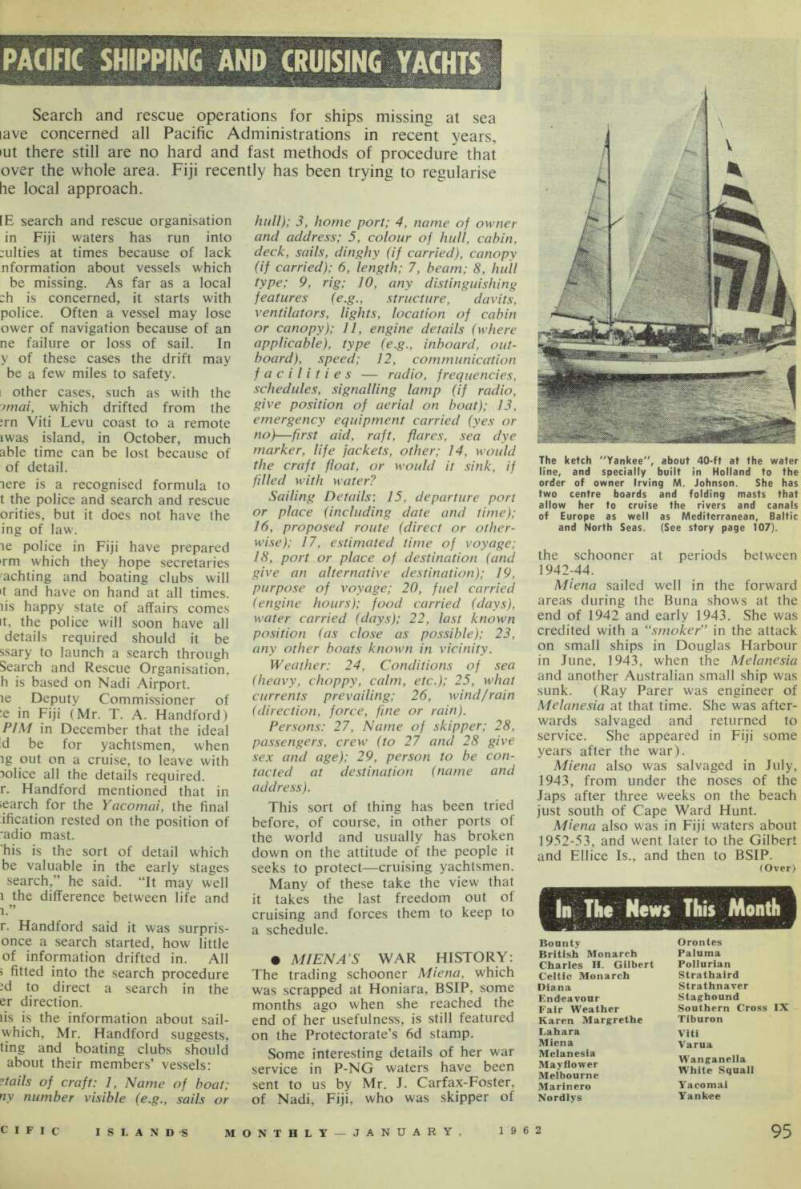
The ketch "Yankee", about 40-ft at the water line, and specially built in Holland to the order of owner Irving M. Johnson. She has two centre boards and folding masts that allow her to cruise the rivers and canals of Europe as well as Mediterranean, Baltic and North Seas. (See story page 107).
was originally built for George Auckland, and carried cement Portland to Auckland. In New , under full sail with the Diesel going, she once logged 7 knots from Buna-Gona area e Ward Hunt. Later she was i down to lower masts and jailed again. On diesel alone eight knots. She was bombed afed repeatedly in early 1943, » never hit. Once she was fired i PT boat and retaliated, for y without casualties. PT boats wiously sunk three small ships !est by mistake. 94 feet long, with a nominal is capacity, she, at times, over 200-tons of stores on rips up the coast, hiding out t day in the mangrove swamps river mouths. She was by far »est ship in the forward areas y 1943, and was a hard ship was permanently armed with calibre Brownings and, also, ith two Oerlikons, “borrowed” le Yanks. ming well aft, she was hard at nights into strange harbours, arfax-Foster says he used to n top of the wheelhouse, where Id see over the bows, and tap khead with a stick to direct the t the helm.
• Those Inflatable
RAFTS: There was much talk in these columns a year or so ago about inflatable rafts for coastal and inter island ships. These it was thought would be more suitable in some
circumstances than conventional life boats.
One of the drawbacks against in flatable rafts is to be sure they are inflatable when the time comes to use them. Therefore they must be kept carefully and inspected regularly. We have now been informed by Perrier & Dickinson Pty. Ltd., who are agents in Australia and the SW Pacific area for. English Dunlop inflatable rafts, that they have appointed an inspector and instructor to their staff. He qualified for the job in the UK by passing the Ministry of Transport examination.
• Strathaird’S Last Port:
Old liners never die, it seems—and some of them become skyscrapers.
The 30-year-old P & O liner Strathaird, which in her day carried thousands of Australasians to Europe, and thousands of European migrants to Australia went to the breakers in Hongkong in the middle of this year.
It seems she yielded no less than 15,000-tons of steel, which melted down, re-rolled and made into re inforcing rods now helps keep up some of Hongkongs’ newest sky scrapers.
Hongkong is one of the world’s busiest and biggest ship-breaking ports —tonnage broken up in a year runs into hundreds of thousands of tons.
A lot of it is remade into reinforcing for the mighty building boom that has been in full blast in this small Colony for the last few years, and still is continuing. Even the new terminal at Tai Shek airport, HK,
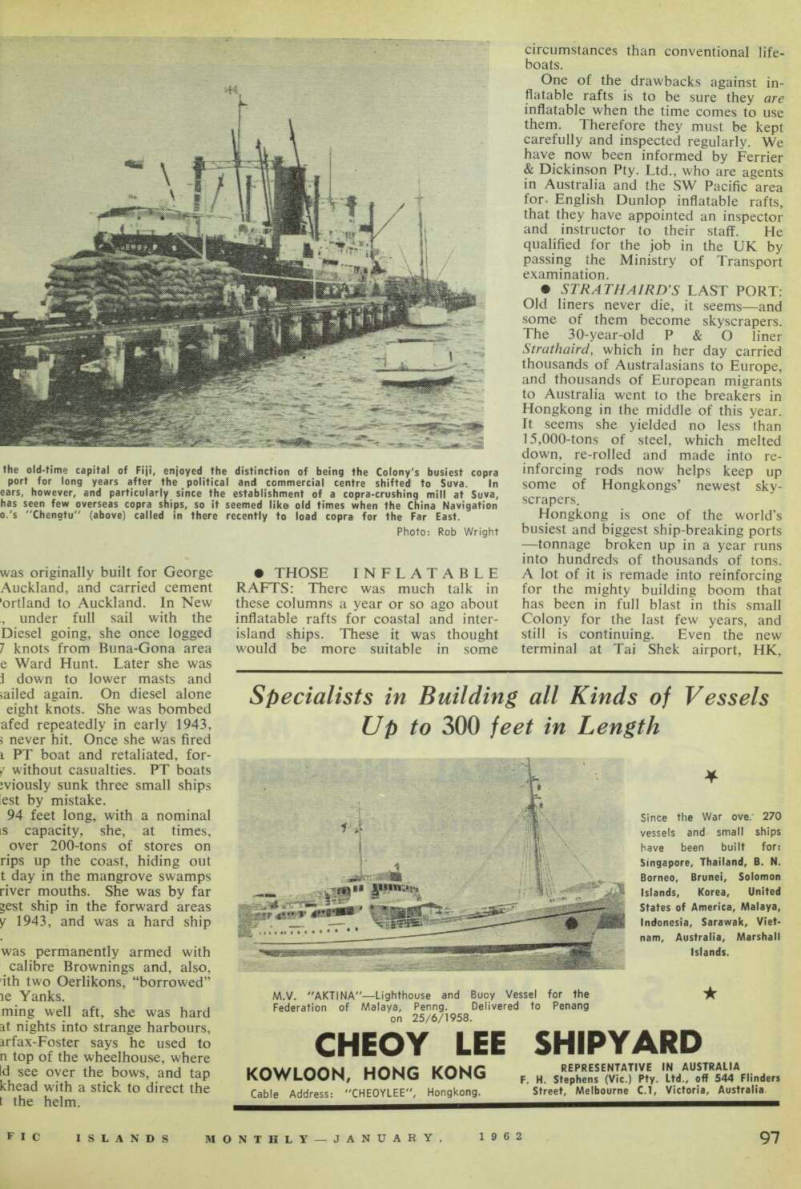
the old-time capital of Fiji, enjoyed the distinction of being the Colony's busiest copra port for long years after the political and commercial centre shifted to Suva. In [?]ears, however, and particularly since the establishment of a copra-crushing mill at Suva, has seen few overseas copra ships, so it seemed like old times when the China Navigation [?]o.'s "Chengtu" (above) called in there recently to load copra for the Far East.
Photo: Rob Wright
a lot of overseas visitors these nake their first acquaintance Hongkong, was reinforced with that started life in a ship.
Doner Than Expected:
will be three fewer voyages i Australia and UK available dlers in 1962. Owing to fewer migrants expected by Australia fast half of this year, the Aus- Government has cancelled tions it had made on outward > of the vessels Orontes and aver. The P & O Orient ny, in its turn, has cancelled yages these vessels were to nade from Sydney in April, nd August. It had been in that these ships, the oldest mpany has in the Australia i passenger service, would ieen withdrawn from service lis year. Now they will be wn earlier—after their current > which begin from Sydney on ry 18 and 23 respectively.
Easter Cruise planned from on April 19, by Strathnaver, o be cancelled.
Company is trying to place :ers who have booked on the voyages and the cruise on )f the company’s ships.
• WANG A NELL A CRUISE 15 ON. It was announced by the Union Steam Ship Company, newlyappointed agents for the ex Huddart Parker liner Wanganella, that the cruise arranged to the Pacific for mid- 1962 is to proceed. Wanganella, veteran of the trans-Tasman passenger service, acquired new owners during 1961 and there was some doubt as to whether she would carry out the cruise that had been arranged, just as there was doubt as to whether she would continue in the Tasman service. She now will do both.
Ihe cruise will commence from
Auckland, NZ, but Australian customers will leave Sydney on June 29 and spend a day or so in Auckland first. Wanganella will then leave Auckland for Suva, Fiji on July 5 spend a couple of days there and' then visit Apia, Western Samoa Vavau and Nukualofa in Tonga the Bay of Islands, North Auckland ’ and reach the port of Auckland on July 20. She will sail next day for Sydney and arrive on July 25.
• A Glutton For Punish
MENT: The way we remember it there was quite a lot of bother, before
[?]anese fisheries training vessel "Koyo
[?]alled at Rabaul for a three days visit About 75 cadets were on board and [?]k the opportunity of having a look [?]l while in port and even found time baseball with a team from the [?] Technical School. The vessel is of [?]s and was built in 1958; she was [?]e of a 16.000 miles training cruise [?]e visited Rabaul and will make calls Papeete, Tahiti, Brisbane, Old., and She was open to the public in [?]nd the picture shows some of the taking advantage of the invitation.
r the event, when the replica fayflower sailed from England rica in 1957. But Australian aptain Alan Villiers, who was ;e of that voyage now wants a replica of Captain Cook’s mr on a voyage of discovery alia. •s got the idea when he read le Sydney interests had toyed 2 notion of purchasing the eplica of the Bounty as a d or marine museum, s Endeavour was of about and, according to Villiers, a could be built in Whitby, e, where the original was r about £Stg. 100,000. She eed a crew of 25 to handle the voyage, round Cape Horn ling at Tahiti, would most ke six months. He sees her lica in every detail—even to eing no auxiliary engine, ight or refrigeration—and no navigational aids other than dsted upon by maritime law.
After the voyage was complete, the ship would be left in Sydney as a permanent memorial to Cook and his men.
Villiers feels that the money for the venture could be raised and that the voyage would stir the imagination of every Australian. He could be right but Australians have shown in the past that they are pretty short on imagination when it comes to gimmicks of the sort that would probably take a quarter of a million pounds to put into action.
Nonetheless, the Australian Historical Society, Sydney, was showing interest in the project in December— but they want the voyage in 1970 — 200 years after Cook’s. Villiers, on the other hand, says he will be too old then. (He’ll be 67).
• The Things Tuna Do:
The United States Fish and Wildlife Service, operating out of Honolulu, just never lets up on its researches into the behaviour of all species of
tuna—for which the United States and other countries have an insatiable appetite.
The Service’s research vessel, Charles H. Gilbert, returned to base in Honolulu early December after two months in the Marquesas, Tuamotu, Society and Line Islands, Skipjack tuna was the variety that most concerned this particular voyage.
In one of the experiments plastic decoy skipjack were towed in the vicinity of schools in an effort to see what the real tuna would think of them. Result: The scientists say cannily that it is too early to judge but the real fish “weren’t repelled” by the artificial ones, Experiments are also being carried out in Hawaiian waters on new methods of catching tuna, particularly with a semi-transparent nylon gill net.
To date, all tuna have been caught with either the pole method or by long-line. No one seems to have made any effort to net them, probably because in the ordinary way of things
TOP LEFT: "Tovata“-ex "Purple Sea"-ex "SC67I", which has been with us since 1948 won't be much longer— except in fond memory.
This is all that is left now of the once adventurous Fairmile which survived to become for a few years the pride of W. R. Carpenter's local Fiji fleet. Mr. Walter Whippy bought her some months ago, minus engines, and has been breaking her up slowly. Her remains, like something left over from a giant cannibal feast, lie outside the boatyard of Charles Whippy and Co., Suva.
In 1948 Ronald Johnson bought the ex sub-chaser as war surplus in Hawaii. She had no engine and he got a tow but when rough weather was encountered en route to Tahiti, the tow captain and Johnson had a difference of opinion as to what should be done.
Johnson decided to remain with his ship and on her he drifted for months until he turned up north of Fiji. He was towed into Suva, fixed the vessel up and finally sold her to Carpenters.
Photo: S. A. Whippy
ABOVE: The MV "Huon", owned by the Papua-New Guinea Administration, is equipped with a portable X-ray unit and used to conduct anti-TB surveys in NG coastal and island areas. There is accommodation on board for European X-ray technicians.
LOWER LEFT: Honolulu in the background, Ala Wai yacht basin in the foreground, and Peter Tangvald's 31-ft cutter “Dorothea", centre, getting some assistance from "Celeste", left, in a mast removal operation. Don Cameron of “Celeste" and Jean Froment, of “Marie Celine"—both yachts well known in Tahiti and to "PIM" readers— were there to give Tangvald a hand. Photo: Bill Schallenberg
this method of fishing is not usedt surface feeding fish. The reasonr trying it now is because tuna ing around Hawaii by traditid methods is proving uneconomic. I
• Sea Miracle: The Bn
freighter, Celtic Monarch, got as from Suva in November with usual quota of stowaways on b<r (they were discovered while stili port), and a new cylinder fitted) Millers Ltd., of that port, vessel had been loading] phosphati Nauru and developed engine tros on the way to Auckland, NZ. f was the nearest port.
Celtic Monarch is not a u visitor to Suva but her Mae Captain John Coutts, had been t before—in British Monarch, of! same Line, in August, 1957, shir after that ship had made world H lines.
Captain Coutts had been MastiJ British Monarch in 1957 whenc second mate, Douglas Wardrojg Kent, UK, lost his balance andb overboard while reading the log. 1 was serious for Douglas as it; 4 a.m., no one knew he was X board and the ship was 1,000 1 out in the Pacific Ocean frorm entrance of the Panama Canaljl heading towards Japan.
As he fell from the stern ol( vessel he was able to grasp a line clung to it for 15 min. till the fri forced him to let go. He wasj missed until 8 a.m. when he wasi to go on watch again. A search! made of the ship and when he « not be found, the course was retd and five hours later the third cd sighted a tiny speck in a swelling!
Captain Coutts says that he dii doubt that they would find Wan but he was concerned, at the that Wardrop might panic ah sight of the ship and perhag drowned. Wardrop did sighli ship about a quarter of a mile* and tried to attract attention by ' ing and splashing, but manage stay afloat.
When the ship was close enn a boat was lowered and Was picked up. In spite of his orde was able to climb into the boas then up a rope ladder of the sH;
• Charting New Gui
REEFS: As master mariners wl\ there know, some of the charts ( Papua and New Guinea ares; based on data over a century oM gathered by such pioneers as CC Owen Stanley and others of thes vintage. But the Royal Austt: Navy is to change all that.
small survey vessel HMAS has already worked for about around China Strait, which > the extreme south-east tip a from its adjacent group of and in the course of that s, as the official jargon had :overed many navigational . These included 26 shoals reefs, previously not marked Admiralty charts although ivigators presumably knew ibout them to keep off. (tember, Palurna returned to for refit and in December th again. She will work for nine months just west of rait and then concentrate on of coastline 90 miles south from Port Moresby—this is a )iece of coast, and ships keep to sea to avoid uncharted Paluma will be away until gust, when she will return Sydney for a spell. It is 3 that there is at least five )rk for the vessel in P-NG graphers in Sydney are now up new charts for the China ised on the survey vessel’s veys.
Years Of Ran: The
istralian Navy celebrated its versary in 1961, and brought iolden Jubilee souvenir—a dsome magazine-type book
that will be of interest to everyone who has served in the Australian Navy or who is interested in fighting ships.
The book is illustrated by about one hundred photographs, in black and white and in colour, and shows the ships of the Navy from the strange shoe-box variety fashionable in 1911, to the pride of the Australian fleet today—aircraft carrier HMAS Mel bourne. Personalities and shore activities of the RAN are also covered.
Looking into the future, Navy soothsayers see the eventual transition
to nuclear power as “inevitable as the advance from sail to steam;” describe the two new guided-weapons destroyers that the RAN is to get from the US; and show an artist’s impression of the new survey vessel that will go into service in 1964.
• The Ships That Waited:
It is just 21 years since German raiders caught half a dozen ships off Nauru and sank them like sitting ducks. Bad westerly gales in that December of 1940 had piled up the shipping hanging off and on Nauru’s giant, phosphate-loading cantilever—
with owner Norman E. Young, CB, [?] both dressed for the occasion— [?] party for friends in Suva where was for a few weeks before pushing [?]e next leg of the journey which [?]e New Zealand. Mr. Young retired post of Comptroller of the National [?]e, UK, in 1954 and he and "Diana" sailing ever since. This is their [?]t to Suva.— Photo: S. A. Whippy.
it was the chance long-awaited 3erman raiders that had preyed ously on shipping in the Pacific for the previous six The world knew of the js of these hit-and-run enemy inly when nearly 500 cast- -passengers and crew from Allied ships—were found on Island, New Guinea.
December of 1961 produced weather for Nauru, the worst :ade, with strong westerly conthat lasted three weeks and up the ships waiting off the er until there were eight.
Do Many Captains:
Islands are not all converted et-age—on some of them the life of small ships, bad ges and tricky reefs still exist his is doubly so in the Cook A correspondent, writing Cook Islands News— a newsued daily in Rarotonga gave ) this from Mitiaro, one of them islands of the Group ie told how a number of
Domw
’ decl up . ' incident,” he says, “was the too many people telling the and crew of the surf-boat is the proper time to row the it through the passage to While half were shouting ie other half were shouting , and the result of this was :n they did start rowing they ■eady nearly reached the • tO . passa 8 e an d were in the breakers. The boat imped and everyone in it— I a fowl and a billy-goat—
were half-drowned. Cameras, a radio and other valuables were soaked.”
All the customers eventually got on board and a week later the ship was back again on her rounds to pick up for Rarotonga. Messrs. W. Ryan and Tei Shepherd were amongst those embarking—during their spell on the island they had exploded 50 depth charges, hundreds of sticks of gelignite and other explosives to blast out a bigger passage through the reef.
Their successful efforts in this direc tion had earned them the grateful thanks of the local residents, who almost killed them with kindness in a series of farewell parties and feasts.
Also embarked was Chief Judge Fraser, who had been holding court ! n tbe local Sunday School and mak in 8 judgments in cases of drunken ness > assau lt, animal trespass and one c . ase of (believe it or not) “fornica tion”- Cook Islands courts can still be courts of morals as well as law, though in other parts of the world this sort of htig a tion was dispensed with about the time the Y g a ve up witch-hunting.
* More Tenders For
It was expected in December that unless the 700-ton motorship Viti was soon sold by private treaty, she would be again put up for tender, She was lying idle at Bledisloe Wharf, Auckland, and is in the hands of the receivers.
Originally a Fiji Government ship she was sold to a group of ex servicemen after the war, who traded under the name of Tasman Steam Ship Company.
She went into receivership to the State Advances Corporation earlier in 1961 because of a £15,000 debt on a rehabilitation loan. (Over)
[?]del of "Miena" [?]ade by Mr. J. [?]osier, and is [?]re by his young Richard. (See [?]y page 95).
• PIRATES: The pride of the Bougainville Company’s fleet in New Guinea, the motorship Pollurian, re turned to Rabaul just before Christmas. She has been absent for some months in Hongkong where she has been undergoing extensive overhaul, and by all accounts she had an eventful voyage home.
For three days after leaving Hong kong she bucketed around in dirty weather and as a result of it a pipe burst in the engine room. The captain decided that it could more easily be fixed if they were hove-to and this manoeuvre was carried out close to the coast of the Philippines.
They were visited by a few of the local small craft from the shore and finally by a fast, powered boat
equipped with a machine gun which opened fire as soon as it was within range.
The Pollurian didn’t wait to see what happened next. The anchor was got up after some preliminary excite ment and they left in a hurry to carry out the remainder of the repairs at sea.
The section of the South China Sea between Hongkong and the northern Philippines is traditionally the haunt of pirates, and some of them these days have some untraditional modern equipment. Small vessels try to give the area a wide berth or keep out of sight of land during daylight hours.
• Southern Cross Ix, Now
nearing completion for the Melan-
esian Mission at the Ballina Sli]i and Engineering Co.’s establish: in Northern NSW, will not leave for the Solomons to tab duty until April.
She will be dedicated in Sy on April 7 by Archbishop Gouji Sydney, and will leave shortly ■ wards for Honiara.
It had been hoped to get her by end of December beforea worst of the North West seaso gales sets in. But when this p: not possible it was decided toe until April when the weather proves.
News of Cruising Yacl
• Fair Weather , West I
built, American owned schoones in Suva, Fiji, in December am pected to leave for New Zt> between Christmas and New v She is owned by Mr. Bill A who is accompanied by his« Suttie, four children and two < members —Ray Pettigroye, who Sydneysider but who joined thu in Tahiti; and Vern Hans© Hawaii.
From Auckland Fair Weather probably cross the Tasman to ney and likely go on from thei a world circumnavigation.
Adams has the time—he’s a ; San Francisco businessman —aif family seems to have the inclin
© Karen Margrethe,,
port San Diego, and owned 1
"Karen Margrethe" in Suva. (See H[?] Photo: S. A. [?]
nport family, was in January prepared to leave Suva where have been for the last six is. Next port, Auckland, NZ.
NORDLYS, well-known Pacific ig yacht, was in Suva in De ;r in company with Fair ter ■ —they had sailed together Papeete, Tahiti, Next port of /ill be Auckland, NZ. In Suva vas slipped by Millers Ltd., d and painted. Amongst a :r of people travelling on her rold Stevens, a Life Magazine pondent.
VARUA, beautiful Papeete brigantine, was the only arrival sd at the Ala Wai boat ir, Honolulu, during the month December 15. She is owned A. Robinson who has written I books in which Varna was doubted heroine.
WHITE SQUALL, the 33-ft md, NZ ketch, owned by Ross oreen Norgrove is at Sausalito, nia, and they will probably here a year before moving to Mexico and the Caribbean.
YANKEE: A Christmas mes rom Irving and Exy Johnson an exciting description of a an summer spent with their vhich is easily convertible with ible centre boards from ocean I to river cruising.
Johnsons are now back in the States for the northern winter Yankee waits it out in a ship ; Ischia in the Bay of Naples.
' and the Johnsons began their sason in March with a cruise Greek Islands; they followed • with a visit to Sicily and e were ready to make their European crossing—up the
Rhone, over the mountains of Swit zerland by waterways built in Napoleon’s time, and down the Rhine to Holland. The Baltic, the island and inland waterways of Scandinavia occupied them until September when they commenced their second trans continental crossing. Up the Rhine this time, across the Vosges Moun tains, down the Doubs and Saone Rivers and into the Rhone again, exit at Marseilles and Mediterranean cruising.
It sounds like a delightful way to
Paul Hurst's "Staghound", now in Madang, New Guinea, after three months in Rabaul and a few weeks in the Witu Grouo. (See page 109).
living and the Johnsons have amusing things to say about ing from Rhine barge cap » bikinis (which are “spelt with small b” in Europe). : beautiful warm calm Octo they record, “we anchored vhile off the famous Mediter- Ile du Levant. There, to our lent, this late in the season, hundred or more completely people playing around the shore, paddling canoes or a dip in the sea. In the past I thought that we had seen r ery small bikinis, but here In’t bother with bikinis at all. were they bothered about our / . . . one imaginative couple aying American Indian.”
'ARINERO, American yacht m Diego, spent some time in )fa harbour, Tonga, in No- On board were owner Floyd son, his wife Doris, two small (Keith and Karen) and n Fred Sibthorpe. They later kualofa for Auckland, NZ.
BURON, a shapely Ameri it which had just arrived from d, via Tonga, was lying in go in November. The owner, Vessey, married Volita, a Eastern Samoa while there way southwards, early in iburon was going eastwards, i. \CHT CLUB; The Power d Yacht Club, formed in w Guinea, in 1960, hasn’t ib house but recently it was
granted the lease of a block of land near the small-ships’ wharf at Voco Point. First task will be to build a ramp and slipway there—club build ings can maybe come later.
The club will cater for both power and sailing boat members and the latter will be under the leadership of Vice Commodore Des Ashton— otherwise Morobe District Officer who, as owner-skipper of the 33-ft sloop Lahara, is a veteran of Trans- Tasman, Sydney-to-Hobart and other blue-ribbon sailing events as well as an accomplished cruising yachtsman. • STAGHOUND, owned by American Paul Hurst, was in Madang, New Guinea, when he wrote us a note on December 12. Paul and his attractive wife (from Tahiti) have spent the last three months in Rabaul after a long Pacific cruise but are now heading in the general direction of the Far East. On the way from Rabaul to Madang they spent a couple of weeks in the Vitu Group.
"Fair Weather" in Suva in December—see page 106.— Photo: S. A. Whippy.
"Nordlys", in Suva in December, and scraped down ready for painting in the boatyard of Millers Ltd. (See page 107).
Photo: S. A. Whippy