This Was Gvsther’S War
pp. 83-85 · Read in the full issue
One precious component in the business of writing books Gunther Bahnemann has in plenty — time. In fact, seven years of it. He is billed as the only successful author in Australia who is writing books in gaol.
I>UT a life of adventure began for Gunther long before he was committed to Boggo Road Gaol, Bris bane, in September, 1959, found guilty on a charge of attempting to kill. It began in the Western Desert in mid-1941, when Rommel’s Afrika Corps was on top in North Africa, as Hitler was in Europe.
He chose this inappropriate time to “shoot through” and for months lived in the desert, dodging not only British and Arabs but Germans and Italians as well. This is the period he describes in his first book, I Deserted Rommel.
At 14 Gunther went to sea in the four-masted barque Pamir, later changed to steam. Ships have been his life for a great part of the 28 years since, but in 1939 he joined the German Army.
He had already won the Iron Cross, first and second class, at the time in 1941 when he decided to leave, so whatever the reason for this it is un likely to have been cowardice. He says it was because he heard that the Gestapo had hanged his father.
He was one grade better than a despatch rider at the time—a courier, in an armoured car—and his idea was to head towards Lake Chad and then to some neutral territory in Africa.
He soon found that it was one thing to give the war away, and quite an other, stuck out in the desert between Derna and Benghazi, to escape it.
For three months, until taken by a British patrol at Bir El Hacheim, he saw more action than in Hitler’s blitz on the Low Countries and France; and except for a posse of Arab free booters who befriended him and with whom he lived in a cave, all men were against him.
The way Gunther tells it, it was a period of wild adventure in which only ruthlessness and physical en durance allowed him to survive but in which there were also sufficient moments of introspection and loneli ness to drive him to despair. In the last 20 years he has learned to read and write English fluently, and although his grafting of the Aus tralian idiom onto Germanic thought processes is initially irritating (although perhaps only to another Australian), the story as it whips breathlessly from one swift-moving incident to the next, holds in terest throughout.
How much of this colour can be attributed to natural literary flair is a matter of opinion, but judging by what is known elsewhere of Gunther Bahnemann, the Western Desert epi sode is very much of a pattern with the rest of his life.
When German MB’s caught up with him in a “luxury hotel” in Barce, Cyrenaica, he set the time-fuse of a hand-grenade, put it on the bed room floor just as they began to batter down the door and was over the balcony and into the street (toss ing another grenade into the hotel entrance as delaying tactics), before the bedroom-door and the grenade burst simultaneously.
In 1959, in Brisbane, when four policemen called at his home in order to settle what appeared to be a late night domestic argument, Gunther got his rifle and prepared to repel boarders. Somehow in the ensuing argument a shot was fired, no one was hurt, and the police were sub sequently decorated for bravery in arresting him. (The Judge took a very dim view of the whole thing and that is why Gunther is at his present address.) Towards the end of 1941, as a prisoner of war of the British, he was sent to Australia for internment.
He was released in 1947, and pre sumably because he was a deserter, was allowed to remain in Australia.
He returned to the sea—first deliver
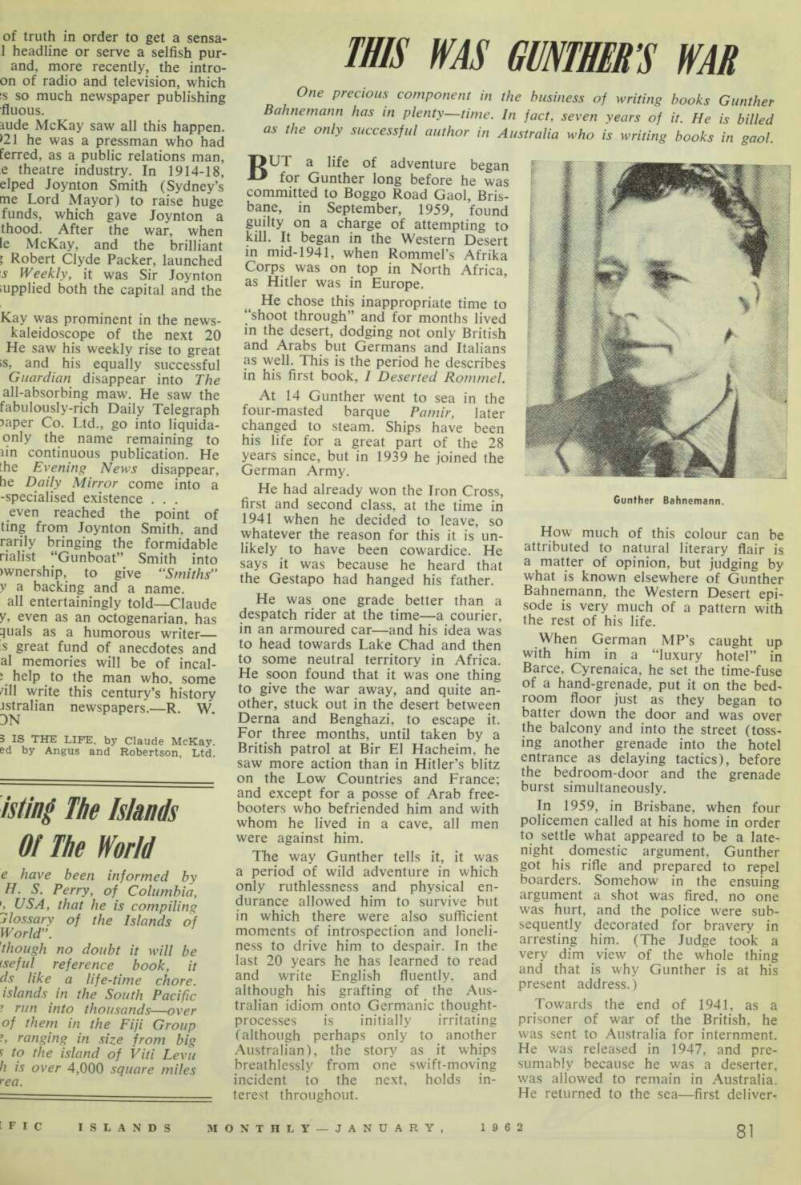
Gunther Bahnemann.
nail ships to the Pacific Islands, operating a mail run between 5 and Thursday Island. For a he was captain of the Catholic >n vessel Stella Maris between i. Port Moresby and Madang, le Mission and Gunther soon and he became owner of the ig vessel Lochiel and operated ►rres Strait and New Guinea also went crocodile shooting in srn Australia and around the ke area of Netherlands New
Guinea; has owned four ocean-going yachts (and sunk two); and worked at Mt. Isa Mines.
In the last two years, since he has the time for it, he has completed the manuscript of a second book which describes his post-war adventures in North Australian and Island waters.
Called Sail Softly Stranger, it is to be published in 1962 and could be even more adventure-packed than his first literary effort. (I DESERTED ROMMEL. Published by t Jarrolds. Australian price, 26/6.)