The Tolais'
p. 76 · Read in the full issue
A Brett Hilder Profile
Mentor
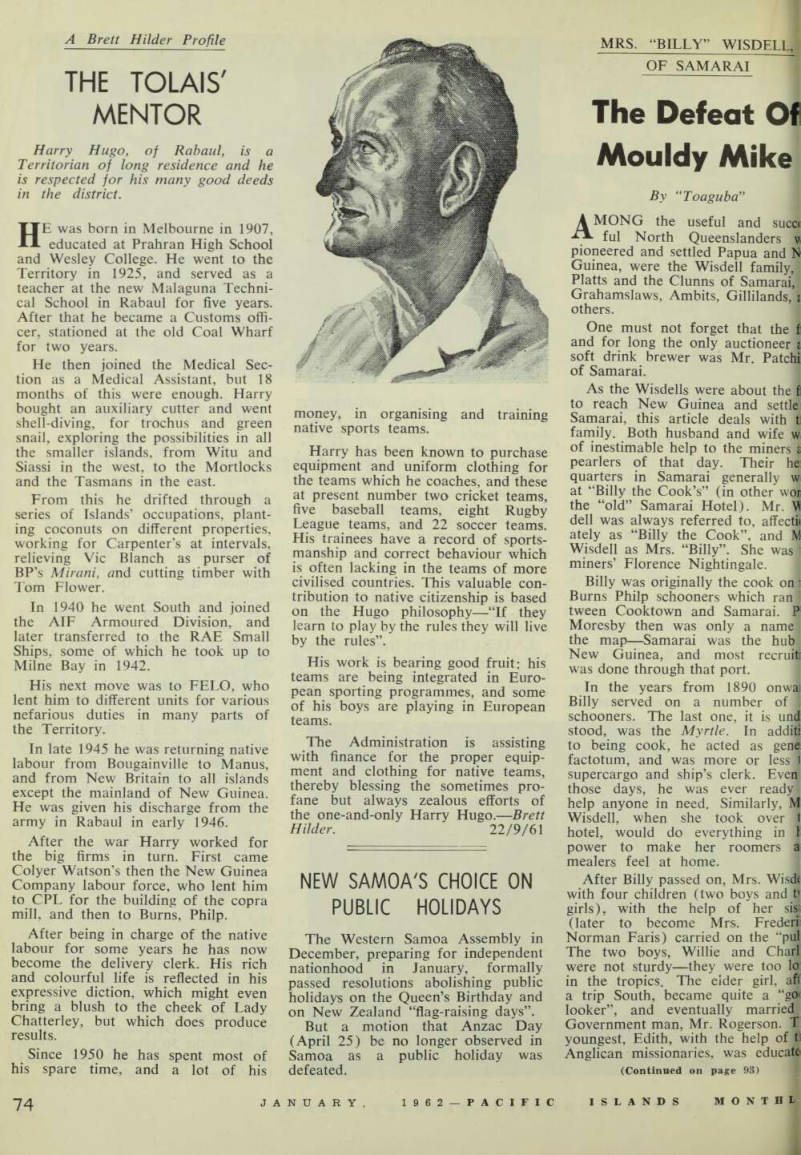
Harry Hugo, of Rabaul, is a Territorian of long residence and he is respected for his many good deeds in the district.
HE was born in Melbourne in 1907, educated at Prahran High School and Wesley College. He went to the Territory in 1925, and served as a teacher at the new Malaguna Techni cal School in Rabaul for five years.
After that he became a Customs offi cer, stationed at the old Coal Wharf for two years.
He then joined the Medical Sec tion as a Medical Assistant, but 18 months of this were enough. Harry bought an auxiliary cutter and went shell-diving, for trochus and green snail, exploring the possibilities in all the smaller islands, from Witu and Siassi in the west, to the Mortlocks and the Tasmans in the east.
From this he drifted through a series of Islands’ occupations, plant ing coconuts on different properties, working for Carpenter’s at intervals, relieving Vic Blanch as purser of BP’s Mirani, and cutting timber with Tom Flower.
In 1940 he went South and joined the AIF Armoured Division, and later transferred to the RAE Small Ships, some of which he took up to Milne Bay in 1942.
His next move was to FELO, who lent him to different units for various nefarious duties in many parts of the Territory.
In late 1945 he was returning native labour from Bougainville to Manus, and from New Britain to all islands except the mainland of New Guinea.
He was given his discharge from the army in Rabaul in early 1946.
After the war Harry worked for the big firms in turn. First came Colyer Watson’s then the New Guinea Company labour force, who lent him to CPL for the building of the copra mill, and then to Burns, Philp.
After being in charge of the native labour for some years he has now become the delivery clerk. His rich and colourful life is reflected in his expressive diction, which might even bring a blush to the cheek of Lady Chatterley, but which does produce results.
Since 1950 he has spent most of his spare time, and a lot of his
money, in organising and training native sports teams.
Harry has been known to purchase equipment and uniform clothing for the teams which he coaches, and these at present number two cricket teams, five baseball teams, eight Rugby League teams, and 22 soccer teams.
His trainees have a record of sports manship and correct behaviour which is often lacking in the teams of more civilised countries. This valuable con tribution to native citizenship is based on the Hugo philosophy—“lf they learn to play by the rules they will live by the rules”.
His work is bearing good fruit: his teams are being integrated in Euro pean sporting programmes, and some of his boys are playing in European teams.
The Administration is assisting with finance for the proper equip ment and clothing for native teams, thereby blessing the sometimes pro fane but always zealous efforts of the one-and-only Harry Hugo. —Brett Milder. 22/9/61