The Glory That Was
p. 73 · Read in the full issue
Herbertshoehe
By “Tolala”
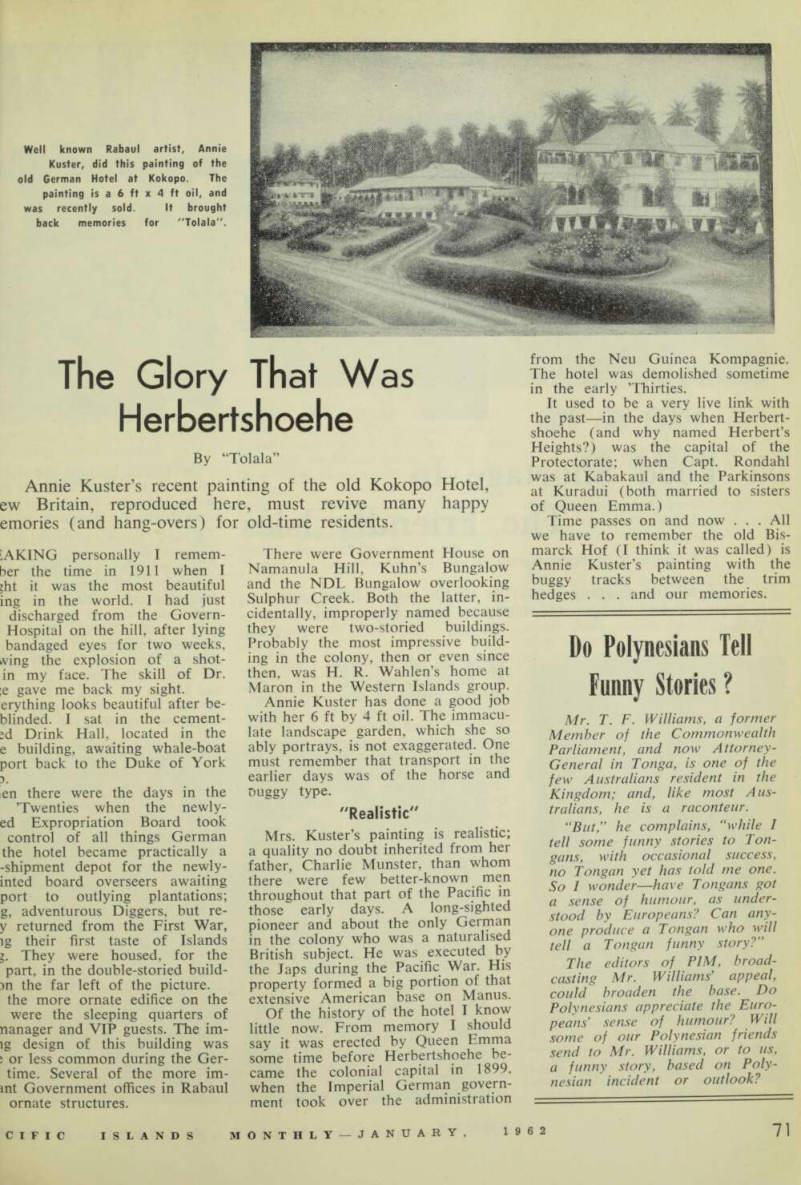
Annie Kuster’s recent painting of the old Kokopo Hotel, ew Britain, reproduced here, must revive many happy emories (and hang-overs) for old-time residents.
MAKING personally I remem ber the time in 1911 when I »ht it was the most beautiful ing in the world. I had just discharged from the Govern- Hospital on the hill, after lying bandaged eyes for two weeks, wing the explosion of a shot in my face. The skill of Dr. ;e gave me back my sight, erything looks beautiful after be blinded. I sat in the cement ed Drink Hall, located in the e building, awaiting whale-boat port back to the Duke of York 3. en there were the days in the ’Twenties when the newly ed Expropriation Board took control of all things German the hotel became practically a -shipment depot for the newly inted board overseers awaiting port to outlying plantations; g, adventurous Diggers, but re y returned from the First War, ig their first taste of Islands y. They were housed, for the part, in the double-storied build m the far left of the picture, the more ornate edifice on the were the sleeping quarters of nanager and VIP guests. The im ig design of this building was ; or less common during the Ger time. Several of the more im mt Government offices in Rabaul ornate structures.
There were Government House on Namanula Hill, Kuhn’s Bungalow and the NDL Bungalow overlooking Sulphur Creek. Both the latter, in cidentally, improperly named because they were two-storied buildings.
Probably the most impressive build ing in the colony, then or even since then, was H. R. Wahlen’s home at Maron in the Western Islands group.
Annie Kuster has done a good job with her 6 ft by 4 ft oil. The immacu late landscape garden, which she so ably portrays, is not exaggerated. One must remember that transport in the earlier days was of the horse and puggy type.
"Realistic"
Mrs. Kuster’s painting is realistic; a quality no doubt inherited from her father, Charlie Munster, than whom there were few better-known men throughout that part of the Pacific in those early days. A long-sighted pioneer and about the only German in the colony who was a naturalised British subject. He was executed by the Japs during the Pacific War. His property formed a big portion of that extensive American base on Manus.
Of the history of the hotel I know little now. From memory I should say it was erected by Queen Emma some time before Herbertshoehe be came the colonial capital in 1899, when the Imperial German govern ment took over the administration
from the Neu Guinea Kompagnie.
The hotel was demolished sometime in the early ’Thirties.
It used to be a very live link with the past—in the days when Herbert shoehe (and why named Herbert’s Heights?) was the capital of the Protectorate; when Capt. Rondahl was at Kabakaul and the Parkinsons at Kuradui (both married to sisters of Queen Emma.) Time passes on and now . . . All we have to remember the old Bis marck Hof (I think it was called) is Annie Kuster’s painting with the buggy tracks between the trim hedges . , . and our memories.
Well known Rabaul artist, Annie Kuster, did this painting of the old German Hotel at Kokopo. The painting is a 6 ft x 4 ft oil, and was recently sold. It brought back memories for "Tolala".