"M y Dear Pre-Entry ..."
pp. 71-72 · Read in the full issue
Pacific Islands Monthly
Magazine Section
From a Special Port Moresby Correspondent What would you do if you were a native Naval cadet in Manus, a clerk in Madang, a Co )peratives worker in Bougainville or a teacher in Wau, and decided it was more than time you mproved your education? The chances are—remembering you are a native—that you would hink of The Correspondence School.
You wouldn't know the correct official title of the school—which happens to be the Pre-Entry and' Auxiliary Training Branch of the Department of Education, Port Moresby—but it’s a certainty you would have some friends doing some lessons there and you would remember that help was waiting for you just for the asking.
WING thus decided on your course of action you would be a letter requesting that you be lied. If you’d already had some -primary education you’d prob begin the letter (in your best Iwriting), Dear Sir. (You may i have access to a typewriter ugh your boss, or a friendly ol officer). you had less know-how you Id perhaps begin Dear Officer-in rge, or even (and it has been wn) Dear Pre-Entry, or Dear ter. aving stated your request for les , you would sign off (again de ling on your own particular ;), Yours Faithfully, Your De d Student, or Your Loving Son. 3me days or weeks later you re e a form which you laboriously iplete and return. Then, some time :e, you receive your first parcel—
a brownish OHMS envelope, contain ing an instruction sheet, a letter of welcome, lesson notes, exercise books and a pre-paid addressed envelope, so that return postage won’t hurt your pocket.
The way has been opened. The rest is up to you. . . .
But that is where so many of the students fall down!
Due to a combination of difficulties —infrequent mails, insufficient free time (particularly in the case of schoolteachers with lessons to pre pare)—too long spent out on patrols, etc.—only the keenest students satis factorily complete the course.
This branch of the Papua-New Guinea Education Department may be unique in the Islands. No one seems to have heard of any similar organisation elsewhere.
For the last three years, the branch has been catering for ex-school
youths and adults requiring education in English and Mathematics from Grade 4 to Grade 9. Those requiring secondary education apply to the Secondary Correspondence School in Brisbane.
The current New Guinea enrolment is approximately 1,700. Very few of the students are girls. Originally, all that was necessary to secure enrol ment was a pass at the Grade 3 level, but because of ever-increasing num bers and ever-dwindling staff, it has reluctantly been confined since last May to Administration personnel only.
The work for each grade is divided into a series of lessons which can be comfortably covered in a year, but there is no limit (within reason) to the time taken to complete the course.
All materials are supplied to stu dents. All lessons are prepared and roneoed in the single large office.
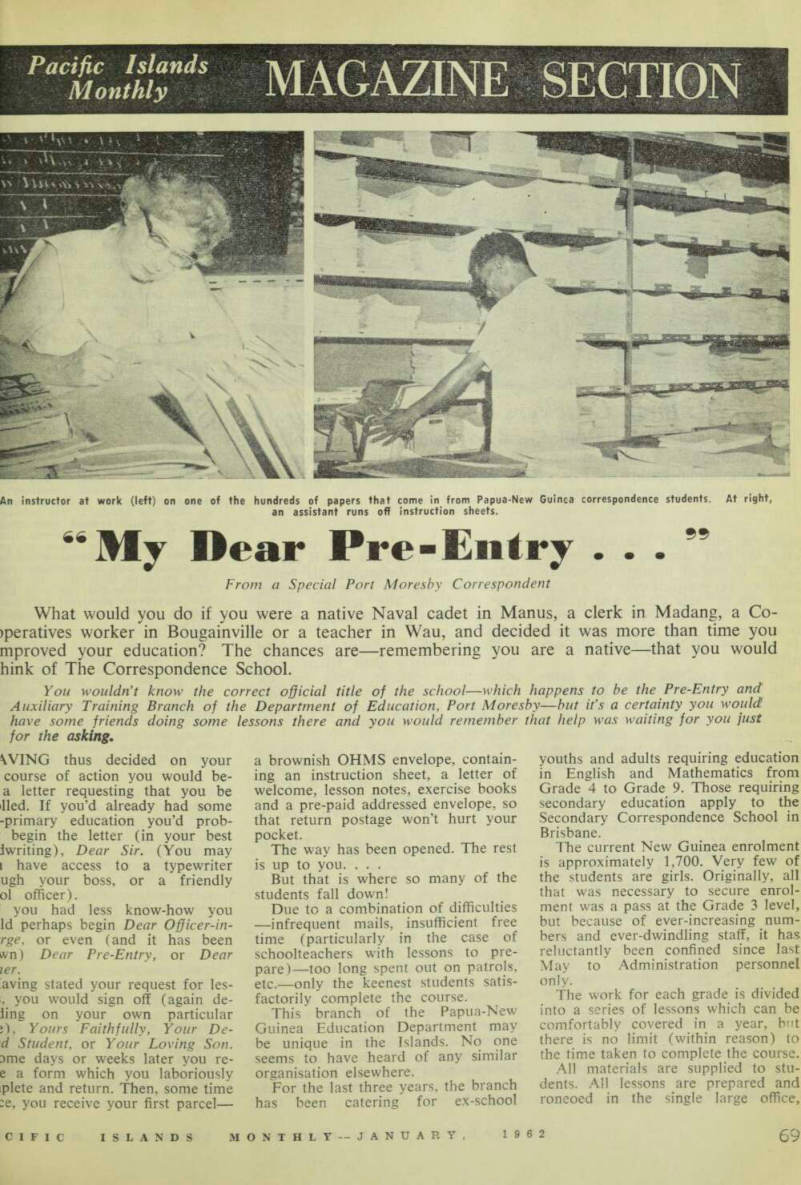
An instructor at work (left) on one of the hundreds of papers that come in from Papua-New Guinea correspondence students. At right, an assistant runs off instruction sheets.
built on stilts over the water, and once the Port Moresby native hospital. It is staffed mainly by women teachers, but presided over by a male, with two or three clerks and typists, and three Papuan office boys. There is a European staff of approximately 16 when at full strength (which isn’t often).
In larger centres, where the numbers are sufficient, correspondence students may be banded together in afternoon or night classes and given some assistance with their work, although still working from the same lesson notes as those working “solo” an out-stations.
The most-wanted examinations are for Grades 7 and 9, as these are the Hajor gateways to promotion, higher aay, etc. Many students ask specifically for these grades, regardless of ;heir previous standards, and some aecome hurt or even indignant at beng accepted only for a lower level.
Phey complain bitterly about having ;o “waste time” in another grade vhen it is the 7 or 9 examination ;hey want to pass!
As with all school-teaching, the vork has its lighter side, such as this •ecent “howler”: Q. “Use the word ‘invented’ in a sentence.”
A. “Breasts were in use long before inned milk was invented.”
There was also the student who complained to his teacher because
she wrote in red ink all over his work. He informed her that if she in sisted in thus disfiguring his books he couldn’t see the point of sending any more in. The teacher agreed with him, and the enrolment was re duced by one.
Through the students’ work, and more particularly their letters, real personalities emerge. Take for in stance the woman teacher who had not sent in any work for some months, and finally wrote: Dear Sir, I feel in my heart I must inform you about the reason of my lessons not coming to you lately. It is be cause I have been in hospital await in& m y fourth child to born. Also in absence one other teacher {name supplied] stole my papers. That is why, Sir, so 1 am sorry, Your Faithful Servant, Mrs. S.P.
The baby’s name is Anna.
One of the greatest difficulties is with students who, for no apparent reason, change their name. Some times it is only one of two names which are changed. The names may be reversed or the name of a friend may be adopted instead. There is the case of a student who, after receiving lessons for some months, sent a hasty note to inform of a change of name, He apologised profusely, but he had enrolled in his sister’s name “by mistake”.