Hospitality Was
pp. 65-69 · Read in the full issue

Indonesian Hospitality Was Overwhelming
By Homer O. Parrish
y wife, Julie, our twelve-years iaughter, Kathy, and I embarked Los Angeles, California, on 31, 1960, in our 30-foot Tahiti i, “M’S Santana’’. Our itinerary ded the Marquesas, Tuamotus, ti, Moorea, Fiji, New Hebrides, Guinea, Torres Strait, Thursday d, Indonesia; and our present i\er at Singapore. \NY adverse reports concern ing the reception of yachts sail the Indonesian waters had been ght to our attention; but, having in mankind, we wanted to see ourselves. iling from Thursday Island on 12, 1961, we set our course for port of entry, Dili, in Portuguese or—a port we never reached. Five out of TI a blow struck us h ripped the seams of both miz and jib sails. We used our motor, the fates were seemingly against as the exhaust pipe blew out, 'ing carbon monoxide into the a and blackening the interior as as the cockpit, eeding a port where we could plete repairs on the sails and ex it pipe, we put in to the beautiful of Saumlaki, Jamdena, in the imbar group. :ores of villagers traipsed down half-mile-long coral pier to look >ver. Officials questioned us and, n satisfied of our need to stay, ed their superiors in the Moluc capital of Ambon to obtain per ion for our stay. All such matters 5 to be relayed to Djakarta for authorisation, s the transfer of messages is very
slow, we did not receive either consent to remain in Saumlaki, or to continue through Indonesian waters, until two weeks had elapsed. Those two weeks on that outpost island of Jamdena turned out to be one of the happiest periods of our H years of sailing.
Though Saumlaki had been severely struck by a hurricane in December of 1960, and was short of supplies, the people insisted on giving us flour, rice, dried beans, dried peas, eggs, macaroni, what little fresh fruits they had, and tinned foods of margarine, powdered milk, and jams.
Time and again we were invited to their homes for tea, chocolate drinks, and to share some of the most delicious meals we have eaten, Dances and song feasts were given in the evenings, and friendships were formed. When the cable from the port of entry of Ambon was received at Saumlaki, giving us permission to proceed, we departed with heavy hearts.
Four or five days later, we dropped our hook in the bay of the lush green Spice Island of Ambon. Offi cials showed us courtesy and con sideration, and we were presented
the official cable from Djakarta, ling the door to the many islands ndonesia. little southeast of Buton Island e is a small island called Wangi igi. We anchored off the coral , enclosing a peaceful lagoon of uoise waters. Beyond, lay white Is with picturesque island boats I on their sides, waiting to be ned and painted. And beyond that med the dome of the Mohamme mosque of the village of Wandji. s we have been the first yacht in ly bays throughout the Pacific, we i usually deluged by young and visitors until a system of ex ige visits was worked out. The
inhabitants of Wandji were the most enthusiastic welcomers we have ever met. Later we were informed that, before we went ashore, all villagers had swept and cleaned their attrac tive, well-laid-out streets, in our honour.
Wandji is a beautiful village. A short walk through the town brings one to a secluded, emerald-green, fresh-water pool amidst towering rocks and trickling waterfalls.
We were invited to dinner at the home of one of the elders of Wandji, and that evening native dances were performed on a large, flat square at one end of the village. About a
thousand men, women, and children attended—all sitting around the square on chairs or benches pro vided. We enjoyed participating in the first dance, the popular “joget” of the islands. After this followed the hypnotic rhythms of the various dances of the outer Indonesian group.
When the time came for depar ture our friends showered us with limes, bananas, papayas, and coco nuts.
After a few days’ sail among the Tiger Islands and along the coasts of Soembawa, Lombok, and Bali, we pointed M’S Santana’s bow towards Surabaja—the naval base of Indo
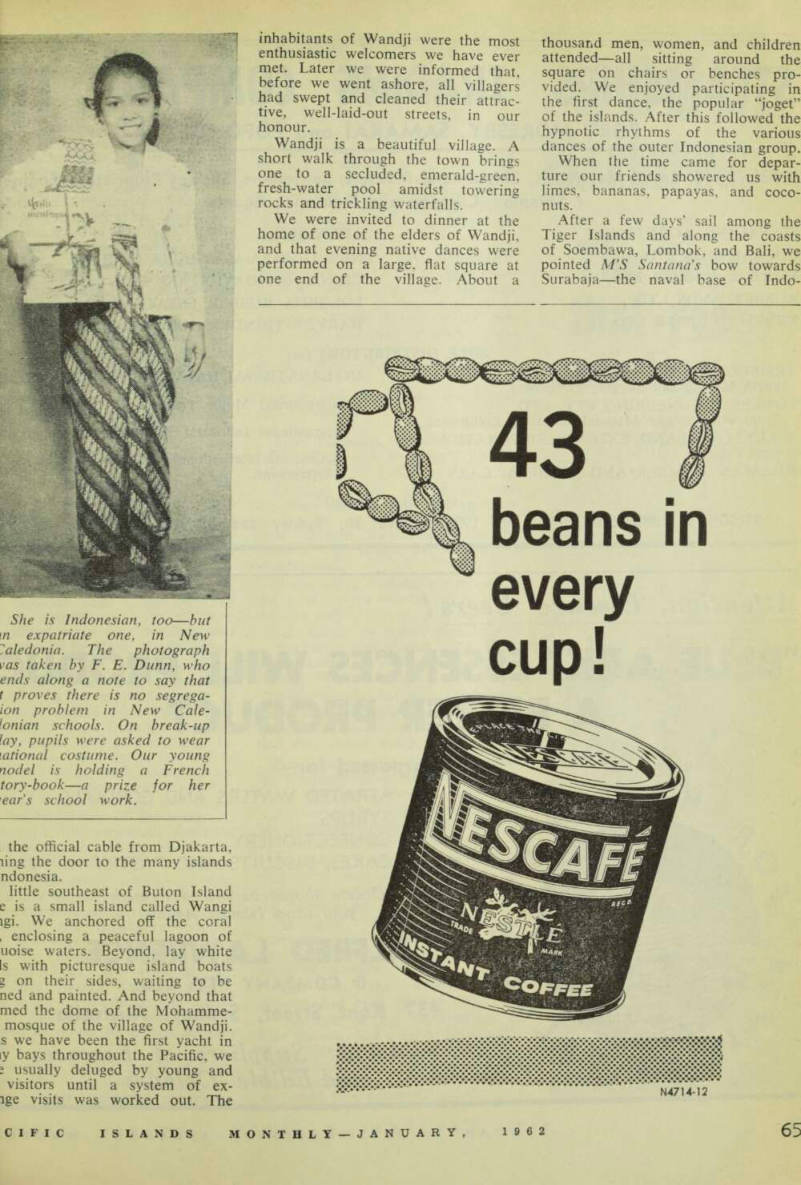
She is Indonesian, too—but [?]n expatriate one, in New [?]aledonia. The photograph [?]as taken by F. E. Dunn, who [?]ends along a note to say that [?]t proves there is no segrega [?]ion problem in New Cale donian schools. On break-up [?]ay, pupils were asked to wear [?]ational costume. Our young [?]odel is holding a French [?]tory-book—a prize for her [?]ear’s school work.
a. During this leg of our journey, e had been little wind, and a tering sun beat down upon us y. Late one afternoon, we grate y dropped our hook west of the ivac pier, at Surabaja, fext morning we prepared to or to the Harbourmaster’s wharf ►btain clearance; but found, to our lay, that the anchor chain was ed on a sunken wreck, /e hailed a passing speed-boat for i and pretty soon Mr. Bleszynski PORAS, (the Surabaja Yacht b) came to our assistance. He Mrs. Bleszynski sent out iges, bananas, eggs, milk, and 1 chicken—which was better than istmas to us! iter futile attempts by the yacht > workers to untangle us, Mr. izynski contacted Major Nataku ia, of the Indonesian Navy. The or and his Under-water Rescue amand sped out to our boat, and >0 minutes the anchor was freed n the sunken wreck.
Wonderful Hospitality
/e were invited to tie up at the it club wharf, where we were ed and dined for two weeks. Pre ;d meals were delivered on board us, sails and rigging were care y gone over. M’S Santana’s top s were painted from stem to stern, the exhaust pipe of our engine replaced with a new one of ible, stainless steel. In addition, official entry into Surabaja was :n care of by Major Natakusuma. >ne evening we gave a lecture to naval cadets and yacht club nbers on the problems at sea of p-water sailing. Next day a long ance call came from the secretary the yacht club in Semarang, in ig us to stop there on our way to karta. Young club members ex ised their desire to hear our lec : and hoped we might stay to en the hospitality of Semarang. As were a little concerned about the isoon season setting in, we de ed the invitation with regret. )ur two weeks’ sojourn in Dja ta was the same story. We were wn the same wonderful Indonesian erosity and hospitality by offi s and yacht club members. Mr.
Mrs. Roosmin, their charming etary, Dari, Mr. Wahjudi, Mr.
Mrs. Joustra, Captain Asnam, e a few of the many who invited to luncheons and dinners, and wed us points of interest in their ital. )ur three months’ period of travel ang the Indonesian islands was y a most wonderful experience.