[?]dneysider
pp. 61-63 · Read in the full issue
At Home Base
You Can Have It Duty-Free
In the middle of 1961, Kingsford-Smith International Air rt in Sydney joined the ranks of those offering a bonus to
vellers: It opened a duty-free shop.
5 was by no means original. luty-free shops—a gimmick like golden beads across the for the edification of air travelmay, for all I know, have been ed by the Dutch in their Schiairport near Amsterdam, but [ea soon caught on elsewhere, gh the national economics of it always escaped me. the goods most in demand, er at Shannon, Ireland, or Fiji, are French perfume and i whisky, the idea seems to be t is better to reef the last shilaff the traveller, even if the ry’s coffers must forego the ms duty, than allow him to ; to spend it elsewhere. iney’s shop differs from many of id elswhere, in that it is estabright in the vestibule and is ;ible to the public. Unless bona ravellers they may not buy—but :an look; and those who come to remain to curse. All Australians d visit Kingsford-Smith dutyshop at least once in a life-time der to see how much the Gov- ;nt makes from their living in mported luxury to which they become accustomed. with most airport duty-free , this one too fobs off the fesex with French perfume and 5 on the principle that 95 per of air travellers are male and for Scotch whisky, cognac, 5, cigarettes, electric shavers and :ulars. I have yet to see any of , anywhere, offering female utili- -like mink coats—duty-free at ous bargain rates. den you leave Sydney, because shop is now there, you may lug the plane with you bottles of
Scotch, guaranteed bottled amongst the bonny heather and 86 proof, at a mere quid (Australian) a bottle, or French cognac at £AI/6/-; or Australian gm at AB/-. Cartons ot US, UK or local cigarettes work out at from 1/6 to 2/- for a packet of 20; electric shavers at about halt Australian retail prices; pocket sized transistor radios at £6/15/-; cameras at a fraction of their price in the ci y.
But when I want to cheer myself up, I go to look at the tape-recorders, About six months ago, in Aden, bought a Grundig transistor tape recorder for £Stg.l9. The same machine m the United Kingdom costs £Stg.29/10/-; the retail price m Sy ney is £A93; and the price from e airport’s duty-free shop, £A4S Taking the Aden price as a starter, it is probable that the ex-factory price of the machine m Germany is about £Stg.l2 a price that permi s even the most rabid protectionist wonder how the multiplication ot t e cost-price by six can be justified.
Australians and others may indulge freely from the shop so long as they have the necessary overseas air ticket and they may pay in any sort of currency. Australian friends may purchase gifts from the shop for de parting travellers and these are de livered to the traveller as he the aircraft. Only the poor old, put upon traveller to Papua an Guinea is specifically excluded from the benefits of a pre-embar duty-free spree—a quirk of t cial mind that takes some under ing as the Territory pays du y Australian imports at the sa P a^s on im P° s where, Whatever else is suffering from
recession in the airline business, that shop isn’t and may in itself, in time, constitute an additional boost to in ternational travel. As things stand even at the moment, it is getting close to the point where it is actually pro fitable for the Australian to take a short trip to, for example, New Zea land.
He could, before he left Kingsford- Smith airport, strap a new watch to his wrist (from £6/10/- in local money); hang binoculars (from £6/5/-) around his neck; clutch a tape-recorder (from £22) and a camera (from £5/10/-) in his hands; toss an electric shaver (about £8), into his brief-case; sprinkle himself with Dior, Lancombe, Carven, Moly neux or Chanel (from £l/8/-); and hold a couple of bottles of Scotch (£1 each) to his breast. If that lot doesn’t represent a saving of more than the return fare to Auckland, my mathe matics are not what they were.
Or he could take the short, com
paratively cheap, jet-propelled pop
over to New Caledonia.
To New Caledonia For Tea When Qantas started its new Boeing 707 jet services to Tontouta, New Caledonia, on December 7 « invited a party of Sydney journalists to go along for the ride. The journa lists were quick to see the advantages of the duty-free shop (which was available to them although they were only on a day excursion), and they immediately did their Christmas grog and present buying.
They saw something too, of the speed of the jet age and some prob lems attendant thereto —like how to serve lunch to a plane load of pas
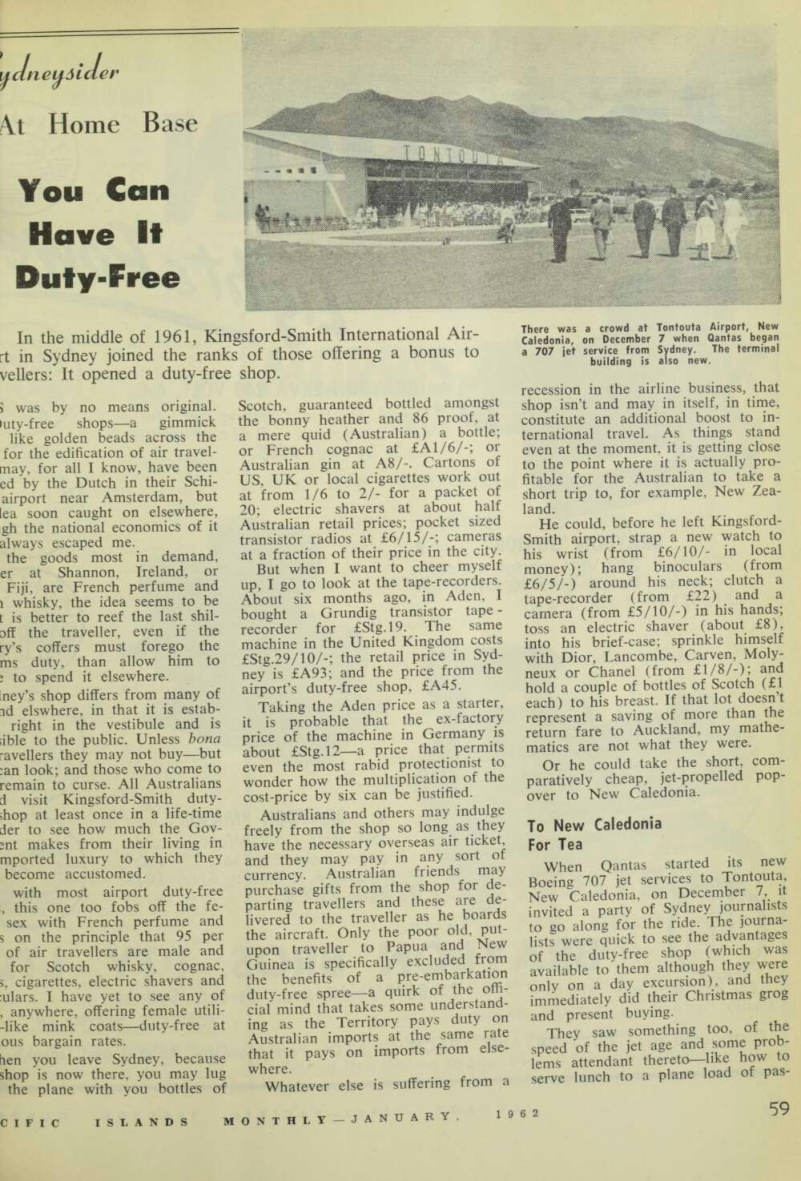
There was a crowd at Tontouta Airport, New Caledonia, on December 7 when Qantas began a 707 jet service from Sydney. The terminal building is also new.
s when you are no sooner up you’re down. o, they saw the Australian lentation that overseas tourists ain about—cards to fill in go ld coming, written customs de ions, health certificates, pass and a tax clearance. It seemed for a day trip—and the French looked at them. The Austra did—it probably provides work le boys. en I first went to New Cale , after the war, the flying-boat Lose Bay, Sydney, between nine ten one night and arrived in lea about six next morning—if inds were coming from the right ;r.
December 7, we left Sydney at m. and the cabin staff had to hard to get the elaborate meal, ts fore and aft trimmings, served :leared away before we landed ntouta just over two hours later, pent an hour and a half on New lonian soil and were back to ly a little after 5 p.m. local time. of which proves that any Syd der with the right amount of change can now run over to Caledonia and back for after -tea (or free champagne) in time than it takes to cross the and visit a friend in an outer :b.