Want?
pp. 55-59 · Read in the full issue
[?]Hat Does
Norfolk
hen one of "PlM's" editors was in Norfolk Island in early August he told the >nt of the Norfolk Island Council, Mr. F. J. Needham, that "PlM's" columns ilways open for the expression of views of responsible people, and he invited ledham to contribute an article giving the Council's point of view on the island's I requirements. There has been much controversy on Norfolk on this subject last 12 months, and the Federal Government has promised Norfolk a referendum 3 help settle the matter. Mr. Needham's article was received in December, too r the December issue.
F. J. Needham, President, Norfolk Island Council e editors of PIM have f offered to publish this i from an elected repre ive of the Norfolk Island e. This is appropriate after
Dnths of most extraordinary
ts emanating from sources
than the elected representa- TST a divergence of opinion is he basis of a healthy demo community, Norfolk Island has emarkably consistent in know hat form of government it Pitcairners, when they came to k Island, requested and were ;ed the same form of self ment they had exercised in n Island. This promise was lly kept by Queen Victoria and jresentative, the then Governor ;f of New South Wales, Sir n Denison. Under the wise ution of Governor Denison, the governed itself satisfactorily years. In 1896, using a noisy ty as a pretext, Governor ien abrogated this constitution eated the first of a long series ecessary administrations (some limilar is happening today when jthorities have ears only for r noisy minority. Is the motive me?). lemorial signed by the elected Hors and many Elders of the was forwarded to Her Majesty arch 27, 1896. This petition inter alia: humbly beg Your Majesty to er seriously the changes that be made by the Governor; as 'nk that they will prove detri f to the welfare of Your loyal ts, the community of Norfolk After assuring Your Majesty that we are progressing com ply, financially, and education we humbly beg that Your
Majesty will not think us unreason able in soliciting Your assistance to prevent the proposed changes, which will prove disastrous to our nearest and dearest interest both spiritually and temporally.
It is interesting to note the com ments of an independent observer, the Earl of Glasgow, then Governor of New Zealand, in a letter dated May, 1896, to the Colonial Office: I am further advised to bring to your notice the agreement which was originally made with the islanders, that, while their island was and would remain, an integral portion of the Empire, they should enjoy local self government without interference; also that, as far as my advisers have been able to ascertain, there has not been sufficient ground for the contem plated abrogation of the rights and privileges of the islanders.
Royal Commission
In 1926 as a result of much dis satisfaction with the form of govern ment, a Royal Commission was ap pointed to investigate the island’s complaints.
The Commission in its finding said that a great deal of benefit would accrue both to the Administration and to the community from the estab lishment of a self-contained code of legislation. The Commission found that the justification for the enquiry into the administrative affairs of Norfolk Island and complaints of the residents had been clearly established.
The evidence revealed that the Ad ministrator’s tendency throughout had been to usurp the powers vested in
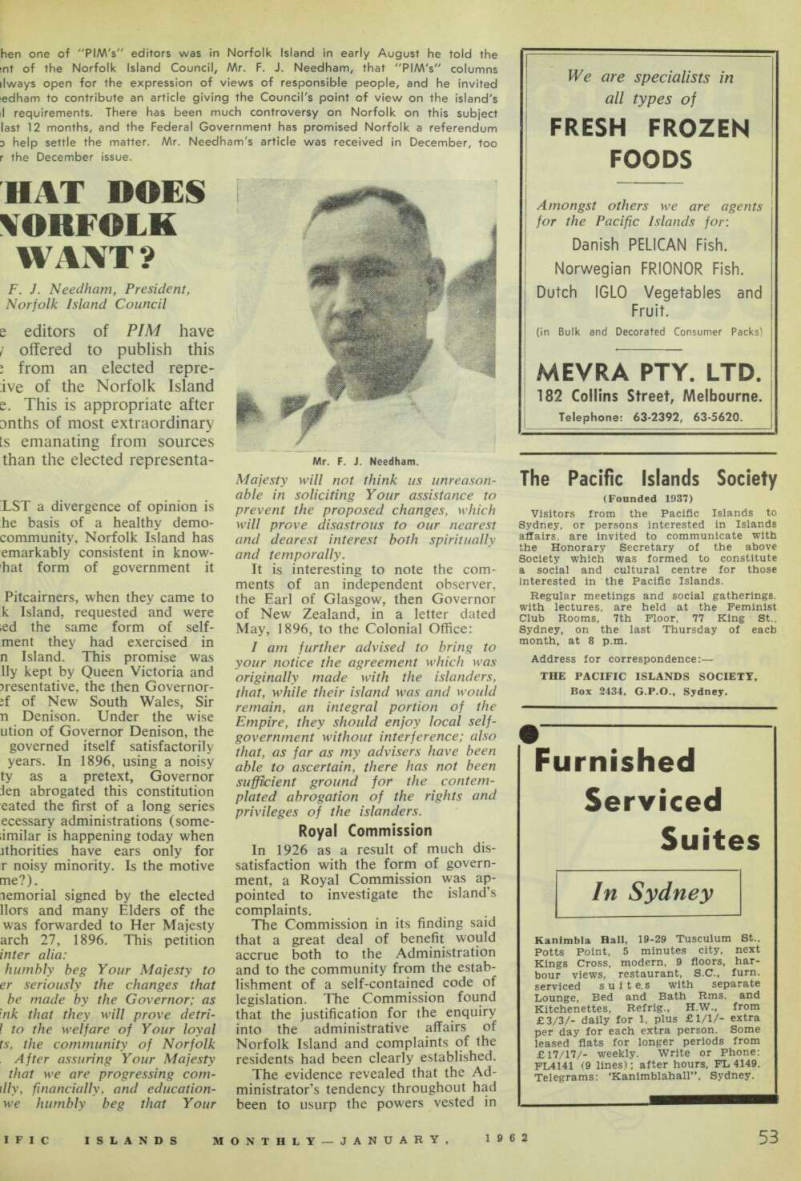
Mr. F. J. Needham.
)r the protection of the people, d disregard the need of en ing sympathetic understanding D-operation. The sworn state indicated that his actions dis , if not destroyed, that esprit de so essential to the satisfactory stration of this remote territory Commonwealth, unsatisfactory form of govern through the years enables this considered applicable to most strators. jite the Commission’s recom tions, no real effort was made ablish a satisfactory form of ment. The dissatisfaction again jlated until 1935 when a ;ntative body of citizens ap to Sir George Pearce, the ;r.
Trouble in 1935 iote briefly from the petition: iresent system of administration Territory is responsible for f the unrest and discontent pre on the island. It is repugnant residents and to British institu )f justice and democratic gov it. It places excessive and un ited powers in the hands of the istrator and his staff, and is to very grave abuses of ity. empowers the Administrator to e the welfare and interests of isidents to his own personal ices and advantages, and to one section of the community expense of the others. In the liture of public revenue con d by them, residents have no latever.” ay we have exactly the same s when we have no say what n the spending of the island’s evenue, and in 1955 the vast ty of the island citizens again tied Her Majesty the Queen store to us the democratic right trol over our domestic affairs”. t is what Norfolk Island wants, sad, after all this, another quite [factory form of government ffered, but was firmly rejected citizens in the first election of orfolk Island Council in 1960. clearly stated policy of the ty of this council (six out of was, inter alia, “to achieve te control over the raising and liture of all forms of revenue )rfolk Island to enable the will 2 people to be the basis of ity”. 5 mandate was further thened at the 1961 election three out of the four seats were
won by candidates who firmly sup port this policy.
PIM in October reported the Minister for Territories, Mr. Hasluck, as saying that he did not regard the political views held by the majority (seven out of eight) of the present Council as necessarily being the will of the people. The Council, he said, did not have a mandate because people voted for different reasons.
If Mr. Hasluck’s party had the same majority in the Federal Govern ment, would he consider it did not have a mandate from the people?
And our policy, after all, has been consistent for 65 years. Can it be more clearly stated in any other form?
We have suggested a democratic form of government which, we are sure, will enable the island to be happily administered.
We have proposed an elected council, with the Administrator as ex officio chairman, that would give directions as to the island’s own revenue. We do not ask for any control over the grant. It is felt that (Over)
g as Australia wishes to keep dministrator here, his senior should continue to manage vernmental activities, i a population of less than 500 the Island cannot possibly a second Administration in the )f clerk to the council and his as laid down in the present k Island Act and Ordinance. administrations with their in tendencies to increase in size pense would be most impractic- Present Administrators who amost vice regal style cannot untained by the island, and of the grant is absorbed in g this expense. ot “Primitive Savages" tone of recent Press articles indicate that Norfolk Island dated by primitive savages who ?e led very slowly along the atic path. a century ago the Pitcairners 100 per cent, literate, which lot be said about Great Britain r other colonies. Further, k Island exercised self ment 50 years before Aus- A considerable proportion of and’s present population en lemocratic rights and responsi until coming to Norfolk and all residents are con competent to exercise demo rights should they take up ce in Australia, statement in a recent PIM that Norfolk Island lives on juts” from Australia, is as i most recent Press statements, ulk Island buys and pays for to the value of some £286,000 ly from Australia, and local to the amount of over is collected annually. The grant of some £32,000 ob is not the island’s main source ime. e clearly the island has in -5 some of which, incidentally, e not inconsiderable amounts sign currency. Given a little n to follow a more progressive these industries could be expanded, to the benefit of k Island and Australia. But lot be done with short term, itent, career Administrators ;ver understand Norfolk Island. 65 years public-spirited citizens tried unsuccessfully to make ted forms of government work, real majority of residents are itermined to establish a happy 'atic government here.