Indonesia's
p. 42 · Read in the full issue
How Strong Is
Air Force?
In any Indonesian attack on West
New Guinea the first clashes would
occur in the air—and probably very
close to Australian New Guinea.
AT first glance, the advantage
would seem to lie with Indo
nesia. So far as is known, the Dutch have not got much in the way of modern fighting aircraft, whereas the
Communist countries have been
steadily feeding new aircraft to Indo
nesia. USA has supplied others.
According to data just received
from London, the following repre
sents the approximate air strength
of the two countries:
Indonesia
Received In—
-1958-59 ... 60 MiG-17 jet fighters and MiG-15 UTI jet trainers —from Russia. 28 11-14 transports—from Russia.
Recently . . . Number of Douglas 826 light bombers —from USA.
Latter half of 1961 . . . Number of modern Tupolev Tu-16 bombers —from Russia. 5 Lockheed C-1308 Hercules heavy transports—from USA. 3 Antonov An-12 transports—from Russia.
Netherlands New Guinea
Received In—
Late ’Fifties . . Squadron of Fairey Firefly MK4—from Holland. 17 Martin PBM—SA Mariners—from Holland —mostly discarded. 1961 ... 15 Lockheed P2V-7 Neptunes very modern —from Holland. 4 Douglas C-47 transports—from Holland.
Squadron of old Grumman TB-3 Avengers—from Holland. 24 Hunter FMk4 —from Holland.
Few Alouette II helicopters.
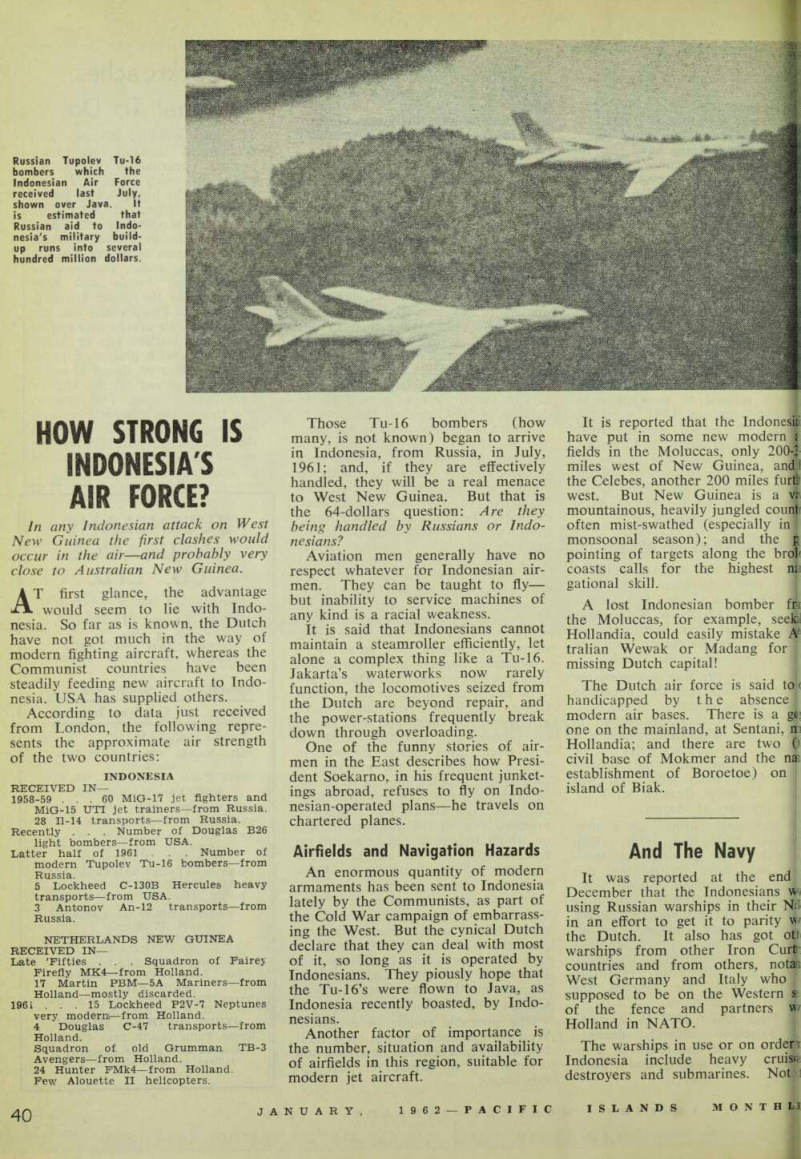
Those Tu-16 bombers (how many, is not known) began to arrive in Indonesia, from Russia, in July, 1961; and, if they are effectively handled, they will be a real menace to West New Guinea. But that is the 64-dollars question: Are they being handled by Russians or Indo nesians?
Aviation men generally have no respect whatever for Indonesian air men. They can be taught to fly— but inability to service machines of any kind is a racial weakness.
It is said that Indonesians cannot maintain a steamroller efficiently, let alone a complex thing like a Tu-16.
Jakarta’s waterworks now rarely function, the locomotives seized from the Dutch are beyond repair, and the power-stations frequently break down through overloading.
One of the funny stories of air men in the East describes how Presi dent Soekarno, in his frequent junket ings abroad, refuses to fly on Indo nesian-operated plans—he travels on chartered planes.
Airfields and Navigation Hazards An enormous quantity of modern armaments has been sent to Indonesia lately by the Communists, as part of the Cold War campaign of embarrass ing the West. But the cynical Dutch declare that they can deal with most of it, so long as it is operated by Indonesians. They piously hope that the Tu-16’s were flown to Java, as Indonesia recently boasted, by Indo nesians.
Another factor of importance is the number, situation and availability of airfields in this region, suitable for modern jet aircraft.
It is reported that the Indoneslli have put in some new modern I fields in the Moluccas, only 200-; miles west of New Guinea, ancfif the Celebes, another 200 miles furtif west. But New Guinea is avr mountainous, heavily jungled counjf often mist-swathed (especially ini monsoonal season); and the p pointing of targets along the brolf coasts calls for the highest nil gational skill.
A lost Indonesian bomber fn the Moluccas, for example, seek- Hollandia, could easily mistake AI tralian Wewak or Madang for I missing Dutch capital!
The Dutch air force is said toj handicapped by the absence a modern air bases. There is a gc: one on the mainland, at Sentani, hi Hollandia; and there are two 0 civil base of Mokmer and the na: establishment of Boroetoe) on island of Biak.
Russian Tupolev Tu-16 bombers which the Indonesian Air Force received last July, shown over Java. It is estimated that Russian aid to Indo nesia's military build up runs into several hundred million dollars.