The History Behind The West New Guinea Crisis
pp. 37-41 · Read in the full issue
West New Guinea Crisis
To get the present situation in West New Guinea into focus, we must go back before World War 11, when the Netherlands Indies had been held and administered by the Dutch for over 300 years.
THE groups of far-flung archipelagoes of what is now known as Indonesia, had never been in any sense a united nation until the Dutch for administrative convenience, brought together into one organisation the various small sultanates through which their influence had spread from the 16th century onwarc j s The government of the Indies was at first in the hands of the Dutch East India Company which had been formed in 1602 and which established a trading centre at Batavia, Java, in 1611. And, apart from some efforts of the British East India Company to horn in on the Indies, the Dutch had little interference with their trade from outside, but the Company did have considerable trouble from insurrections by native princes and sultans In 1789 the Netherlands Government took over the adminis- .ration, and the Company was dis- In a more recent period, the Indies were divided, for ease of administration, into sections—Java, Sumatra, Borneo, Celebes and Moluccas etc.
Western New Guinea was added to this administrative organisation in the IsS,«ntoy and initially formed a •division of the Residency of the
Moluccas, In the early 1930’5, how ever, it became an independent ad ministration, quite separate from the Moluccas, as the Dutch by then had begun to take more interest in this primitive area and, as the people were ethnically completely dissimilar to the people of the Indies, making New Guinea a separate entity was con sidered the best solution in the cir cumstances. The people of West New Guinea were the same as those in Australian New Guinea—primitive Melanesians, with no racial relation ship with the people of the Indies.
From 1616 when the Dutch navi gators Le Maire and Schouten made an accidental landing m New Guinea, the Dutch made sporadic visits to the country and it had also been visited regularly by the wandering praus of the natives of the Indies No one took much interest in the primitive and apparently useless tern to a no-one were the first Europeans to lay clam, to any part of the big island-through proximity more than for any other reason.
In August, 1828, the Dutch tablished Fort Dubus, in Triton Eav, West New Guinea and formally claimed possession of the region as
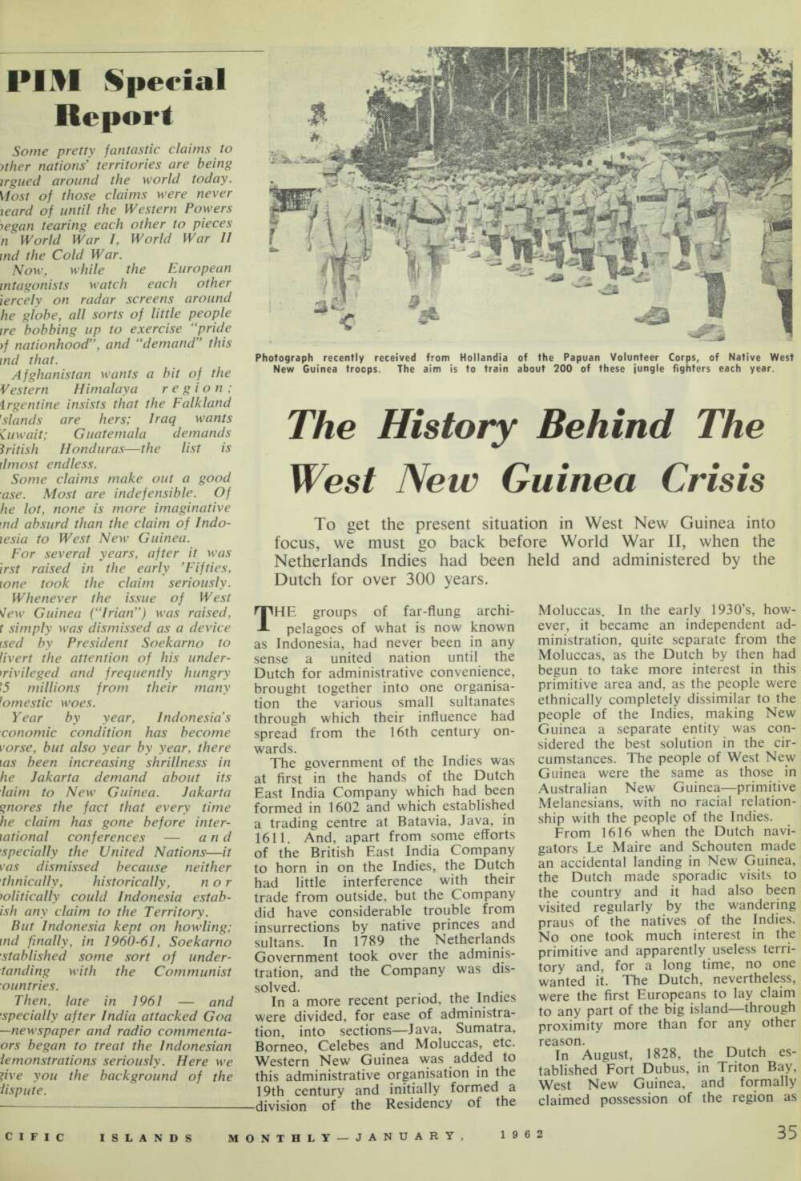
Photograph recently received from Hollandia of the Papuan Volunteer Corps, of Native West New Guinea troops. The aim is to train about 200 of these jungle fighters each year.
ar west as the 141st Meridian. Some >0 years later, this frontier was con irmed by the British and the Germans. tu i • , i he huge area remained almost un- ■ n <r,“d undeveloped until he iarl y 1930 s, when oil rights in the /ogelkop Peninsula were leased for 5 years to the New Guinea Oil .ompany (a combination ofDutch American and British interests) which >egan an extensive oil search. By 941, when World War II caused evacuation, this Company had located i couple of promising oilfields in the lorong-McCluer Gulf area of Vogel- :op. But development had to await he end of the war.
Isolation of The Dutch 1116 1945-50 era was a time of great international confusion. The West had planned general dis armament and that international re ,ations should in future be controlled by UNO; and UNO was dominated by Western and especially American ideaHstSj who immediately set their faces most reso utely a / ainst what th called “colonialism”
But by 1947-48, all UNO plans were awry—it was seen that the Red nations, refusing disarmament, had launched the Cold War.
The Dutch attempted with great resolution to save their East Indies
empire but they had been greathl weakened by the German occupation of Holland in 1940-45 and they fought alone.
The Japanese had occupied Indo: nesia from early 1942 until well int< 1946. They should have been ejected in 1945, just as they were ejected by the Allies from other Pacific ano Asian countries, but neither the new/ born UNO, Britain nor America did anything to help the Dutch.
There had been, even before thir war, a strong movement among somir sections of Indonesians for sell determination and strong efforts b?f the Japanese during their occupatior went a long way towards scramblinj the Dutch eggs permanently, and paw ing the way for an Indonesian takes over. In 1945-46 the Japanese enci couraged Indonesian nationalism to
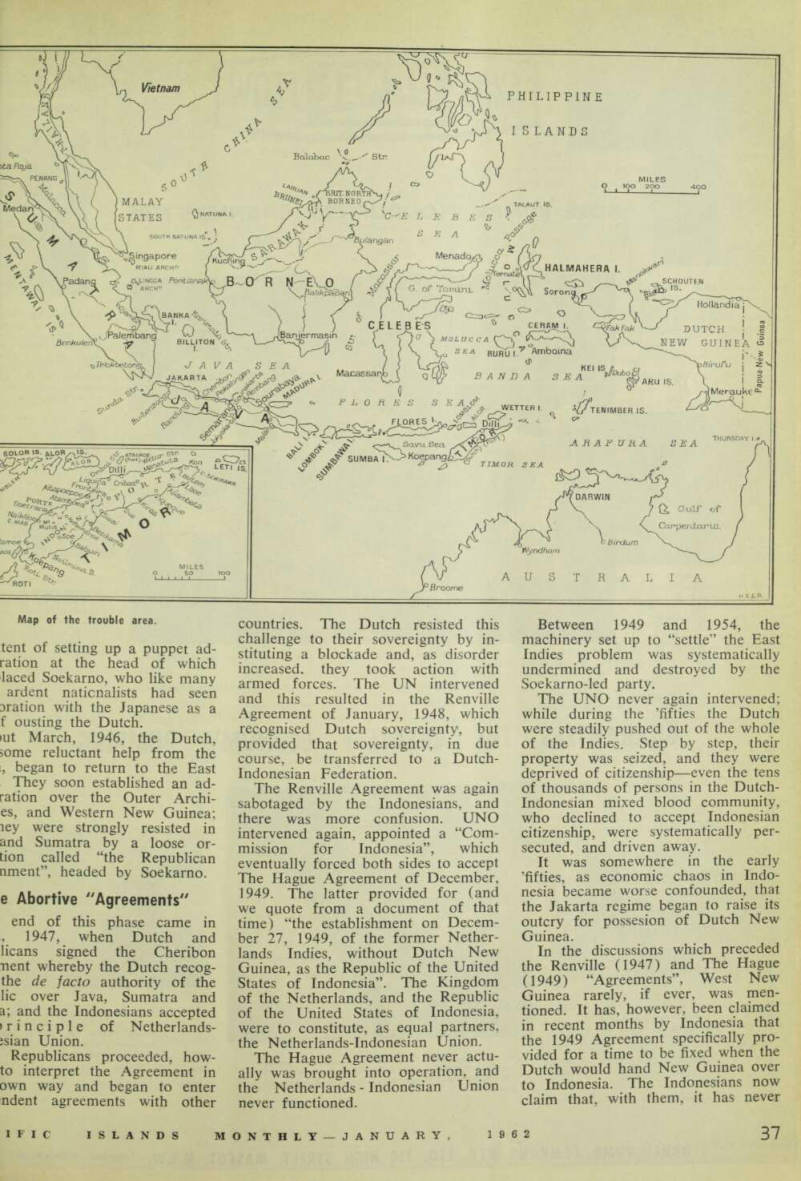
Map Of the trouble area. . . f ... , en o up a puppet adration at me head ot which laced Soekarno, who like many araent nationalists had seen 3ra ion witn the Japanese as a
I *° m T-* i
•ut March, 1946, the Dutch, some reluctant help from the , began to return to the East ihey soon established an adration over the Outer Archies, and Western New Guinea; ley were strongly resisted in and Sumatra by a loose orlon ! ecl , Republican nment , headed by Soekarno. p Ahnrtivo "Anroamantt"
" end of this phase came in , 1947, when Dutch and licans signed the Cheribon nent whereby the Dutch recogthe de facto authority of the lie over Java, Sumatra and a; and the Indonesians accepted •rinc i p 1 e of Netherlandsjsian Union.
Republicans proceeded, howto interpret the Agreement in own way and began to enter ndent agreements with other
countries. The Dutch resisted this challenge to their sovereignty by instituting a blockade and, as disorder i ncrea sed. they took action with armed forces . The UN int ervened and th j s resu ited in the Renville Agreement of January, 1948, which recognised Dutch sovereignty, but provided that sovereignty, in due course, be transferred to a Dutch- Indonesian Federation.
The Renville Agreement was again sabotaged by the Indonesians, and there was more confusion. UNO intervened again, appointed a “Commission for Indonesia”, which eventually forced both sides to accept The Hague Agreement of December, 1949. The latter provided for (and we quote from a document of that time) “the establishment on Decernber 27, 1949, of the former Netherlands Indies, without Dutch New Guinea, as the Republic of the United States of Indonesia”. The Kingdom of the Netherlands, and the Republic of the United States of Indonesia, were to constitute, as equal partners, the Netherlands-Indonesian Union.
The Hague Agreement never actually was brought into operation, and the Netherlands - Indonesian Union never functioned.
Between 1949 and 1954, the machinery set up to “settle” the East Indies problem was systematically undermined and destroyed by the Soekarno-led party, The UNO never again intervened; while during the ’fifties the Dutch were steadily pushed out of the whole of the Indies. Step by step, their property was seized, and they were deprived of citizenship—even the tens of thousands of persons in the Dutch- Indonesian mixed blood community, who declined to accept Indonesian citizenship, were systematically per secuted, and driven away.
It was somewhere in the early ’fifties, as economic chaos in Indo nesia became worse confounded, that the Jakarta regime began to raise its outcry for possesion of Dutch New Guinea.
In the discussions which preceded the Renville (1947) and The Hague (1949) “Agreements”, West New Guinea rarely, if ever, was men tioned. It has, however, been claimed in recent months by Indonesia that the 1949 Agreement specifically P r ® vided for a time to be fixed when the Dutch would hand New Guinea over to Indonesia. The Indonesians now claim that, with them, it has never
i question of whether New belongs to them —but when therlands can be persuaded to back. believed, however, by every ;e who has thought about the that no matter what claims ionesians might have had for ; their own country, they had aims whatever—on ethnic s, alone—on West New . The only real reason they jntinued to claim it is because atch. 5 they now do, use the Hague lent of 1949 to bolster their they are on pretty tenuous , as it was the Indonesians ves who sabotaged that Agree i 1955 onwards the Indo ’ campaign against the Dutch ir claim for West New Guinea more active form. In 1956 >ia refused to pay her debts land and in 1957 started a gn of reprisal against Dutch Is and property in Indonesia, y was seized and compensa fused—the Indonesian govern tating that this could not be ;d until such time as West minea was handed over. itical Effect of Oilfields e could be some connection i the Indonesian attitude to- Vest New Guinea and the oil n the Vogelkop peninsula— ;se must have been a minor ration in the larger campaign to embarrass the Dutch, sdiately the war was over, the rests which held the concession i the development of the field. 10 years, they had opened up imono field, from which a 6 fine was laid 60 miles to the f Sorong; and the Mogoi field, from which oil was 1 22 miles through an 8 in. the port of Maturi. the early ’fifties, when they ited their first public claim tch New Guinea, the Indo may have decided that this valuable oilfield. By this time, ere systematically persecuting tch, and the Indonesian-Dutch; ; increased confusion in ad ation and the country’s lie condition; and trying to with widespread rebellions them in the Celebes, the as and Sumatra, from about 1955-56 onwards, Vogelkop oilfields declined ’ in value, the result of a re low, poor quality, and a world
By 1960, it was clear that the Dutch would be glad to be rid of New Guinea if they could do so with honour. It has a very limited eco nomic value now, and its administra tion costs the Netherlands Govern ment at least £l2 millions Australian per annum.
Only two things have stood in the way of a transfer of the Territory by the Dutch—namely, Dutch reluctance to submit to any demand by Indo nesians; and Australia’s unwillingness to have an Indonesian set-up (which is increasingly under Communist in fluence) on her northwest frontier.
Whatever has been Australia’s diplomatic and official attitude on the matter, it has long been recognised that the continued presence of the Dutch in their half of New Guinea was of far greater benefit to Australia than to the Dutch. But at the same time, Australia has been exceedingly careful not to commit herself to the defence of NNG against Indonesia.
Australia’s official attitude has been, and is, that (a) she recognises the Netherlands sovereignty of West New Guinea; (b) she sympathises with the Netherlands expressed intention that the natives of West New Guinea shall ultimately be allowed self-determina tion; (c) if the Netherlands should, however, come to some freely negotiated agreement with Indonesia over West New Guinea, Australia will not oppose it; and (d) should, at some future time, the natives of West New Guinea choose freely to throw in their lot with Indonesia, she will not dispute that, either.
Whatever happens in the immediate future, whatever line the Dutch take —no blame can attach to them. New Guinea has been a continual source of expense to them and has shown no profits; and although Australia has given them moral support in their aspirations for the progress of their native peoples, they have got no support of any description from any one else. New Guinea has, moreover, provided one of the convenient pegs on which Indonesia has hung the re fusal to pay the Dutch reparations for property confiscation in Indo nesia.
If Indonesia does get its way over West New Guinea —which seems en tirely likely at this stage—it may clear the way for the Netherlands to recover compensation for assets con fiscated in Indonesia; and to claim the amount they have spent in New Guinea since 1945.
The probable course of events in West New Guinea was not clear until late in 1961. These are described and discussed in an article on page 15, this issue.