[?]ying the Value of
p. 21 · Read in the full issue
the Pacific Franc
Merchants and property-owners New Caledonia do not sleep \ndly at nights just now. There persistent rumours afoot that Pacific franc will be de-valued, i taxation of incomes may be r oduced as a set-off to what r economic dislocation is caused a recession in the nickel in try. fH things appear still to be >ased on rumours; but both ally are feared in the big French iy. ; Noumea Chamber of Com : may have started the Pacific rumour. It pointed out that conduct of commercial and “ial enterprises were complicated e wide difference in value be the New Metropolitan French and the French Pacific franc, jublicly suggested some reform. to the end of 1959, the £ sterl vas worth between 1,100 and French Metropolitan francs, round 250 Pacific francs. Then e decided to tidy up her icy, and did it by the simple ient of dropping two o’s from ice value of the printed paper For example, 100 francs be -1 franc; and that one franc, of ;, increased 100 times in value, is the New Franc—as it now is —has been stabilised as worth 3 £1 Stg. (about 1/6 each), or £ 1 Australian. the Pacific franc retained its due, which is now 245 to £1 that is, each Pacific franc is almost exactly Id, as compared he 18d value of the New Franc.
Noumea Chamber of Commerce ged, not that the Pacific francs ■valued, but that they be made and more convenient by replac em with New Francs (or “heavy” )■ years, prior to Metropolitan re-valuation, French public ts benefited by working in the : area. They were paid in Pacific ; and, when they carried their France, they found they could 50 Metropolitan francs for each ' franc. Thus, for years, such ' were called “five-fifty-ers”—a )f derision. Now, the conversion s 18.8 Pacific francs for one Franc; and, for the public t, the old halcyon days are long over.
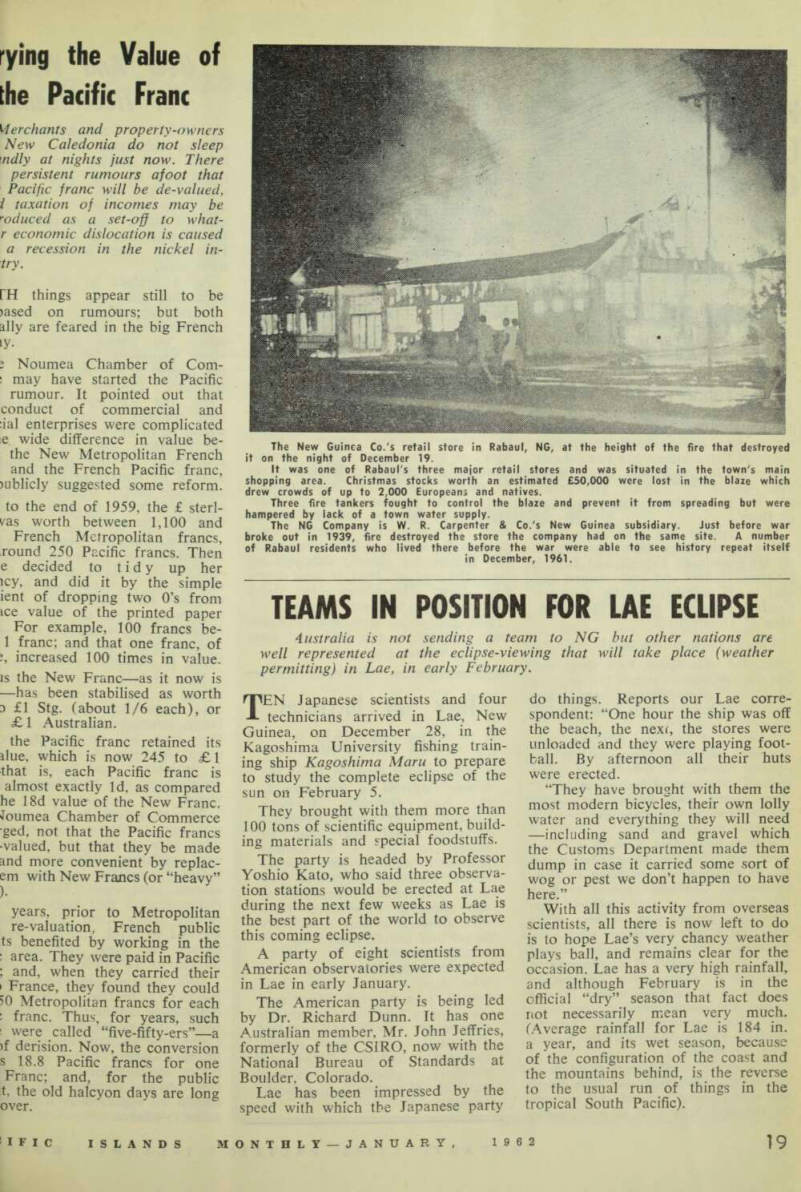
The New Guinea Co.'s retail store in Rabaul, NG, at the height of the fire that destroyed it on the night of December 19.
It was one of Rabaul's three major retail stores and was situated in the town's main shopping area. Christmas stocks worth an estimated £50,000 were lost in the blaze which drew crowds of up to 2,000 Europeans and natives.
Three fire tankers fought to control the blaze and prevent it from spreading but were hampered by lack of a town water supply.
The NG Company is W. R. Carpenter & Co.'s New Guinea subsidiary. Just before war broke out in 1939, fire destroyed the store the company had on the same site. A number of Rabaul residents who lived there before the war were able to see history repeat itself in December, 1961.