Significant Fiji-Indian Clashes
pp. 19-20 · Read in the full issue
In Legco Debates
A new development in Fijian-Indian relationship, in re rd to the future government of Fiji, became apparent during e Budget Session debate of the Fiji Legislative Council in member.
i discussions ranged over inance, possible constitutional ;es, land control and the con- Df the sugar industry; and at they were among the stormiest heard in that Chamber. ; the most significant statement uade by Ratu Penaia Ganilau he expressed his disappoint that a Fijian recommendation le future constitutional struc had been rejected. The Fijians daimed that they should have, ; Legislative Council, one more ;entative than those allowed to ther racial communities (Euro and Indian). This had been op by the Indians and rejected e Government. u Penaia Ganilau stands high g the younger Fijian chiefs. well known as the last Corn er (Lieut.-Colonel) of the Fiji ion in Malaya, u Penaia said: long as the present system of ament exists in Fiji, the Fijians welcome parity in the numbers official members who sit here, se this will safeguard and atee their legitimate interests, t when the time comes—and e it will not come soon—when is a new form of government
to replace the British system, then the Fijians would like the composi tion of the Legislative Council to be reviewed.
“I would like it recorded here that when that time comes, the running of this Colony must be handed over into the hands of the Fijians—by that, I mean administratively and politically .’
Ratu George Cakobau and Ravu ama Vunivalu were quick to echo Ratu Penaia’s statement.
Shrewdly, Penaia had made no de mand for independence by any given date. In fact, he said he hoped there would be no early change in the form of Government. But Ratu George Cakobau (who is one of the chiefs of highest rank) did not mince words: “The ultimate aim—and let us put it bluntly—is independence,” he said, “I have nothing aganst inde pendence—let independence come! -—but I would like it to be recorded in this House that when indepen dence comes, let the British Govern ment return Fiji to the Fijians, in the same spirit as that in which the Fijians gave Fiji to Great Britain.”
Ravuama is Fierce Ravuama, who has acquired a reputation as an “Indian baiter”, was quick to support the two chiefs; and he took the opportunity to direct some forthright words at the Indian members.
His chief target was the loquacious Mr. B. D. Lakshman, who represents the major cane-growing districts; but another to feel the lash of his tongue was Mr. A. I. N. Deoki, an Indian lawyer, whose constituents are in the south of the Group, and who is a member of the Governor’s Executive Council, which is Fiji’s nearest ap proach to Cabinet Government.
The five Indian members seemed stunned by Ratu Penaia’s statement, and their position became more miserable as Ratu George and Ravuama backed up Penaia. There was little they could do about it, however, for they had already taken part in the debate and could not speak again.
The mere mention of Fijian land is enough to make Ravuama see red; and after brief remarks on the Con stitution, he turned on a full-scale attack on what he believed to be Indian aspirations towards land con trol.
Accused by Mr. Deoki of having an obsession about Fijian land, Ravuama readily admitted it. He frankly confessed that, if Mr. Deoki meant he was worried about the future of the Fijians in relation to their own land, he was more ob sessed than Mr. Deoki imagined. (Over),
[?] Penaia Ganilau with his wife.
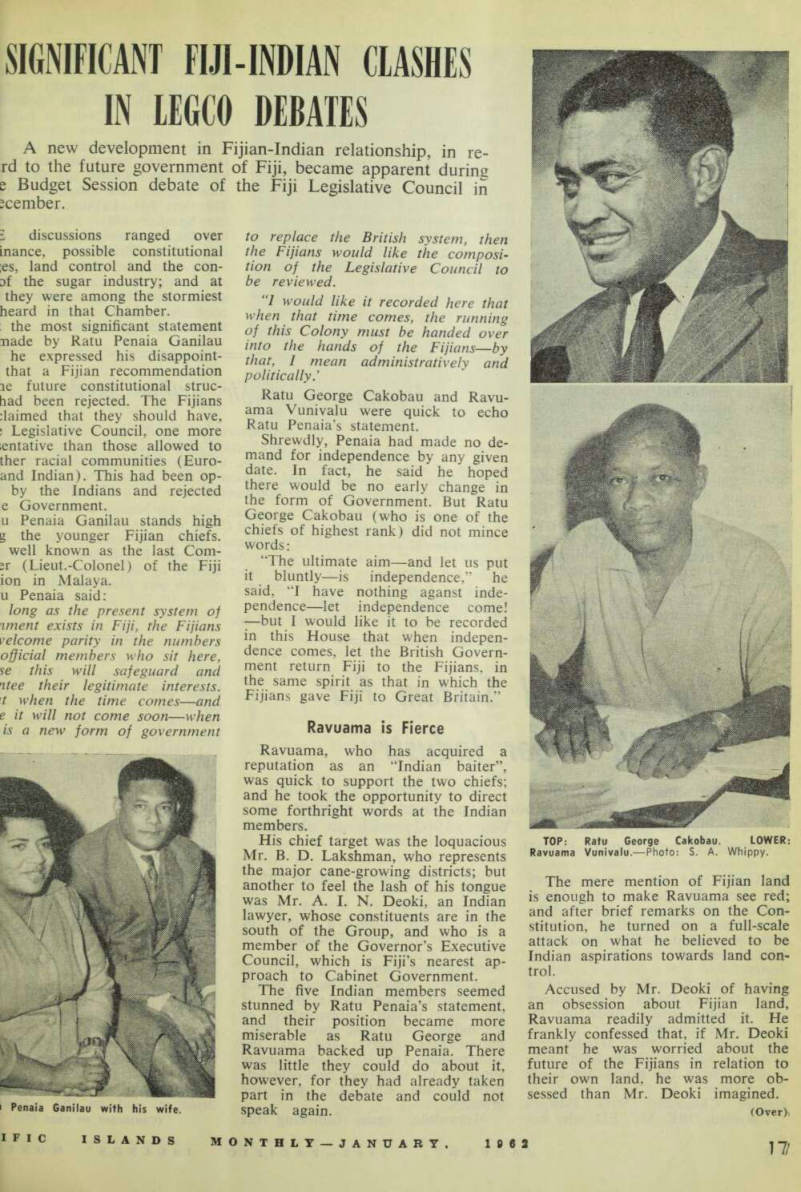
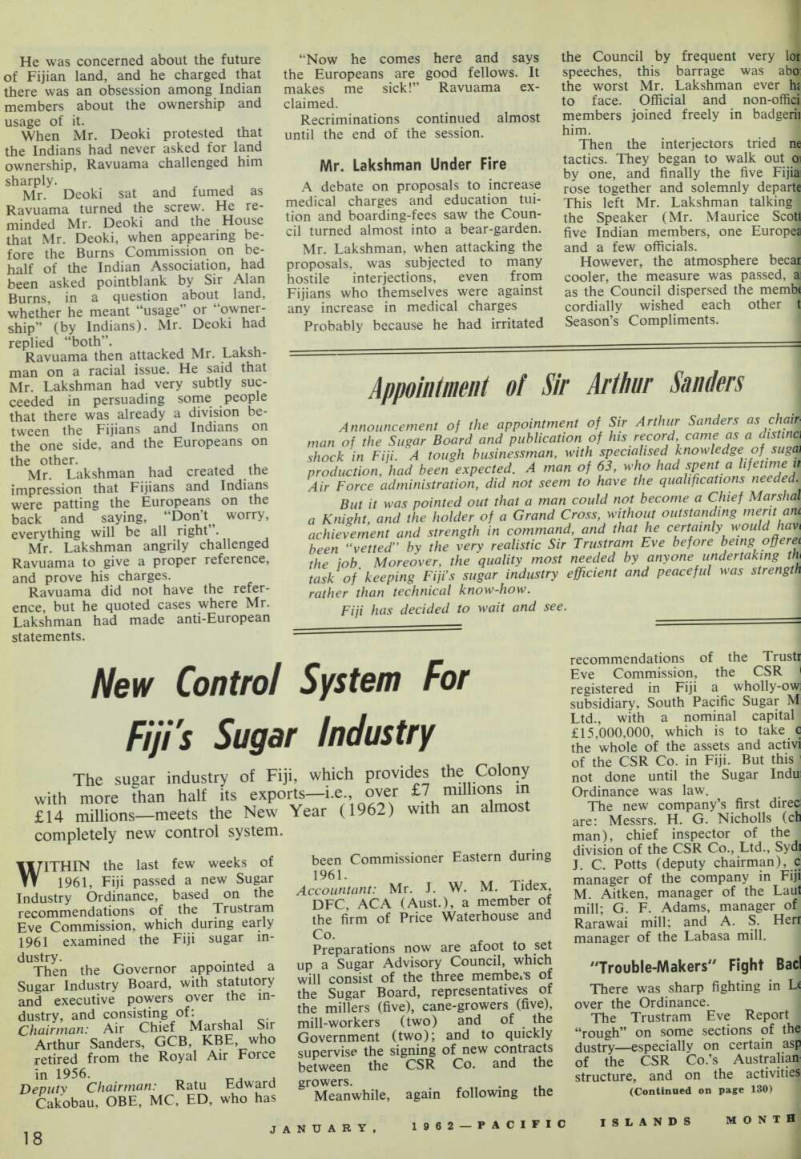
TOP: Ratu George Cakobau. LOWER: Ravuama Vunivalu. — Photo: S. A. Whippy.
He was concerned about the future of Fijian land, and he charged that there was an obsession among Indian members about the ownership and usage of it.
When Mr. Deoki protested that the Indians had never asked for land ownership, Ravuama challenged him sharply.
Mr. Deoki sat and fumed as Ravuama turned the screw. He re minded Mr. Deoki and the House that Mr. Deoki, when appearing be fore the Burns Commission on be half of the Indian Association, had been asked pointblank by Sir Alan Burns, in a question about land, whether he meant “usage” or “owner ship” (by Indians). Mr. Deoki had replied “both”.
Ravuama then attacked Mr. Laksh man on a racial issue. He said that Mr. Lakshman had very subtly suc ceeded in persuading some people that there was already a division be tween the Fijians and Indians on the one side, and the Europeans on the other.
Mr. Lakshman had created the impression that Fijians and Indians were patting the Europeans on the back and saying, worry, everything will be all right .
Mr. Lakshman angrily challenged Ravuama to give a proper reference, and prove his charges.
Ravuama did not have the refer ence, but he quoted cases where Mr.
Lakshman had made anti-European statements.
“Now he comes here and says the Europeans are good fellows. It makes me sick!” Ravuama ex claimed.
Recriminations continued almost until the end of the session.
Mr. Lakshman Under Fire A debate on proposals to increase medical charges and education tui tion and boarding-fees saw the Coun cil turned almost into a bear-garden.
Mr. Lakshman, when attacking the proposals, was subjected to many hostile interjections, even from Fijians who themselves were against any increase in medical charges Probably because he had irritated
the Council by frequent very lor speeches, this barrage was abo: the worst Mr. Lakshman ever hi to face. Official and non-offici members joined freely in badgerii him.
Then the interjectors tried ne tactics. They began to walk out oi by one, and finally the five Fijiai rose together and solemnly departe This left Mr. Lakshman talking ■= the Speaker (Mr. Maurice Scotl five Indian members, one and a few officials.
However, the atmosphere becai cooler, the measure was passed, a: as the Council dispersed the memb< cordially wished each other t Season’s Compliments.