Danger of a Red Indonesia on
pp. 17-18 · Read in the full issue
Our Northwest Frontier
In December, the Cold War moved perceptibly closer to” le South Pacific countries at three points; and in Indonesia it ive signs of becoming hot.
ENTS in Indonesia have been— and still are, at the time of this ng— confused and contradictory, could mean early danger for Guinea in particular, and for ralia and New Zealand and the ds generally. they could be little more than w phase of posturing by Indo ’s President, over-emphasised by lewspapers’ headline-writers dur the holidays’ “silly season”, e three developments of signifle to us are: Indonesia is demanding that Netherlands immediately hand the administration of Western Guinea, otherwise Indonesia nvade.
United States and Britain have ited probable early resumption large-scale atomic tests at tmas Island (near centre of South c).
United States has announced the ition of a new system of patrols, ►ver the South Pacific Islands, r years, Soekarno has been de ing possession of Dutch New ja, but at first none took him isly; for the last 12 months the ire has been increased, culmin in a threat of force, in late De sr. his youth, Soekarno was im ted by the Dutch in their ious Digoel River camp as a :rous agitator During World 11, he collaborated with the Jap , and the Japanese put him in e of a nationalist, anti-Dutch nment before they left in 1946. irno, understandably, is moti by hatred of the Dutch, ng denied Western help, the i could not restore their fignty over the Netherlands i and oust Soekarno in 1946-50; ley did resume their full admin on over West New Guinea at nd of 1945. (See page 35 for round of dispute). >m the early ’Fifties, Soekarno ently demanded Dutch New :a but got little support from nations or UNO as there are no historical, racial or political, en New Guinea and Indonesia, wever, in 1961, as Soekarno’s nds were stepped up he was in
creasingly supported by the numer ous new Afro-Asian nations which had joined UNO, After India, in December, invaded and seized Goa, Soekarno began to threaten war. Goa was a Portuguese enclave on the coast of India, south wards of Bombay. (A commentator has described an enclave as “a small, foreign-controlled area, entirely sur rounded by trouble”.) The Dutch (believed to be willing to get rid of their expensive territory) said they were ready to negotiate, provided the rights of West New Guinea people to self-determination were protected.
The Indonesians said they would negotiate but would accept no settle ment which did not provide for the transfer of West New Guinea to In donesia.
Headline News On December 19, Soekarno called on Indonesia to prepare for war, and be ready to invade West New Guinea when he gave the order. Thenceforth, all through the Christmas-New Year, the “threat to New Guinea” was headline news.
The situation seemed to cnange every day and it is difficult to tell whether Soekarno intends his war of nerves and propaganda to really lead to fighting.
There is no doubt that the Com munist countries in 1961 had sup plied Indonesia with a lot of modern armaments (the West also supplied some) and were now actively en couraging Soekarno in his daily yelling.
There also is no doubt that official Australia was disturbed by the situa tion; that Mr. Menzies radiophoned the British Prime Minister on the eve of his departure to confer with Pre sident Kennedy in Bermuda; and that immediately after Bermuda the United States put strong pressure on both Indonesia and Netherlands to settle their dispute by negotiation.
Both countries again said they would negotiate. Bu t Netherlands (probably conscious of the tens of thousands of Dutch-Indonesians who had settled there) still insisted that New Guineans should have the right to “self-determination”; whereas In donesia said it would agree to nothing that did not mean a transfer of sovereignty.
On December 23, a very forthright Note, directed to Indonesia and Holland, was issued by Australia, in which Indonesia was categorically accused of bad faith, and of breach of promises given the Australian Prime Minister. (See article below by our Canberra correspondent.) In the ensuing week, there were (Continued over page)
contradictory reports about the at titude of the Dutch. On January 3, in a rabble-rousing speech, Soekarno directed abuse at Australia, denied Australia’s charge of bad faith, and ordered his Air Force onto “alert”.
During this period, all airlines (although it affected only Australia’s major airline, Qantas), were ordered by Indonesia to keep clear of the Moluccas-Celebes area, when flying the Darwin-Manila-Hongkong route.
The apparent reason was that Indo nesia’s air and sea forces were active in the Celebes-Moluccas islands, from which an invasion of West New Guinea presumably would be launched.
Noting the extraordinary, day-to day changes in the reports, it could be assumed that Australia, either directly or through Britain, was asking United States to prevent an outbreak in the New Guinea region; and that United States, either directly or through United Nations, was really putting the pressure on Indonesia.
Up to January 10, no warlike act had occurred in the New Guinea area, although the headlines of a fortnight before had insisted that invasion was inevitable and imminent.
On January 5-6, Soekarno, with a large party of diplomats and officials, was over in Celebes, making inflam matory speeches. He had with him a group of Russians, and two educated Papuans—Frits Kiriheo (who some how disappeared from Leydin Uni versity, in Holland, and turned up in Indonesia) and a J. Dimara. Re ports said that Dimara was “the new Indonesian governor of West New Guinea,” although other reports said the “Governor” was already in WNG.
There seems little doubt, by the year’s end, Soekarno had assembled a respectable Air Force and a num ber of quite modern small warships, and anything up to 100,000 troops, and was rearin’ to go.
It is assumed that, like most dictators, he is anxious for military glory.
He still may strike—he has both the means and the will, and it was
reported he had set January 6 as D Day—but something appears to have restrained him. It probably was Washington.
On January 10, Indonesia’s Foreign Minister, Dr. Subandrio, said that Indonesia would make a “final de cision” within 10 days whether the West New Guinea issue would be settled by diplomatic means. At the same time, some correspondents on the spot in Jakarta set the “in vasion” as far ahead as “next August.”
Up to Christmas Eve, Britain and America were too deeply concerned with events elsewhere around the world to bother with Indonesia. They probably awakened to the danger when Australia made her urgent appeal in December, Britain and America seemingly cared little about the argument over the ownership of New Guinea.
But their outlook changed sharply when they were reminded that Indo nesia is being armed and encouraged by the Communists, and that the Communist Party now is the strongest political organisation in Indonesia, and is using Soekarno as a puppet.
An Indonesian invasion of New Guinea would not immediately endanger the security of Australia and the Islands Territories but be cause of the Communist angle, it would represent an enormous and ex pensive nuisance potential for Aus ti alia in the Northwest Pacific.
Australia's Embarrassment That probably was why Australian Foreign Minister Barwick, on Jan uary 4, issued a statement calculated to placate Indonesia, as a probable near neighbour in New Guinea. But in view of Australia’s strong Note of Christmas Eve, it was unfortunately phrased, and caused much irritation among the Government’s best friends.
Its timing—following the blustering statement by Soekarno abusing Aus tralia in general and Prime Minister Menzies in particular—was even more unfortunate. Its probable result was tc give the Indonesians the idea that v/hen Soekarno yells, Australia pipes down.
The probabilities are that I Dutch will abandon New Guinea I that Indonesia eventually will m in. But Australia will be savec lot of embarrassment and trouble the change is kept slow and orde Meantime in West New Gui there is calm while the Governn makes preparations in case of atti Scores of women and children f left West New Guinea in the last weeks and there has, over the ] year, been a steady exodus.
The Dutch believe that it will anything but a push-over for Ii nesia if the Indonesians attack; many believe that Soekarno is leally prepared to go to war.
Flans for the official visit of Pa] New Guinea Director of Na Affairs, Mr. J. K. McCarthy,: Hollandia on January 19, will go The visit was planned some moi ago. Australia’s liaison officer Hollandia is Mr. P. J. Mollison; h keeping the P-NG Administration fait with developments in WNG.
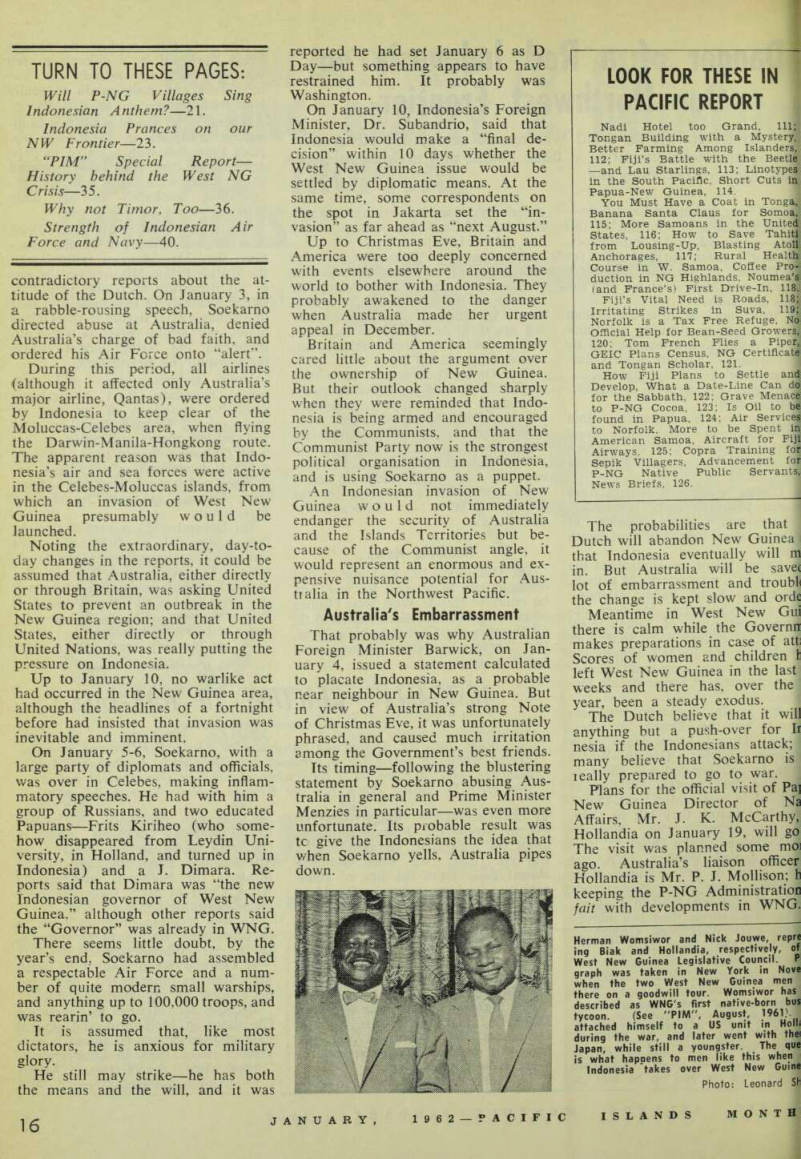
Herman Womsiwor and Nick Jouwe, repre[?] ing Biak and Hollandia, respectively, of West New Guinea Legislative Council. P[?] graph was taken in New York in Nove when the two West New Guinea men there on a goodwill tour. Womsiwor has described as WNG's first native-born bus tycoon. (See "RIM", August, 1961) attached himself to a US unit in Holl[?] during the war, and later went with the[?] Japan, while still a youngster. The que[?] is what happens to men like this when Indonesia takes over West New Guine[?] Photo: Leonard Sh[?]