Pacific Report
pp. 111-137 · Read in the full issue
The month’s round-up of news and pictures of people and nts, from PIM correspondents in the South Pacific.
uts Fiji
ia Quota
poor old banana producer in in hardly be blamed at times inking he is some sort of a 11 to be kicked about at the of New Zealand importers, Zealand politicians, and the Department of Agriculture, as s being subject to floods and mes. latest kick in the pants came Fruit Distributors, Wellington, mouncing a cut of 25 per cent, i’s export quota to her only )le market. The reason was ew Zealand was having balance le difficulties, company’s general manager, a few soothing words, when d there was no doubt that in to come New Zealand would gain rely on Fiji for substantial des of bananas. He urged them sp their plantations in good and look on the reduction as horary reverse.
New Zealand Government has ed or severely reduced import s for many lines of goods, and is are amongst those coming the “severely reduced” head jians grow most of the bananas port, and little versed in such :t words as “balance of trade”, re likely to shake their heads in r, and in spite of pleas, lose
for Fijian
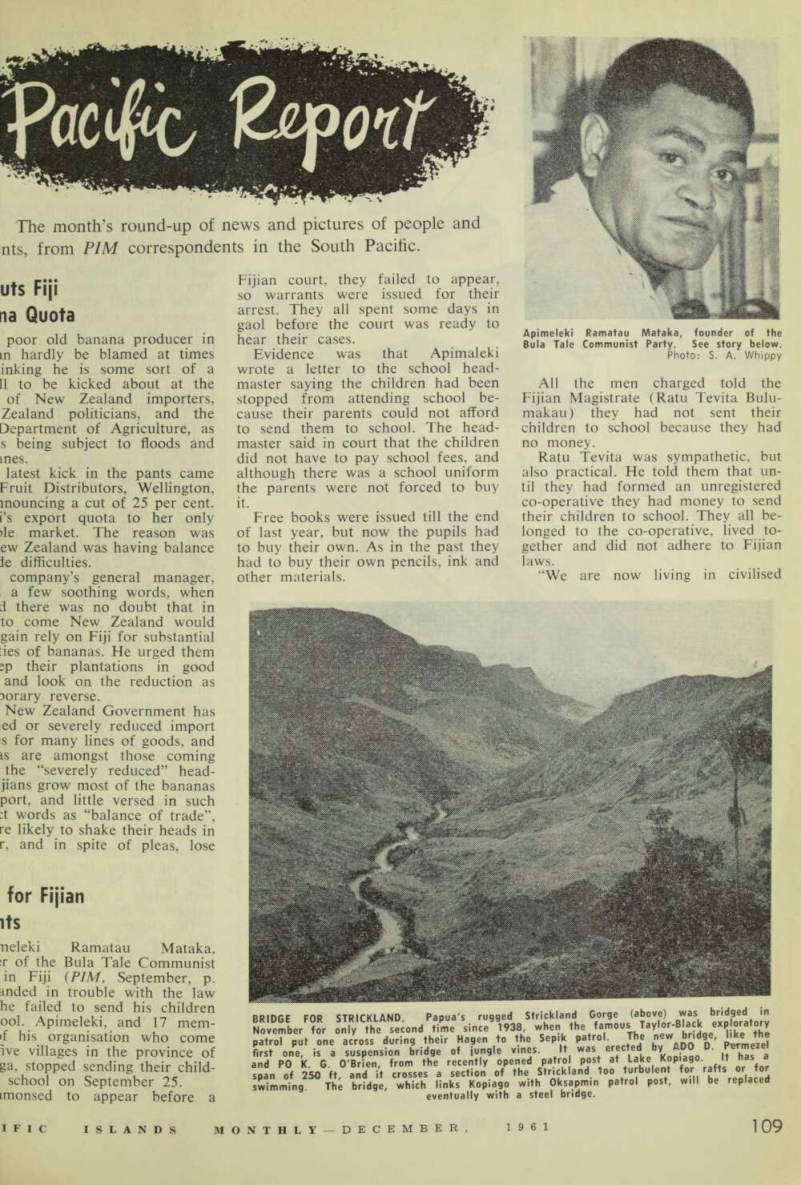
its neleki Ramatau Mataka, :r of the Bula Tale Communist in Fiji (PIM, September, p. anded in trouble with the law he failed to send his children 001. Apimeleki, and 17 mem ►f his organisation who come ive villages in the province of ga, stopped sending their child school on September 25. imonsed to appear before a
Fijian court, they failed to appear, so warrants were issued for their arrest. They all spent some days in gaol before the court was ready to hear their cases.
Evidence was that Apimaleki wrote a letter to the school head master saying the children had been stopped from attending school be cause their parents could not afford to send them to school. The head master said in court that the children did not have to pay school fees, and although there was a school uniform the parents were not forced to buy it.
Free books were issued till the end of last year, but now the pupils had to buy their own. As in the past they had to buy their own pencils, ink and other materials.
All the men charged told the Fijian Magistrate (Ratu Tevita Bulu makau) they had not sent their children to school because they had no money.
Ratu Tevita was sympathetic, but also practical. He told them that un til they had formed an unregistered co-operative they had money to send their children to school. They all be longed to the co-operative, lived to gether and did not adhere to Fijian laws.
“We are now living in civilised
Apimeleki Ramatau Mataka, founder of the Bula Tale Communist Party. See story below.
Photo: S. A. Whippy
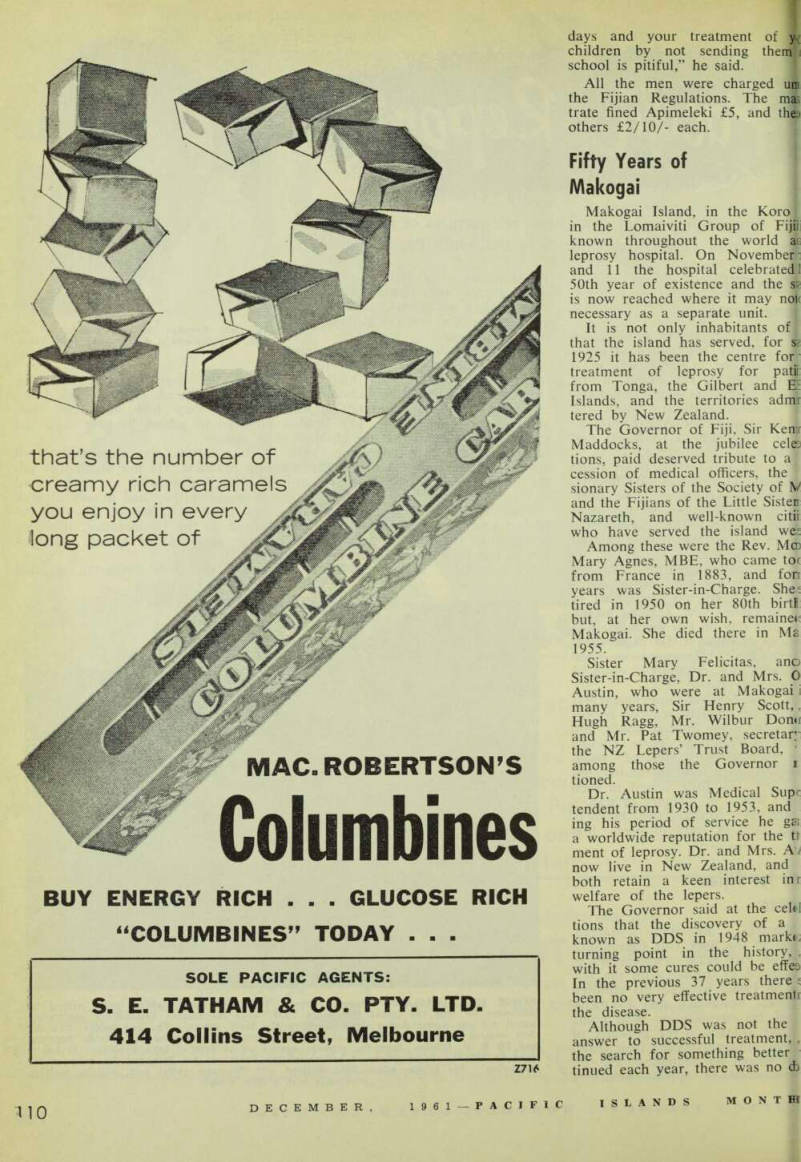
BRIDGE FOR STRICKLAND Papua's rugged Strickland Gorge (above) was bridged in November for only the second time since 1938, when the famous Taylor-Black exp oratory patrol put one across during their Hagen to the Sep.k patrol The new bridge, like the first one, is a suspension bridge of jungle vines. It was erected by ADO D. Permezel and PO K. G. O'Brien, from the recently opened patrol post at Lake Kopiago. It has a span of 250 ft, and it crosses a section of the Strickland Too turbulervt for rafts or for swimming. The bridge, which links Kopiago with Oksapmm patrol post, will be replaced eventually with a steel bridge.
days and your treatment of children by not sending them!] school is pitiful,” he said.
All the men were charged urn the Fijian Regulations. The mas trate fined Apimeleki £5, and thes others £2/10/- each.
Fifty Years of
Makogai
Makogai Island, in the Korol in the Lomaiviti Group of Fijiii known throughout the world as leprosy hospital. On November! and 11 the hospital celebrated]! 50th year of existence and the si? is now reached where it may nok necessary as a separate unit.
It is not only inhabitants of I that the island has served, for sb 1925 it has been the centre for treatment of leprosy for patir; from Tonga, the Gilbert and EE Islands, and the territories admr tered by New Zealand.
The Governor of Fiji, Sir Kenir Maddocks, at the jubilee celes tions, paid deserved tribute to a| cession of medical officers, the sionary Sisters of the Society of W and the Fijians of the Little Sisten Nazareth, and well-known citii who have served the island web Among these were the Rev. Mod Mary Agnes, MBE, who came toe from France in 1883, and fon years was Sister-in-Charge. Shes tired in 1950 on her 80th birtl but, at her own wish, remained Makogai. She died there in Ms 1955.
Sister Mary Felicitas, ano Sister-in-Charge, Dr. and Mrs. 0 Austin, who were at Makogai i many years, Sir Henry Scott,, Hugh Ragg, Mr. Wilbur Domr and Mr. Pat Twomey, secretary! the NZ Lepers’ Trust Board, ’ among those the Governor i tioned.
Dr. Austin was Medical Supc tendent from 1930 to 1953, and ing his period of service he gffi; a worldwide reputation for the tf ment of leprosy. Dr. and Mrs. Av now live in New Zealand, and both retain a keen interest inr welfare of the lepers.
The Governor said at the ceUI tions that the discovery of a known as DDS in 1948 mark®, turning point in the history, , with it some cures could be effea In the previous 37 years there been no very effective treatment! the disease.
Although DDS was not the answer to successful treatment, , the search for something better tinued each year, there was no (b
ged the whole picture of the Those members of the staff tients who were at Makogai 1948 knew this well. 956 it was decided to en other territories to retain itients rather than send them ogai, as it was felt with the ffective treatment and quicker y it would be better for to be close to their homes, e last few years many patients sn repatriated, but even with number now requiring treat ad fallen sharply. At the end 1 there were 664 patients; now aber is less than 280. In 1958 >es were discharged as cured, 1959 the figure was 131. patients themselves spared no 0 ensure that the celebrations lemorable. A unique display licrafts won unstinted admira concert by 50 patients, and a ul procession with the Gover ad the director of Medical 5 (Dr. P. W. Dill-Russell) in form, and the Speaker of the ive Council, Mr, Maurice a robes and full bottomed wig, mething which will not be for for many years.
Scouts, Guides and Wolf Cubs d guards of honour, and performed traditional welcome nies. For Ratu Dr. J. A, R. a brother of the late Ratu Sir akuna), who is at present in at Makogai, it was a proud d.
Dill-Russell
ave Fiji
Director of Medical Services Dr. P. W. Dill-Russell, will the Colony some time in ’ to become Deputy Chief 1 Officer to the Department of :al Co-operation, which has over many functions of the d Office in London. rrived in Fiji late in 1956 from where he had held a similar Dill-Russell served in the Wes :sert during World War II with >t Highland Division and the \rmoured Division, better as the “Desert Rats”. He was ached to the Chinese Army for ►d, while he was stationed in wife was born in Russia, but nily left that country at the the Bolshevik revolution. She ;d herself with many women’s ;s in Fiji, most of them asso vith hospitals and the Medical nent. ian is one of the six languages
which she speaks fluently, and several times this year when Russian ships have called at Suva she has been called in as an interpreter.
The Case of the
Missing Millions
Although the Fiji tourist industry is still expanding, all those connected with it met at the end of this month in a two-day conference of “self-criticism”.
Operators of hotels, travel agen cies, transport companies, airline and shipping companies got together for a frank exchange of views on present weaknesses there may be in
the provision of facilities for tourists and to seek new ways of creating new attractions for tourists.
In the past 10 years the annual number of visitors to the Colony has trebled but the current year’s figures show only a fraction increase on those of 1960. This in itself is not important—Hawaii, which still tops the poll as the most-favoured Pacific island for tourism was also in the same position—but Fiji tourist in terests don’t feel that they can sit back yet and be complacent about static tourist figures.
According to a survey made by the Pacific Area Travel Association for the first six months of 1961, this is
rder of popularity with tourists he area which PATA covers: lii, Japan, Hong Kong, India, pore and Malaya, Thailand, alia, New Zealand, the Philip- Taiwan, Vietnam, Macau, Fiji, i, Tahiti, Burma, Indonesia, Caledonia and Samoa, nay be more correct, of course, y that this is not so much the of what tourists liked best as as where people went. Some ising names are in that list, some em by virtue of the fact that are on the way to somewhere ; greatest disadvantage suffered e tourist industry in Australasia the South Pacific Islands, of e, is that they have been out at nd of the line. New air routes nore liners on the Pacific service foing a great deal to overcome 3ut so far they have not been to overcome the other limiting r—the cost of getting here, [e who live down in this part of 'odd are conditioned to the high of fares when they want to go id. People who live in America Europe think hard before they id the same amount of money it out and visit us. For them are so many other cheaper I alternatives. e Australian National Travel nation recently issued a small called The Case of the Missing Million. They calculate that Aus n travellers spend that much overseas each year than visitors ustralia spend there. One of the functions of ANTA is to even ts present imbalance and they a vigorous team of executives on ob in offices in San Francisco, York, London and Wellington, who give a lot of skilled atten to it.
'JTA is the body charged by the ral Government with the de ment of more travel to Aus i. Its financial support comes the Commonwealth and State irnments, air and shipping com :s, the travel trade and scores meral business interests in Aus i. 1 islands in the South Pacific fit indirectly from any success A achieves because it is a guinea gooseberry that any overseas >r that the Association can lure mstralia will spend some time, r coming or going, in at least one le South Pacific Islands.
boards Speed Things
in N. Caledonia
mr east coast New Caledonian s which have vehicular ferries
formerly operated by man power, may soon have power propulsion.
Experiments have recently been carried out on the Tchamba River 400 yd. ferry crossing which, pre viously took 30 minutes with two natives hauling on the steel cable.
A 25 hp outboard motor was found to do the job in six minutes, in normal weather conditions. Outboards of less hp will do the job for the three other smaller streams.
Another Jet for NC
But None for NG
New Caledonia got its second jet air-service on December 7 when Qantas Airways began operating Boeing 707 V’s between Sydney and Tontouta (the airport for Noumea).
Qantas Electras have been on this service for some time but the 3i hours they have been taking for the 1,000 mile journey will now be cut to hours. The jets will depart Sydney every Thursday at 11 a.m. and return from there that same afternoon.
Qantas began its first service to Noumea with Sandringham flying boats in 1945, the flying-time then being 8 hours. The flying-boats were followed by DC4’s, Super-Constella tions and Electras, The V-jets will carry first and economy class passengers.
About the only South Pacific group of any importance that has escaped the jet age is Papua-New Guinea.
Aviation was firmly established there 30 years ago, at a time when other
which now have daily jet had never seen any sort of But since the end of War II P-NG air-services ome so tightly controlled by s Australian governments - instrumentalities that it is >eing left behind in modern air travellers were promised on the Sydney-NG service s before that company with in the New Guinea service and for a year before they they used Super-Constella the Sydney-Port Moresby However, since TAA and NA replaced Qantas the sed have been DC6’s. g
ian Bill
patterns change almost as ashions these days, but Fiji low that the United King till the Colony’s best custo e UK bought about £F7 r orth of Fiji goods last year, as just under half of total i was next best customer 'bases totalling £F2,278,000; land third with £F1,392,000; tralia a bad fourth with 0. es quite well from her near ■s —Western Samoa where half a million pounds worth s; Tonga which took goods t over £F300,000; and the nd Ellice Islands which paid i 4,000.
Fiji bought the pattern was Terent. Australia gets the
biggest share of the market by selling goods worth £F4i million, just beating the UK with £F4,100,000. New Zealand comes third with only £F 1,300,000.
The imbalance of trade between Australia and Fiji has been a sore point in Fiji for many years, and almost all of value of Fiji exports to Australia is from one commodity —gold. In recent years this has averaged between £Ali million to £Ali million. Molasses, which is next in order of importance, runs between a value of £A 10,000-15,000.
Hides and skins third in importance, is very much less than that.
If and when the mines at Vatukoula are worked out, or they are closed down, Australia would be away down near the bottom of the list of Fiji’s customers. Most important on the list of goods Australia sells Fiji is £FU million worth of food—over half of it flour and sharps; and cars.
One of the most disappointing trends in Fiji trade figures is the decline in exports to the United States in the last three years under review.
This can be attributed largely to the
•m having fallen out of the man se market. 1957, Fiji exported £F450,000 i of manganese, a large propor of it to the United States. The id States now prefers, for freight and political reasons, to buy newly discovered manganese de s in South America. In 1960 manganese exports crashed to r £F25,000.
iling in the
Pacific
e Norfolk Island and Byron Whaling Co. had some bad in early November when the on tanker Forso caught fire leav lydney Harbour. The mishap de d the company of the vessel’s :es just after the Norfolk Island n had finished and oil was in :ss of being exported, e ship left its anchorage about n. on November 9 but before it led the Sydney Heads fire broke i the electrical generator. Half an later she grounded on a reef South Head where fire floats iged to put out the flames. The was taken off in a pilot launch, was believed at first that Forso a complete loss; but later exam ms show that she is repairable.
The Company’s Norfolk Whaler stayed on at NI at the end of the baleen whaling season on October 31 to investigate the possibilities of sperm whaling. If anything comes of this, it could extend the Island’s whaling season from six to nine months.
The baleen whaling season for NI extends from May 1 to October 31 but experience during the last few seasons shows that this is about a month early at both ends of the period. The company did not begin whaling operations this year until mid-June and it has applied to the international authority that controls whaling for the season, in future years, to be June 1-November 30.
Meanwhile in Fiji, there has been considerable interest in the fact that whales tagged there between 1956 and 1958 have finally met their doom thousands of miles away.
There have been several whale counting campaigns in Fiji in recent years but the most systematic survey was made between July and October in 1956, 1957 and 1958 by W. R.
Carpenter & Co. (Fiji) Ltd. The idea was to form some idea of the num ber of whales that migrated between the islands of Wakaya and Ovalau during these periods.
Sighting stations were built on the islands and connected by radio and
a large launch remained on duty au Levuka. When whales were sighted the launch gave chase and if it coul6 get near enough, a stainless steel dam was fired at the whale from a modfiJ fied shotgun. The markers were numo bered and records of the sighting anoi an estimate of the size of the whald were kept.
One marker fired in July, 195© was recovered over three years latee in a whale caught at the whaling stas tion in Cook Strait, New Zealand) Another fired in July, 1957, in Fiji! was recovered in June this year hi the Hauraki Gulf, New Zealand. Thr latest recovery was at Morton Island) Queensland, in October. It had beeie fired into a whale in Fiji in August -1957.
In spite of the research that was done, Fiji still has no whaling station —possibly because the internations whaling authority feels that sufficiem whales are now being taken in thr South Pacific. The total number cd whales that were sighted during W R. Carpenter’s survey has not beee revealed.
Bigger VW's for
Pacific Market
Volkswagen fans—and VW owner ship is supposed to be a way of lift rather than a matter of car owner ship—might be interested to knon that a bigger model is to be built ii Australia in 1962 and distributee from there to Pacific Islands market!! including Fiji and Samoa.
The new VW—to be known as thri Volkswagen 1500—will not replace the 1192 c.c. current model whice has not changed its exterior beetF design since 1938, The new modei will be additional, cost more and hd “radically different”. It will come it two varieties—sedan and statioc waggon.
VW’s are manufactured in Austrs' lia by a subsidiary company at Clayi ton, Melbourne. This subsidiary wit now take over the Pacific expon market from the parent company.
Jim A/lcKenney Goes
South, Finish
As November ended, in Pago Pager there were more parties to the squaiti yard than that gracious American Samoan town had ever before knowr They were saying “Goodbye” ft James McKenney, long famous if that area as “the man who has presents for everyone at Christmas’s Jim McKenney left New Zealam and went seeking his fortune in Fir and Samoa in 1921. He did not fim fortune, but he worked happily fo'
lext quarter century in Fiji and ►a as a road-builder, a plantation iger, a biscuit-factory executive, dmine section boss, a Fiji Army :eman, a hospital section mana and a hotel manager. Among nployers in this period were the Malcolm Brodie, Mr. E. G. dore, Sir Hugh Ragg—he speaks em all with affection. He even a year as a member of the isation which, at Deuba, pro l the film His Majesty O’Keefe. sn Jim pulled up his Fiji roots, vent over to Eastern Samoa to his daughter, Mrs. Gordon ay. The Americans grabbed and for the last eight years he >een Government Property and portation Officer, and his hos e flat, right down overlooking Dint in Pago Pago Harbour, has known pleasurably to many lers. plans to spend his remaining —he is 70—in the inconspicuous Zealand village of his boyhood, ddress henceforth is James Mc ;y, Palmerston South, NZ. The wishes of Fiji and both Samoas
th him.-
Rwr.
Deputy Director of Agricul n Fiji, Mr. N. Lamont, retired vember to return to his home n New Zealand, He joined the ment in 1949. He acted several as Director of Agriculture. His was well known to radio rs as “Cecile”, who conducted len’s session once a week over iji Broadcasting Commission, .amont took a keen interest in i’s activities in the Colony. For 12 months she was editor of w defunct “Guardian”, a weekly iper which was published at
\. Mcßean For
i Pacific Commission
A. Mcßean, BA, who has won itation for himself and his as principal of the Niue High (established in 1958) leaves n December, on appointment Social Services Division of the Pacific Commission, with head s in Noumea. Niue’s High now has an enrolment of 180 nd girls, who eagerly seek this mity of post-primary training, wider knowledge of English.
Mcßean has taken a keen in n the young Niueans’ personal , and encouraged them to n and be proud of their native —the songs and dances which gularly present at High School ave won fame far outside of
This may account for his it to a bigger field. His de e is viewed with much regret ; Niueans.
Sugar Production
)0 Tons Short
s sugar crush ended in mid iber and resulted in only 0 tons of raw sugar from )00 tons of cane. is 1,000 tons of raw sugar an the estimated total made by lonial Sugar Refining Company tober, and a very long way of the 199,367 tons permitted ider various sugar agreements, gear’s production is sufficient to cover the 126,000 tons 1 under the British Common- Sugar Agreement and the tons Fiji consumes locally or > to neighbouring islands. >ons for the poor production lieved to be (a) the late start 1960 crush due to the sugar and related troubles, and the uent delay in the maturing of oon, or second, crop; and (b) f fertiliser used on the ratoon y tenant farmers. (Ratoon cane the estates of the CSR Co., had got adequate fertiliser, ormal yield.)
c Islands Society
tmas Party
Pacific Islands Society, of , which was founded in 1937, ilebrate its Silver Jubilee next loyal membership of over 200 ;rs —many of them Islands Tiers” —meets monthly under :sidency of Mr. N. H. Foxcroft evening party; and annually at dmas cocktail party. This year, ristmas event will be on Wed evening, December 20, in the of the Feminist Club, 77 King dn ey- (Over)
Seen At The
Fiji Show
The Fiji Show has been re-established, and here are some of the highlights seen [?]at Buckhurst Park, Laucala Bay, in October.
Main emphasis was on production, and the quality of the stock is clear, it was a great day for the children. In the centre picture, the judge for the equestrian events, Mr. Watts, inspects the mount of rider [?]ane Keith-Read, who was adjudged best woman rider of the show. The show lasted For two days and organisers expect the [?]number of entries will be increased next [?]ear. —Photos; Rob Wright.
Samoa Has
Banana Trouble
New Zealand is never “banana happy” for very long—and just at the moment, Western Samoa is not happy either.
The damage caused by the hurri :ane in March this year is still affect ing production on Samoan banana plantations, and to make the export position worse, shortage of other native foodstuffs is causing greater local consumption of bananas.
Banana shipments from Apia in November fell far short of what was expected and the pinch is already being felt in New Zealand.
In recent years Western Samoa has had the largest share of the banana
trade to New Zealand—which also takes this fruit from Fiji and Niue.
Samoa is now exporting at half the normal quantity, and that makes it all the more strange that NZ should select this time to restrict banana im ports from Fiji.
NG's Cattle Industry
Goes Ahead
It has been a long, hard road and heavy slugging since the end of World War II but there are signs that New Guinea cattle industry is at last growing up; and that the time may be coming when meat will be locally killed, and not come ex-freezer or ex can.
Two milestones in the progress to
wards this happy day are the recers formation in Lae of the New Ginner Graziers’ Association: and the di cision of the Administration to builii an abattoir at Lae.
The new Association was former in October and it is hoped that i time it will be affiliated with the Am tralian Woolgrowers’ and Grazier Council. At the inaugural meeting!
Lae. the following officers wes elected: President, Mr. L. J. Brady (Ke. nantu): vice-president. Mr. B. ] Jephcott (Dumpu); secretary, Mr.i Hurrell (Wau); committee. Mrs, R. Jephcott, Messrs. M. Leak
(Zenag). G. Knopke (Malahang)J,
Staines (Gusap), and L. Oxlap (Arona).
There were then lengthy discv: sions on matters pertaining to the N industry—including approval for ti Administration’s decision to build! central abattoir (it has got to tl stage where an architect has bes looking at sites); and approval of It Government subsidy on catltJ although it was agreed that this o not go far enough.
At present the Administration ps< a freight subsidy on cattle importi into NG but pays only on bill-i -lading which does not cover sv; stantial incidental costs. The opinn of those attending the meeting w that the shipping companies ww benefiting from the subsidy schemes a greater extent than farmers. It m however, agreed, that without s subsidy scheme there would be cattle industry in the Territory at i Some Assn, members would II to see subsidy extended to stol horses which are becoming incr©ingly necessary as herds of cae increase. At present it costs £5O ( ship a horse from Sydney to M and £37 from North Queenslanor plus cost of providing a stall, fi and an attendant.
It is felt, also, that it is time stock routes to be gazetted and s veyed so that natives can be advih to keep their gardens off them. r ’ most used stock route in P-NG is 8 the Markham Valley but the greae trouble in droving stock there is ko; ing the animals from native villas! and cultivation.
NNG Timber Concession
To Australian Co.
The Government of West M Guinea has recently granted a tinrr concession of 22,500 acres on Jan Is., to a new company, Australia New Guinea Timbers Ltd.
The company will establish a c»o pany to be registered in NNG
undertake logging and the con tion of a jetty near the village Limberbaba. gging operations will be corn ed next year and the timber will orked with heavy tractors, self ng trailers and a number of / cranes. Later on, a sawmill a peeling unit for semi-manufac goods will be installed, gotiations for the concession been carried through by Mr.
A. McKennariey, of Lae, P-NG, is connected also with an agency, ft and export business there i trades under the name of >rp.
5 Patrols
Their Men
wn to dusk patrolling in driving and over the steep mountains leavy bush of the Kagua and areas of the Southern High of Papua recently ended by I Officer G. P. Jensen-Muir and
ohce getting their men—s 4 of
: patrol began when it was re- I that four men of the Tiri had been murdered by their seople as a reprisal for alleged y. As soon as some of the sus heard about the patrol they fled tCagua country which enraged
the Kagua people to such an extent that they joined the administration patrol to help run down the fugitives.
Because of the bad weather and the terrain it was realised by the patrol that the suspects were probably as exhausted as the police, so they kept going hoping to catch the fugi tives while they were off-guard rest ing. But when the search area was steadily enlarged, two more relief patrols were called in from lalibu.
In all, the patrols located and arrested 54 Tiri people and took them in for questioning. The names of five other suspects are known and will be rounded up in due course.
longer Madang Airstrip
To Help Highlands
It was expected that work on ex tending the airstrip at Madang, NG by 670 ft (to 5,000 ft) would begin at end of November and be com pleted— at an estimated cost of £50,000 —by next June.
When it is finished it will alleviate, to some extent, the results of the action of the Australian Department of Civil Aviation in February this year which restricted take-off weights of DC3 aircraft to 5,600 lbs.
The longer runway will allow take
eight to be increased to 7,000 nd this will be a factor in get r freights to the Highlands back :conomic range. >m the end of the Pacific War :n the DCA first made its ap ace in New Guinea aviation— erritory had a special dispensa ibout take-off weights and other itions but in February this year, regulations were brought into with Australian conditions— mtly without much thought to conomic consequences in the ory. : new regulations affected the ands districts particularly be virtually all freight in and out 1 by air. Restrictions on the ff weight of DC3 aircraft— did most of the freighting— bviously going to make freight :s dearer and this unfortunately at a time when there was a in the world price of coffee, lighlands main export com f. air companies have done what could —by introducing Bristol er aircraft on Highlands runs, ipping DC3’s down to essen > more freight could be carried /en by fitting jet-assisted take lits. Nonetheless, it has been nt that the real solution will Dnly when airstrips in the High er serving the Highlands are 'ed to the extent that DC3’s are ted to get off with bigger pay ing is the chief coastal air -3r servicing the Highlands and nger airstrip when it is in on, will be a step in the right m.
Airborne
1 Reps
esentatives of Tasman Empire r s Ltd., in Pacific Islands
centres took on another job in Nov ember—that of Trade Correspondents for New Zealand. (In this, of course, they took a page out of Qantas’ book; some Qantas overseas mana gers act as Australian trade repre sentatives.) The new TEAL/Trade Correspon dents are; Mr. John B. Wisdom, TEAL’S Pacific Islands manager, Suva, Fiji.
Mr. K. W. Gibson, TEAL repre sentative at Nadi international air port, Fiji.
Mr. Rex McLaughlin, TEAL rep resentative at Papeete, Tahiti.
It’s all part of New Zealand’s drive to sell more goods to the Pacific Islands and so help out her unsatis factory general balance-of-trade posi tion.
The new representatives will under take trade inquiries, provide centres for the issue of trade publicity and as inquiry points for general in formation about trade with NZ. NZ Trade Commisioner for the Pacific, Mr. K. W. Davies, whose head quarters are in Auckland, will still make regular visits to the Islands.
American Samoa—-" Future
Not So Black"
The land use in American Samoa compared with that in Western Samoa was the subject of a paper delivered at the 10th Pacific Science Congress held in Honolulu in September. It was presented by Associate Professor Bryan Farrell, of the Department of Geography, University of Alberta, Canada, who spent some time in both Samoas in 1960, and these are some of the points he made: Although the level of agricultural technology, as judged by an outsider, is low in both Samoas the potential of Western Samoa is considerably greater than that of American Samoa as the result of a much greater area and a terrain more suited to agri culture.
American Samoa has approxi mately a third of its area (16,500 acres) in crops. Western Samoa has 148,800 acres of agricultural land in crops—a ninth of its total area.
With a population density four times greater than Western Samoa (256 per sq. mile v. 64 per sq. mile), Ameri can Samoa has far less room for ex
UVA FIRTST. Following their elections in November, Suva City Council now has six [?] Fijian councillors for the first time, and also-another frist-a Fijin Deputy cr. Livai Volavola (right) was mominated by the retiring Deputy Mayor, G. D. Lawlor (left) and was returned unoposed. The Mayor, Mr. Charies Stinson, was returned. Photo: C. L. Cheng.
PACIFIC FLAVOUR. The important New Guinea centre of Rabaul has recently introduced a South Seas flavour into its street naming programme. New streets include Gilbert, Ellice, Samoa, Biak, and Nauru. However, the street naming department this time seems to be way ahead of the road building department, and poor Norfolk Street, above, is nothing but a junk-strewn paddock. Elsewhere in town Nauru Street points into a line of native quarters.
pansion than its better endowed neighbour.
The agriculture of American Samoa is dominantly subsistence and unlike Western Samoa, it does not have a tradition of commercial agriculture.
Only a few hundred acres are used for commercial farming.
Other than the production of a portion of the food requirements for local consumption American Samoa’s prime function up to 1951 was as a military base.
In order to sell its small quantity of agricultural products, American Samoa looks north for its limited markets. Western Samoa has a sub stantial market for bananas to the south, in New Zealand. As a non- British territory economically within
the dollar area, American Samoa would have difficulty in entering this market in competition, even though transport is available. On the other hand there would be little likelihood of arranging transport, and finding a market, for small quantities of perishable foodstuffs in North America, Over-all there are few incentives towards a more prosperous agri culture. Disincentives are formidable, There are no really large areas await ing the enterprising farmer. Outside sources of income, administrative policy and a general lack of enthusiasm for agriculture, as well as physical limitations, have been to the detriment of a thriving agriculture.
Today’s per capita yearly agricultural
export is $10; in Western Samoa* $86.00.
Some of the apathy stems from r assumption that American Samoa: an over-populated, resource-jj territory which will never be able! provide for itself. This picturei over-pessimistic.
An increasing proportion of ft is imported western food, and i common to bring in traditional fo’i stuffs from Western Samoa. Ll agricultural production, could, hi ever, theoretically be doubled I departmental supervision and by t using present agricultural land onn western third of Tutuila andb interior Tau. At the same time,] duction from present croplands cc be considerably increased by thee of fertiliser, leguminous cn: systematic rotation, an increa emphasis on livestock and so onn Although the potential is not g? land resources have not yet 1 exploited to their fullest pose extent.
It should be possible to incr production by providing gm incentives for the Samoan fair together with expert aoj sympathetically given by well-trs officers of the Department of a culture at the village site—nob Pago Pago. Encouragement o be given the agriculturist to j non-perishable, exportable comm© crops and to utilise the United S market into which Samoa has j entry.
It may be also necessary to vince the Administration that! outlook is not completely blacks that it might be more valuable stimulate and subsidise an agriem industry than to provide a subsii; jet airport.
Agriculture has a more fin based foundation than a tourise dustry, which it is hoped the aib will stimulate. A well-conca agricultural programme, as wea being of economic benefit, mae a morale booster, giving inspiratw an agriculturally aimless farm lation who still form the bulk co people. It may help, as well, to c the tide of migration and sugg©; some young men with initiatives there is something constructivea rewarding that can still be doic their own homeland.
At the end of his paper, Prole Farrell said that this year i beginnings of an organised replas programme have been commenca the agriculturally unused lano western Tutuila; and that a i appointed Director of Agricultural encouraging the production of 5 crops.
it To Do When
Bomb Drops
someone ever does push the I button in Russia, England will 15 minutes to do something in ition before the missile hits. But the disinterest in fallout rs amounts almost to national y. Across the Atlantic, however, there is maybe twice as long inch something retaliatory, the >t in shelters is rapidly develop to a national neurosis. The dis as now spread to Honolulu. Our pondent there writes: lumnists write about them, disc-jockeys talk about them, notion firms advertise that they u'ld them and the Letters-to-the columns debate them. There vo schools of thought—those eel that shelters are vital to il defence and should be built s Government and damn the nd those who calculate that if megaton bomb falls on this there won’t be any of Oahu lyway. at least one boat has been sed under the heading ‘Escape ’. The idea is that when the hits, you dash away in this eed, de-luxe motor cruiser. It’s o see where this leaves the ! owner—but presumably he’d sitting disconsolately on the clutching his radio-active while the gamma-laden dust ntly down on top of him.”
ill Games
Fire in Noumea
5 is some agitation in Noumea, aledonia, at present to have irated games banned. The :s are usually located in bars -ooms giving access to bars ir principal clients are child th European and native. Re free-for-all amongst a group gsters broke out in a subur over one of these games, es called pin-ball but known as “baby footballs”. (The take various forms but are iquently the manipulation of ball by levers in a miniature football.) French law, children are not m bars or to have any access ar—but it is a law more J m the breach in Noumea tors are often astonished at bers of youngsters who hang these places at all hours of or night. ame machines are also an at for local messenger boys who
Jrop in for half-an-hour or so while their bosses are probably back in their offices waiting for the answer to an important message.
Another RNZAF
Mercy Flight
In mid-November a RNZAF Sunderland flying-boat from Laucala Bay, Fiji, made a flight to Niue Island to pick up a seriously ill New Zealand nursing sister, Miss P. D.
Chapman.
The flight was made in strong head wind conditions and the landing at Niue had to be in the open sea.
Niue has no land airstrip; and unlike most other Pacific Islands, has no fringing reef and therefore no sheltered anchorage. This was only the fourth time an aircraft has ever landed at Niue; the other three occasions were also RNZAF flying boats picking up seriously ill persons.
NG Mountains Still
Give Up War Secrets
In early November, an Adminis tration patrol into the Owen Stanley Range, of Papua, found the wreck age of an American DC3 plane that had crashed there 19 years previously.
This revived memories of one of the stranger tragedies of the Pacific War —and particularly for District Officer David Marsh of Port Moresby, who had been closely connected with rescue operations at the time.
The crash of the plane and the fate of its score of occupants is recorded in US air force files but a
new twist to the drama was given by the discovery by the 1961 patrol of a door in the wrecked plane on which someone had written a crude diary covering the period from the day of the crash (November 10, 1942) until December 30, 1942.
The recent patrol was led by Cadet Patrol-Officer J. Absolom, who was accompanied by two Army officers of the US War Graves Commission who are experts in identifying human remains and have, in the course of duty, investigated scores of old plane wrecks.
The Flying Dutchman, as the crew named the DC3, was the second of two planes found on this patrol. The first, probably an American 825, was at the 7,790 ft level. The men cut their way another 1,200 ft up the range and found the DC3.
The diary on an interior door re corded the hour and date of the crash and that 17 were alive.
On November 11, the entry said only 16 were alive. Later there were entries stating that some of the sur vivors had left to try to get help, and recorded facts about food supplies and water. The last entry was on De cember 30. It said simply: “Johnny died today”. It did not record how many men were still living.
News of the crash finally got to the coast and the ouside world in mid-December, 1942, when two of the survivors reached Abau where Lieutenant David Marsh, of ANGAU, was in charge of the post.
What the two men had to tell him did not entirely add up, and he was, some weeks later, recalled to Port Moresby to give evidence at a US Army inquiry, but for the moment he was more concerned in organising a patrol to the scene of the wreck.
Along the way he joined forces with another ANGAU officer and an American and their patrols, also look ing for the wrecked plane, and they headed for Mt. Obree, a peak of over 10,000 ft in the Owen Stanley Range.
For days they searched valley and moss-grown mountain sides and twice during this time, it was subsequently proved, they must have been within hailing distance of the plane wreck at a time when there were still sur vivors.
On January 3, 1943, with their food supplies exhausted, they had to withdraw. Marsh went to Safia, where there was an airstrip and a food dump, and from here he immediately sent back a patrol of natives to con tinue the search. This patrol, some days later, found the wreck and one survivor, a padre, who died soon afterwards. The padre had kept a diary in the pages of his Bible and
"Monterey" Passengers. Among The[?]
sengers to Sydney from the US in the MM[?] liner "Monterey" on November 23 were top) Mr. and Mrs. Paul Aird; Mr. M[?] Chase, and Captain Fred Lawton Mr. Ai[?] writing a series of articles on the South [?] fic for the "Detroit News . Mr. Chase i[?] newly-appointed US Information Office[?] Sydney, replacing Mr. Richard Joyce whe[?] been appointed US Press Attache in Dials[?] For a report on Captain Lawton see Shipp[?] p. 107.
vas iater handed over to the US rilies. e writing on the door of the was, at that time, either over d by the native patrol or the
writing was not understood by them.
The bodies of the victims were, at a later time, taken out to Rigo by natives but records show that four other men, of the 17 who survived the crash, had left the wreck about November 16, 1942, and after wandering in Japanese-held territory were eventually picked up by natives and taken to safety.
New Caledonia Has
Dam But No Timber
When New Caledonia finally got its new Yate Dam filled last year there was rejoicing—except from a
local timber milling company, Bois Sud. The company had been cutting timber in the area for about 18 years and had built a network of roads and bridges which, when the dam filled, were found suddenly under the water.
As a result of curtailed milling operations, New Caledonia is short of timber and has to import it. What is more, the milling company has not received any compensation for dam ages and there has been considerable local discussion on this point, both in local newspapers and in the Assembly Territorial. It seems that someone miscalculated in the amount of land
LANDS INTEREST. Under an archway of [?] held by the bridegroom's fellow officers, [?]ut. John Whitehead and his bride—the [?] Adrienne Candy—leave St. John's [?] Toorak, Melbourne. Flt.-Lieut. White [?] is the son of Mr. and Mrs. E. F. [?]head, of Lae. His sister, Anne (at rear) [?] bridesmaid. The bride is the daughter [?] Vice Marshal and Mrs. Douglas Candy, [?]e lower picture Police Inspector Bill [?]son and his bride, the former Miss Shirley [?]nk, cut the cake after their marriage at Rabaul Memorial Church. Inspector son comes from Scotland and his bride from Surrey, England.
the dam was going to cover—but while the argument goes on, the mill remains idle.
Two Killed in
P-NG Air Crash
Captain Marenus Zuydam, one of P-NG’s best-known and experienced pilots, was killed with his co-pilot in the crash of a TAA Otter in the NG Highlands on December 2.
Captain Zuydam, 41, and First Officer Brian Badger, 26, were the only two aboard the Otter when it
crashed on a ridge south-west of Mt.
Hagen. First Officer Badger was piloting. Earlier the aircraft had sent out a distress signal.
Captain Zuydam, a Dutchman, had been flying in P-NG for various com panies for about 14 years. He was married and lived in Lae. First Officer Badger about two months pre viously had crash-landed an Otter fitted with floats in the sea near Samarai after an engine failure.
He was praised for his handling of the aircraft on that occasion, when his coolness probably saved the passengers from injury.
Mr. & Mrs. Gordon Russell
leave The Cooks
Two Australians who in the nine years have taken a great inter© in the community life at Rarotong Cook Islands, called it quits ar departed permanently on the Octobd Moana Roa. They are Mr. and Mi Gordon F. Russell and they will I missed in this Islands town whes their collective interests have rang« all the way from golf to painting.!.
Mr. Russell’s official job m Aerodrome Superintendent and O. ( Meteorological Service, but he tocr an active part in golfing, the propose library and museum and vfr well known for his contributions! overseas and local magazines. H was Editor of the Cook Islam Review from its inception in 19!* until 1956.
Mr. Russell started his life as i ship’s officer and for a while durili the Pacific War period was in FI engaged in the experimental extra tion of oil from sharks’ livers (whid is supposed to have some speck vitamin content).
Mrs. Russell has taught ballet I Rarotonga and took a keen inters:
in golf and painting.
On the same ship that took t) Russells away with their family, the arrived Mr. and Mrs. J. F. BeaW and their two children. Mr. Beatl will succeed Gordon Russell Aerodrome Superintendent and Ml officer. He is a trained meteorologioi observer (tropical service in tt Gilbert and Ellice Islands Colony an ex Air Force officer and a eras rifle shot, (The latter qualification observes the Cook Is. daily new sheet, may be of interest to pc owning residents in the airstrip area;
ASOPA Awards For
P NG Officials
Awards and Certificates gained the Papua and New Guinea studen at the Australian School of Pack Administration (and presented inr public ceremony on December 7) a as follow:
Patrol Officers’ Certificates!
(Credits are shown in brackets) Peter James Barber (history); Grahd Clyde Black; David Cyril Brethertd Stephen Harold Cooper; lan MacMc Douglas: Robert John Fayle; John Edwsv Fowke; Peter Aucherlone Hardie (hist©; anthropology); Kent William Humphn. (anthropology, geography, law, historn Stewart Phillip Kahler (history); 1 McLachlan; Robert William McLenrti f Government, history, anthropology Terence Mitchell (history, law); WilbJJ Henricus Muskens (history); Harold Jam Redmond (history); David Ronald Schuju Noel Henry Walters (history, anthd pology); Neal Currie Watt; John AltefJ
re (history); David Gerald Worland 7).
L Prizes For Patrol Officers
. Robson prize for law —Mr. K. W. reys.
W. Robson prize for general ncy—Mr. K. W. Humphreys.
Book Company prize for highest te marks for law assignments— Mitchell.
Det Education Officers’
Certificates
3th Rawson Ball; Peter Alexander ; Paul Andrew Silas Brigg; Charles Cameron; Terrence William in; Peter John Cox; Kenneth John i; Willem Rebels; Michael Hill; Arthur Howard; Roger Stevenson Simon Sen Beng Hui; Miss Jones: Vilnis Kapcejevs; Brian ! Kille; Rover Leong; Miss Dorothy Livingstone; Graham Douglas ay; Christopher Geoffrey Moloney; Charles Newall; Eric David r, Graham Frank Patterson; Noel Rentoule; Anthony Peter Repin; illeen Lucille Riley; Ralph Kingsley Hendrikus Antonius Maria ma; Kevin John Smith; Yanlne alasi Sparks: William Edmond g; Paul Suret; Robert John James s; Margaret Anne Walters.
Auruan Cadet Teacher
Certificate
mce Stephen.
Ecial Prizes For Cadet
Education Officers
d University Press prize for general icy—Mr. A. P. Repin, la Wedgwood prize for native in—Mr. R. S. Hunter, aans Green prize for general icy—Mr. R. J. Andrews.